Marketing
How to market B2B SaaS: A practical guide to growth

, Community Leader
44 minutes


Marketing a B2B SaaS product is not simply a matter of generating traffic and converting a percentage of visitors into subscriptions. SaaS companies have to sell an intangible product, communicate recurring value, reach several people involved in the buying decision, and acquire customers at a cost that makes sense relative to the revenue those customers generate over time.
That makes B2B SaaS marketing a combination of market selection, positioning, demand generation, education, lead generation, sales enablement, and customer marketing. Individual marketing tactics matter, but they work much better as part of a coherent system.
A good B2B SaaS marketing strategy starts by answering four questions: Who should buy the product? What problem makes them willing to change? Why should they choose this solution instead of the alternatives? And how do they actually research and buy software?
This guide starts with those foundations before moving into the SaaS marketing funnel, specific marketing channels and tactics, content marketing, lead generation, and measurement.
What is B2B SaaS marketing?
B2B SaaS marketing is the process of attracting, educating, converting, and retaining business customers for software delivered through a subscription model. Unlike a one-time software sale, a SaaS business's economics depend not only on winning a customer but also on keeping that customer long enough for the relationship to become profitable.
This changes the role of marketing. A marketing team cannot focus exclusively on generating the initial conversion. It also needs to set accurate expectations, communicate the product's value, help buyers evaluate the solution, support adoption, and give existing customers reasons to continue or expand their use.
The exact approach varies considerably across the SaaS market. A $20-per-month productivity tool for small businesses may depend on SEO, content marketing, self-service onboarding, and product-led growth. A SaaS product with a $50,000 annual contract might rely more heavily on account-based marketing, sales conversations, case studies, events, and detailed procurement materials.
In other words, no universal collection of B2B SaaS marketing strategies works equally well for every product. The right strategy depends on factors such as average contract value, sales cycle, target customer, market maturity, product complexity, and how buyers prefer to purchase.
How B2B SaaS marketing differs from traditional B2B marketing
Traditional B2B and SaaS marketing share many fundamentals: both require understanding customers, creating demand, building trust, and proving business value. The difference is that the SaaS business model changes the economics and often the buying experience.
A SaaS company earns revenue over time, which makes retention part of the acquisition equation. A marketing campaign that produces many inexpensive signups is not necessarily successful if those customers quickly cancel or never adopt the product.
There are several practical differences:
Area | Traditional B2B | B2B SaaS |
|---|---|---|
Revenue model | Often transactional, project-based, or contract-based | Recurring subscription revenue |
Product experience | Often evaluated through sales materials and proposals | Can frequently be demonstrated, trialed, or experienced online |
Acquisition economics | Initial contract value can dominate the calculation | CAC, lifetime value, retention, and payback interact |
Customer relationship | May center on individual transactions or contracts | Continuous value delivery is critical |
Buying process | Often sales-led | Can range from self-service to complex enterprise sales |
Marketing role | Primarily acquisition and sales support | Acquisition, activation, retention, and expansion |
This is why copying traditional marketing tactics without considering SaaS economics can be misleading. More leads are useful only when they can become customers who receive enough value to stay.
At the same time, B2B SaaS should not be confused with purely digital marketing. Trade shows, communities, partnerships, webinars, direct sales, customer referrals, and offline events can all be effective marketing channels when they match the target market.
Why B2B SaaS marketing requires a different approach
One defining characteristic of B2B buying is that the person discovering a SaaS product may not be the person approving it, paying for it, checking its security, or using it every day.
This makes the buying process less linear than a simple awareness → consideration → purchase funnel suggests. Gartner describes B2B buying as a set of activities that buyers repeatedly revisit, including identifying the problem, exploring solutions, defining requirements, selecting suppliers, validating the choice, and creating internal consensus. Gartner also reports that 75% of B2B buyers prefer a sales experience without a representative, although combining digital tools with human sales support can improve the quality of complex purchasing decisions.
For SaaS marketers, that has an important implication: your SaaS website, educational content, product pages, comparison pages, case studies, documentation, demos, and sales conversations should not behave like disconnected marketing initiatives. Together, they help different B2B buyers answer different questions.
A user may want to know whether the product makes their work easier. A department head may care about implementation and team adoption. Finance may focus on ROI. IT may examine integrations, security, and data handling. The marketing strategy has to provide enough information for the internal champion to build confidence among these stakeholders.
How the SaaS market shapes your marketing strategy
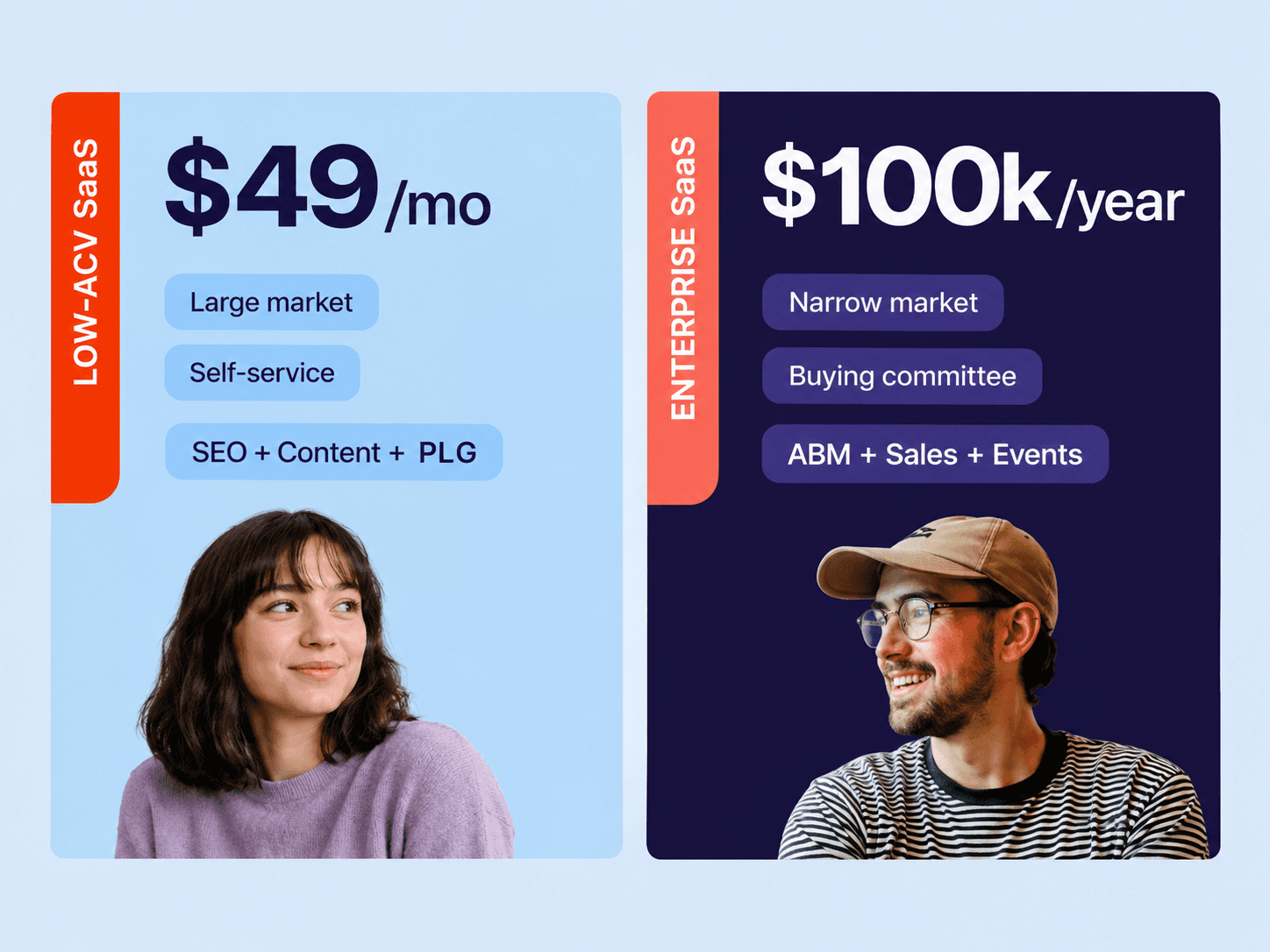
The market structure matters as much as the quality of the marketing.
Consider two SaaS companies selling analytics software. One serves independent ecommerce businesses for $49 per month. The other sells analytics infrastructure to enterprise financial institutions for $100,000 per year. Calling both companies "B2B SaaS" is technically correct, but their marketing plans should look almost nothing alike.
Before choosing a marketing channel, understand where your product sits across a few dimensions:
Market size: Is the addressable market broad or narrow?
Customer size: Are you selling to small businesses, mid-market companies, or enterprises?
Contract value: Can the economics support expensive acquisition channels and a sales team?
Sales complexity: Can one person purchase the product, or does the deal require a buying committee?
Category maturity: Are buyers already searching for this type of SaaS product, or do you first need to explain why the category matters?
Competitive intensity: Are you creating a new market, entering an established category, or replacing an incumbent?
Product complexity: Can buyers understand the value in minutes, or does the product require education, integration, and organizational change?
These factors narrow the set of realistic marketing channels. A high-volume, low-ACV SaaS business usually needs relatively inexpensive and scalable customer acquisition. An enterprise SaaS business can justify higher acquisition costs, but its marketing efforts must support a longer and more complicated sales process.
The first lesson, therefore, is simple: do not start your SaaS marketing plan with a list of channels. Start with the market and the buyer.
Build your B2B SaaS marketing strategy
A SaaS marketing strategy defines which customers you want, what position you want to occupy in their minds, how you will reach them, and how marketing contributes to revenue.
This is different from a list of marketing tactics. "We will publish four articles per month, run LinkedIn ads, and start a newsletter" is an activity plan. It becomes a strategy only when those activities follow from a clear understanding of the market and customer.
For example, a cybersecurity SaaS company targeting regulated enterprises might decide that its best opportunity is a narrow set of accounts with an urgent compliance problem. That could lead to an account-based marketing approach supported by industry research, security-focused content, targeted outbound, and events.
A bootstrapped SaaS product targeting thousands of small agencies might instead prioritize SaaS SEO, templates, integrations, founder-led content, and a self-service free trial.
Both can be effective SaaS marketing. They are simply optimized for different markets.
Define your ideal customer profile
An ideal customer profile, or ICP, describes the type of company most likely to benefit from your product and become a valuable customer.
This should be more precise than "small businesses" or "B2B SaaS companies." A useful ICP combines organizational characteristics with the situation that creates a reason to buy.
For example:
B2B SaaS companies with 50–250 employees that have recently built a dedicated customer success team, use Salesforce, and are struggling to identify accounts at risk of churn.
This gives the marketing team far more information than "SaaS companies." It suggests potential pain points, decision-makers, marketing messages, content topics, integrations, targeting criteria, and buying triggers.
A practical ICP can include:
Dimension | Questions to answer |
|---|---|
Industry | Which industries have the strongest need for the product? |
Company size | At what size does the problem become significant? |
Geography | Where can you realistically sell and support customers? |
Technology | Which tools or systems indicate product fit? |
Business model | Does the customer's model affect your solution's value? |
Pain | Which expensive or persistent problem does the product solve? |
Trigger | What event makes solving that problem urgent now? |
Buying process | Who discovers, evaluates, approves, and uses the product? |
Budget | Can this customer reasonably afford your pricing? |
Expansion potential | Can usage grow across seats, teams, or products? |
If your SaaS company already has customers, the best starting point is usually not intuition. Look at the customers who activate quickly, use the product consistently, renew, expand, require manageable support, and recommend you to others. Those patterns can reveal a better ICP than simply analyzing which leads are easiest to acquire.
For an early-stage SaaS business without enough historical data, the ICP is necessarily a hypothesis. Start narrow enough to produce meaningful feedback, then update the profile as sales conversations and product usage reveal who actually receives value.
Create a marketing strategy for B2B SaaS
Once the ICP is clear, translate it into a concrete marketing approach. This is where many SaaS marketers make the mistake of jumping directly into channel selection.
Instead, work through the strategy in order:
Define the target segment. Decide which part of the SaaS market or broader B2B market you will prioritize.
Identify the urgent problem. Understand what creates enough pain or opportunity for a buyer to consider changing their current behavior.
Define your positioning. Explain why your SaaS product is a better choice for that specific customer and situation.
Map the buying process. Identify who participates, what information they need, and what can prevent the purchase.
Choose the acquisition model. Decide whether growth will primarily be product-led, marketing-led, sales-led, partner-led, or a combination.
Select marketing channels. Choose channels based on where your buyers actually discover and evaluate solutions.
Define conversion points. Decide whether the next step is a signup, free trial, demo, consultation, content download, or another action.
Measure revenue outcomes. Connect marketing performance to pipeline, acquisition cost, conversion, retention, and ultimately revenue.
This sequence prevents a common problem: investing in a marketing channel because it is popular rather than because it fits the business.
Match your strategy to the SaaS marketing funnel
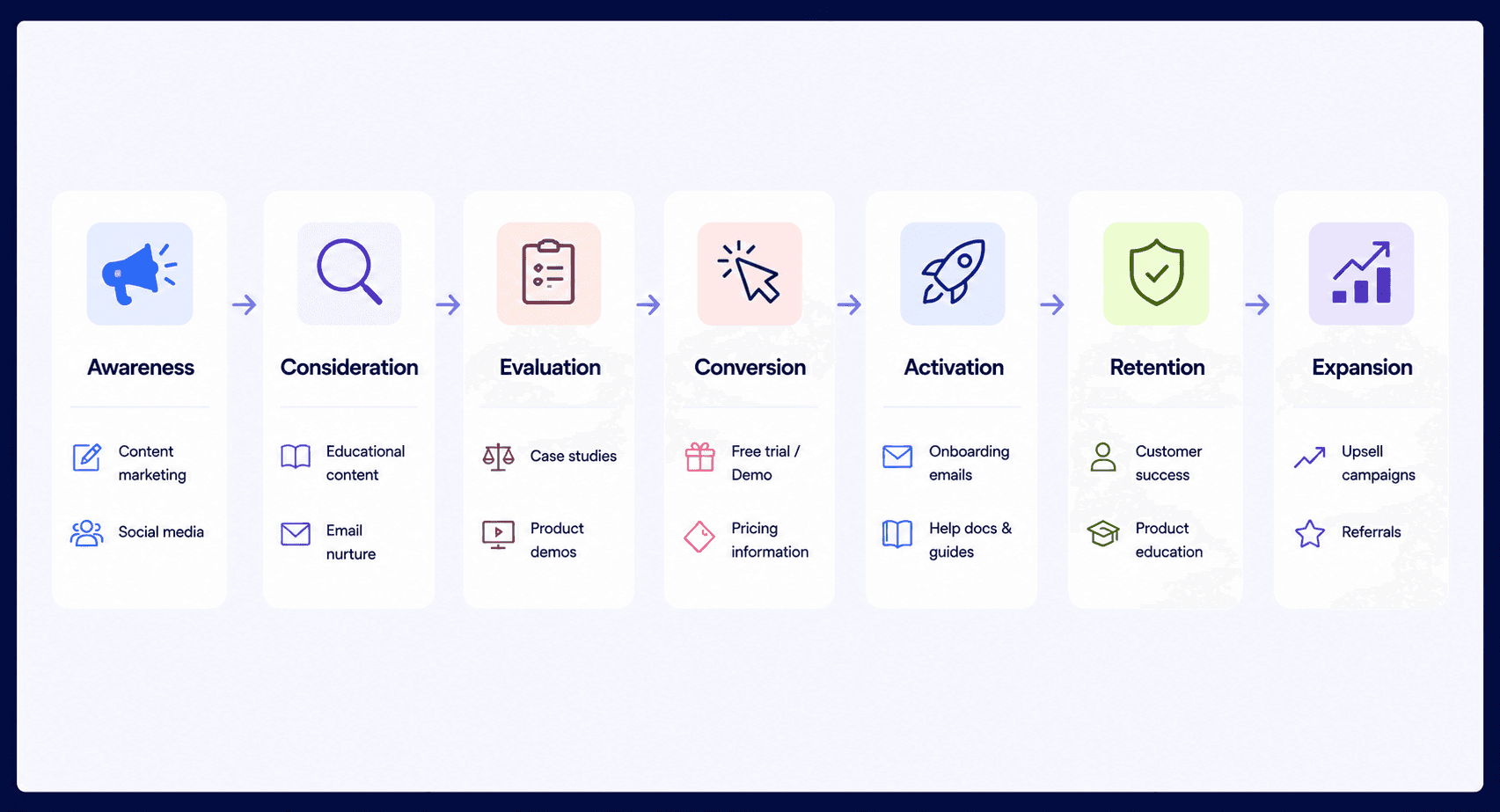
A marketing funnel is useful as a planning model even though real B2B buying is rarely linear. Buyers may discover a product through LinkedIn, visit the website, disappear for three months, find an SEO article through Google, read reviews, ask colleagues for recommendations, return to a comparison page, and only then request a demo.
Gartner's research similarly emphasizes that B2B buyers revisit buying tasks rather than progressing through them in a fixed sequence.
For marketing purposes, however, the SaaS marketing funnel can still help organize goals and content:
Funnel stage | Buyer question | Typical marketing goal | Examples |
|---|---|---|---|
Awareness | "Do we have a problem worth solving?" | Create or capture attention | Educational content, social media, research, communities |
Consideration | "What approaches could solve it?" | Build preference and trust | Guides, webinars, newsletters, category content |
Evaluation | "Which product should we choose?" | Prove fit and reduce risk | Product pages, comparisons, case studies, reviews |
Conversion | "Is this worth buying now?" | Remove purchasing friction | Trials, demos, ROI tools, sales enablement |
Activation | "Can we actually get value from this?" | Reach initial value quickly | Onboarding, lifecycle email, product education |
Retention | "Should we continue paying?" | Reinforce recurring value | Customer education, success programs, usage communication |
Expansion | "Where else can we use this?" | Increase account value | Upsells, cross-sells, additional seats, customer marketing |
This broader B2B SaaS marketing funnel is useful because it prevents acquisition from becoming the only objective. For a subscription business, the marketing promise made at the top of the funnel must eventually be fulfilled by the product.
If marketing attracts customers for a use case the product handles poorly, acquisition can look healthy while retention deteriorates. Conversely, targeting customers who experience value quickly can improve both conversion and long-term economics.
Set goals and define your marketing budget
A marketing budget should follow the growth model rather than an arbitrary percentage copied from another SaaS company.
An early-stage founder who is still searching for product-market fit should usually prioritize learning. Spending heavily to scale acquisition before understanding who converts and retains can simply accelerate inefficient growth.
Once the company has repeatable demand, reliable conversion, and evidence of retention, the question changes. Marketing can then focus more aggressively on increasing the volume of qualified opportunities and finding additional scalable channels.
This means marketing goals should evolve with the business:
SaaS stage | Primary marketing goal | Useful signals |
|---|---|---|
Pre-PMF / early stage | Learn who has the strongest problem | Interviews, activation, early retention, sales feedback |
Initial traction | Find repeatable acquisition | Qualified leads, conversion rates, channel performance |
Growth | Scale proven channels efficiently | CAC, pipeline, payback period, revenue growth |
Mature SaaS | Optimize and diversify growth | LTV: CAC, expansion, retention, market share |
The marketing budget then becomes a resource allocation decision. How much can the company spend to acquire a customer while maintaining acceptable economics? Which channels can absorb additional spending without acquisition costs rising too quickly? How long can the business wait to recover its acquisition cost?
These questions are more useful than asking what percentage of revenue every SaaS company "should" spend on marketing.
The same principle applies to the marketing team. An early-stage founder may personally handle customer interviews, content, outbound, and positioning. As the SaaS business grows, specialists can take ownership of content marketing, demand generation, product marketing, paid acquisition, lifecycle marketing, and marketing operations. The team structure should follow the marketing strategy, not precede it.
With the market, ICP, positioning, buying process, and goals defined, the next question becomes much more practical: which marketing channels should you actually use, and how should they work together across the B2B SaaS marketing funnel?
Choose the right B2B SaaS marketing channels
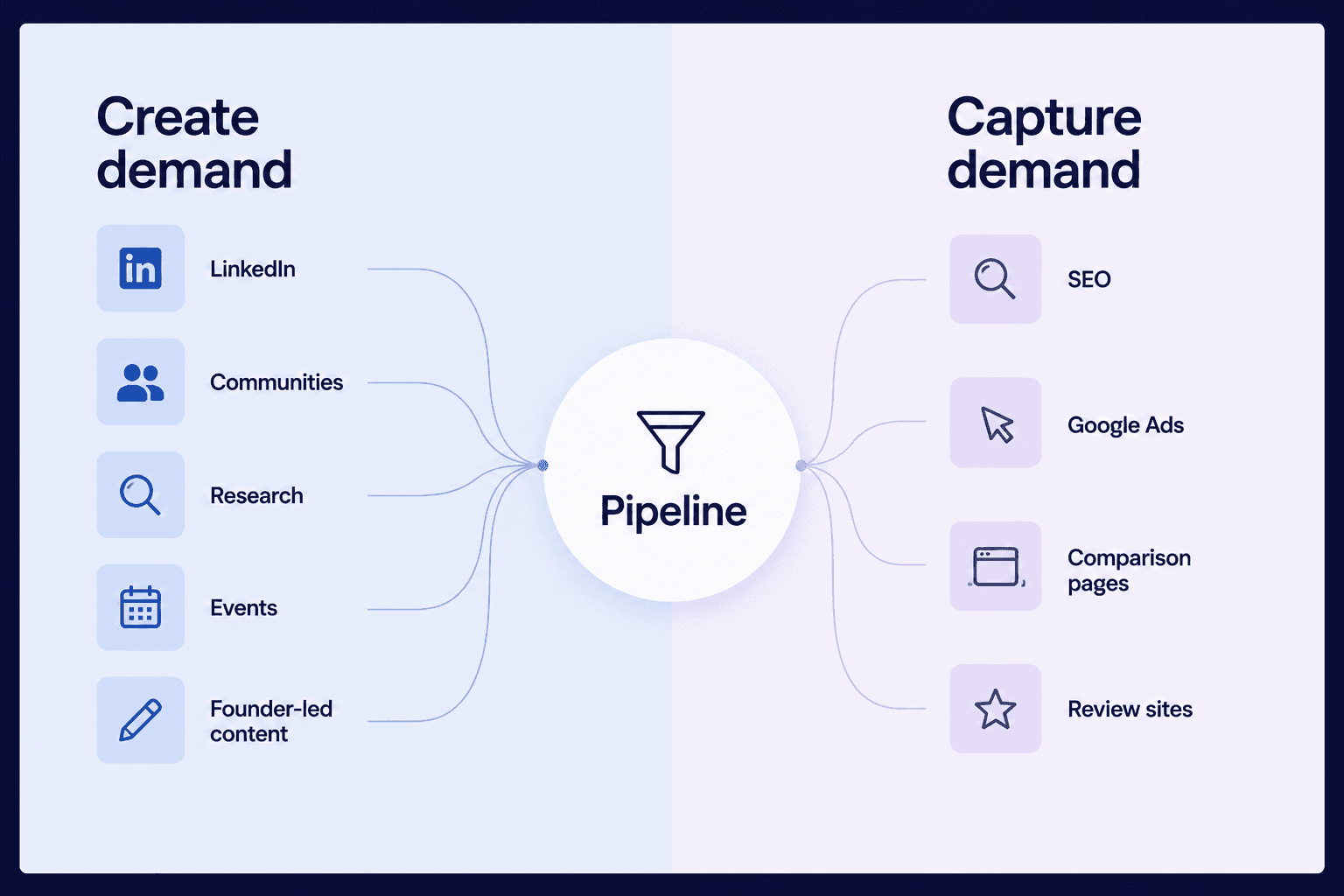
No single marketing channel is best for every SaaS business. The right mix depends on where your B2B buyers spend time, how they discover solutions, how much education they need, and whether your economics support a high-touch sales process.
This is why channel selection should come after ICP and positioning. If you know exactly who you are trying to reach and why they should care, you can evaluate channels based on their ability to reach those people rather than their popularity among other SaaS marketers.
A useful distinction is between demand capture and demand creation. Demand-capture channels reach people who are already looking for a solution. Search advertising, SaaS SEO, review sites, comparison pages, and some marketplaces fall into this category. Demand-creation channels reach potential customers before they begin actively searching. Founder-led content, communities, events, newsletters, research, and social media can all play this role.
Most effective B2B SaaS marketing strategies eventually use both. Demand capture converts existing interest, while demand creation expands the number of buyers who know the problem, category, and SaaS brand in the first place.
Content marketing and SEO
Content marketing is particularly well suited to B2B SaaS because software purchases usually involve questions that can be answered before a buyer ever speaks with sales.
A SaaS company can create content around the problems its product solves, the category it operates in, implementation questions, alternatives, integrations, benchmarks, and specific use cases. The objective is not simply to generate traffic. Content should help the right buyer move closer to understanding the problem and evaluating a solution.
SEO adds a distribution mechanism to that content. Instead of relying entirely on ongoing promotion, a useful article or landing page can continue attracting people who search for relevant questions over time.
A practical SaaS content marketing strategy usually covers several types of search intent:
Search intent | Example query | Useful content |
|---|---|---|
Problem-aware | "how to reduce SaaS churn" | Educational guides |
Solution-aware | "customer retention software" | Category and solution pages |
Product-aware | "[product] alternatives" | Comparison pages |
Use-case | "CRM for recruiting agencies" | Use-case landing pages |
Integration | "[tool A] [tool B] integration" | Integration pages |
Commercial research | "best customer success software" | Product comparisons and buyer guides |
The closer a query is to a purchasing decision, the smaller its search volume may be, but the commercial value of each visitor can be much higher. This is why a content marketing strategy based purely on traffic potential can produce impressive analytics without much pipeline.
SEO and content marketing should therefore cover the entire buying process, not just high-volume informational keywords. A healthy portfolio can include broad educational content for discovery alongside highly specific pages for buyers comparing products.
LinkedIn and founder-led marketing
LinkedIn can be valuable for B2B SaaS companies because customers, founders, executives, operators, and other decision-makers already use the platform in a professional context.
For an early-stage SaaS company, founder-led marketing can be particularly effective. Founders often understand the customer problem more deeply than anyone else in the company and can communicate without the distance of a corporate brand account.
Useful founder-led content can include lessons from customer conversations, industry observations, original data, product decisions, failures, case studies, and informed opinions about how the market is changing. The goal is not to turn every post into a product promotion. It is to establish a recognizable association between the founder, a particular problem, and the expertise required to solve it.
Social distribution also compounds other marketing efforts. An original research report can become several posts. A customer story can lead to a discussion. Insights from those discussions can produce new articles, webinars, or product marketing materials.
This works best when social media is treated as a relationship and distribution channel rather than a vanity-metric competition. Impressions and followers can be useful leading indicators, but qualified conversations, website visits, signups, opportunities, and revenue provide a much stronger indication of marketing performance.
Email marketing and marketing automation
Email marketing gives SaaS companies a direct channel to people who have already expressed some level of interest. That can include newsletter subscribers, leads, trial users, existing customers, and previously engaged accounts.
The mistake is treating them all as the same audience.
A person who downloaded an educational report may need additional context before considering a product. Someone who started a free trial may need help reaching the first meaningful outcome. An enterprise prospect who attended a webinar may need a case study relevant to their industry.
Marketing automation makes it possible to respond to those differences at scale. Common automated sequences include:
welcome and educational sequences for new subscribers;
lead-nurture campaigns based on topic or intent;
free-trial onboarding;
abandoned signup or incomplete onboarding reminders;
webinar and event follow-up;
product education based on usage;
re-engagement campaigns;
customer marketing for expansion or additional use cases.
Automation should not mean sending more email simply because software makes it possible. The best automation responds to meaningful signals and provides information appropriate to the recipient's situation.
For B2B SaaS companies with longer sales cycles, email also provides continuity. A buyer who is not ready today may become a qualified opportunity months later. Maintaining a useful relationship is often more efficient than repeatedly trying to generate the same lead again.
Inbound marketing
Inbound marketing combines content, search, social distribution, email, tools, and other resources that help potential customers discover the company and choose to engage.
For SaaS, the appeal is obvious: a company can build assets that continue attracting buyers rather than paying for every interaction individually. But inbound is not automatically cheap or passive. High-quality content requires research and expertise, competitive search markets require sustained investment, and converting visitors requires strong positioning and a capable SaaS website.
Inbound marketing is most effective when the company understands what happens after traffic arrives. A generic CTA to "book a demo" on every page may work for some enterprise products, but it can be too big a commitment for someone at the beginning of the buying process.
Different pages can instead offer different next steps: read a related guide, subscribe, use a free tool, view a case study, start a trial, explore an interactive demo, or speak with sales.
This creates multiple paths through the marketing funnel without forcing every visitor into the same conversion.
Paid digital marketing
Paid digital marketing can create traffic immediately, which makes it attractive compared with slower channels such as SEO. Google Ads can capture existing search demand, while LinkedIn and other advertising platforms can reach specific professional audiences.
The challenge is economics.
A marketing campaign that generates leads at $100 each may appear efficient until only 2% become customers paying $50 per month. Conversely, an enterprise SaaS company selling six-figure contracts may be able to spend thousands of dollars generating a qualified opportunity.
Paid acquisition should therefore be evaluated against downstream revenue, not just clicks or leads. Useful questions include:
What does it cost to generate a qualified opportunity?
What percentage of those opportunities become customers?
How much revenue does the average acquired customer generate?
How long does it take to recover acquisition costs?
Do paid customers retain as well as customers from other channels?
For early-stage SaaS, paid campaigns can also help test messages and demand. But large budgets are usually easier to justify after the company has demonstrated that its positioning, sales process, and retention work.
Account-based marketing
Account-based marketing, or ABM, reverses the usual lead-generation logic. Instead of attracting a large audience and determining which leads are valuable later, the company identifies high-value target accounts first and coordinates marketing and sales around them.
This marketing approach is particularly relevant when the potential customer base is relatively small, and each contract is valuable enough to justify personalized effort.
An ABM program might combine targeted advertising, personalized outreach, industry-specific content, executive engagement, events, direct mail, and custom sales materials. The marketing and sales teams share an account list and measure progress at the account level rather than treating every individual form submission as an independent lead.
ABM makes much less sense for a $30-per-month self-service SaaS product. The cost and complexity would overwhelm the potential revenue. But for enterprise B2B SaaS sales, the same level of attention can be economically rational.
Partnerships, communities, and events
Not every acquisition channel needs to be owned or paid. Partnerships allow SaaS companies to reach audiences that another business, creator, integration partner, or community has already assembled.
Potential partnership models include co-marketing, integrations, affiliate relationships, referral programs, webinars, newsletter swaps, marketplace listings, and joint research. The strongest partnerships usually have a natural overlap between audiences without making the two products direct substitutes.
Communities can serve a similar role, but they require a different mindset. Joining an industry community solely to promote a SaaS product rarely works well. Instead, founders and SaaS marketers can contribute expertise, answer questions, participate in discussions, and build relationships over time.
Events range from large conferences to small founder dinners, workshops, webinars, and virtual roundtables. Their value tends to increase when the audience is tightly matched to the ICP. A small event with 30 relevant B2B buyers can be more valuable than broad exposure to thousands of people with little purchasing intent.
The core principle across these marketing channels and tactics is the same: distribution should follow buyer behavior. You do not need to be everywhere. You need enough presence in the places that influence how your customers discover, understand, and evaluate products.
Build a B2B SaaS content marketing strategy
Publishing content is not the same as having a content marketing strategy.
A strategy connects content to a specific audience, business objective, distribution mechanism, and stage of the buying process. Without those connections, a company can publish dozens of articles while generating little qualified demand.
For B2B SaaS, content has another important role: it allows the company to demonstrate expertise before asking the buyer to trust the product. This matters particularly when the software solves an expensive, technical, or strategically important problem.
Create content for each stage of the marketing funnel
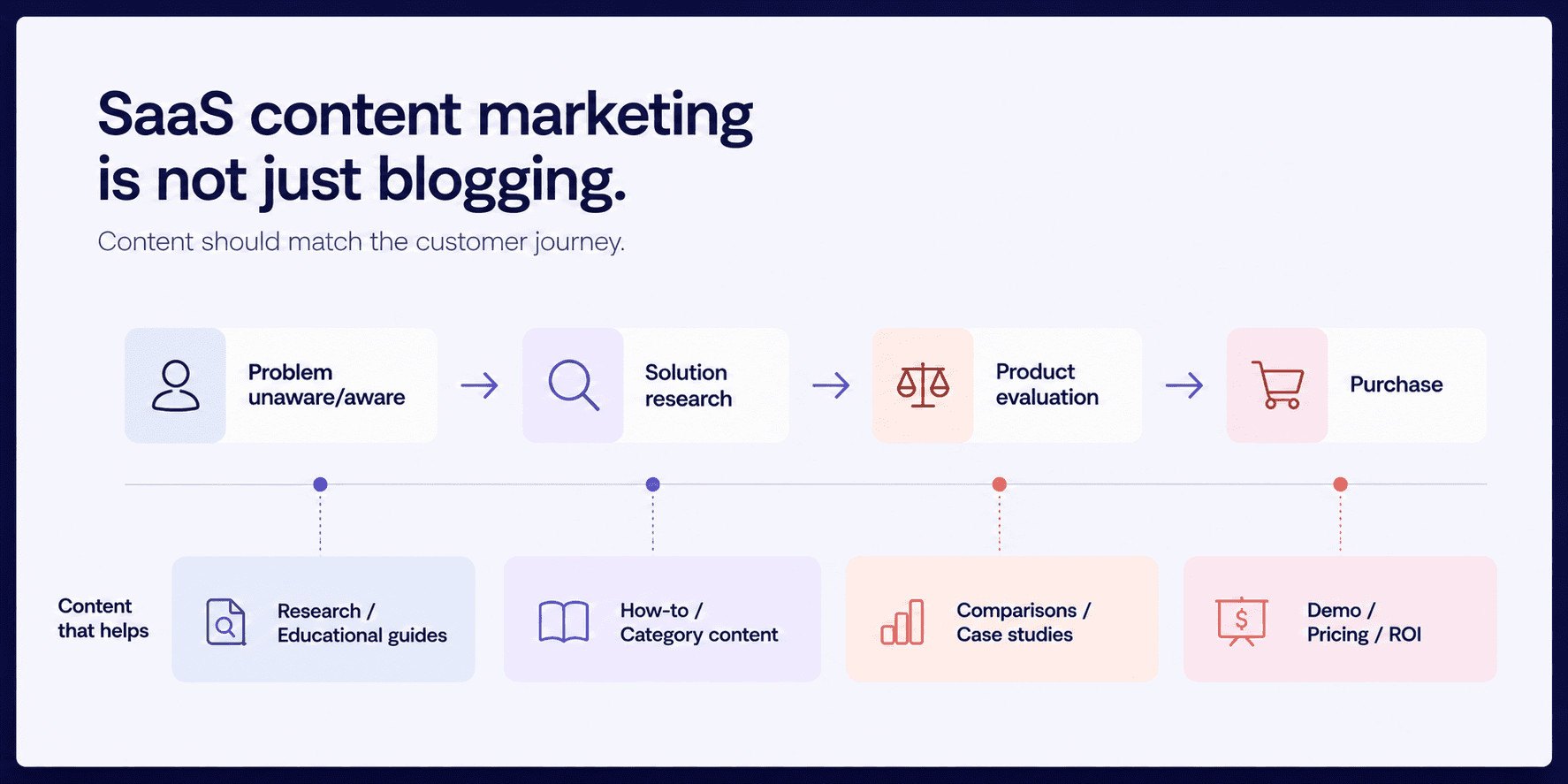
A common mistake is concentrating almost all content at the top of the funnel. Broad educational articles can attract significant traffic, but many readers may have little reason to purchase the product.
A stronger SaaS content marketing strategy connects topics to different stages of buyer intent.
At the awareness stage, the content can help buyers understand a problem. In the middle of the funnel, it can explain possible solutions, frameworks, and trade-offs. Near the bottom, content should make product evaluation easier through comparisons, case studies, use cases, implementation guides, pricing information, security documentation, and ROI evidence.
This does not mean every piece needs an aggressive sales CTA. A useful educational article should primarily answer the question that brought the reader there. Introduce the commercial connection where it is genuinely relevant.
Content can also serve several stages simultaneously. Original industry research might generate initial awareness, earn backlinks for SaaS SEO, provide data for sales conversations, create social posts, support a marketing campaign, and give existing customers useful benchmarks.
Capture existing demand with search content
Search demand is especially valuable because the buyer declares intent through the query.
Someone searching "project management software" is already aware of the category. Someone searching "Asana alternatives for software teams" is even closer to evaluating products. Someone searching a specific product's pricing or integration capabilities may be close to a decision.
This makes search content useful beyond traditional blogging. A SaaS SEO program can include:
category landing pages;
alternative and comparison pages;
use-case pages;
industry-specific pages;
integration directories;
templates;
glossaries;
free calculators and tools;
product documentation;
educational articles.
The objective is to build useful pages around the ways customers actually research the market.
This is also why keyword volume should not be the only criterion. Ten visits from companies that closely match your ICP may be commercially more valuable than a thousand visits from students or consumers who will never purchase the product.
Use educational content to create demand
Search is strongest when people already know what to search for. In a new category, that may not be the case.
Suppose a SaaS product solves a problem that companies currently handle with spreadsheets, manual work, or a combination of unrelated tools. Potential buyers may experience the problem every day without knowing that a software category exists to solve it.
Demand creation begins one step earlier. Instead of competing only for searches around a product category, the company can educate the market about the underlying problem, its cost, and a better way to approach it.
Original research is particularly useful here. A company with access to proprietary product data can publish benchmarks and trends that would otherwise be unavailable. Surveys, expert interviews, internal analyses, and aggregated customer data can also create information that other publications, SaaS companies, and industry professionals can reference.
This type of content is harder to produce than another generic "10 tips" article, but that difficulty is part of its value. It gives the SaaS brand something distinctive to distribute through search, social media, email, PR, partnerships, and sales.
Turn customer success into social proof
A SaaS company saying its own product is effective is advertising. A customer explaining what changed after adopting it is evidence.
Customer stories can take several forms of social proof: short testimonials, detailed case studies, quantitative results, video interviews, quotes, review-site profiles, and examples in sales materials.
Strong case studies go beyond generic statements such as "we love the product." They explain the initial problem, why the customer chose to change, how implementation worked, and what measurable result followed.
For example:
Instead of "Company X improved productivity," a useful case study might show that the team reduced its weekly reporting process from six hours to 45 minutes after implementation.
Specificity makes the claim easier to understand and more credible.
SaaS review sites can provide another source of social proof, particularly when buyers use them during commercial research. Reviews also reveal how customers describe the product in their own language. That vocabulary can inform product marketing, landing pages, sales conversations, and future content.
Customer marketing should continue after the case study is published. Successful users can participate in webinars, events, community discussions, referral programs, and advisory groups. In mature SaaS companies, the existing customer base becomes its own distribution network.
How to generate and convert B2B SaaS leads
Lead generation is useful only when the definition of a lead has commercial meaning.
A person downloading an ebook, starting a trial, requesting a demo, and asking for enterprise pricing may all appear as "leads" in a dashboard, but they represent very different levels of intent.
Effective B2B SaaS lead generation therefore combines volume with qualification. The goal is not to maximize the number of contacts in a CRM. It is to create enough relevant opportunities for the company's acquisition model.
Create high-intent landing pages
High-intent landing pages address visitors who are already evaluating a solution. They should make it easy to understand what the SaaS product does, who it is for, what makes it different, and what the visitor should do next.
The exact information depends on the product, but useful elements can include:
a clear value proposition;
product screenshots or demonstrations;
relevant use cases;
customer evidence;
integration information;
pricing or an explanation of how pricing works;
security and compliance information where relevant;
FAQs that address purchasing objections;
an appropriate conversion action.
For complex products, hiding essential information behind a sales conversation can create unnecessary friction. B2B buyers often want to research independently before they are ready to talk to a representative.
The SaaS website should make that research easier. Sales can then add value when buyers need help with implementation, technical requirements, business cases, or organization-specific questions.
Use lead magnets and free tools
Traditional lead magnets exchange information for contact details: ebooks, templates, reports, checklists, webinars, or industry research.
They can still work, but the value exchange needs to justify the friction. Gating a generic article behind a form may simply reduce the number of people who read it.
Interactive resources often provide a stronger reason to engage. A calculator, assessment, benchmark, generator, template, or free version of a product feature can solve a small problem immediately while introducing the company to a potential customer.
For example, an analytics SaaS company could offer a free benchmark calculator. A security product might offer an assessment. An accounting platform might provide a financial template.
The best free tools sit close enough to the paid product that people who find them useful are plausible customers.
Optimize demos and free trials
A demo and a free trial solve different buying problems.
A demo allows the company to explain a complex product, tailor the conversation to a buyer's situation, and answer questions. A free trial allows the buyer to experience the product directly.
Which one works better depends on product complexity, contract value, implementation requirements, and buyer preference.
A simple SaaS product can often let users sign up immediately. Forcing every prospect through sales may add friction without adding much value. Enterprise software involving integrations, security reviews, custom workflows, or organizational change may benefit from a guided process.
Free trials should also be evaluated by activation rather than signup volume. If thousands of users create accounts but never reach the point where they experience the core value of the SaaS product, increasing trial acquisition will not solve the underlying problem.
Marketing, product, and customer success should therefore agree on what activation means and help new users reach that moment as efficiently as possible.
Nurture leads that are not ready to buy
B2B buying does not always happen on the marketer's schedule. A relevant company may have the right problem but no budget until the next quarter. Another may be researching options before a current contract expires.
Declaring every non-converting lead "lost" ignores this reality.
Lead nurturing keeps the relationship useful without turning every email into another request for a sales call. Educational newsletters, new research, customer examples, product updates, webinars, and relevant guides can give the prospect reasons to stay connected.
Segmentation improves this process. A technical evaluator may care about integrations and implementation. An executive may care about cost and business impact. A user may care about workflow improvements.
The more closely nurturing reflects actual buyer concerns, the less it feels like an automated marketing sequence.
Build an effective marketing-to-sales handoff
In sales-assisted SaaS, marketing and sales need a shared definition of what deserves sales attention.
If marketing is rewarded for generating maximum lead volume while sales is rewarded only for revenue, the two teams can easily optimize for different outcomes. Marketing celebrates thousands of leads while sales complains that none are qualified.
A better handoff combines explicit information with behavioral signals. Company size, industry, role, geography, and technology can indicate fit. Demo requests, pricing-page visits, repeated product research, event attendance, or trial activity can indicate intent.
The exact scoring model matters less than feedback between the teams. Sales should explain why opportunities are accepted or rejected, while marketing should use that information to improve targeting and campaigns.
For smaller SaaS companies, this feedback loop can be informal. For larger organizations, it may involve lead scoring, lifecycle stages, service-level agreements, marketing automation, and revenue operations.
Either way, B2B sales and marketing should be optimizing the same system: attracting companies that fit the product, helping them make a confident buying decision, and acquiring them at economics the SaaS business can sustain.
Best B2B SaaS marketing strategies by growth stage
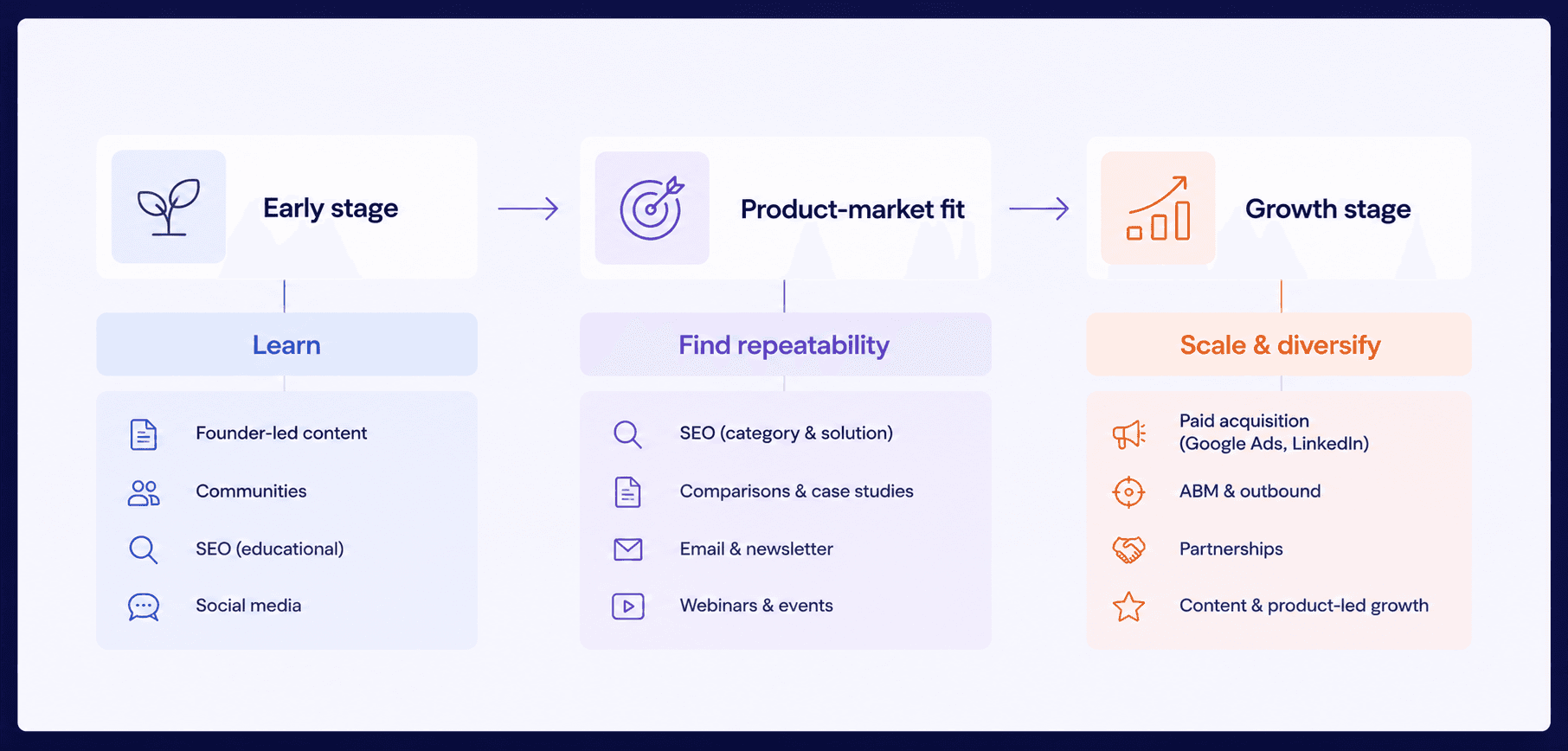
The right B2B SaaS marketing strategy changes as the company grows. A channel that works well for an established SaaS business can be a poor investment for a startup that is still trying to understand its customers. Similarly, tactics that help founders acquire their first 20 customers may become difficult to scale once the company needs hundreds or thousands.
This is why copying a much larger competitor's marketing plan is rarely useful. Their brand awareness, marketing budget, team, customer base, and market position may give them options that an early-stage company does not have.
A better approach is to match marketing initiatives to the questions the business needs to answer at its current stage.
Marketing an early-stage SaaS business
Early-stage SaaS marketing should optimize for learning and proximity to customers before it optimizes for scale.
At this point, the company may still be testing its ICP, positioning, pricing, onboarding, and even the problem the product should solve. Marketing channels that create direct contact with potential customers can therefore be particularly valuable.
Founder-led sales, targeted outbound, niche communities, LinkedIn, customer interviews, partnerships, and small-scale content marketing can all provide feedback alongside acquisition. If ten prospects reject the same value proposition for the same reason, that information may be more valuable than thousands of anonymous website visits.
The objective is to identify repeatable patterns:
Which companies respond most strongly to the problem?
Which job titles become internal champions?
What event triggers a search for a solution?
Which objections repeatedly delay B2B sales?
Which customers activate quickly and continue using the product?
What language do customers use to describe the problem and value?
Which marketing tactics consistently create qualified conversations?
SaaS lead generation at this stage does not need to operate at enormous scale. A founder who can reliably generate a small number of conversations with highly relevant B2B buyers may learn faster than a company running broad marketing campaigns.
SEO can also begin early because organic visibility takes time to develop. However, the initial objective should be to build useful content around validated customer problems rather than publishing hundreds of pages before the company knows what its market actually cares about.
Marketing SaaS companies with product-market fit
Once a company has evidence that customers buy, activate, and stay, marketing can begin shifting from exploration toward repeatability.
The question becomes: which acquisition methods can produce more of the customers we already know are valuable?
This is where many SaaS companies begin formalizing their marketing efforts. A founder who previously wrote every article or managed every campaign may hire SaaS marketers specializing in content, demand generation, product marketing, paid acquisition, or lifecycle marketing.
Existing customer data should inform channel decisions. The company can compare customers acquired through organic search, paid campaigns, referrals, partnerships, outbound, events, and other sources. It can then look beyond initial conversion to retention, expansion, and customer lifetime value.
At this stage, marketing and sales should also become more coordinated. Product marketing can sharpen positioning and competitive messaging. Content can address common sales objections. Sales conversations can reveal new topics for content and campaigns. Customer success can identify stories that become case studies.
The result is a feedback system, not several independent departments.
Scaling marketing for growth-stage B2B SaaS companies
Growth-stage SaaS companies face a different challenge: increasing acquisition without allowing efficiency to deteriorate too quickly.
A channel that works with a $10,000 monthly budget may not produce ten times as many customers with $100,000. Search demand is finite. Advertising audiences become saturated. The highest-intent keywords become expensive. Content production can expand faster than content quality.
Scaling therefore usually requires both optimization and diversification.
A growth-stage company might continue investing in its strongest core B2B SaaS marketing channels while adding complementary ones. Strong organic search can be combined with paid search. A successful direct-sales motion can be supported with account-based marketing. Partnerships can supplement product-led acquisition. Original research can support PR, SEO, events, social distribution, and sales enablement simultaneously.
Geographic expansion, new customer segments, additional use cases, and product expansion can create further sources of SaaS growth, but each changes the marketing problem. Entering a new segment may require different positioning, pricing, proof, and sales processes rather than simply increasing the existing marketing budget.
Growth marketing at this stage should therefore be understood as disciplined experimentation around a proven core, not constant pursuit of new channels.
How to measure B2B SaaS marketing ROI
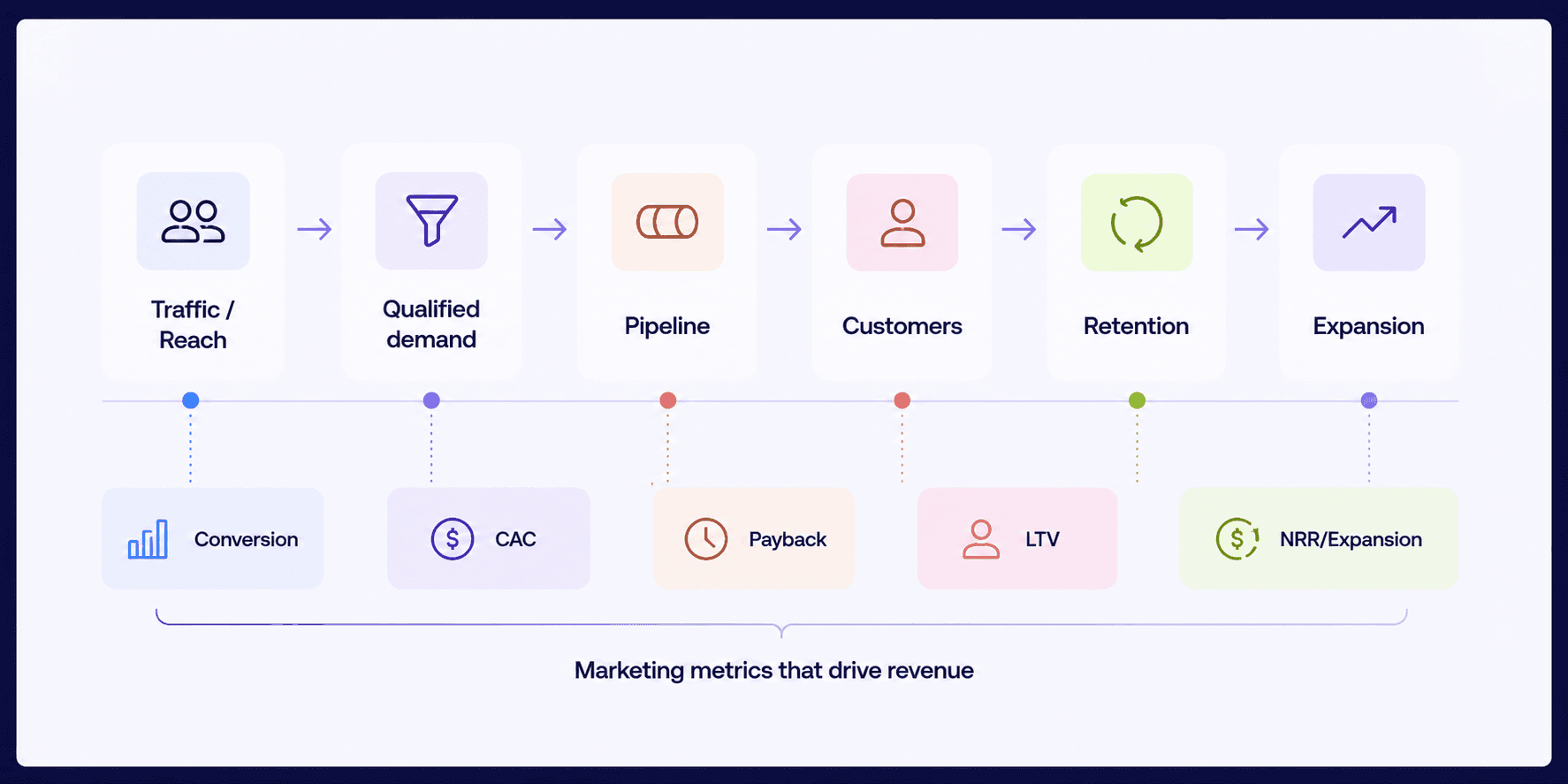
Marketing performance is difficult to understand from a single metric. Traffic can rise while pipeline falls. Lead volume can increase while lead quality deteriorates. Customer acquisition can accelerate while churn makes that growth uneconomical.
B2B SaaS companies need to connect marketing activity to the economics of recurring revenue.
This does not mean every individual blog post, podcast appearance, community interaction, or social post needs an exact revenue attribution. B2B buying often involves multiple interactions over a long period, making perfect attribution unrealistic.
Instead, use a combination of funnel metrics, customer economics, and channel-level performance to determine whether marketing is contributing to sustainable growth.
Customer acquisition cost and customer lifetime value
Customer acquisition cost, or CAC, measures how much the company spends to acquire a new customer.
At its simplest:
CAC = Sales and marketing costs ÷ New customers acquired
If a SaaS company spends $100,000 on marketing and sales during a period and acquires 100 new customers, its blended CAC is $1,000.
The calculation becomes more useful when compared with customer lifetime value, or LTV. LTV estimates how much economic value a customer generates during the relationship.
The familiar LTV: CAC ratio can provide a quick view of acquisition economics, but it should not be treated as a universal score. LTV calculations depend on assumptions about retention, gross margin, expansion, and customer behavior. Young SaaS companies may not have enough historical data to estimate lifetime value confidently.
Segmenting these metrics can be more revealing. A company may have healthy blended economics while one marketing channel, geography, or customer segment performs poorly.
Marketing-sourced pipeline and revenue
For sales-led SaaS, pipeline bridges marketing activity and closed revenue.
Rather than counting every form submission equally, the company can track how much qualified pipeline originated from or was influenced by marketing. This makes it possible to compare marketing campaigns based on their ability to generate genuine commercial opportunities.
Suppose two campaigns each produce 100 leads:
Campaign | Leads | Qualified opportunities | Pipeline created | Closed revenue |
|---|---|---|---|---|
Campaign A | 100 | 8 | $80,000 | $20,000 |
Campaign B | 100 | 25 | $250,000 | $75,000 |
A lead-based dashboard would make the campaigns appear identical. A revenue-oriented view shows a very different result.
Attribution still requires caution. A buyer might first discover the SaaS brand through a founder's LinkedIn post, later read several articles, attend a webinar, search the company name, and finally request a demo through Google. Assigning all credit to the final search click would misrepresent the buying journey.
For that reason, marketing teams should combine attribution data with self-reported attribution, sales feedback, and qualitative customer research.
Funnel conversion rates
Conversion rates help identify where the marketing funnel is losing potential customers.
Depending on the business model, a SaaS company might track:
Website visitor → Signup → Activated user → Paid customer → Retained customer
or:
Visitor → Lead → Marketing-qualified lead → Sales-qualified opportunity → Closed customer
No universal funnel applies to every company. A product-led SaaS business and an enterprise sales organization have fundamentally different buying processes.
The value comes from measuring transitions that matter to your own business.
For example, increasing website traffic by 50% has limited value if demo requests remain unchanged. Increasing demo requests may also be misleading if the additional prospects rarely become qualified opportunities. Improving the conversion from qualified opportunity to customer may produce more revenue without generating a single additional lead.
Funnel analysis helps the marketing team identify the actual constraint rather than assuming the solution is always "more traffic."
Customer acquisition payback period
CAC payback measures how long it takes for the gross profit generated by a customer to recover the cost of acquiring that customer.
This matters because two SaaS companies can have the same LTV: CAC ratio but very different cash requirements. Recovering acquisition costs in several months creates a different growth profile from waiting several years.
The exact acceptable payback period depends on factors such as company maturity, available capital, retention, growth rate, and contract structure. No single threshold makes sense for every SaaS business.
Marketing ROI should therefore be evaluated alongside cash efficiency. A channel may eventually generate profitable customers but still be difficult for a bootstrapped company to finance if the payback period is too long.
Annual prepayments can improve cash flow, while high churn can make long payback periods particularly dangerous because some customers may leave before their acquisition cost has been recovered.
Retention and expansion revenue
Acquisition metrics tell only part of the story. Because SaaS revenue recurs, customer retention can dramatically change marketing value.
Imagine two campaigns that each acquire 100 customers at the same CAC. Customers from the first campaign retain for years and frequently upgrade. Customers from the second churn after several months.
From a lead-generation perspective, the campaigns look equally successful. From a SaaS business perspective, they are not remotely equivalent.
This is why marketing performance should eventually be analyzed by customer cohort and acquisition source. Useful questions include:
Which channels produce customers with the strongest retention?
Which segments expand most frequently?
Are customers acquired through discounts more likely to churn?
Do customers from product-led acquisition behave differently from sales-led customers?
Which marketing messages attract customers who actually receive the promised value?
Customer marketing can also contribute directly to expansion revenue. Educational campaigns, new-use-case content, feature adoption programs, customer communities, and relevant product announcements can help existing accounts discover additional value.
In recurring-revenue businesses, the line between acquisition marketing and customer marketing is therefore much less rigid than it might appear.
Common B2B SaaS marketing mistakes
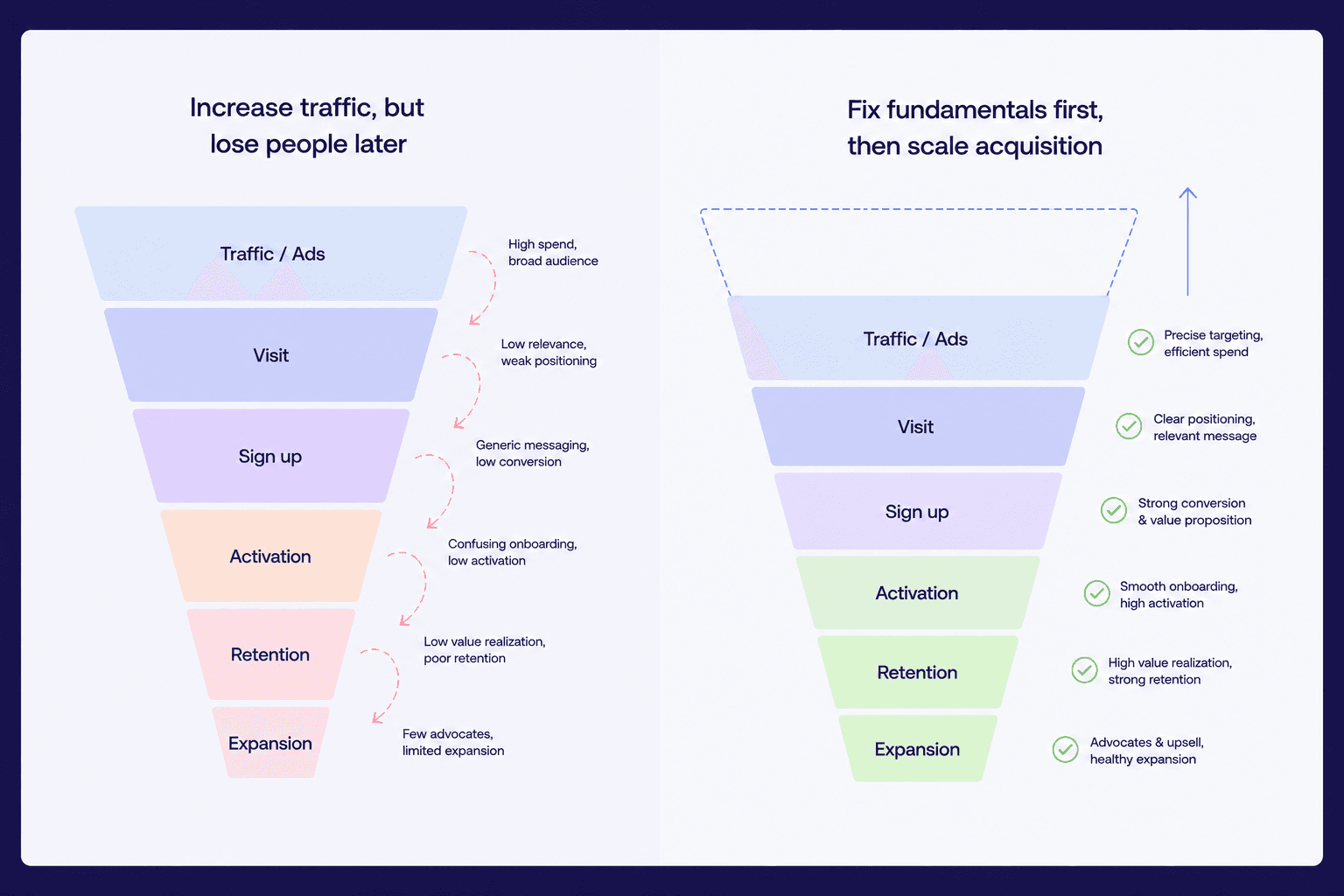
Many marketing problems are not caused by a lack of tactics. They come from applying reasonable tactics in the wrong order, to the wrong audience, or before the company is ready to scale them.
Recognizing these patterns can prevent expensive marketing experiments from being mistaken for evidence that a particular channel "doesn't work."
Using too many marketing channels and tactics at once
A small marketing team trying to run SEO, LinkedIn, YouTube, paid search, paid social, webinars, a podcast, events, partnerships, email, and account-based marketing simultaneously is likely to execute most of them poorly.
Each marketing channel has its own learning curve. Content marketing requires topic selection, production, distribution, and measurement. Paid advertising requires creative testing, targeting, landing pages, and conversion optimization. Partnerships require relationship development. Communities require sustained participation.
Spreading limited resources across too many channels reduces the number of experiments the company can run within each one.
For an early-stage company, it is often better to select one or two core channels that closely match buyer behavior, develop competence, and add new channels after the initial ones become repeatable.
Targeting a SaaS market that is too broad
"B2B companies" is rarely a useful target market. Even "B2B SaaS companies" can describe businesses ranging from two-person startups to public corporations.
Broad targeting creates broad messaging. Broad messaging then makes it difficult for any particular buyer to recognize that the product was built for their situation.
Narrow positioning does not necessarily mean the company must remain in a small market forever. It can provide a practical entry point.
A SaaS product might begin with recruiting agencies, establish strong product-market fit and customer proof there, then expand to other professional services. Another might begin with early-stage SaaS companies before moving into larger software organizations.
Winning a defined segment can make expansion easier than attempting to appeal to everyone from the beginning.
Focusing on traffic instead of qualified pipeline
Traffic is easy to measure, which makes it easy to overvalue.
A SaaS website receiving 100,000 monthly visitors is not necessarily performing better than one receiving 10,000. The relevant questions are who those visitors are, why they arrived, and what happens afterward.
This is especially important for SaaS SEO and content marketing. Broad informational keywords can generate large audiences with little commercial intent. An article may rank extremely well while attracting people who will never become customers.
Traffic still matters. It creates opportunities for discovery and can indicate growing organic visibility. But it should be interpreted alongside qualified conversions, pipeline, revenue, and assisted influence.
The goal is not the largest possible audience. It is the largest useful audience the business can convert and serve profitably.
Scaling SaaS digital marketing too early
Digital marketing can amplify a working acquisition system, but it can also amplify its problems.
If positioning is unclear, spending more on advertising sends more people to an unclear message. If onboarding is weak, generating more trials creates more inactive users. If retention is poor, faster acquisition fills the top of a leaking funnel.
This is one reason early-stage SaaS companies should distinguish between experiments designed to learn and marketing initiatives designed to scale.
A small paid campaign may be valuable for testing whether B2B buyers respond to a message. That does not mean the company should immediately multiply its marketing budget after generating a few leads.
Before scaling, look for evidence across the complete path from acquisition to customer value.
Ignoring retention and existing customers
A company can grow new-customer acquisition while barely growing recurring revenue if existing customers leave at a similar rate.
Marketing cannot solve every retention problem. Product quality, onboarding, support, pricing, competition, and customer fit all contribute. But marketing influences who becomes a customer and what expectations they have before purchasing.
Overpromising can improve short-term conversion while damaging retention. Targeting poorly matched customers can create the same effect.
Existing customers also represent an audience that many SaaS companies underuse. They can provide referrals, testimonials, reviews, case studies, product feedback, expansion revenue, and introductions to other potential customers.
Customer marketing therefore deserves a place in the broader SaaS marketing strategy rather than being treated as something that happens only after marketing's job is finished.
Frequently asked questions about B2B SaaS marketing
What are the best B2B SaaS marketing strategies?
The best B2B SaaS marketing strategies depend on the product's target customer, contract value, buying process, market maturity, and growth stage. In most cases, a strong strategy combines clear positioning with a small number of acquisition channels that match buyer behavior.
For many SaaS companies, this can include content marketing and SEO to capture demand, founder-led or social content to create demand, email marketing to nurture, partnerships for distribution, and product-led or sales-led conversion depending on product complexity. Enterprise SaaS may also rely heavily on account-based marketing, events, targeted outbound, and sales enablement.
The important distinction is between a collection of marketing tactics and a strategy. Effective SaaS marketing explains why a particular channel should reach a particular customer and how that attention eventually becomes recurring revenue.
Which marketing channel works best for B2B SaaS?
No single B2B SaaS marketing channel is universally best. Search can work extremely well when buyers already look for the category. Founder-led marketing and communities can be effective when trust and expertise matter. Paid acquisition can work when customer economics support it. Account-based marketing can make sense when the number of target accounts is small and contract values are high.
The right marketing channel reaches your ICP at a reasonable cost and consistently contributes customers with healthy retention.
A practical approach is to identify where current customers first discovered the company, which sources influenced their decisions, and which channels produce the highest-quality customers. That evidence is usually more valuable than copying a generic list of "best channels."
How much should SaaS companies spend on marketing?
No fixed percentage of revenue applies to every SaaS company. The appropriate marketing budget depends on growth targets, margins, available capital, acquisition costs, retention, sales efficiency, and company stage.
An early-stage bootstrapped SaaS company may spend relatively little while founders handle much of the marketing themselves. A venture-backed growth company may deliberately invest a large share of revenue in sales and marketing to capture market share.
Rather than starting with a universal percentage, work backward from customer economics. Estimate what you can afford to spend to acquire a customer, how quickly that cost is recovered, and how much additional demand each marketing channel can absorb efficiently.
How long does a SaaS marketing strategy take to work?
The timeframe depends heavily on the marketing approach.
Paid search can begin generating traffic as soon as a campaign launches, while SEO and content marketing typically take longer to build rankings, backlinks, topical authority, and a useful content library. Partnerships and communities may also take time because their value depends on relationships and trust.
Sales cycle length adds another delay. A marketing initiative may generate qualified demand today, but the resulting B2B SaaS sales may not close for several months.
For this reason, evaluate channels using both leading and lagging indicators. Search impressions, qualified traffic, engagement, trials, demos, and pipeline can show progress before closed revenue provides enough data for a final judgment.
What should a B2B SaaS marketing plan include?
A practical SaaS marketing plan should connect business goals to specific actions. At minimum, it should define:
the ideal customer profile and priority market;
positioning and core messaging;
the problem and buying triggers;
the B2B SaaS marketing funnel and conversion points;
core marketing channels and tactics;
the content marketing strategy;
sales and marketing responsibilities;
the marketing budget and resources;
the key experiments or marketing campaigns to run;
the metrics used to evaluate marketing performance.
The plan should be specific enough to guide execution but flexible enough to change when new evidence appears. Marketing a SaaS product is an iterative process. Customer conversations, campaign results, sales feedback, product usage, and retention data should continuously improve the assumptions behind the plan.
Which metrics should B2B SaaS companies track?
The most useful metrics depend on the acquisition model and growth stage, but they should connect marketing activity to customer and revenue outcomes.
Typical metrics include qualified website traffic, conversion rates, activated trials, qualified leads, sales opportunities, marketing-sourced pipeline, customer acquisition cost, CAC payback, customer lifetime value, recurring revenue, retention, churn, and expansion.
Early-stage companies do not need a massive dashboard. A smaller set of metrics that reveals whether the company is attracting the right customers, converting them, and retaining them is usually more useful.
Ultimately, successful B2B SaaS marketing is not about executing every available tactic. It is about understanding a specific market deeply enough to choose the right customers, communicate a compelling reason to change, reach buyers through the channels they actually use, and turn that demand into customers who continue receiving value from the product.
That is what makes SaaS marketing sustainable: acquisition, conversion, retention, and expansion working as parts of the same system.