Marketing
How to Build a Community Around a SaaS Brand (+ Examples)

, Community Leader
20 minutes


Building a community around a SaaS brand starts with six core steps:
Define a clear purpose.
Identify your target audience.
Choose the right community format and platform.
Create reasons for members to participate.
Attract your first members.
Consistently nurture engagement.
When these elements work together, your community becomes a long-term growth asset that strengthens customer retention, brand loyalty, and organic growth.
Unlike an audience, a community isn't just a group of people following your company. It's a place where community members help one another, share experiences, provide continuous product feedback, and build relationships around common challenges.
In this guide, you'll learn how to build a community around your SaaS brand from the ground up. We'll cover how to develop an effective community-building strategy, choose the right platform, grow a thriving SaaS community, avoid common mistakes, and measure success over time.
Building a great SaaS product is no longer enough to stand out. Features can be copied, pricing can be undercut, and new competitors appear every month. Much harder to replicate is a group of people who actively support your product, share their experiences, answer questions, and help shape its future.
That is why more SaaS companies are investing in community building. A thriving SaaS community creates relationships that go far beyond transactions. Instead of interacting with customers only when they need support or are ready to renew, companies build an environment where users learn from each other, share best practices, and become part of a larger ecosystem.
Why SaaS Companies Need a Strong Community
For years, SaaS businesses focused primarily on acquiring new customers. Marketing generated leads, sales converted them, and customer success worked to reduce churn. While this model still matters, many successful SaaS companies now see community as another growth engine that strengthens every stage of the customer journey.
A strong community helps potential customers discover your product, supports new users during onboarding, encourages existing customers to share knowledge, and creates long-term advocates for your brand. Instead of every conversation happening between your team and an individual customer, valuable discussions begin to happen among community members themselves.
This shift creates benefits that extend far beyond engagement metrics.
Without a community | With a thriving SaaS community |
|---|---|
Customers depend entirely on support | Members help each other solve problems |
Feedback comes from occasional surveys | Continuous product feedback flows naturally |
Marketing creates most educational content | Members contribute user-generated content |
Relationships are transactional | Customers feel connected to your brand |
Growth relies heavily on paid acquisition | Word of mouth and community-driven recommendations contribute to organic growth |
Community has become a measurable business function rather than just a marketing initiative. The 2025 CMX Community Industry Report found that mature communities are commonly used to improve customer retention, increase engagement, collect product feedback, and strengthen customer advocacy.
Perhaps the biggest difference is that community becomes a long-term business asset rather than another marketing campaign. While advertising stops generating results when you stop spending, a healthy community continues creating value through conversations, knowledge sharing, and relationships.
What is a SaaS community?
A SaaS community is a dedicated community where customers, prospects, partners, and industry professionals interact around a shared interest related to your SaaS product or the problems it solves.
The community doesn't have to revolve around your software itself. In fact, the most successful communities often focus on helping members become better at their jobs rather than constantly promoting the product.
For example:
Notion's community focuses on productivity systems and knowledge management.
Figma's community revolves around design workflows and collaboration.
HubSpot's community helps marketers and sales professionals improve their skills.
Ahrefs brings together SEO professionals who share strategies, experiments, and insights.
In each case, the product plays an important role, but it is not the only reason people participate. Members return because they consistently find useful discussions, practical advice, and opportunities to connect with peers facing similar challenges.
A thriving SaaS community usually includes several elements:
Discussions between members
Educational resources
Community events or meetups
Product feedback
User-generated content
Success stories
Networking opportunities
Over time, these interactions create a sense of belonging that is difficult for competitors to replicate.
Notion is a good example of a SaaS brand that extends its community beyond product support. Through its Ambassador Program, experienced users host meetups, lead local and virtual groups, teach workshops, and share resources with other members.
Further reading: Notion Ambassador Program
Why community-led growth matters for SaaS
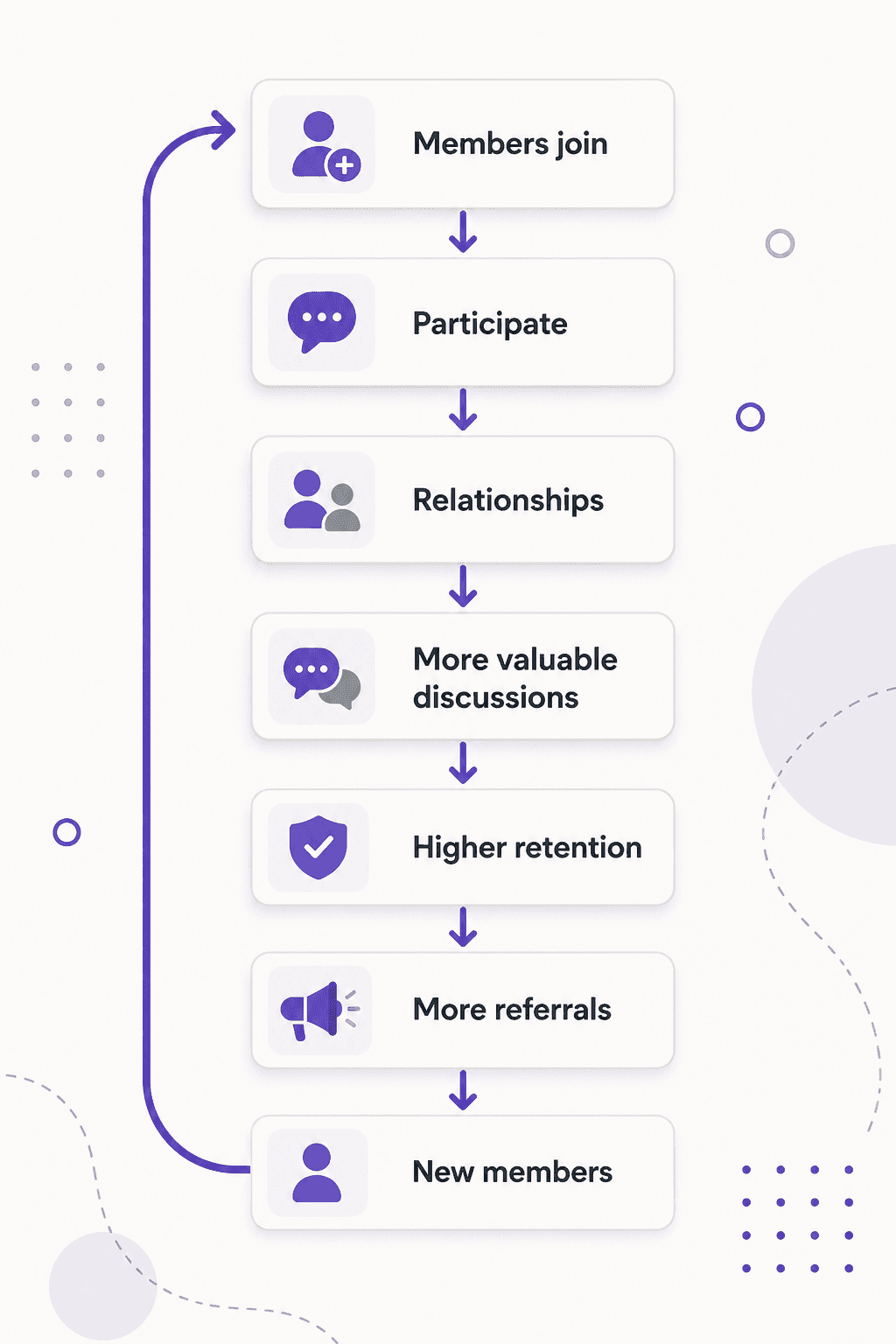
Community-led growth is a business strategy where your community actively contributes to customer acquisition, activation, retention, and advocacy.
Rather than treating community as an isolated marketing initiative, SaaS businesses integrate it into the entire customer lifecycle.
Here's how that typically looks:
Stage | How the community contributes |
|---|---|
Awareness | Members share experiences, recommend your product, and increase brand awareness. |
Evaluation | Prospective customers ask questions and receive authentic answers from experienced users. |
Onboarding | Community members provide practical advice that complements documentation and customer support. |
Retention | Regular participation keeps customers engaged and encourages continued product adoption. |
Expansion | Existing users discover advanced use cases and new features through other members. |
Advocacy | Satisfied customers become brand ambassadors who recommend your product to others. |
Community-led growth is especially relevant as B2B buyers become more comfortable researching products independently. Gartner reports that 75% of B2B buyers prefer a sales experience without direct interaction with a sales representative. At the same time, fully self-service purchases are more likely to result in purchase regret, suggesting that buyers still benefit from trusted guidance, peer experiences, and opportunities to ask questions.
One of the biggest advantages of community-led growth is trust. Buyers often place more confidence in recommendations from experienced users than in marketing materials produced by the company itself.
Communities also generate valuable insights for product teams. Instead of relying solely on surveys or support tickets, companies can observe recurring pain points, identify feature requests, and evaluate how customers actually use the product in real-world situations.
When should you build a community around your SaaS brand?
One of the most common questions founders ask is whether they need a community before reaching product-market fit or only after they've built a larger user base.
There isn't a universal answer, but there are clear signals that indicate you're ready.
You should consider building a community if:
Customers regularly ask similar questions.
Users enjoy sharing workflows or best practices.
Your audience wants to connect with peers.
You receive frequent product feedback.
You want to improve customer retention and brand loyalty.
Many founders assume they need thousands of customers before starting. In reality, successful communities often begin with a few dozen highly engaged users. A smaller group makes it easier to establish culture, encourage participation, and learn what members actually value.
At the same time, launching too early can create problems. If there is no clear purpose, no regular activity, and no commitment to delivering value, people quickly lose interest. An empty Slack workspace or inactive Discord server rarely inspires confidence.
Instead of asking, "Do we have enough users?" a better question is:
Do we have a group of people who genuinely want to learn from one another?
If the answer is yes, you already have the foundation for building a community around your SaaS brand.
The next challenge is deciding exactly what that community should exist to accomplish. That's where every successful community building strategy begins.
Step 1. Define Your Community Building Strategy
The biggest mistake companies make is launching a community before deciding why it should exist. They create a Slack workspace, invite customers, and hope conversations will happen naturally. In most cases, they don't.
Successful communities begin with a clear strategy. Before choosing a platform or inviting your first members, you need to understand who the community serves, what value it provides, and how you'll define success.
Identify your target audience
Not every customer belongs in the same community.
A community works best when members have similar goals, challenges, or interests. The more specific your target audience, the easier it becomes to create relevant discussions and valuable connections between community members.
For example:
Broad audience | Focused audience |
|---|---|
SaaS founders | Bootstrapped B2B SaaS founders |
Designers | Product designers working in SaaS |
Marketers | B2B SaaS content marketers |
Developers | Developers building AI applications |
A narrower focus doesn't limit growth. Instead, it makes your community far more valuable because discussions remain relevant.
Ask yourself these questions before inviting members:
What pain points do they share?
What experience level do they have?
What outcomes are they trying to achieve?
What conversations would they enjoy having every week?
The answers will shape every decision you make later, from your community content to your events and moderation style.
Solve one specific problem
People rarely join communities because they simply want to "network."
They join because they expect the community to solve a problem or help them achieve a goal.
Compare these two positioning statements:
❌ Join our SaaS community.
✅ Join a community where B2B SaaS founders get weekly feedback on their product positioning.
The second example immediately communicates value.
Some communities help members:
Learn new skills
Solve technical challenges
Share product feedback
Find customers
Build professional relationships
Discover best practices
Stay accountable to long-term goals
The clearer your promise, the easier it becomes to attract the right people and maintain high community engagement.
Set goals beyond member growth
Many founders judge community success by a single metric: the number of members.
In reality, community size tells you very little.
A community with 300 active members often creates far more value than one with 10,000 inactive users.
Instead, define what success looks like before launching your community.
Common goals include:
Community goal | Example metrics |
|---|---|
Improve customer retention | Renewal rate, customer retention, churn rate |
Improve onboarding | Activation rate, time to first value, onboarding completion |
Generate product feedback | Feature requests, beta participants, feedback discussions |
Increase engagement | Active members, posts, comments, event attendance |
Build brand advocacy | Referrals, testimonials, user-generated content |
Rather than chasing member count, focus on metrics that reflect your community's purpose. A support community, a founder network, and a customer education hub will naturally measure success differently, but each should connect its community metrics to broader business outcomes.
These objectives are much closer to business outcomes than simply growing your member count.
As your community matures, you can evaluate progress using metrics such as active participation, discussion quality, recurring contributors, referral activity, and retention among community members compared to non-members.
Further reading: Higher Logic's guide to community KPIs.
Step 2. Choose the Right Type of SaaS Community
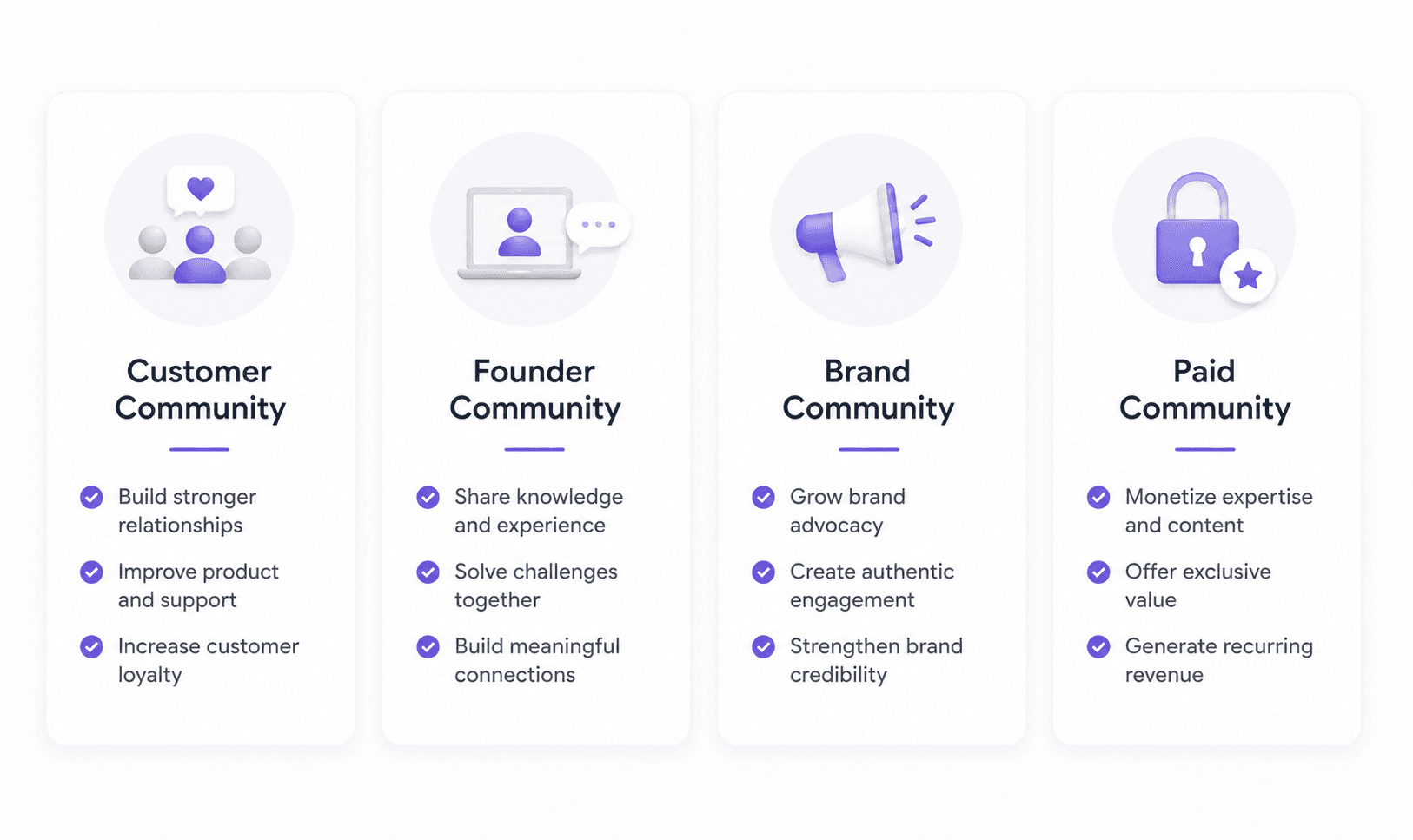
There isn't a single blueprint for building a SaaS community. The right model depends on your product, your audience, and the type of value you want members to receive.
Some communities focus on product education, while others revolve around professional networking or industry discussions.
Choosing the right format from the beginning makes community management significantly easier.
Customer communities
Customer communities are the most common type.
Their primary purpose is helping customers succeed with your SaaS product through shared knowledge, discussions, tutorials, and product updates.
Members typically:
Ask questions
Share workflows
Exchange templates
Report bugs
Discuss new features
Help other customers
Because experienced users answer many questions, customer communities can reduce pressure on support teams while improving customer satisfaction.
They also become an excellent source of continuous product feedback.
Founder communities
Instead of centering discussions around software, founder communities connect people facing similar business challenges.
Members may discuss:
Customer acquisition
Hiring
Pricing
Fundraising
Product strategy
Leadership
Growth experiments
Many successful founder communities include members using completely different SaaS products. Their shared identity comes from building companies rather than using the same software.
This approach often fosters stronger relationships because conversations focus on shared experiences rather than product support.
Brand communities
Brand communities bring together people who identify with your company's mission, philosophy, or way of working.
Unlike customer communities, participation isn't limited to paying users.
Members might include:
Customers
Prospects
Industry experts
Partners
Creators
Influencers
These communities often become important drivers of brand awareness because members voluntarily share experiences, recommend the product, and introduce new people to the ecosystem.
The strongest brand communities create emotional attachment rather than transactional relationships.
Free vs paid communities
Many founders wonder whether they should charge for access.
The answer depends on the type of experience you're offering.
Free community | Paid community |
|---|---|
Easier to grow | Higher commitment from members |
Larger user base | Smaller but more engaged community |
Good for awareness | Better for networking and accountability |
Lower barrier to entry | Higher perceived value |
Free communities are often effective for education, product adoption, and customer support.
Paid communities typically work better when members receive exclusive access to experts, structured networking, accountability, coaching, or premium resources.
Many SaaS businesses eventually combine both models by offering a public community alongside a dedicated community for paying members.
Step 3. Choose the Best Platform for Building a Community
The platform itself rarely determines whether a community succeeds.
People don't stay because you chose Slack instead of Circle. They stay because the experience consistently delivers value.
That said, your platform influences how easily members participate, discover discussions, and build relationships over time.
When comparing community platforms, consider factors such as:
Ease of onboarding
Discussion organization
Search functionality
Notifications
Events
Member directory
Analytics
Integrations
Mobile experience
Below is a comparison of the most common options.
Platform | Best for | Limitations |
|---|---|---|
Circle | Dedicated community platform with events, courses, and memberships | Paid platform |
Slack | Fast discussions and support | Older conversations disappear quickly |
Discord | Technical and developer communities | Can become noisy without moderation |
Facebook Groups | Large existing audiences | Limited ownership and frequent distractions |
LinkedIn Groups | Professional networking | Lower engagement than most dedicated community platforms |
Custom platform | Full flexibility | High development and maintenance costs |
No matter which platform you choose, remember that technology supports community building. It does not replace it.
A mediocre platform with outstanding community management will outperform a perfect platform with no meaningful discussions.
In the next section, we'll look at what actually keeps people coming back after they join and how successful communities create habits that sustain engagement over the long term.
Step 4. Build a Thriving SaaS Community
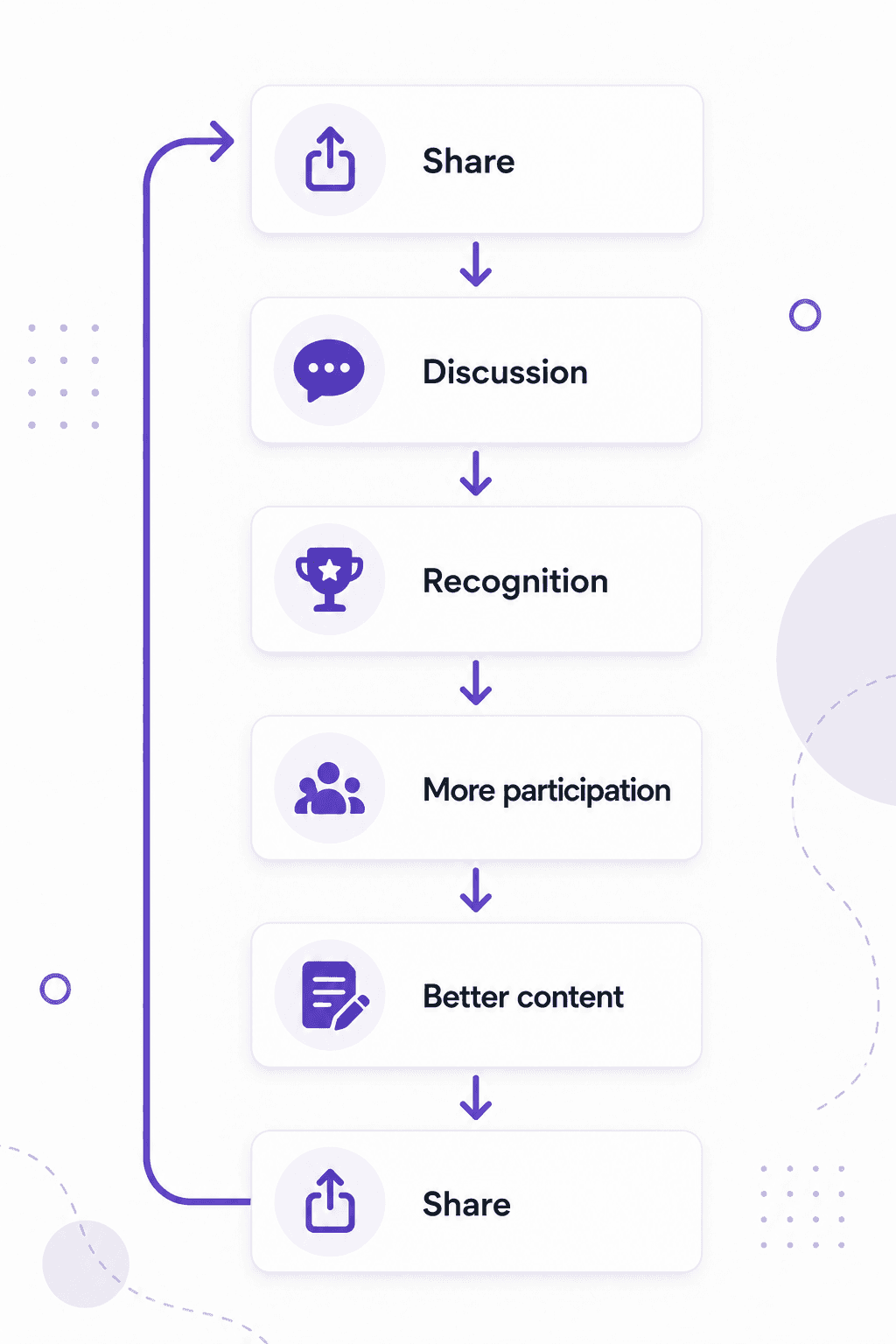
Launching a community is only the beginning. The real challenge is creating an environment where people continue participating long after the initial excitement fades.
Communities don't become active by accident. They grow because members consistently find conversations, relationships, and resources worth returning for.
The goal isn't simply increasing activity. It's creating habits that make participation a routine for your members.
Encourage user-generated content
One of the clearest signs of a healthy community is that members create content without waiting for the company to start every conversation.
User-generated content might include:
Tutorials
Workflow examples
Success stories
Product tips
Templates
Questions
Case studies
Lessons learned
This content often carries more credibility than branded marketing because it comes from people solving real problems.
To encourage members to contribute, make participation easy. Ask open-ended questions, invite people to share their experiences, and publicly recognize valuable contributions.
The easier it is for someone to post for the first time, the more likely they are to become a regular contributor.
Foster meaningful discussions
Many communities become inactive because conversations remain too superficial.
Questions like "How's everyone doing?" or "What's your favorite feature?" rarely generate lasting discussion.
Instead, create prompts that encourage members to share insights, experiences, or specific challenges.
For example:
Instead of asking... | Try asking... |
|---|---|
Any updates? | What's one lesson you learned while acquiring customers this month? |
Need help? | What's the biggest challenge slowing your growth right now? |
Share your thoughts. | Which feature saved you the most time this week, and why? |
The objective isn't simply generating replies. It's helping community members learn from each other.
As discussions become more valuable, members naturally begin returning to see what others have shared.
Create recurring events
Consistent events give members a reason to return even when they don't have an immediate question.
Popular formats include:
Weekly office hours
Live product demos
Expert interviews
Ask Me Anything sessions
Community workshops
Virtual meetups
Accountability sessions
Recurring events also strengthen community connections because members come to recognize familiar faces over time.
You don't need large productions. Even a simple monthly discussion can become an important part of your community if it consistently delivers value.
Reward your most active members
Every successful community has a relatively small group of highly engaged members who contribute far more than the average participant.
These power users answer questions, welcome newcomers, and keep conversations moving.
Recognizing them encourages continued participation and demonstrates the type of behavior your community values.
Recognition doesn't always require financial rewards.
You might offer:
Public recognition
Special community roles
Early access to new features
Invitations to beta programs
Opportunities to speak during events
Exclusive networking sessions
Over time, many of these contributors naturally become brand ambassadors who introduce new members and strengthen your community culture.
Step 5. Grow Your Community Around Your SaaS Brand
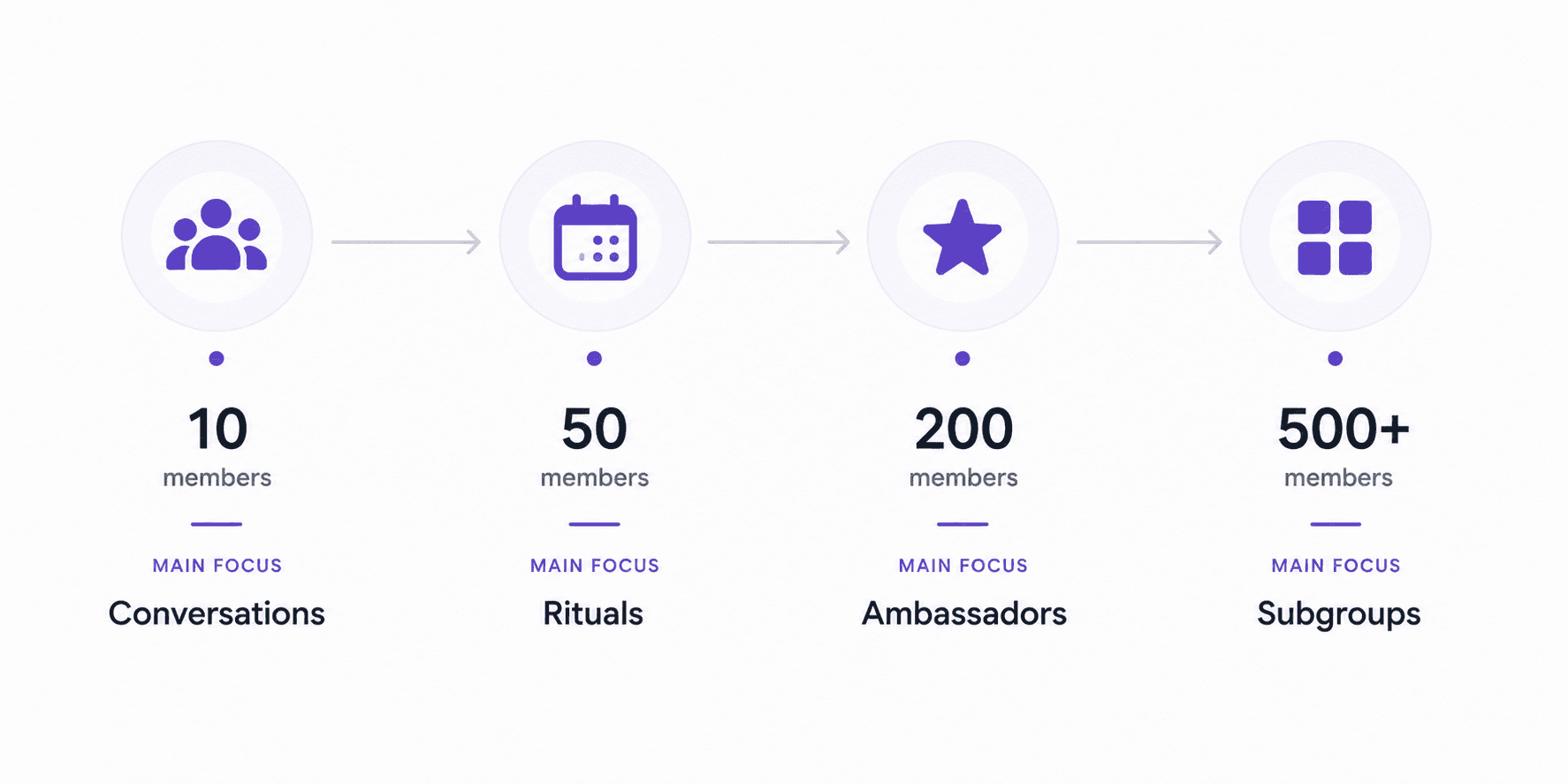
Once your community provides consistent value, the next step is sustainable growth.
Many founders focus on growing as quickly as possible. However, successful communities usually prioritize quality over speed.
Adding hundreds of inactive members rarely improves the experience. A smaller group of engaged community members is almost always more valuable.
Invite your existing customers
Your current customers are the most natural place to begin.
They already understand your SaaS product, trust your company, and are more likely to contribute useful discussions.
Consider inviting customers during key moments, such as:
After successful onboarding
Following positive support interactions
After achieving a meaningful milestone
When they leave positive feedback
These users often become the foundation of a thriving community.
Partner with industry experts
You don't have to build credibility alone.
Industry experts can introduce fresh perspectives, answer questions, and attract new audiences.
Partnerships may include:
Guest webinars
Live interviews
Educational workshops
Collaborative community content
Joint case studies
These collaborations also help your community become part of a broader industry ecosystem instead of existing in isolation.
Attract your first members
If you're starting from zero, focus on personally inviting people rather than relying on public announcements.
Your first members shape the community's culture.
Look for people who already:
Enjoy helping others
Share knowledge publicly
Participate in discussions
Give thoughtful feedback
The first 20 engaged members often contribute more to long-term success than the next 500 passive members.
Scale without losing engagement
As communities grow, maintaining quality becomes increasingly difficult.
What works for 50 members won't necessarily work for 5,000.
As your community expands, consider introducing:
Dedicated moderators
Community managers
Discussion guidelines
Topic-specific channels
Structured onboarding
Regular analytics reviews
Scaling successfully means preserving meaningful interactions rather than maximizing activity.
Step 6. Keep Your Dedicated Community Active
A community isn't successful because people join.
It's successful because they continue participating months or even years later.
Long-term engagement requires consistent attention and continuous improvement.
Build community habits
The most active communities develop recurring participation patterns.
Members know when events happen, when discussions begin, and how they can contribute.
Simple recurring habits might include:
Weekly discussion prompts
Monthly workshops
Product feedback sessions
Community challenges
Member introductions
Predictability helps participation become part of members' routines.
Support community-driven conversations
Not every discussion needs to originate from your team.
In fact, community becomes significantly stronger when members regularly initiate conversations themselves.
Encourage people to:
Ask questions
Share insights
Celebrate milestones
Recommend resources
Discuss industry trends
Communities become more sustainable when knowledge flows among members rather than always coming from the company.
Measure engagement instead of member count
One of the most common mistakes in community management is celebrating growth while ignoring participation.
Instead of focusing only on registrations, evaluate metrics such as:
Metric | Why it matters |
|---|---|
Active community members | Indicates ongoing participation |
Community engagement | Shows how often members contribute |
Returning visitors | Measures habit formation |
Customer retention | Demonstrates long-term business impact |
User-generated content | Reflects community health |
Referral activity | Indicates advocacy and organic growth |
These metrics provide a much better picture of whether your community is actually delivering value.
Common Community Building Mistakes
Even experienced SaaS businesses make mistakes when building community.
Avoid these common pitfalls.
Growing too fast
Rapid growth sounds exciting, but adding large numbers of inactive members often reduces engagement.
Healthy communities grow gradually while maintaining the quality of discussion.
Building without a clear purpose
People don't join communities simply because they exist.
Without a compelling reason to participate, activity quickly disappears.
Always define the value your community provides before inviting members.
Making the community about your product
Members rarely want to spend their free time reading advertisements.
Your SaaS product should support discussions, not dominate them.
The most successful communities focus on helping people solve problems rather than promoting features.
Ignoring inactive members
Not everyone participates immediately.
Sometimes people simply need encouragement, clearer onboarding, or conversations that better match their interests.
Review your analytics regularly to identify where participation declines and evaluate which improvements could increase engagement.
Examples of SaaS Companies with Thriving Communities
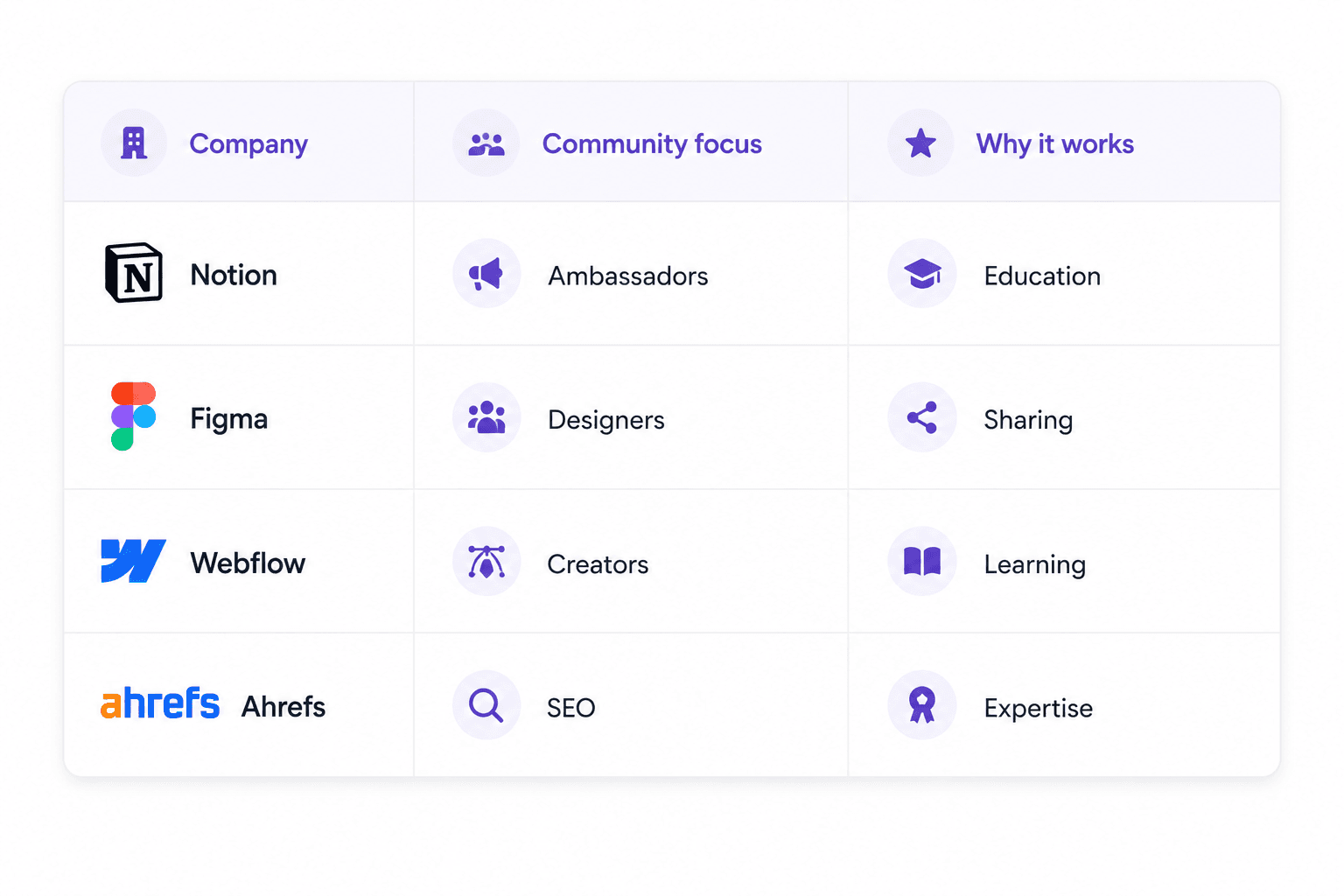
Many of today's most successful SaaS businesses treat community as a core part of their growth strategy rather than an optional marketing channel.
Company | Community focus |
|---|---|
Notion | Productivity, templates, workflows, education |
Figma | Design collaboration, resources, community events |
Ahrefs | SEO education, tutorials, industry discussions |
Webflow | Web design, development, learning, showcases |
Although these communities serve different audiences, they share several characteristics:
They solve real customer pain points.
They encourage members to help each other.
They produce valuable community content.
They continuously gather product feedback.
They strengthen brand loyalty through long-term relationships.
Frequently Asked Questions About Building a SaaS Community
How long does community building take?
Most successful communities require several months before meaningful engagement becomes consistent. Building trust and participation is a gradual process, not a one-time launch.
Do you need a community before product-market fit?
Not necessarily. However, once you have a group of users who genuinely want to learn from one another, building a community can accelerate product learning and customer relationships.
Should your SaaS community be free or paid?
Free communities are usually better for education, support, and awareness. Paid communities work best when members receive exclusive networking opportunities, structured programs, or premium resources.
How do you measure community success?
Look beyond member count. Community engagement, customer retention, referral activity, recurring participation, and user-generated content provide a much clearer picture of long-term success.
What makes a thriving SaaS community?
A thriving SaaS community consistently delivers value, encourages meaningful conversations, helps members solve real problems, and creates relationships that continue long after someone first joins.