Marketing
How to improve your LinkedIn visibility as a founder

, Community Leader
34 minutes

For a founder, being visible on LinkedIn is not simply about getting more impressions. The real goal is to become easier to discover and remember by the people who can actually matter to your business: potential clients, other founders, investors, collaborators, partners, and people with relevant expertise.
That changes how you should think about LinkedIn strategy. A post that reaches 50,000 random people may be less valuable than one that reaches 2,000 people in your industry and starts five useful conversations. Likewise, an active account can generate plenty of feed exposure while the founder’s profile does a poor job of explaining who they are, what they are building, or why someone should connect with them.
Improving your LinkedIn presence therefore requires more than posting content. Your profile, network, content, comments, and interactions reinforce one another. Content creates opportunities to be discovered, conversations expose you to new networks, and an optimized LinkedIn profile converts some of that attention into profile views, connections, and eventually business opportunities.
How can I improve my LinkedIn visibility as a founder?
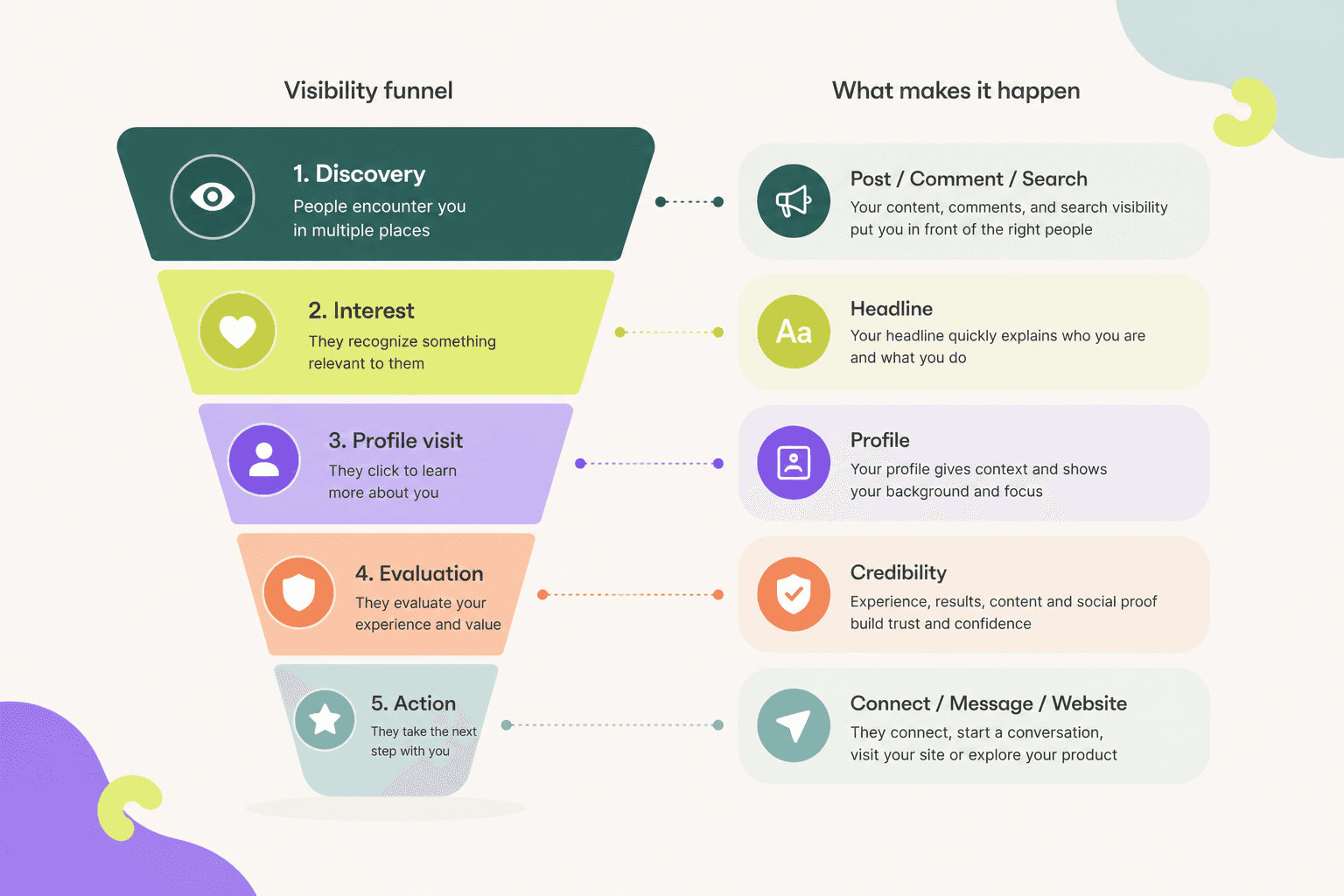
The most effective approach is to work on three layers simultaneously: discoverability, relevance, and engagement. People need opportunities to encounter you, a reason to pay attention when they do, and enough context to understand why connecting with you could be valuable.
LinkedIn itself distinguishes between profile appearances and profile views. An appearance happens when your name and headline are shown in places such as search results, posts, comments, and network recommendations. A profile view represents the next step: someone was interested enough to click on your profile and learn more.
For founders, that distinction is useful because it creates a simple funnel:
Stage | What happens | What influences it |
|---|---|---|
Discovery | Someone encounters your name or content | Search, posts, comments, connections |
Interest | They recognize something relevant | Positioning, topics, headline |
Profile visit | They click on your profile | Credibility, curiosity, relevance |
Evaluation | They decide whether you are worth following or contacting | Profile, experience, social proof |
Action | They follow, connect, message, visit your site, or start a conversation | Relevance, trust, clear next step |
You do not need to maximize every number in this funnel. You need enough of the right people moving through it.
What visibility on LinkedIn actually means
There are several ways someone can discover you while using LinkedIn. They might find your profile through search, see one of your posts, encounter a comment you left under somebody else's post, receive a network recommendation, or notice that a mutual connection interacted with you.
This is why using LinkedIn only as a publishing platform leaves a lot of potential reach unused. Your comments, connections, profile optimization, and participation in relevant conversations can all build visibility even on days when you do not post content.
LinkedIn's profile analytics reflect this broader definition. Search Appearances can show not only how often you appeared in search, but also information such as the companies and job titles associated with people who found you and the job titles you were found for. For a B2B founder, these signals are much more informative than looking at a raw impression count alone.
Discoverability also extends beyond LinkedIn itself. Depending on your privacy settings, your public LinkedIn profile can appear in Google, Bing, DuckDuckGo, and other search tools. LinkedIn notes that changes to a public profile can take weeks or sometimes months to be reflected by external search engines.
So when evaluating your presence, ask a better question than "How many people saw me?" Ask who is discovering me, where they find me, and what happens after they do.
Why the right audience matters more than total reach
Imagine two SaaS founders publishing on LinkedIn.
Founder A receives 40,000 impressions on a broad post about productivity. It generates hundreds of reactions, but most come from people who have little connection to the founder's market.
Founder B receives 4,000 impressions on a detailed post about reducing trial-to-paid friction in B2B SaaS. The audience includes SaaS founders, product leaders, and potential clients. Three founders join the discussion, two relevant people connect afterward, and one potential client messages.
Founder A has more reach. Founder B arguably has more useful visibility.
This distinction should influence everything from the connections you make to the content you publish. If you are building a SaaS product for agencies, attracting agency owners, SaaS founders, potential partners, and people with expertise in that market is usually more valuable than maximizing generic engagement.
That does not mean large reach is bad. It means you should evaluate reach in context. The best LinkedIn strategy expands your audience without gradually diluting its relevance.
Optimize your LinkedIn profile to make a strong first impression
The most effective approach is to work on three layers simultaneously: discoverability, relevance, and engagement. People need opportunities to encounter you, a reason to pay attention when they do, and enough context to understand why connecting with you could be valuable.
LinkedIn itself distinguishes between profile appearances and profile views. An appearance happens when your name and headline are shown in places such as search results, posts, comments, and network recommendations. A profile view represents the next step: someone was interested enough to click on your profile and learn more.
For founders, that distinction is useful because it creates a simple funnel:
Stage | What happens | What influences it |
|---|---|---|
Discovery | Someone encounters your name or content | Search, posts, comments, connections |
Interest | They recognize something relevant | Positioning, topics, headline |
Profile visit | They click on your profile | Credibility, curiosity, relevance |
Evaluation | They decide whether you are worth following or contacting | Profile, experience, social proof |
Action | They follow, connect, message, visit your site, or start a conversation | Relevance, trust, clear next step |
You do not need to maximize every number in this funnel. You need enough of the right people moving through it.
What visibility on LinkedIn actually means
There are several ways someone can discover you while using LinkedIn. They might find your profile through search, see one of your posts, encounter a comment you left under somebody else's post, receive a network recommendation, or notice that a mutual connection interacted with you.
This is why using LinkedIn only as a publishing platform leaves a lot of potential reach unused. Your comments, connections, profile optimization, and participation in relevant conversations can all build visibility even on days when you do not post content.
LinkedIn's profile analytics reflect this broader definition. Search Appearances can show not only how often you appeared in search, but also information such as the companies and job titles associated with people who found you and the job titles you were found for. For a B2B founder, these signals are much more informative than looking at a raw impression count alone.
Discoverability also extends beyond LinkedIn itself. Depending on your privacy settings, your public LinkedIn profile can appear in Google, Bing, DuckDuckGo, and other search tools. LinkedIn notes that changes to a public profile can take weeks or sometimes months to be reflected by external search engines.
So when evaluating your presence, ask a better question than "How many people saw me?" Ask who is discovering me, where they find me, and what happens after they do.
Why the right audience matters more than total reach
Imagine two SaaS founders publishing on LinkedIn.
Founder A receives 40,000 impressions on a broad post about productivity. It generates hundreds of reactions, but most come from people who have little connection to the founder's market.
Founder B receives 4,000 impressions on a detailed post about reducing trial-to-paid friction in B2B SaaS. The audience includes SaaS founders, product leaders, and potential clients. Three founders join the discussion, two relevant people connect afterward, and one potential client messages.
Founder A has more reach. Founder B arguably has more useful visibility.
This distinction should influence everything from the connections you make to the content you publish. If you are building a SaaS product for agencies, attracting agency owners, SaaS founders, potential partners, and people with expertise in that market is usually more valuable than maximizing generic engagement.
That does not mean large reach is bad. It means you should evaluate reach in context. The best LinkedIn strategy expands your audience without gradually diluting its relevance.
Optimize your LinkedIn profile to make a strong first impression
Content and comments can bring someone to your profile, but they cannot control what happens once that person arrives. Your profile has to do that job.
For a founder, it helps to think of the profile like a landing page rather than an online résumé. A résumé is primarily a record of your professional history. A founder's profile also needs to communicate your current position: what you are building, which problem you understand, who you help, and why someone might want to know you.
This does not require turning every section into a sales pitch. In fact, aggressively selling from the first line can undermine credibility. The objective is clarity. Someone who lands on your profile should quickly understand enough about you to decide whether they want to continue reading.
A strong profile typically answers four questions:
Who are you? Your current role and professional identity.
What are you working on? Your company, product, market, or areas of expertise.
Why should I pay attention? Relevant experience, insights, results, or social proof.
What should I do next? Follow you, connect, explore your product, read your work, or start a conversation.
Profile optimization isn't separate from building visibility. It determines what happens to the attention your other LinkedIn activity creates.
Craft a compelling headline that explains your position
Your headline occupies prime real estate because it frequently travels with you around LinkedIn. Profile appearances can include your name and headline across search, posts, comments, and network recommendations. That means people may encounter your headline before they ever see the rest of your founder’s profile.
The default approach of simply writing "Founder at Company X" wastes much of that opportunity. Unless the company is already well known, the reader still has no idea what you actually do.
A stronger headline can combine three elements:
Role + company/product + useful context
For example:
Founder at Acme | AI customer support for B2B SaaS teams
This tells someone considerably more than:
Founder & CEO at Acme
There is no need to stuff every possible keyword into the headline. Choose language that accurately describes how you want to be found and understood. If "B2B SaaS", "AI customer support", or another industry-specific term is genuinely central to your work, including it gives both humans and LinkedIn more context about your professional identity.
Should the headline ultimately pass a simple test: would someone who knows nothing about your company understand roughly what you do within a few seconds?
Use your About section to tell your story and build credibility
Once the headline establishes your position, the About section gives you room to explain it.
Many founder profiles fall into one of two extremes. The first is effectively empty: a couple of sentences and a link. The second reads like corporate marketing copy filled with claims, buzzwords, and broad statements that could describe almost any startup.
A useful About section should tell your story while remaining relevant to the person reading it. Explain what you are building, why the problem matters, what experience brought you there, and the areas in which you have genuine expertise.
For example, a founder might structure the section around:
the problem they are currently solving;
what their product or company does;
relevant background and experience;
industries or areas of expertise;
who they are interested in meeting;
a simple call to action.
This is also a natural place to use relevant keywords that would sound awkward if forced into your headline. A B2B SaaS founder working on lead generation, for example, can discuss those subjects naturally when describing the product and their experience instead of repeating a list of search terms.
Credibility should come primarily from specifics. "Helping companies achieve incredible growth" says very little. Explaining that you built a particular product, worked with a defined type of customer, reached a meaningful milestone, or learned something from a failed approach builds trust because the reader has something concrete to evaluate.
Treat your LinkedIn profile like a landing page
A good landing page has hierarchy. It does not give every piece of information equal importance, and neither should your profile.
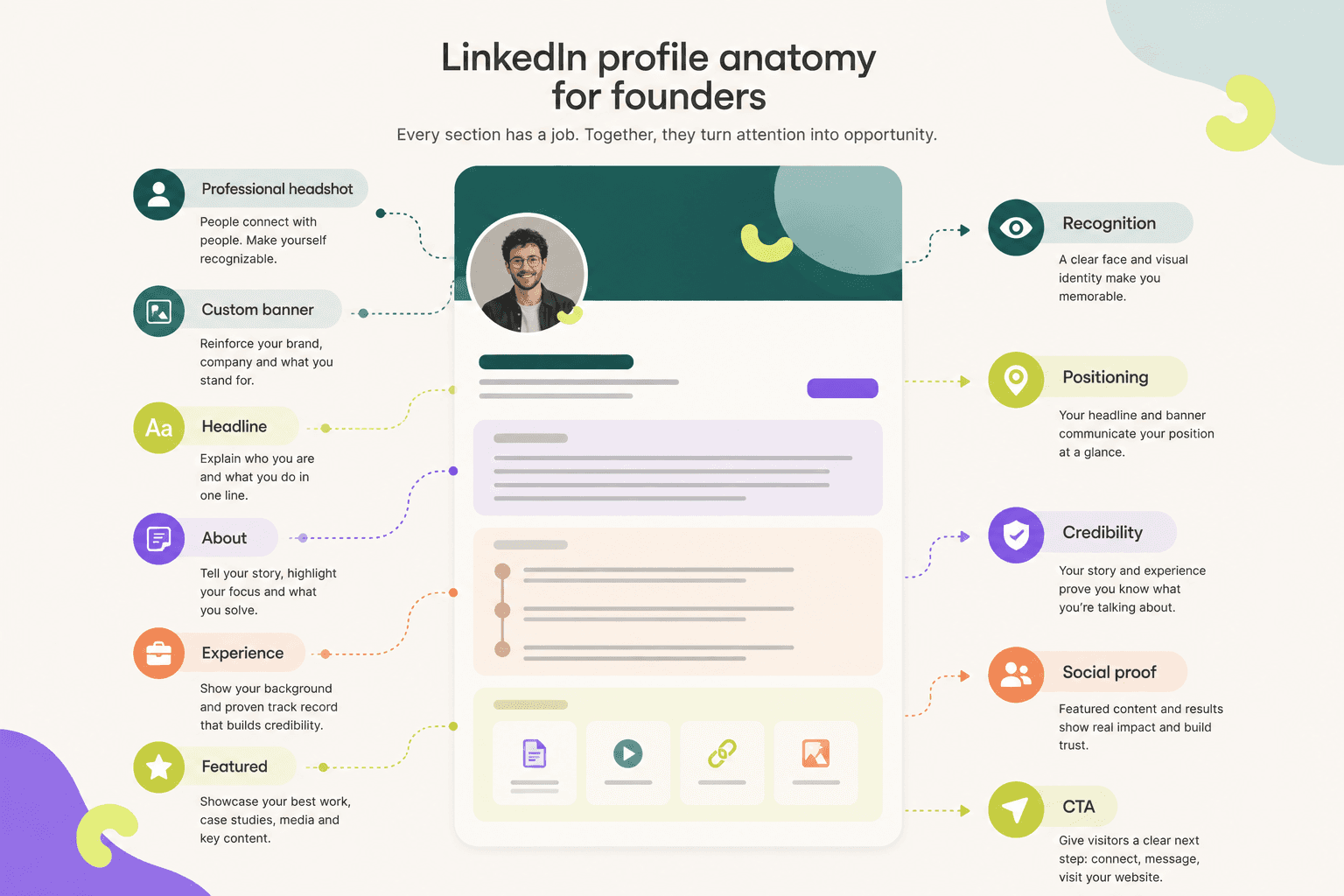
Think about what someone sees as they move down the page. Your professional photo and banner establish the first visual impression. Your headline explains your position. Your About section provides context. Your experience section supports your claims. Your Featured section can then provide evidence or direct someone toward something worth exploring.
LinkedIn describes the Featured section as a place to showcase selected work, including your own posts and articles as well as external media, documents, and links. Unlike the Activity section, you curate it, so you control which examples receive prominence. Featured content isn't discoverable through LinkedIn search, so the section is primarily a conversion and credibility tool after someone reaches your profile, rather than a discovery mechanism.
For a founder, useful Featured items might include a product page, a strong case study, an industry-specific article, a founder interview, a product demo, or a post that demonstrates expertise. You don't need to fill the section just because space exists. Curate a small number of items that reinforce the story the rest of your profile tells.
The same principle applies to your experience section. It should provide enough substance to reinforce your credibility without forcing visitors to reconstruct your current work from a chronological career history.
Your profile photo and custom banner deserve attention too, but their job is not to make the profile look elaborate. A clear professional headshot makes the person behind the company immediately recognizable, while a banner can reinforce the company, product, market, or message. The goal is consistency: every major element should help a visitor reach roughly the same conclusion about who you are and why you are relevant.
The result is a profile designed not merely to exist on LinkedIn, but to convert attention into understanding, trust, and a logical next step.
Improve your LinkedIn presence with profile optimization
Once the basic positioning is clear, the next step is making the profile easier to discover and more useful when it appears in front of the right people. That means paying attention to the language you use, the evidence you provide, and the sections you choose to emphasize.
Profile optimization should not turn your page into an SEO document. The goal is to make the signals already present in your work explicit enough for both people and LinkedIn to understand.
Use relevant keywords throughout your profile
Start with the terms that genuinely describe your work. These might include your category, customer type, product type, expertise, or a specific problem you solve: B2B SaaS, product analytics, AI agents, developer tools, conversion optimization, and so on.
Then use those terms naturally where they belong: your headline, About section, current job title and description, experience, and skills. Avoid repeating the same keyword simply to increase its frequency. A profile written for an algorithm but unpleasant for humans defeats the purpose of attracting relevant people.
LinkedIn provides Search Appearances analytics that can help you evaluate whether this positioning is working. Depending on the analytics available to your account, you can see where you appeared and the companies and job titles associated with people finding you.
Treat that information as feedback. If you are trying to attract SaaS founders but your profile is consistently associated with an old job title or an unrelated area of expertise, your current positioning may not be clear enough.
Optimize your experience section for credibility
The experience section is where you can reinforce the claims made higher on the page.
For your current company, avoid stopping at a job title and company name. Briefly explain what the business does, who it serves, what problem it addresses, and your role in building it. Where appropriate, add concrete evidence such as customers served, product milestones, case studies, or other meaningful results.
Previous roles should be selective. A decade-old position may establish useful expertise, but it does not need the same level of detail as the company you are building today.
The objective is not to make your profile longer. It is to make your experience easier to interpret.
Curate your featured section around what matters most
Finally, decide what proof you want someone to see after reading your profile.
A potential client may benefit from seeing a case study. Another founder might find your best article or founder story more interesting. A potential collaborator might want to understand the product. Someone evaluating your expertise may respond to an in-depth post or interview.
This makes the Featured section particularly useful for founders because different assets can provide different forms of social proof without turning the About section into a wall of links.
Choose a few assets strategically and order them according to what you want visitors to notice first. If your priorities change, update the section accordingly. A founder raising a round, launching a product, looking for early customers, and building industry authority may each want a different profile to attract the right opportunities.
By this point, the foundation is in place: people can understand what you do, your profile supports your credibility, and relevant visitors have clear ways to explore further. The next challenge is creating enough opportunities for those people to encounter you in the first place.
Build a relevant network that increases visibility
Your network determines much of the environment in which your LinkedIn activity happens. If most of your connections have little to do with your company, market, or interests, publishing better content alone will not necessarily solve the problem.
For founders, network building should be intentional without becoming transactional. The objective is not to connect only with potential clients. A healthy founder network can include other founders, operators, investors, industry specialists, potential collaborators, and people building complementary products.
This creates a useful secondary effect. Every relevant connection introduces you to another network. When people interact with your posts, or you participate in their conversations, you gain opportunities to be seen by people who would otherwise have little reason to discover your profile.
Connect with people you actually want to attract
Start by defining the types of people you would genuinely benefit from knowing. A B2B SaaS founder might prioritize SaaS founders in adjacent categories, potential customers, product and growth leaders, integration partners, and specialists working on similar problems.
This is more useful than treating LinkedIn as a database and sending requests indiscriminately.
LinkedIn also applies invitation limits and restrictions intended to encourage thoughtful connection behavior. The platform recommends adding context to invitations and using follows or other forms of interaction when you do not know someone personally.
You do not necessarily need to pitch anything when someone accepts. In many cases, the better first step is simply becoming part of the same professional network. Their posts begin appearing in your environment, your content can reach them, and more opportunities for a real conversation can emerge naturally.
For potential clients in particular, this can be more effective than treating every new connection as an immediate lead generation opportunity. Being familiar before asking for something reduces the distance between a stranger and a business conversation.
Focus on relevant relationships instead of network size
A large network can increase potential distribution, but size alone is a poor measure of network quality.
Consider a founder with 15,000 connections accumulated across unrelated industries and another with 2,000 connections concentrated among SaaS founders, product leaders, and people in their target market. The first network is larger, but the second may be much more valuable for distributing industry-specific content and creating relevant conversations.
This is especially important for founders operating in relatively narrow B2B markets. If you sell infrastructure software to engineering teams, there is limited value in optimizing your content to attract everyone on LinkedIn. You want enough concentration around the people who understand, buy, recommend, or influence products like yours.
Think of network growth as increasing density, not simply increasing volume. The more valuable connections exist around your areas of expertise, the easier it becomes for relevant conversations to compound.
That does not mean every connection needs an obvious commercial purpose. Some of the most valuable relationships may be with founders facing similar problems, collaborators with complementary skills, or people who simply contribute thoughtful perspectives. The common denominator is relevance, not immediate revenue.
Create content that builds trust and attracts the right people
Once your profile and network provide the foundation, content gives people repeated reasons to encounter you.
This is where many founder LinkedIn strategies become unnecessarily complicated. They begin with questions about formats, posting frequency, hooks, algorithms, or the best time to post. Those factors can matter, but none solves the fundamental question: why should somebody in your target audience care about what you have to say?
Founders have an advantage here because running a company continuously produces material. Customer conversations, product decisions, failed experiments, hiring problems, pricing changes, growth experiments, unexpected results, and changes of opinion can all become useful content.
The challenge is learning to recognize those experiences as material worth sharing.
Share founder experience instead of generic advice
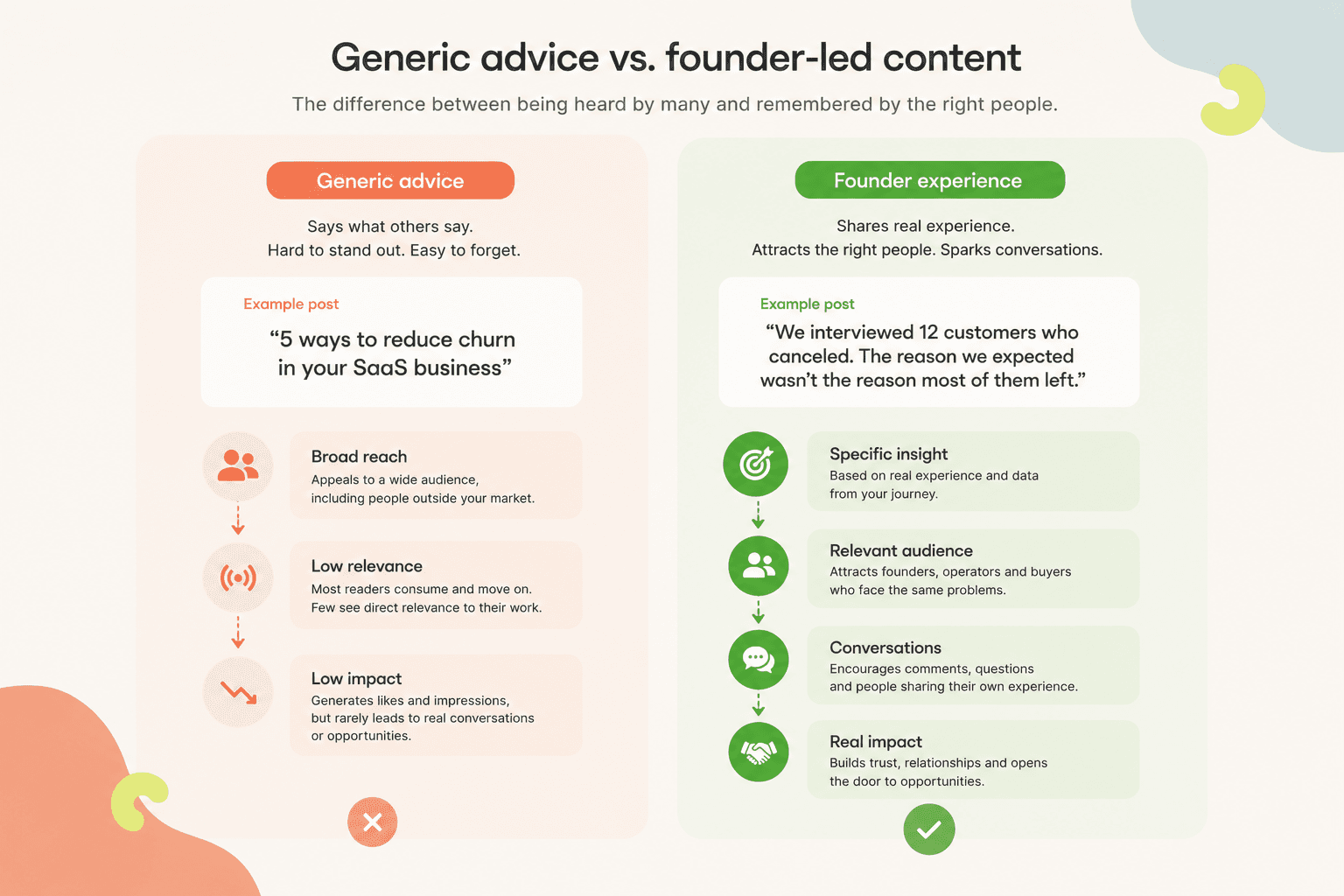
Generic advice is easy to create and difficult to differentiate.
Compare these two ideas:
Five ways to reduce SaaS churn.
and:
We interviewed 12 customers who canceled. The reason we expected wasn't the reason most of them left.
Both can lead to useful content, but the second starts with information that belongs specifically to the founder. It contains experience, uncertainty, and a potential lesson.
You do not need dramatic success stories to create this kind of content. In fact, ordinary operational decisions often make stronger founder content because people in similar businesses recognize the situation.
Useful sources include:
an experiment that produced an unexpected result;
a product decision and the trade-off behind it;
a customer objection that changed your thinking;
a mistake and what you would do differently;
a metric that moved and your hypothesis about why;
an industry assumption you now disagree with;
a milestone and what actually contributed to it.
The important distinction is between documenting experience and manufacturing expertise. You do not need to present every observation as a universal lesson. "This happened in our company, and here is what I think it means" can be more credible than pretending to have discovered a rule that applies to every startup.
For SaaS founders, this also creates natural opportunities to use industry-specific language and discuss the problems potential clients or collaborators already care about. Your content reinforces your position without every post needing to promote your product.
Create content around problems your audience already cares about
Founder experience becomes more useful when it intersects with an existing audience problem.
Suppose you are building an analytics product. You could post about your new dashboard. That may matter to existing customers, but most people have little reason to care about another company's product update.
Alternatively, you could explain what you learned after watching customers repeatedly misinterpret a particular metric. Now the post addresses a problem other product teams may recognize. Your product provides the context, but the reader gets value even if they never buy it.
This distinction matters most when using LinkedIn for B2B growth. If every post points directly back to your company, your LinkedIn presence begins to resemble a corporate feed. If your content consistently explores problems relevant to your market, the company becomes part of a larger body of expertise.
A simple content mix for a founder might look like this:
Content type | Example | Primary purpose |
|---|---|---|
Founder experience | What changed after altering onboarding | Build credibility |
Experiment | Results from testing a new acquisition channel | Create discussion |
Industry observation | Why a common SaaS practice is changing | Demonstrate expertise |
Failure or lesson | A feature customers did not use | |
Customer insight | A recurring problem from user interviews | Attract the right audience |
Company milestone | Reaching a meaningful product or revenue milestone | Provide social proof |
The categories do not need fixed percentages. Their purpose is to prevent your content from becoming either entirely promotional or so broad that nobody can associate you with a particular area.
Build your personal brand through consistent themes
A personal brand is partly a product of repetition. If you discuss completely unrelated subjects every day, individual posts may perform well while readers struggle to remember what you are associated with.
Choose a small number of themes connected to what you are building and what you genuinely know or are learning.
A founder building an AI sales product, for example, might consistently discuss AI agents, sales workflows, outbound experiments, product development, and the experience of building an early-stage SaaS company. These themes are broad enough to produce many posts but narrow enough to create an identifiable position.
Consistency does not mean repeating the same argument. You can approach a theme through stories, data, opinions, questions, case studies, failures, experiments, or practical explanations.
Over time, the association itself becomes valuable. Someone does not need to remember your exact post from six weeks ago. It is enough that when they encounter your name again, they think, "I've seen this founder talking intelligently about this problem before."
That recognition is one way content builds trust before a direct conversation ever happens.
Increase visibility through meaningful comments
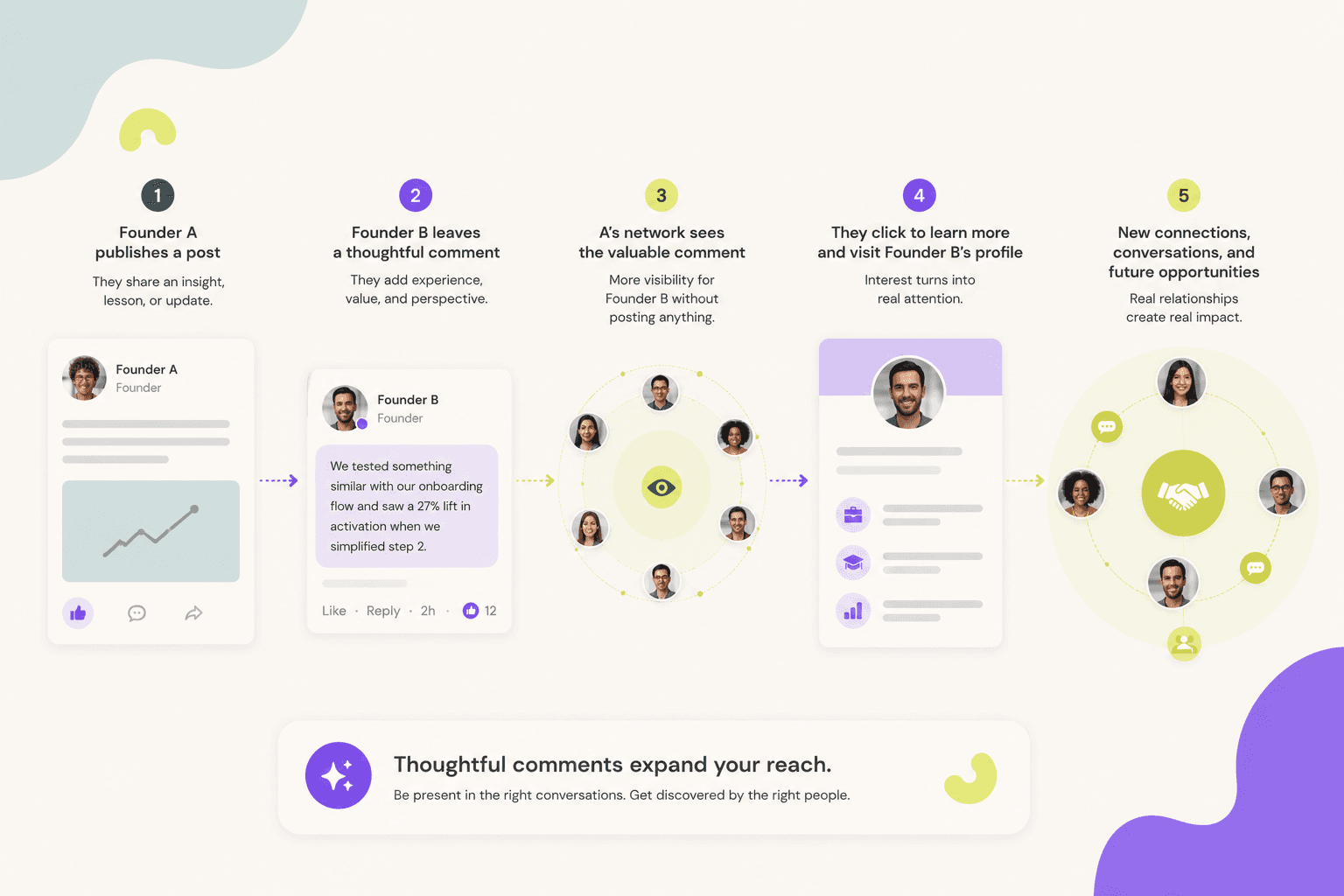
Posting is only one way to participate on LinkedIn. Comments can put your name, headline, and perspective into conversations that already have an audience.
This is particularly useful when you are still building LinkedIn presence and your own posts have limited distribution. You don't need to wait until you have thousands of followers to contribute to discussions with the people you want to know.
The key word is contributing.
Writing "Great post!" under twenty posts may technically increase activity, but it gives readers almost no reason to click on your profile or remember who you are. A useful comment adds information, experience, disagreement, a question, or another perspective.
Comment where your target audience already spends attention
You do not need to comment on the largest accounts. You need to participate in the right conversations.
A founder selling to SaaS companies might follow other SaaS founders, software investors, product leaders, and specialists who regularly discuss acquisition, retention, pricing, or product development. A founder selling to agencies would build a different environment.
When choosing where to participate, consider three questions:
Is the topic relevant to something I genuinely know or care about?
Are people I would like to know likely to read this discussion?
Can I add something beyond agreement?
If the answer to all three is yes, the comment has strategic value even if the original post never becomes viral.
This also makes commenting easier. Instead of searching for clever things to say everywhere, you are responding to subjects where you already have experience.
Use conversations to build credibility and attract profile visits
A strong comment often works like a miniature piece of content.
Suppose another founder writes about switching from a free trial to a freemium model. If you have tested something similar, you might briefly describe what happened, identify a trade-off they did not mention, or ask a specific question about activation.
Someone reading the discussion now has a reason to notice you. Your headline provides context, the comment demonstrates experience, and a curious reader can click on your profile.
This is another reason profile optimization and engagement should not be treated as separate tactics. The comment creates the profile visit; the profile determines whether that visit leads anywhere.
Comments can also create valuable connections without a cold introduction. If you exchange thoughtful replies with someone several times, a later connection request or message has context. You are no longer two completely unfamiliar profiles.
You don't need to force this process into a rigid engagement routine. A smaller number of substantive conversations is usually more useful for a founder than dozens of generic comments written only to increase activity.
Measure whether your LinkedIn visibility is improving
LinkedIn activity becomes difficult to improve if you evaluate it only by intuition.
Fortunately, you do not need an elaborate analytics system. A small set of indicators can tell you whether more people are discovering you, whether they are the right people, and whether that attention is turning into something meaningful.
LinkedIn provides several types of individual analytics, including post impressions and engagement, follower analytics, profile viewers, and profile appearances. LinkedIn also provides combined post analytics you can use to review trends across your content over time.
The important part is deciding what each metric actually tells you.
Track profile views, search appearances, and content reach
Start with the top of the funnel.
Post impressions tell you roughly how much distribution your content is receiving. They are useful for identifying changes over time, but an impression does not necessarily mean someone carefully read your post.
Profile appearances tell you how often your name and headline were shown across LinkedIn surfaces such as search, posts, comments, and recommendations.
Profile views represent stronger intent. Someone moved beyond encountering you and chose to learn more.
Search appearances can provide another perspective on discoverability. LinkedIn's search appearance analytics can include information about the companies and job titles of people who found you and the job titles you were found for.
Looking at these numbers together is more useful than treating any one of them as a score.
For example, suppose your post impressions increase substantially while profile views remain flat. Your content may be reaching more people without creating enough curiosity about you or your company. If profile views increase but relevant inbound conversations do not, the profile itself or your audience targeting may deserve attention.
The direction matters more than any universal benchmark.
A simple monthly dashboard might look like this:
Metric | What it helps you understand | What to look for |
|---|---|---|
Post impressions | Content distribution | Is relevant content reaching more people? |
Profile appearances | Overall exposure | Are you appearing more often across LinkedIn? |
Profile views | Interest | Are appearances turning into curiosity? |
Search appearances | Discoverability | Are people finding you for relevant roles and topics? |
Relevant new connections | Network quality | Is your network becoming more useful? |
Inbound conversations | Business relevance | Is attention creating real opportunities? |
Do not overreact to weekly fluctuations. One unusually successful post can distort short-term numbers. Looking at monthly trends makes it easier to distinguish sustained growth from a temporary spike.
Measure relevant engagement instead of impressions alone
Engagement becomes more informative when you look at who is engaging.
Ten comments from founders, potential clients, or people with relevant expertise may be more useful than 100 reactions from an audience unrelated to your business. The same principle applies to new followers and connections.
This is why qualitative observation belongs next to quantitative analytics.
Periodically review questions such as:
Who is commenting on your content?
Are more people from your target market connecting with you?
Are potential clients appearing among your profile views?
Do people mention your content when they message you?
Are other founders beginning to recognize or reference your work?
Are posts producing discussions rather than passive reactions?
Are conversations leading to introductions, collaborations, demos, or signups?
Some of these signals cannot be summarized neatly in a LinkedIn analytics dashboard. They may nevertheless be the strongest evidence that your strategy is working.
For a founder, the ideal outcome is not merely increasing profile traffic. It is creating a more relevant professional network around yourself and your company.
Common LinkedIn profile and visibility mistakes founders make
Most LinkedIn problems aren't caused by one missing optimization. They come from a mismatch between what a founder wants from the platform and how they actually use it.
A founder wants potential clients to discover them but writes almost exclusively about generic entrepreneurship. Another wants to build industry authority but posts only company announcements. Someone else produces useful content but has a profile that says little beyond their job title.
These mistakes can limit results even when the individual tactics look reasonable.
Creating a profile that makes a weak first impression
The most obvious problem is ambiguity.
If someone lands on your profile and cannot tell what your company does, who it serves, or what you know about, you are asking them to do unnecessary work. Most visitors will not investigate further.
Review your profile from the perspective of someone who has never heard of you or your company. Look at the photo, custom banner, headline, About section, experience section, and Featured content together.
Do they reinforce the same position?
Your profile photo should make you recognizable. Your banner can communicate useful context about the company or product. Your headline should explain more than your job title. The About and experience sections should support those claims with specifics. Your Featured section should contain assets worth clicking.
A strong first impression does not require elaborate design or clever copy. It requires clarity.
Optimizing for reach instead of the right audience
Broad subjects tend to have larger potential audiences. A post about motivation, productivity, or entrepreneurship can theoretically interest millions of LinkedIn users. A detailed analysis of activation for vertical SaaS products has a much smaller audience.
For a SaaS founder, the smaller audience may be substantially more useful.
Chasing broad reach can gradually change what you publish. You notice that generic topics receive more reactions, so you write more of them. The numbers improve, but the relationship between your content and your company weakens.
This does not mean every post needs to be industry-specific. Founders are people, and personal experiences can make content more interesting and memorable. But there should be enough consistency that the audience attracted by your content overlaps with the network you actually want to build.
A useful question before publishing is: if this post performs extremely well, are the people it attracts people I would actually like to have in my network?
Treating LinkedIn as a publishing channel instead of a network
The final mistake is perhaps the most important.
LinkedIn is not simply a place to distribute articles in miniature. It is a professional network. Publishing creates opportunities, but much of the value comes from what happens around the content: replies, comments, introductions, connection requests, messages, and repeated interactions.
A founder who posts three times per week and disappears immediately afterward may get distribution but miss many of the relationships that distribution could create.
When someone leaves a thoughtful comment, respond when there is something worth continuing. When another founder writes about a problem you have experienced, contribute your perspective. When a potential collaborator repeatedly appears in relevant conversations, learn what they are working on.
These actions are difficult to automate meaningfully because their value comes from context.
AI can help brainstorm topics, organize ideas, edit drafts, or repurpose existing material. It cannot replace having genuine experience or building a relationship with another person. The more AI-generated content fills professional networks, the more valuable specific experiences, recognizable perspectives, and real conversations may become.
A simple LinkedIn visibility strategy for founders
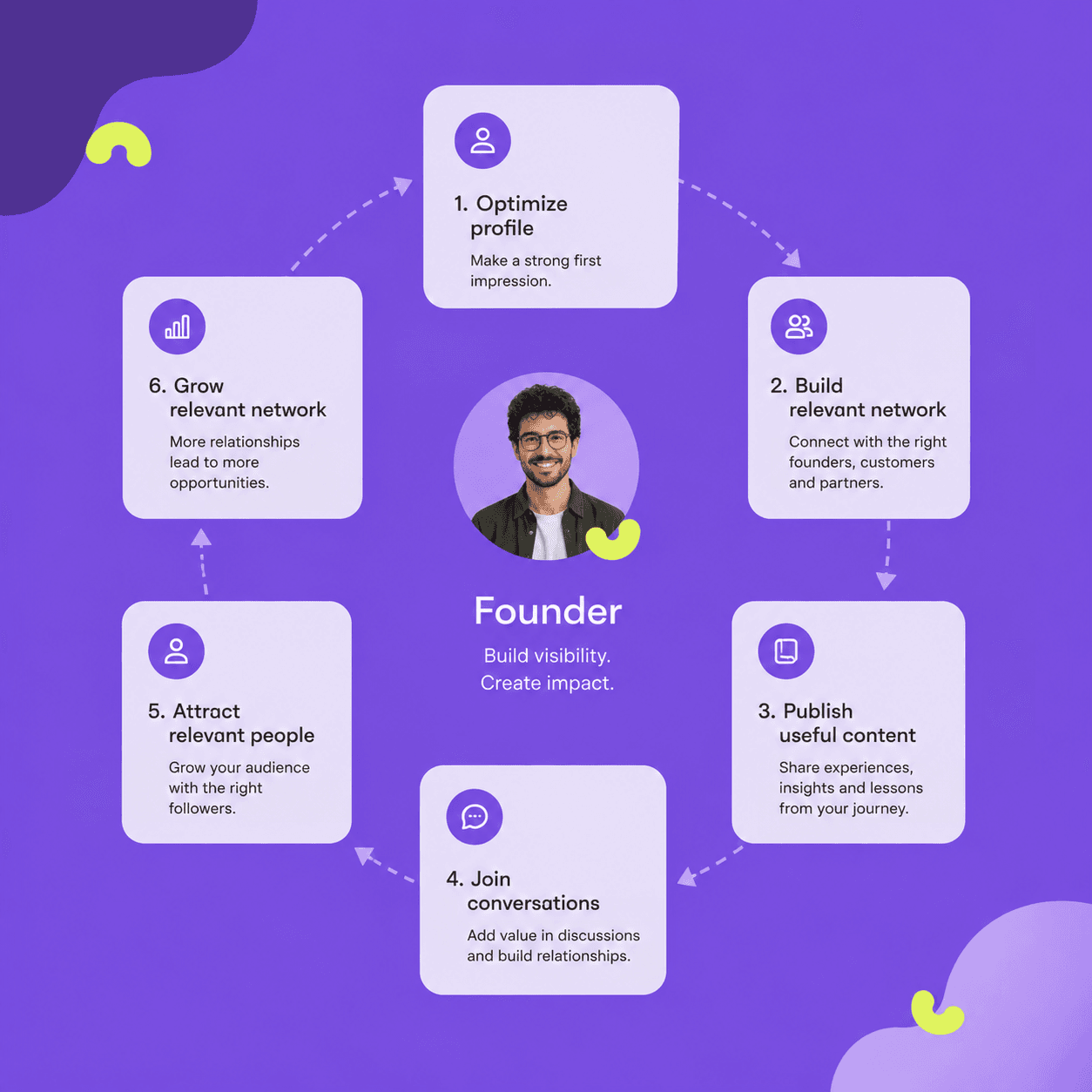
Improving your LinkedIn presence does not require turning yourself into a full-time creator. It requires making the different parts of your activity reinforce one another.
Start by optimizing your profile so that someone who discovers you can quickly understand who you are, what you are building, and why your work might matter to them. Use a clear headline, relevant keywords, a focused About section, useful experience descriptions, and carefully curated Featured content.
Then build a network around the people you genuinely want to know. For B2B and SaaS founders, that may include potential clients, other founders, industry experts, collaborators, investors, and people working on adjacent products.
Publish content drawn from the experience of actually building your company. Share experiments, customer insights, mistakes, decisions, case studies, and observations instead of competing with thousands of accounts publishing the same generic business advice.
Participate in other people's conversations, too. Thoughtful comments can build visibility before your own audience is large and create natural paths toward valuable connections.
Finally, measure whether the system is producing the result you actually want. Profile views, appearances, search appearances, and impressions are useful indicators, but they are intermediate metrics. Stronger signals include relevant connections, conversations, opportunities, and the growing number of people in your industry who know what you do.
You do not need everyone on LinkedIn to recognize your name.
You need the right people to encounter you often enough, understand what you stand for, and remember you when the right conversation or opportunity appears.