Scaling a SaaS company means increasing revenue much faster than operating costs. The most successful SaaS businesses achieve this by reaching product-market fit, building scalable systems, improving customer retention, optimizing customer acquisition, and making data-driven decisions. In this guide, you'll learn the 12 proven strategies that help SaaS companies grow sustainably, avoid common scaling mistakes, and build a business that can support long-term growth.
Whether you're a SaaS founder preparing for your next growth stage or already generating recurring revenue, scaling requires more than simply acquiring new customers. Every new customer puts additional pressure on your product, infrastructure, onboarding, customer support, and internal processes. Without a solid foundation, rapid growth often creates more problems than opportunities.
What does it mean to scale a SaaS business?
Many founders use the terms "growth" and "scaling" interchangeably, but they describe different stages of building a business.
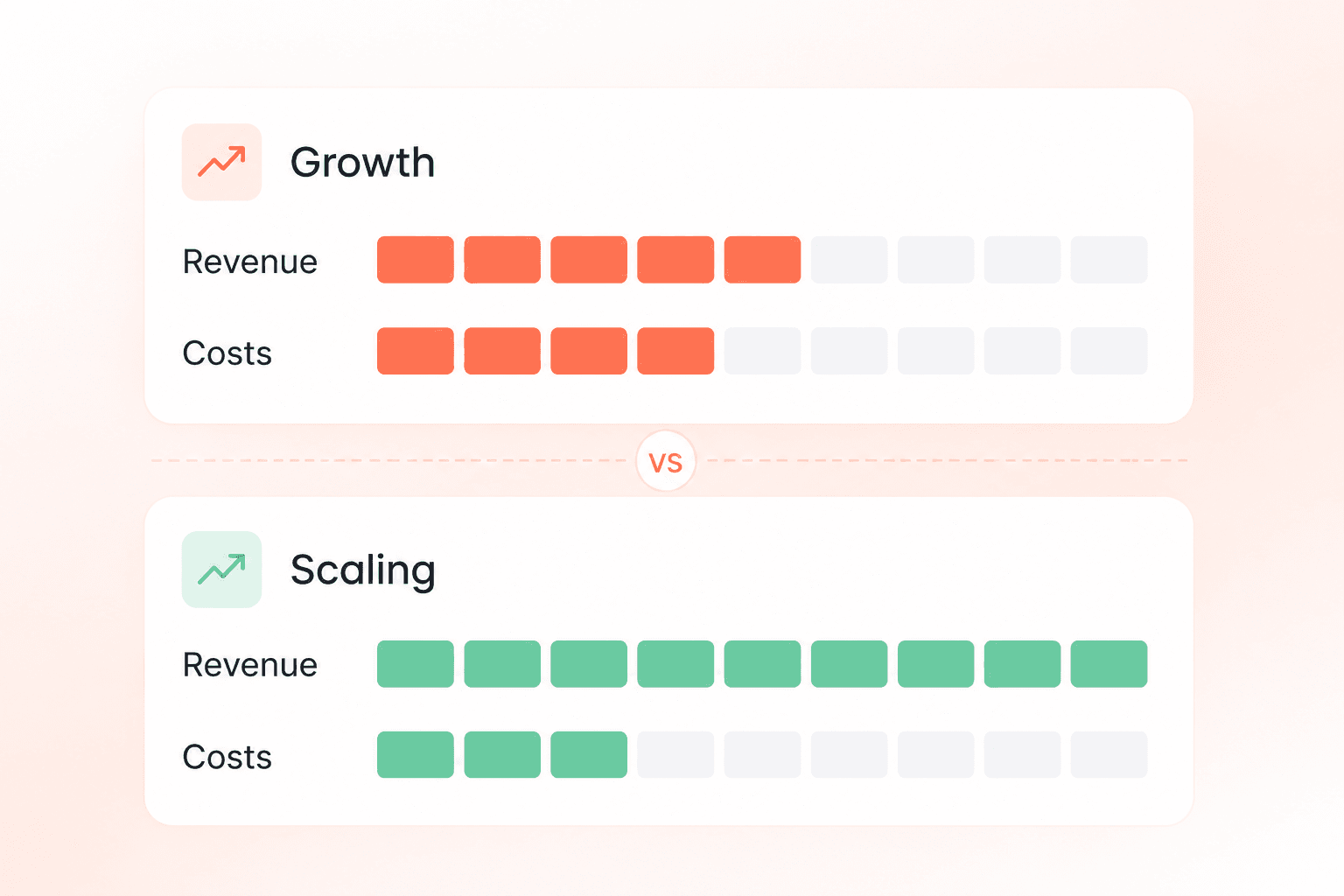
Growing a SaaS business simply means increasing revenue, customers, or team size. Scaling a SaaS business means achieving that growth while keeping costs under control and improving operational efficiency. Ideally, revenue grows significantly faster than expenses, allowing profit margins to improve over time.
For example, imagine two SaaS companies that both double their annual recurring revenue from $1 million to $2 million.
Company
Revenue Growth
Cost Growth
Result
Company A
+100%
+95%
Growth with limited operating leverage
Company B
+100%
+35%
Scalable growth with improving profitability
Both companies are growing, but only the second one is truly scaling.
This distinction matters because every successful SaaS company eventually reaches a point where hiring more people and spending more on marketing produces diminishing returns. Sustainable SaaS growth comes from building systems that continue generating value without requiring costs to increase at the same pace.
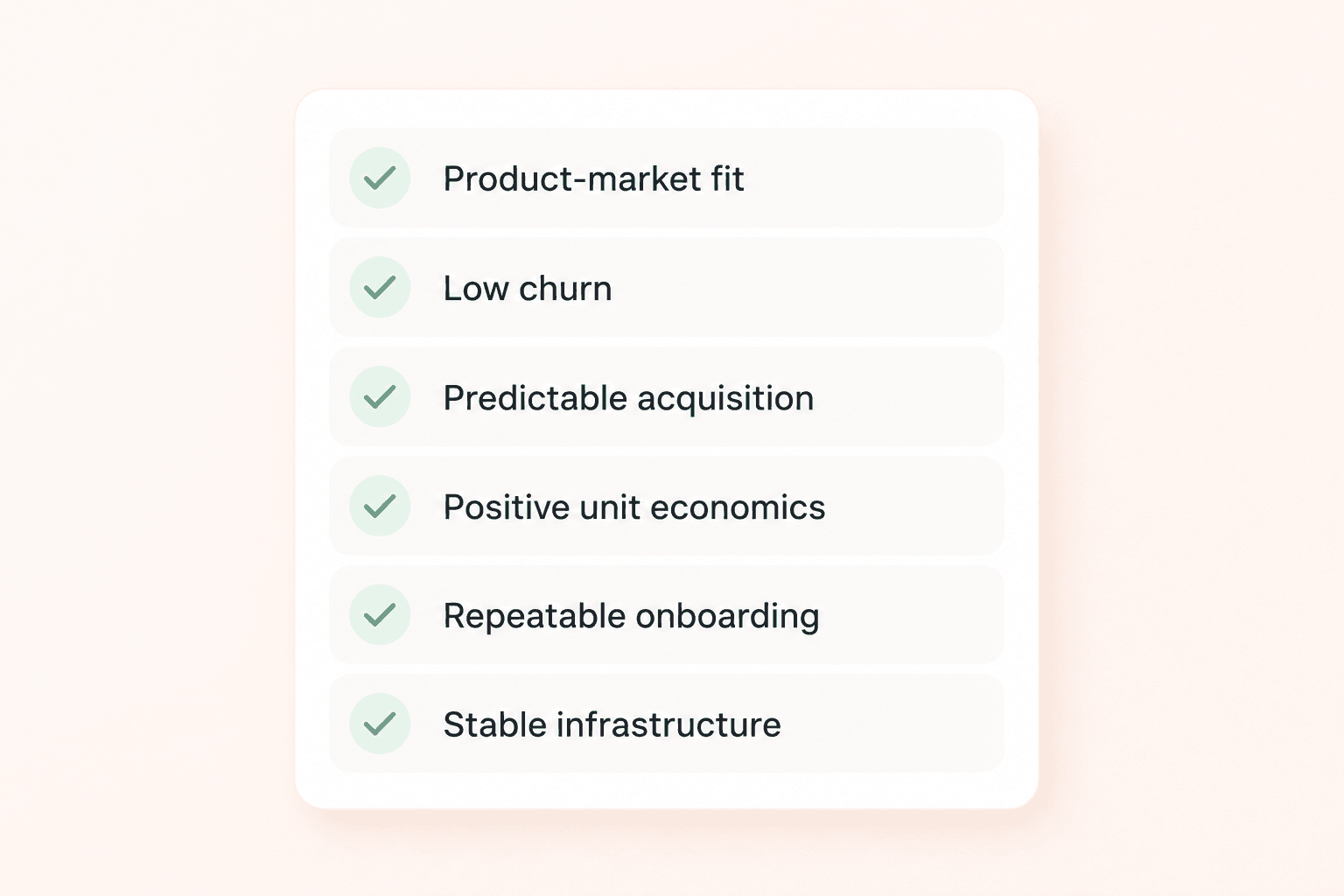
Scalable SaaS companies typically share several characteristics:
Strong product-market fit.
High customer retention.
Predictable customer acquisition.
Repeatable sales and marketing processes.
Reliable onboarding and customer success.
Automated workflows wherever possible.
Data-driven decision-making.
These qualities allow companies to scale efficiently instead of constantly reacting to operational bottlenecks.
SaaS scaling vs. SaaS growth: What's the difference?
The easiest way to understand SaaS scaling is to compare it directly with traditional business growth.
SaaS growth
SaaS scaling
Focuses primarily on increasing revenue
Focuses on increasing revenue while improving efficiency
Costs often rise proportionally with revenue
Revenue grows faster than operating costs
Hiring solves many problems
Systems and automation solve many problems
Processes are still evolving
Processes become standardized and repeatable
Teams spend more time operating
Teams spend more time optimizing
This is why many growing SaaS companies struggle to scale. Revenue continues increasing, but complexity grows even faster. More customers generate more support tickets, more infrastructure costs, more manual work, and more coordination between teams.
Successful SaaS companies recognize these bottlenecks early. Instead of continually adding headcount, they optimize their SaaS platform, improve internal workflows, automate repetitive tasks, and invest in systems that support future business growth.
Scaling is not about growing faster at any cost. It is about building a company that becomes stronger as it grows.
How to know when your SaaS startup is ready to scale
One of the biggest mistakes SaaS founders make is trying to scale before the business is actually ready. Investing heavily in marketing or hiring a larger sales team rarely fixes problems with the product itself. Instead, it usually accelerates existing weaknesses.
Although every SaaS startup is different, several signals indicate that you're ready to scale your SaaS business.
Sign
Why it matters
Strong product-market fit
Customers consistently receive value and recommend the product.
Low and stable churn
Existing customers continue paying instead of leaving after a few months.
Predictable customer acquisition
You understand which acquisition channels generate profitable customers.
New customers consistently reach their first success without excessive manual effort.
Stable infrastructure
Your SaaS platform can support growing usage without performance issues.
These indicators reduce risk because they show that growth is likely to compound rather than expose weaknesses.
A useful way to think about scaling is that it amplifies whatever already exists. If your onboarding experience is excellent, scaling brings more satisfied customers. If your churn is high, scaling simply means losing more customers every month. If your customer success process depends entirely on manual work, acquiring twice as many customers may require twice as many employees.
Before focusing on growth strategies, ask yourself a simple question:
If we doubled our customers over the next six months, would our product, team, and processes become stronger or begin to break?
The answer often reveals whether your SaaS business is truly ready to scale or whether your next priority should be strengthening the foundation first.
12 proven strategies for scaling your SaaS business
1. Achieve product-market fit before you scale SaaS
Every successful SaaS company reaches a point where growth starts to accelerate. The temptation is to invest heavily in marketing, hire a larger sales team, or expand into new markets as quickly as possible. However, none of those investments matter if customers don't consistently receive enough value to stay.
Product-market fit is the foundation of SaaS scaling. It means you've built a product that solves a meaningful problem for a clearly defined audience, and customers are willing to pay for it over time. Without product-market fit, every dollar spent on customer acquisition becomes increasingly expensive because new users leave almost as quickly as they arrive.
The term "product-market fit" was popularized by Marc Andreessen, who described it as the point where a product satisfies a strong market demand.
While there is no universal formula for measuring product-market fit, most successful SaaS businesses share several characteristics:
Low and stable churn.
Strong product adoption.
Positive customer feedback.
Growing referrals and word of mouth.
Increasing recurring revenue without relying entirely on paid advertising.
Many founders focus primarily on acquiring new customers, but retention often provides a much stronger signal. If existing customers continue paying month after month, your marketing efforts become significantly more effective because you're building on a stable foundation instead of constantly replacing lost users.
2. Build a scalable SaaS product and architecture
As your customer base grows, your SaaS platform must handle increasing demand without sacrificing performance or reliability. Infrastructure problems rarely appear overnight. They usually emerge gradually as usage grows, making them easy to overlook until they become expensive to fix.
Building a scalable SaaS product means designing systems that can support thousands or even millions of users without requiring constant architectural changes. This includes both technical scalability and operational scalability.
Operational scalability is equally important. Manual deployments, undocumented processes, and inconsistent development workflows may work for a small SaaS startup, but they quickly become bottlenecks as the engineering team grows.
Scalable SaaS companies invest early in automation, documentation, testing, and deployment pipelines because these improvements reduce technical debt and make future growth significantly easier.
3. Improve retention and reduce churn
Acquiring customers is expensive. Keeping existing customers is usually far more profitable.
One of the biggest differences between growing SaaS companies and those that scale successfully is their focus on retention. Businesses with low churn can continue increasing recurring revenue even if customer acquisition temporarily slows down. Companies with high churn must constantly replace lost customers just to maintain the same revenue.
Retention is influenced by many factors, including:
Product quality.
Customer onboarding.
Customer success.
Customer support.
Pricing.
User experience.
Rather than treating churn as a single metric, break it down by customer segment. Enterprise customers, small businesses, and individual users often leave for completely different reasons.
For example:
Type of churn
Common cause
Possible solution
Early churn
Poor onboarding
Simplify setup and improve product education
Value churn
Customers don't see ongoing value
Increase engagement through new features and customer success
Pricing churn
Product becomes too expensive
Review SaaS pricing or introduce additional plans
Competitive churn
Customers switch products
Improve positioning and strengthen differentiation
Reducing churn by only a few percentage points can dramatically increase customer lifetime value and improve long-term business growth.
4. Optimize your SaaS customer acquisition channels
Scaling customer acquisition doesn't necessarily mean spending more money. It means finding repeatable channels that consistently bring profitable customers.
Many SaaS founders rely too heavily on a single acquisition source. When that channel becomes more competitive or more expensive, growth slows immediately. Diversifying acquisition channels reduces risk and creates more predictable growth.
Common customer acquisition channels include:
Channel
Best suited for
SEO
Long-term organic growth
Content marketing
Building authority and product discovery
Paid advertising
Faster customer acquisition with measurable ROI
Product-led growth
Self-service adoption and viral expansion
Partnerships
Accessing complementary audiences
Referral programs
Leveraging existing satisfied customers
Instead of asking which channel generates the most traffic, ask which one produces customers with the highest lifetime value and lowest acquisition cost.
The most scalable acquisition channels are rarely the ones with the highest visitor numbers. They're the ones that consistently attract customers who stay.
5. Increase customer lifetime value with better SaaS pricing
Customer lifetime value is one of the most important metrics for scaling a SaaS business. Increasing LTV allows you to invest more aggressively in customer acquisition while maintaining healthy profit margins.
Many SaaS founders underestimate how much pricing influences growth. Small pricing improvements often generate larger revenue gains than acquiring hundreds of additional customers.
Several approaches can increase lifetime value:
Introduce usage-based pricing.
Offer annual billing with discounts.
Expand premium features.
Create higher-value plans for larger customers.
Increase expansion revenue through add-ons.
Pricing should evolve as your product evolves. Customers who receive significantly more value are often willing to pay more, especially if the pricing remains aligned with the outcomes your SaaS product delivers.
Many infrastructure SaaS companies, including Twilio and Snowflake, have successfully adopted usage-based pricing models that scale alongside customer usage.
However, increasing prices without improving customer experience or product value often leads to higher churn. Successful SaaS pricing balances revenue growth with long-term customer retention.
6. Build a repeatable customer acquisition funnel
Early-stage founders often acquire customers through founder-led sales, personal networks, or direct outreach. While these methods can generate initial traction, they rarely scale efficiently.
A repeatable funnel produces consistent results regardless of who operates it. Every stage should be measurable, predictable, and continuously optimized.
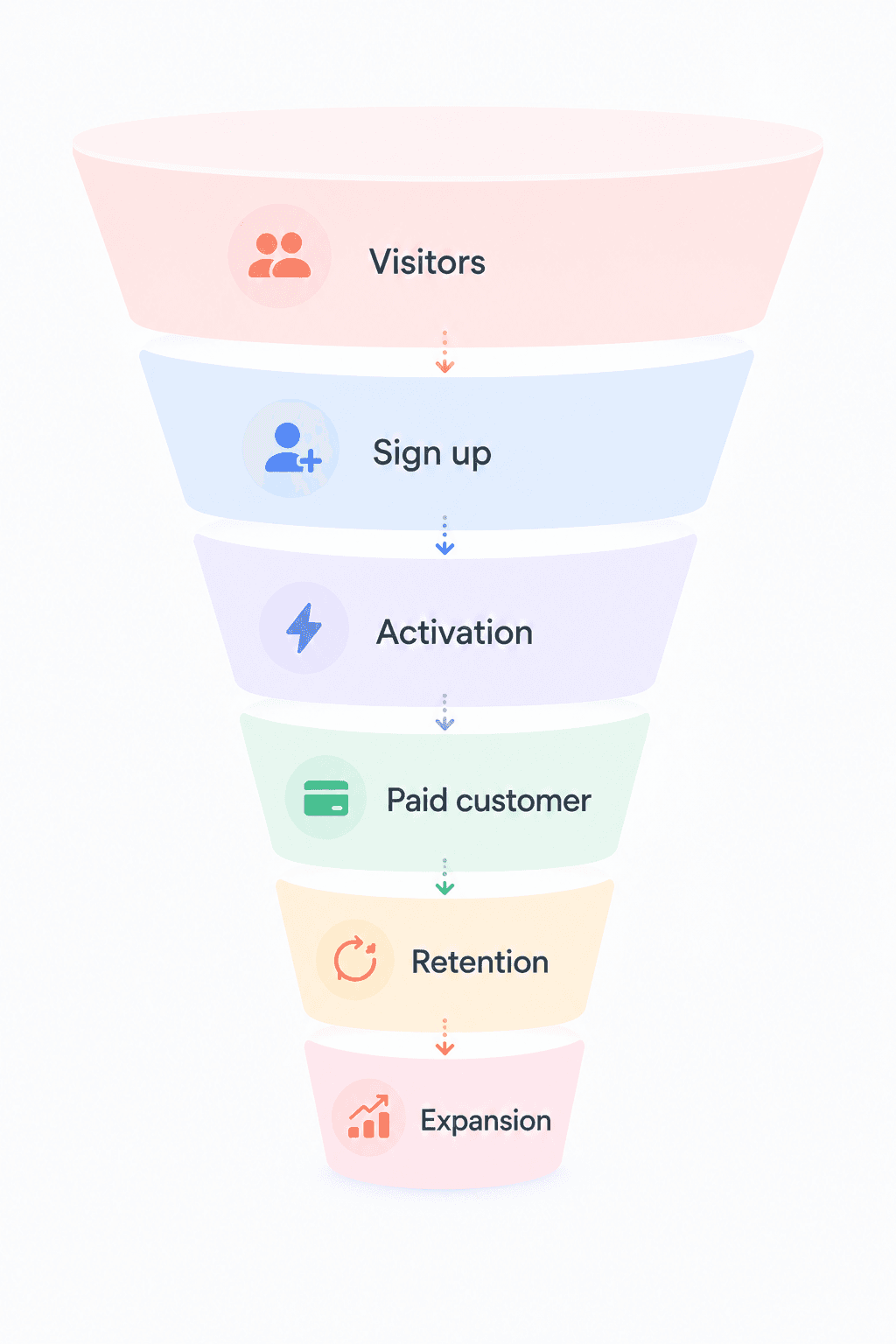
A typical SaaS acquisition funnel includes:
Awareness.
Website visit.
Free trial or demo.
Product onboarding.
Paid conversion.
Expansion.
Referral.
Each stage should have clearly defined conversion rates. If one stage underperforms, optimizing it usually produces a larger impact than increasing traffic at the top of the funnel.
For example, improving trial-to-paid conversion from 20% to 30% often generates more revenue than increasing website traffic by 50%.
The goal isn't simply to build a larger funnel. It's to build one that consistently converts qualified prospects into satisfied, long-term customers.
7. Automate processes to scale efficiently
As a SaaS business grows, manual work quickly becomes one of the biggest obstacles to scaling. Tasks that once took only a few hours each week can eventually consume entire teams. Customer onboarding, billing, reporting, support requests, and internal approvals all become increasingly difficult to manage without automation.
Automation doesn't eliminate the need for people. Instead, it allows your team to focus on work that creates the most value, such as improving the product, helping customers succeed, and developing new growth strategies.
Areas that are commonly automated include:
Customer onboarding emails.
Billing and subscription management.
CRM workflows.
Customer support routing.
Product usage notifications.
Internal reporting and dashboards.
CRM automation is commonly implemented using platforms like HubSpot or Salesforce.
The objective isn't to automate everything. It's to identify repetitive tasks that slow down your team and replace them with reliable systems that can handle increasing volume as your SaaS companies continue to grow.
8. Scale your SaaS team without losing efficiency
Hiring more people doesn't automatically make a company more productive. In fact, communication overhead often grows faster than the team itself.
Many SaaS founders experience a period where every new hire seems to reduce efficiency instead of increasing it. Meetings become longer, decisions take more time, and responsibilities become less clear.
Successful SaaS companies usually follow three principles when expanding their teams:
Hire only after improving processes.
Clearly define ownership and responsibilities.
Document workflows before they become tribal knowledge.
Instead of asking, "Who should we hire next?", a better question is, "What process keeps breaking as we grow?"
If the answer is a process problem rather than a people problem, improving the system may have a much greater impact than hiring another employee.
As your company grows, different roles become important at different stages.
Stage
Typical hiring priorities
Early stage
Engineers, product, customer support
Growth stage
Marketing, customer success, sales
Scale stage
Operations, finance, leadership, data
The right hiring sequence depends on your business model, but the underlying principle remains the same: systems should scale before headcount does.
9. Use product-led growth to scale your SaaS
Many modern SaaS businesses rely on product-led growth rather than traditional sales-led expansion.
In a product-led growth model, the product itself becomes the primary driver of customer acquisition, activation, retention, and expansion. Users experience value before speaking with a salesperson, reducing acquisition costs and improving scalability.
Companies such as Slack, Dropbox, and Zoom have popularized this approach by letting users experience the product before committing to a paid plan.
Examples of product-led growth include:
Free trials.
Freemium plans.
Self-service onboarding.
In-product upgrades.
Referral mechanisms.
Collaboration features that encourage team adoption.
This approach doesn't eliminate the need for sales. Instead, it allows the sales team to focus on larger opportunities while smaller customers adopt the product independently.
Product-led growth works especially well when onboarding is simple, time to value is short, and customers can clearly understand the benefits without extensive guidance.
10. Track the right metrics for sustainable SaaS growth
Scaling decisions should be driven by data rather than intuition.
Many founders focus on vanity metrics such as website traffic or social media engagement. While these numbers may look impressive, they often have little connection to business growth.
Instead, prioritize metrics that directly influence long-term performance.
Net Promoter Score (NPS), developed by Fred Reichheld, remains one of the most widely used indicators of customer loyalty.
No single metric tells the entire story. The strongest businesses monitor several indicators together because improvements in one area often influence others.
For example, improving onboarding can increase product adoption, reduce churn, improve customer satisfaction, and ultimately increase lifetime value.
11. Expand your SaaS business into new markets
Eventually, many SaaS businesses reach the limits of their initial target audience. At that point, sustainable growth often comes from serving new customer segments rather than simply spending more on marketing.
Expansion can take several forms:
New geographic markets.
Additional industries.
Enterprise customers.
Small business customers.
International localization.
New pricing tiers.
However, expanding too early creates unnecessary complexity.
Before entering a new market, make sure your existing business is healthy. Strong retention, predictable customer acquisition, and consistent recurring revenue provide a much better foundation for expansion than rapid but unstable growth.
Successful SaaS companies usually dominate one market before moving to the next.
12. Continuously optimize your SaaS product
Scaling isn't a one-time milestone. It's an ongoing process of continuous improvement.
Customer needs change, competitors introduce new features, and technology evolves quickly. Companies that stop improving eventually stop growing.
Continuous optimization includes:
Collecting customer feedback.
Monitoring product usage.
Improving user experience.
Reducing friction during onboarding.
Simplifying workflows.
Regularly reviewing SaaS pricing and packaging.
The goal isn't to release more features than competitors. It's to consistently improve the value customers receive from your SaaS product.
Small improvements, repeated over months and years, often produce a much larger impact than occasional major product launches.
Common SaaS growth and scaling mistakes
Even companies with strong products can struggle to scale if they make the wrong strategic decisions. Most failures are not caused by a lack of demand, but by trying to grow faster than the business can support.
Some of the most common mistakes include:
Mistake
Why it hurts scaling
Scaling before product-market fit
Marketing amplifies product weaknesses instead of strengths.
Ignoring retention
Acquiring new customers becomes increasingly expensive.
Hiring too early
Costs rise faster than productivity.
Relying on one acquisition channel
Growth becomes vulnerable to market changes.
Measuring vanity metrics
Teams optimize activity instead of outcomes.
Neglecting customer success
Poor onboarding and support increase churn over time.
Avoiding these mistakes doesn't guarantee success, but it significantly improves the odds of building a scalable SaaS business.
How to build a roadmap to scale your SaaS business successfully
Every company follows a different path, but most successful SaaS businesses move through three distinct stages.
Operations, international expansion, recurring revenue, business growth
Rather than trying to solve every problem at once, focus on the challenges that matter most for your current stage. What works for a company with 100 customers is often very different from what works for one with 100,000.
Frequently asked questions about SaaS scaling
How do you scale a SaaS business?
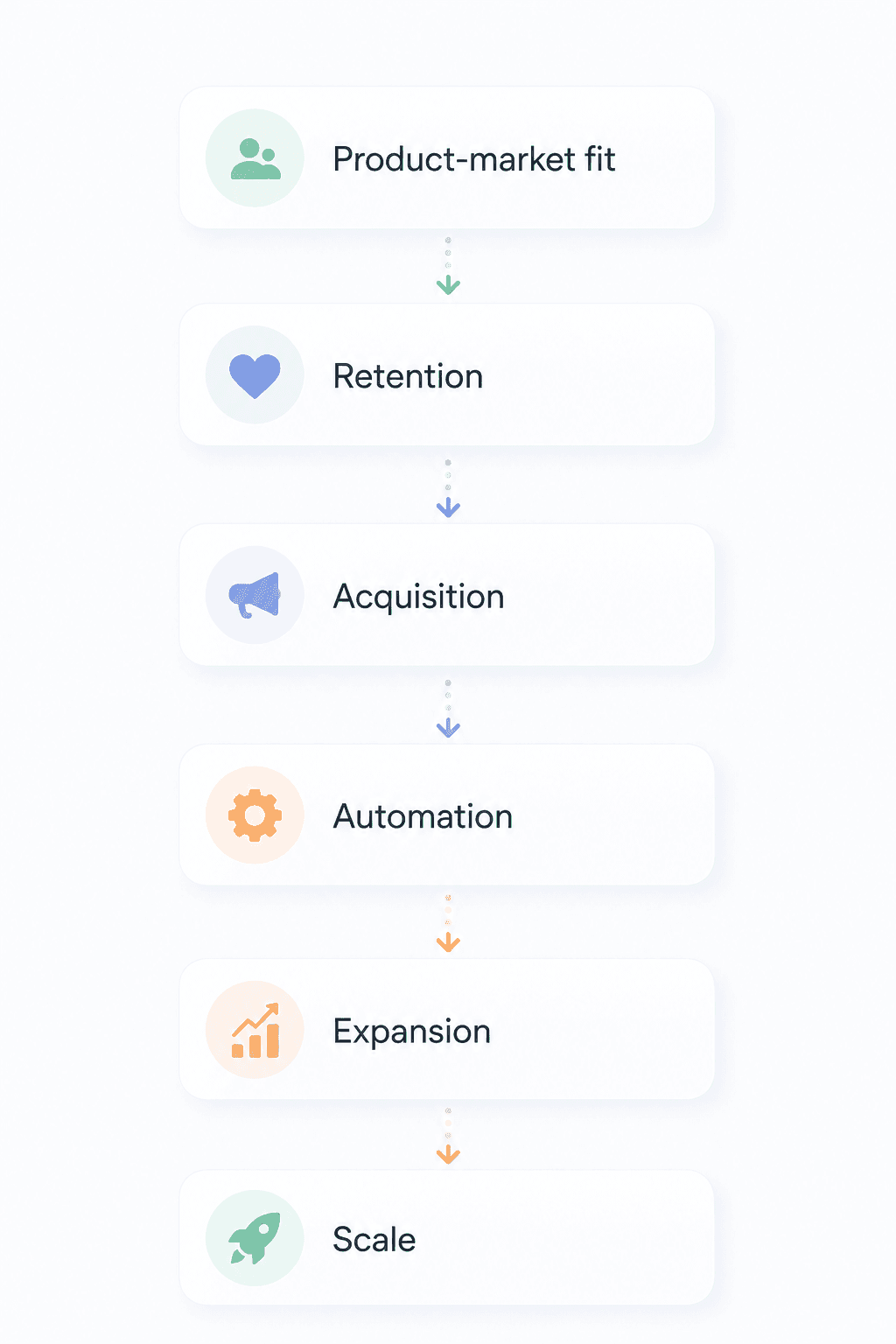
To scale a SaaS business successfully, first achieve product-market fit, then build predictable customer acquisition, improve retention, automate repetitive processes, optimize pricing, and invest in scalable systems. The goal is to increase revenue faster than operating costs while maintaining a high-quality customer experience.
Why do SaaS companies struggle to scale?
Most SaaS companies struggle to scale because they focus on acquiring new customers before solving problems with churn, onboarding, customer success, or operational efficiency. Scaling amplifies both strengths and weaknesses, so unresolved issues become increasingly expensive as the business grows.
What are the best strategies for scaling a SaaS company?
The most effective strategies include strengthening product-market fit, reducing churn, improving customer lifetime value, adopting product-led growth, automating operations, tracking meaningful metrics, and continuously optimizing the product based on customer feedback.
When is a SaaS startup ready to scale?
A SaaS startup is generally ready to scale when it has strong product-market fit, predictable customer acquisition, healthy retention, stable recurring revenue, and operational processes that can support additional growth without significant disruption.
How can you scale up your SaaS without increasing costs too quickly?
Focus on automation, operational efficiency, scalable infrastructure, and improving customer lifetime value. Increasing retention and conversion rates often produces greater business growth than simply increasing marketing spend.
Conclusion
Learning how to scale a SaaS company isn't about finding a single breakthrough strategy. It's about strengthening every part of the business so that growth becomes predictable, repeatable, and sustainable.
The most successful SaaS companies don't scale because they spend the most on marketing or hire the largest teams. They scale because they build products customers genuinely value, create systems that improve efficiency, and continuously optimize every stage of the customer journey.
If you focus on product-market fit, customer retention, scalable operations, and data-driven decision-making, your SaaS business will be in a much stronger position to achieve sustainable growth for years to come.
Subscribe to newsletter that helps SaaS founders get unstuck from mind blocks, blind spots, and skill gaps.
Free newsletter. Unsubscribe anytime.
3,000+
Subscribers
Subscribe to newsletter that helps SaaS founders get unstuck from mind blocks, blind spots, and skill gaps.
Free newsletter. Unsubscribe anytime.
3,000+
Subscribers
Subscribe to newsletter that helps SaaS founders get unstuck from mind blocks, blind spots, and skill gaps.
Free newsletter. Unsubscribe anytime.
3,000+
Subscribers
Subscribe to newsletter that helps SaaS founders get unstuck from mind blocks, blind spots, and skill gaps.