Product
What Is a B2B SaaS Company? Definition & Examples

, Community Leader
31 minutes


A B2B SaaS company develops cloud-based software that other businesses access over the internet, typically through a recurring subscription. Instead of purchasing software once, installing it on company computers, and maintaining it internally, customers pay to use a SaaS product while the provider manages the application, infrastructure, updates, and maintenance.
B2B SaaS has become a common way for companies to buy business software. Customer relationship management, accounting, project management, marketing automation, analytics, communication, and customer support can all be delivered through SaaS applications. Salesforce, for example, helped popularize this model by bringing customer relationship management software to the cloud.
This guide explains what B2B SaaS means, how the model works, the main types of B2B SaaS products, how B2B SaaS differs from B2C SaaS, and how SaaS companies generate and grow recurring revenue.
What is B2B SaaS and how does it work?
B2B SaaS stands for business-to-business software as a service. It describes software companies that provide applications to other businesses through the cloud rather than primarily selling software to individual consumers.
A typical B2B SaaS customer creates an account, selects a plan, and accesses the software through a web browser, desktop application, or mobile app. The SaaS provider operates the underlying infrastructure and generally handles hosting, security updates, product improvements, backups, and other technical requirements.
This approach changes both how software is distributed and how customers pay for it. Traditional business software often required an upfront license, installation, and internal IT resources. Cloud-based software can usually be deployed much faster and paid for monthly, annually, or according to usage.
B2B SaaS definition
A simple B2B SaaS definition is:
B2B SaaS is cloud-based software provided by one business to other businesses, usually through a subscription or usage-based pricing model.
The term combines two concepts. “B2B” identifies the target customer as a business, while “SaaS” describes how the software is delivered. A company can therefore sell B2B software without necessarily following a SaaS model, just as a SaaS company can sell primarily to consumers rather than businesses.
For example, a cloud-based accounting tool designed for small businesses can be a B2B SaaS product. A downloadable accounting program sold under a perpetual license is still B2B software, but it does not follow the typical software-as-a-service model.
How B2B SaaS works

In a traditional software model, a company might purchase licenses and install an application on its own computers or servers. With SaaS, much of that technical responsibility moves to the software provider.
The basic B2B SaaS model generally works like this:
The SaaS company develops and hosts the software.
Business customers access the SaaS platform through the internet.
Customers pay a recurring subscription or are charged according to usage.
The provider maintains the infrastructure and releases updates centrally.
Customers continue paying for as long as they need access to the product.
Because one cloud-based SaaS application can serve many customers, providers can distribute new features and fixes without requiring every customer to install a new version. This also makes it easier for a SaaS business to serve customers in different locations without maintaining separate physical distribution channels.
The model does not mean that every customer receives exactly the same experience. B2B SaaS solutions can include different pricing tiers, user permissions, integrations, storage limits, usage allowances, and enterprise features while still operating on shared cloud infrastructure.
What makes a SaaS company B2B?
The defining characteristic is the customer. A B2B SaaS company builds its SaaS software primarily to solve problems for organizations, teams, professionals, or specific business departments.
Those problems can be relatively simple, such as scheduling meetings, or deeply integrated into business operations, such as managing sales pipelines, payroll, cybersecurity, or financial reporting. As a result, B2B SaaS products often include features that consumer applications may not need, including team permissions, administrative controls, integrations, reporting, security features, and centralized billing.
The distinction can sometimes become blurred. The same SaaS product may offer a free plan for individuals while generating most of its revenue from teams and enterprise companies. In that case, its business model, product development, and go-to-market strategy may still be primarily B2B.
Types of B2B SaaS products and solutions
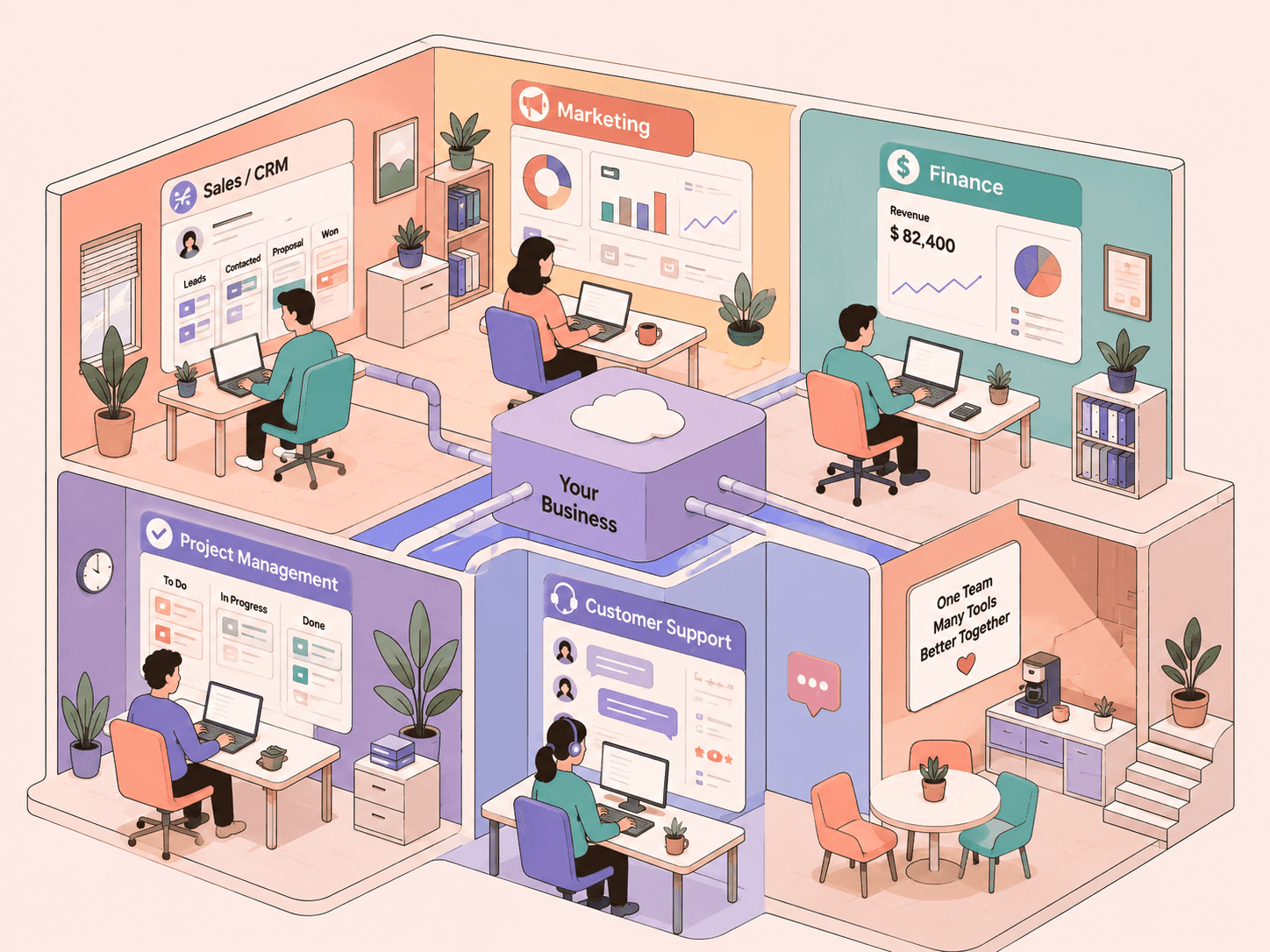
There is no single type of B2B SaaS product. SaaS solutions now cover most major business functions, from acquiring customers and coordinating projects to managing employees and processing payments.
One useful distinction is between horizontal and vertical SaaS. Horizontal SaaS products solve a common problem across many industries, while vertical SaaS is designed around the requirements and workflows of a particular industry.
Type of B2B SaaS | What it does | Typical users |
|---|---|---|
CRM and sales software | Manages leads, deals, and customer relationships | Sales teams |
Marketing software | Supports campaigns, email, SEO, analytics, and automation | Marketing teams |
Project management software | Organizes tasks, projects, deadlines, and workflows | Teams across departments |
Accounting and finance software | Handles invoicing, expenses, accounting, and reporting | Finance teams and SMBs |
Customer support software | Manages tickets, conversations, and service workflows | Support and success teams |
Vertical SaaS | Solves industry-specific operational problems | Businesses in a particular industry |
These categories frequently overlap. A modern B2B SaaS solution may begin with one core function and gradually expand into adjacent workflows as customers adopt more of the platform.
CRM and sales B2B SaaS products
Customer relationship management is one of the best-known categories in the B2B SaaS market. CRM software helps companies organize information about prospects and customers, track interactions, manage sales pipelines, and forecast revenue.
Salesforce is a prominent example. Its cloud-based approach demonstrated that complex business applications could be delivered as an online service rather than installed and maintained on customers' own infrastructure.
Modern sales SaaS applications extend well beyond traditional CRM. They can include lead generation, sales intelligence, call recording, email automation, proposal management, and revenue analytics. This has created a large ecosystem of B2B software applications that either compete with major CRM platforms or integrate with them.
Marketing SaaS solutions
Marketing is another large segment of the SaaS industry because many marketing activities are digital, measurable, and repeatable. SaaS tools can help companies manage email campaigns, publish content, analyze website traffic, optimize search performance, automate workflows, and measure conversions.
For smaller businesses, a single SaaS solution may cover several of these functions. Larger organizations tend to use multiple specialized tools connected through integrations, creating a broader marketing technology stack.
This category also illustrates why integrations matter in B2B SaaS. A marketing SaaS platform becomes considerably more useful when data can move between the company's CRM, analytics software, advertising platforms, and other business systems.
Project management and collaboration SaaS applications
Project management and collaboration tools help teams coordinate work without relying on spreadsheets, email threads, and locally stored documents. Typical features include task management, deadlines, shared workspaces, comments, file sharing, workflow automation, and reporting.
These SaaS applications are examples of horizontal SaaS because the underlying need exists across many industries. A software company, marketing agency, construction business, and nonprofit organization may all need project management software even though their actual workflows differ substantially.
Cloud-based software is particularly well suited to collaboration because multiple people can access the same information from different locations. Changes can be synchronized centrally rather than distributed through separate document versions or local installations.
Accounting and finance SaaS software
Finance-focused B2B SaaS solutions can handle invoicing, bookkeeping, expense management, payments, payroll, budgeting, and financial reporting. For smaller companies, SaaS software can reduce the amount of infrastructure needed to maintain financial systems internally.
These products often become deeply embedded in a customer's operations. Once financial data, integrations, workflows, and historical records accumulate inside a platform, switching to another SaaS provider can require considerably more effort than simply creating a new account elsewhere.
That makes trust especially important in this part of the B2B SaaS industry. Reliability, data security, integrations, compliance requirements, and customer support may influence purchasing decisions as much as individual product features.
Customer support SaaS platforms
Customer support SaaS platforms give businesses a centralized place to manage customer conversations across channels such as email, chat, help centers, and messaging. More advanced products may add automation, AI assistance, customer data, reporting, and integrations with CRM or product analytics tools.
The value of these platforms tends to increase as a company grows. A small business might initially manage customer questions through a shared inbox, but that approach becomes difficult when support volume increases, and multiple employees need to coordinate responses.
This progression is common across the B2B SaaS space. Many SaaS products replace a manual process that initially works well enough but becomes increasingly difficult to manage as the customer grows.
B2B SaaS vs B2C SaaS
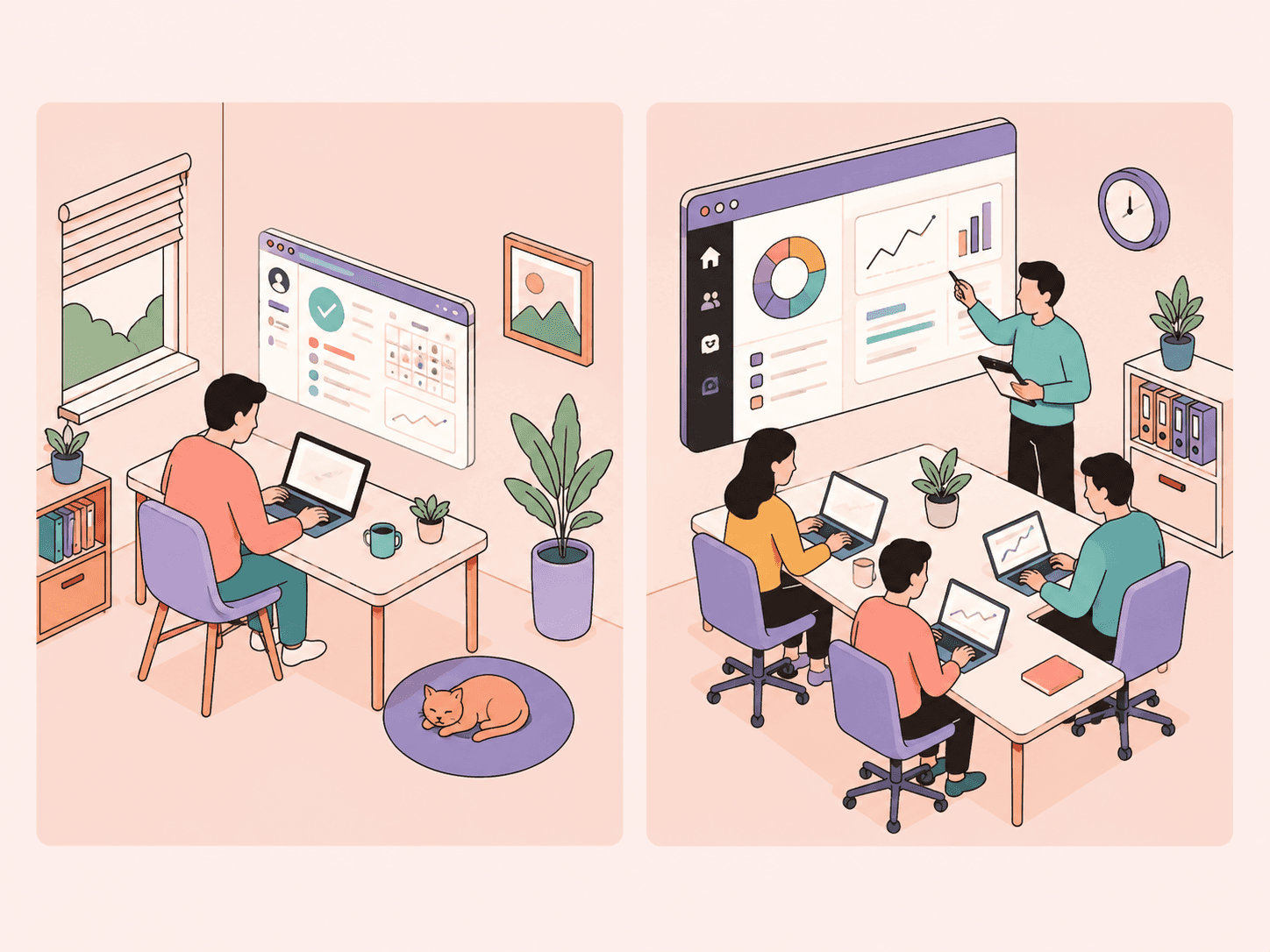
B2B SaaS and B2C SaaS use the same basic software delivery model, but they serve different customers. B2B SaaS companies sell primarily to organizations and professional teams, while B2C SaaS companies provide software primarily to individual consumers.
That difference affects product design, pricing, marketing, sales, and customer relationships.
Factor | B2B SaaS | B2C SaaS |
|---|---|---|
Primary customer | Businesses and teams | Individual consumers |
Buying decision | Often involves multiple stakeholders | Usually made by one person |
Pricing | Often higher and more complex | Usually lower and standardized |
Sales cycle | Can take weeks or months | Often immediate or short |
Product requirements | Permissions, integrations, security, reporting | Usually focused on individual use |
Customer relationship | Often includes onboarding and ongoing support | More frequently self-service |
The boundary is not always absolute. Some software companies serve both individuals and organizations, using self-service plans for consumers or small teams alongside larger B2B offerings.
B2B SaaS customers vs B2C SaaS customers
A consumer generally decides whether a SaaS product solves their own problem and whether the price is worthwhile. In B2B, the person using the software may not be the person who chooses or pays for it.
A B2B SaaS customer can therefore involve several stakeholders. Employees may evaluate usability, managers may care about productivity and reporting, IT teams may evaluate security and integrations, while executives or procurement teams may approve the final purchase.
This difference becomes more pronounced as SaaS companies move upmarket. Selling a $20-per-month SaaS tool to a small business can resemble a consumer purchase, while selling a six-figure software contract to a large organization may involve demonstrations, security reviews, negotiations, procurement, and legal approval.
How sales and marketing differ
Many B2C SaaS products depend heavily on high-volume acquisition channels and self-service conversion. A customer might see an advertisement or search result, visit the website, start a trial, and subscribe without ever interacting with a salesperson.
B2B SaaS companies can use the same approach, particularly when targeting small businesses. However, more expensive or complex B2B SaaS products often combine content marketing, search, outbound prospecting, product demonstrations, partnerships, account-based marketing, and dedicated sales teams.
The economics also differ. A SaaS company can justify spending considerably more to acquire a customer worth thousands of dollars per year than a consumer paying a few dollars per month. This relationship between acquisition costs and customer value becomes one of the central considerations when scaling a B2B SaaS business.
How SaaS pricing models differ
B2C SaaS pricing is often relatively simple, with a free version or trial followed by one or several fixed subscription plans. B2B SaaS pricing models can be more varied because businesses differ substantially in size, usage, and requirements.
Common approaches include per-user pricing, feature-based tiers, usage-based pricing, flat subscriptions, and custom enterprise contracts. Some SaaS providers combine several models, such as charging a base subscription plus additional fees as usage increases.
The pricing structure can also support expansion revenue. If a customer starts with five users and later grows to fifty, the SaaS company's revenue from that account can increase without acquiring a new customer. This ability to grow revenue within existing accounts is one of the characteristics that makes the B2B SaaS model particularly attractive.
How does a B2B SaaS business make money?
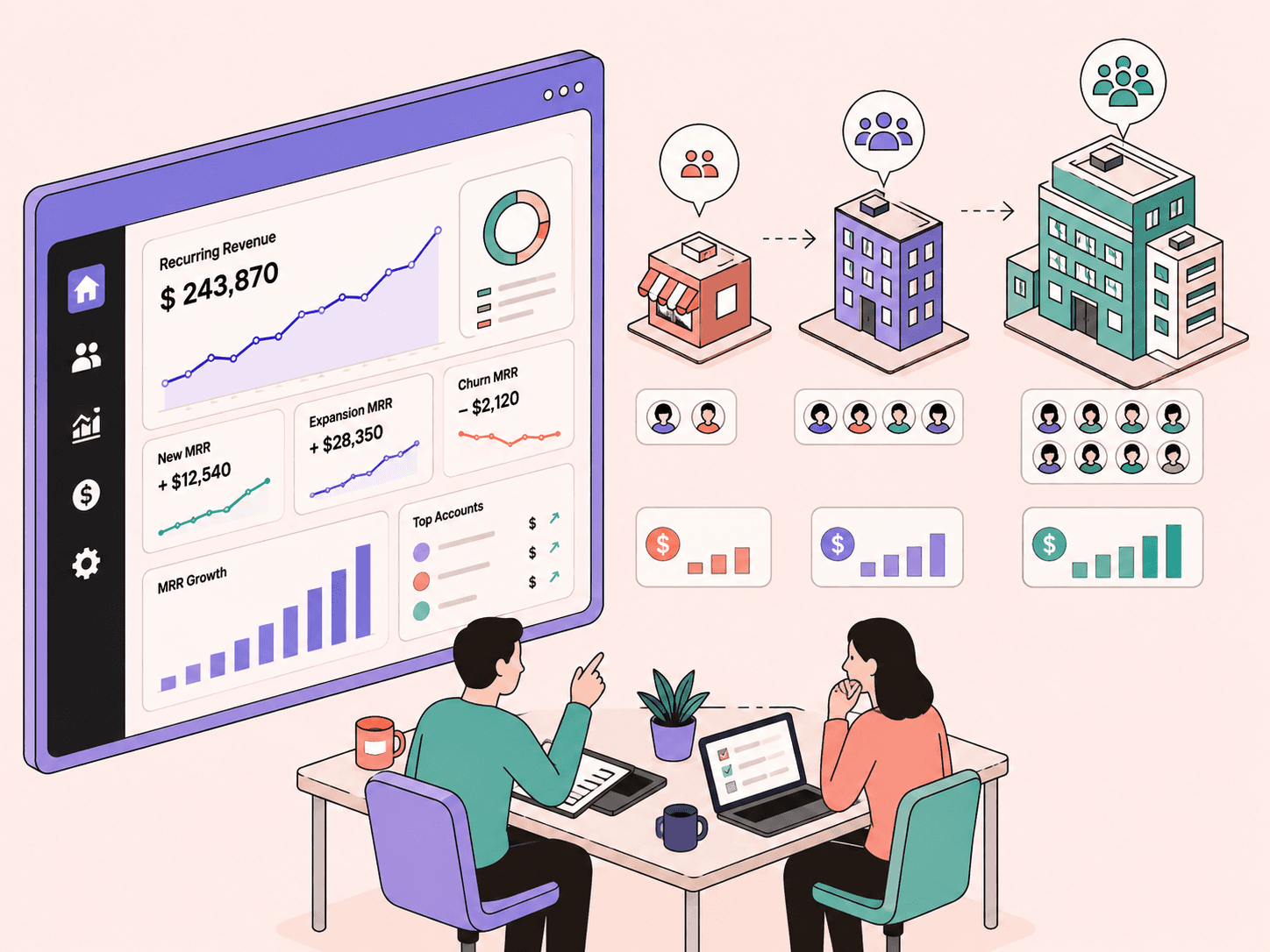
Most B2B SaaS companies generate revenue by charging customers for continued access to their software. Instead of relying primarily on one-time license sales, the SaaS business model creates recurring revenue as long as customers continue using the product.
This model gives SaaS providers greater visibility into future revenue, but recurring revenue should not be confused with guaranteed revenue. Customers can downgrade or cancel, which means retention is just as important as acquiring new customers. Successful B2B SaaS companies therefore focus on bringing customers in, keeping them, and increasing the value customers receive over time.
Subscription-based SaaS pricing models
Subscriptions remain one of the most familiar SaaS pricing models. Customers pay a monthly or annual fee for access to the SaaS platform, with annual subscriptions often offered at a lower effective monthly price.
A SaaS company can structure subscriptions in several ways:
Flat-rate pricing charges the same subscription fee for a defined product.
Per-user pricing increases the price according to the number of users or seats.
Tiered pricing separates features and limits into plans such as Starter, Pro, and Business.
Enterprise pricing uses customized contracts for organizations with more complex requirements.
The appropriate pricing model depends heavily on how customers receive value from the SaaS product. A collaboration tool might naturally charge per user, while an analytics platform might base pricing on data volume or another measure of usage.
Usage-based pricing
Usage-based pricing connects the customer's bill directly to how much of the service they consume. A SaaS provider might charge for API requests, transactions, storage, emails sent, data processed, or another unit related to product usage.
This approach can reduce the initial commitment required from customers because they pay less when their usage is low. It can also create natural expansion revenue when successful customers use more of the B2B SaaS solution.
However, usage-based pricing can make expenses less predictable for customers and revenue less predictable for providers. For this reason, some B2B SaaS companies combine a recurring base subscription with usage charges above specified limits.
Tiered pricing and enterprise plans
Tiered pricing allows SaaS companies to serve customers with different needs without building a separate product for each segment. A small company may need only basic features, while a larger organization may require advanced permissions, integrations, reporting, security controls, and priority support.
Enterprise SaaS often adds another layer. Instead of displaying a fixed price, the SaaS provider may create a custom contract based on company size, usage, required features, service levels, or implementation needs.
Moving toward enterprise companies can increase average contract value significantly, but it also changes how a B2B SaaS company operates. Larger deals frequently require sales representatives, onboarding, security reviews, procurement processes, account management, and more sophisticated customer support.
B2B SaaS revenue and recurring revenue
Recurring revenue is central to how founders and investors evaluate a SaaS business. Two of the most widely used measurements are monthly recurring revenue (MRR) and annual recurring revenue (ARR).
For example, if 200 customers each pay $100 per month, the company generates $20,000 in MRR. If those subscriptions remain active for a full year, that represents $240,000 in annualized recurring revenue.
B2B SaaS revenue can also expand within the existing customer base. Customers may add seats, upgrade plans, increase usage, or purchase additional products. Conversely, cancellations and downgrades reduce recurring revenue. Understanding these movements is essential because two B2B SaaS companies with identical current revenue can have very different growth trajectories depending on retention and expansion.
Examples of B2B SaaS companies
The B2B SaaS market includes software companies serving almost every business function. Some have developed broad SaaS platforms used by large organizations, while others concentrate on a narrow problem for a specific type of customer.
Well-known examples include Salesforce for customer relationship management, HubSpot for marketing and sales, Slack for workplace communication, and Atlassian products such as Jira for project and software development workflows.
These examples show how broad the B2B SaaS definition can be. A SaaS company does not have to sell the same type of software, target the same company size, or use the same go-to-market strategy. What connects these businesses is that they provide cloud-based software services to other organizations.
Popular B2B SaaS companies
Some of the largest B2B SaaS companies have expanded far beyond the original problem they were created to solve. Salesforce began primarily with CRM, for example, but developed into a much broader collection of sales, marketing, service, commerce, analytics, and other business applications.
Other popular B2B SaaS companies have followed a similar path by building additional products around their original offering. This can allow a SaaS provider to increase revenue from existing customers while making its platform more deeply integrated into their operations.
Not every successful SaaS company needs to become a large platform, however. Thousands of smaller SaaS providers build sustainable businesses by solving narrower problems for particular customer segments. A specialized SaaS tool can compete effectively when it solves a specific problem better than a much broader platform.
Examples of B2B SaaS by industry
B2B SaaS solutions can also be categorized according to the markets they serve. Horizontal SaaS products address needs shared across many industries, whereas vertical SaaS focuses on the workflows of a particular sector.
For example, horizontal products can include CRM, payroll, communication, accounting, or project management software. Vertical SaaS products may instead be designed specifically for restaurants, construction companies, medical practices, property managers, law firms, or logistics companies.
Vertical SaaS can offer an advantage when an industry has specialized workflows that general-purpose software handles poorly. Rather than asking customers to adapt a generic SaaS tool to their operations, the software can incorporate industry terminology, processes, integrations, and reporting from the beginning.
Benefits of B2B SaaS
The benefits of B2B SaaS exist on both sides of the transaction. Customers can gain access to sophisticated business software without maintaining all of the infrastructure themselves, while SaaS companies can build recurring relationships with customers instead of repeatedly selling new software licenses.
Cloud delivery also allows B2B SaaS solutions to evolve continuously. New features, fixes, and security updates can be deployed centrally, giving customers access to improvements without purchasing and installing an entirely new software version.
Predictable recurring revenue
Recurring subscriptions make revenue more predictable than a business model based entirely on one-time purchases. If a SaaS company begins a month with thousands of active subscriptions, it already has an existing revenue base before acquiring a single new customer.
This predictability helps with planning hiring, marketing budgets, infrastructure spending, and product investment. It also makes customer retention particularly important. Losing a customer affects not only the current month but potentially many months of future revenue.
The strongest SaaS businesses can also generate expansion revenue from existing customers. When upgrades and additional usage exceed the revenue lost through downgrades and cancellations, revenue from an existing customer cohort can grow even without new customer acquisition.
Scalable SaaS applications
Cloud-based software can often serve additional customers at a lower incremental cost than traditional software distribution. The SaaS company does not need to manufacture physical products or perform a completely new software installation for every account.
That does not mean scaling is free. Infrastructure costs grow, customer support requirements increase, and enterprise customers may require substantial implementation work. Still, the ability to serve many organizations through shared software infrastructure gives SaaS applications attractive scaling characteristics.
The internet also gives SaaS providers access to a global SaaS market. A relatively small software company can potentially serve B2B companies across multiple countries without establishing a physical office in each market, although localization, regulation, payments, and support can complicate international expansion.
Lower software distribution costs
Traditional software distribution once involved physical media, local installation, version management, and significant customer-side infrastructure. Cloud-based SaaS offerings eliminate much of this process by making the application accessible online.
Updates can be deployed centrally rather than distributed individually to every customer. This makes it possible for a SaaS company to improve its product frequently and maintain a more consistent version across its customer base.
Customers benefit as well. They can often start using a new SaaS solution quickly without purchasing servers or managing complex installations, particularly when the product is designed for self-service adoption.
Long-term B2B SaaS customer relationships
A recurring business model changes the relationship between the software company and the customer. Winning the initial sale is valuable only if the customer continues to find the product useful enough to renew the subscription.
This creates a strong incentive for B2B SaaS providers to invest in onboarding, support, education, product improvements, and customer success. In more complex B2B SaaS environments, customer success teams may actively help customers adopt features and achieve the outcomes that motivated the purchase.
Long-term relationships can also generate valuable feedback. Because SaaS companies can observe how their products are used and communicate regularly with customers, they can identify recurring problems and use that information to guide product development.
Key metrics for a B2B SaaS company
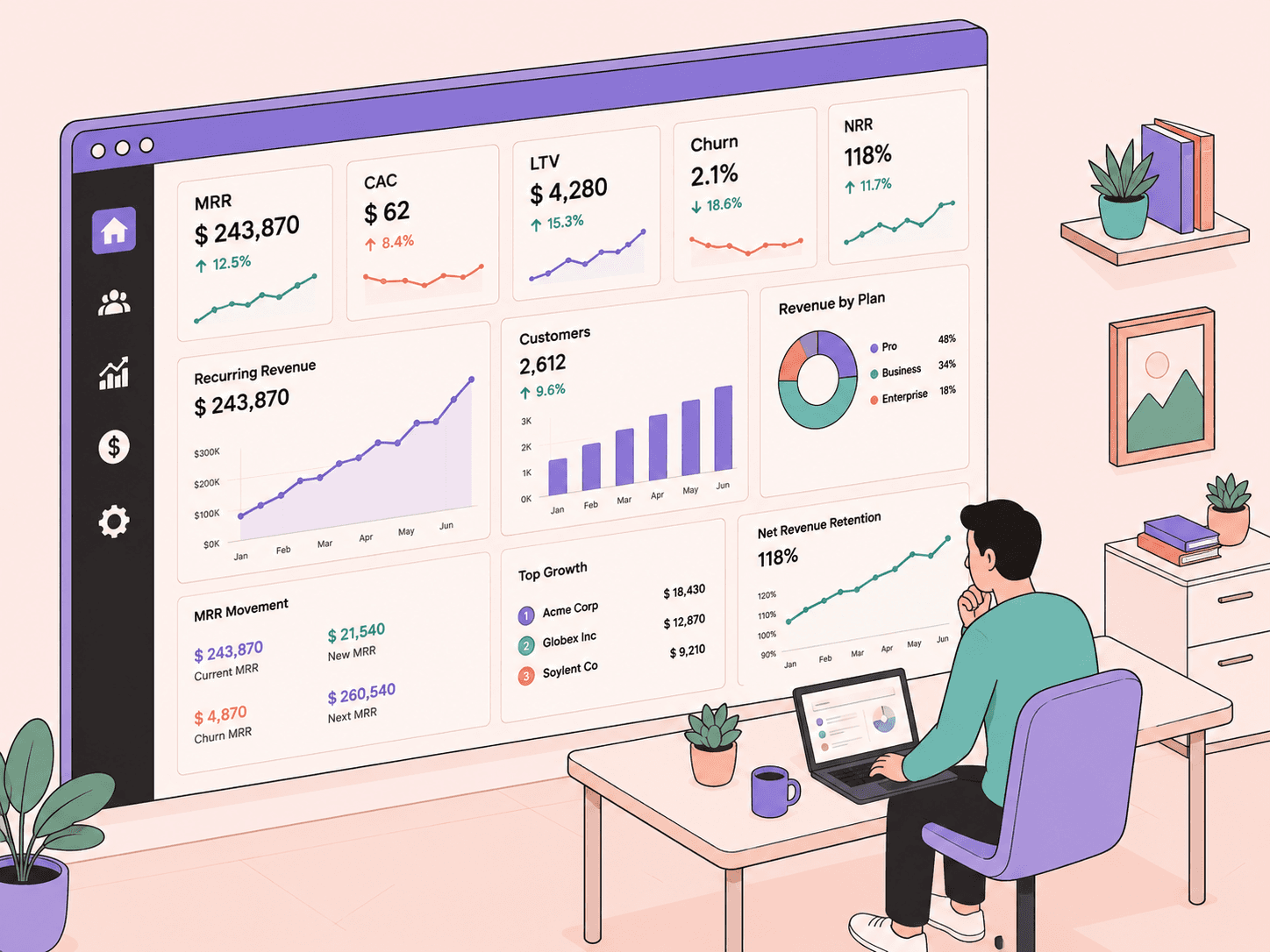
Recurring revenue creates a set of metrics that are especially useful for understanding SaaS performance. Revenue growth alone does not show whether a company is acquiring customers efficiently, retaining them, or building a sustainable business.
Five metrics are particularly important:
Metric | What it measures | Why it matters |
|---|---|---|
MRR | Monthly recurring revenue | Shows the recurring monthly revenue base |
CAC | Customer acquisition cost | Shows how much it costs to acquire a customer |
LTV | Customer lifetime value | Estimates the value generated by a customer over time |
Churn | Customers or revenue lost | Indicates retention problems |
NRR | Revenue retained and expanded from existing customers | Shows whether the existing customer base is growing or shrinking |
These SaaS metrics should be interpreted together. A fast-growing SaaS company with high churn or unsustainable acquisition costs may be in a weaker position than its headline revenue growth initially suggests.
Monthly recurring revenue (MRR)
Monthly recurring revenue represents the predictable subscription revenue a SaaS company expects to generate in a month. It provides a standardized way to track recurring subscriptions even when customers are on different plans or billing schedules.
MRR can be separated into new MRR from newly acquired customers, expansion MRR from existing customers, contraction MRR from downgrades, and churned MRR from cancellations. Looking at these components helps founders understand what is actually driving changes in B2B SaaS revenue.
Annual recurring revenue is closely related and is commonly used for businesses with annual contracts or when discussing larger revenue figures. The appropriate metric depends partly on the company's pricing and contract structure.
Customer acquisition cost (CAC)
Customer acquisition cost measures how much a company spends to acquire new customers. At a basic level, it can be calculated by dividing relevant sales and marketing expenses by the number of new customers acquired during a period.
CAC varies dramatically across the SaaS industry. A self-service SaaS product might acquire customers through organic search or product-led growth at relatively low cost, while an enterprise SaaS company may employ sales representatives and spend months closing a single contract.
A higher CAC is not automatically bad. What matters is whether the revenue and gross profit generated by those customers justify the acquisition expense and how long it takes the SaaS business to recover that investment.
Customer lifetime value (LTV)
Customer lifetime value estimates the economic value an average customer produces over the duration of the relationship. Higher customer retention generally increases LTV because customers continue generating recurring revenue for longer.
SaaS companies often compare LTV with CAC to evaluate whether their customer acquisition strategy makes economic sense. However, LTV is an estimate rather than a fixed number, particularly for young B2B SaaS companies that do not yet have enough historical retention data.
For an early-stage SaaS business, it can therefore be useful to examine the underlying variables rather than relying exclusively on a single LTV calculation. Average revenue per account, gross margin, churn, expansion, and retention patterns provide a more detailed picture.
Churn rate
Churn measures the customers or recurring revenue lost during a given period. Customer churn tracks lost accounts, while revenue churn measures the financial impact of cancellations and downgrades.
Even modest churn can become a serious problem as a B2B SaaS business grows. If a company continually has to replace a meaningful portion of its existing revenue before it can grow, customer acquisition becomes progressively more demanding.
Reducing churn often begins with understanding why customers leave. Poor onboarding, missing features, weak customer support, pricing, product complexity, or simply targeting the wrong customers can all contribute to retention problems.
Net revenue retention (NRR)
Net revenue retention measures what happens to recurring revenue from an existing group of customers after accounting for expansion, contraction, and churn. It excludes revenue from newly acquired customers, making it particularly useful for understanding the health of the existing customer base.
An NRR above 100% means expansion from retained customers is greater than the revenue lost through cancellations and downgrades. In practical terms, the existing customer base is generating more revenue over time even before the SaaS company adds new customers.
This can be especially powerful for B2B SaaS companies that charge per seat or according to usage. As customers grow, add employees, adopt additional products, or use the SaaS platform more heavily, their spending can increase alongside the value they receive.
How B2B SaaS companies acquire customers
Building a useful SaaS product does not automatically create a sustainable business. B2B SaaS companies also need repeatable ways to reach potential customers, demonstrate the value of their software, and convert prospects into paying accounts.
The right acquisition strategy depends on factors such as pricing, target market, product complexity, and customer lifetime value. A $30-per-month SaaS tool may rely heavily on self-service acquisition, while an enterprise SaaS platform worth tens of thousands of dollars per year can support a much more expensive sales process.
Many successful B2B SaaS companies ultimately combine several acquisition channels rather than depending on a single source of customers.
Content and search marketing
Content marketing is particularly well suited to B2B SaaS because potential customers frequently research problems and compare software before making a purchase. A SaaS company can create educational articles, templates, reports, case studies, comparison pages, and other resources that address these searches.
Search traffic can become especially valuable when content targets problems closely connected to the product. Someone searching for information about managing a sales pipeline, for example, may eventually need customer relationship management software.
However, traffic alone is not the objective. A smaller number of visitors with a genuine need for the SaaS solution can be much more valuable than a large audience with little purchase intent. Effective search strategies therefore connect informational content with the problems the product actually solves.
Product-led growth for B2B SaaS products
Product-led growth allows the software itself to play a central role in customer acquisition and conversion. Prospective customers can typically start with a free trial or free plan, experience the SaaS product directly, and upgrade when they need additional functionality.
This approach can reduce dependence on sales teams, particularly for SaaS applications that are easy to understand and adopt. It can also create organic expansion when individual users introduce the product to colleagues and eventually bring an entire team onto the SaaS platform.
Product-led growth is not appropriate for every B2B SaaS model. Complex enterprise software may require implementation, integration, training, or organizational approval before customers can experience meaningful value. Some SaaS companies therefore combine self-service adoption with sales assistance for larger accounts.
Outbound sales
Outbound sales reverses the acquisition process. Instead of waiting for potential customers to discover the company, sales teams identify relevant organizations and contact decision-makers directly through email, LinkedIn, calls, or other channels.
This can work particularly well when the target customer is narrowly defined and individual contracts are valuable enough to justify manual outreach. A vertical SaaS company serving a specific industry, for example, may be able to identify most of its potential customers relatively easily.
Outbound becomes more difficult when targeting a broad market with a low-priced product. The revenue from each account may simply be too small to support a labor-intensive sales process. This is why SaaS pricing, customer acquisition cost, and go-to-market strategy need to fit together.
Partnerships and referrals
Partnerships can give B2B SaaS providers access to customers through businesses that already serve the same audience. These relationships can include affiliate programs, integration partnerships, agencies, consultants, resellers, and other SaaS vendors.
Referrals work differently but benefit from the same underlying advantage: trust. A recommendation from another founder, colleague, consultant, or existing customer can reduce the uncertainty associated with selecting a B2B SaaS solution.
For products with collaborative features, referrals may happen naturally as customers invite other people to use the software. SaaS providers can also encourage referrals more deliberately through partner programs, incentives, and customer advocacy.
Challenges in the B2B SaaS industry
The characteristics that make the SaaS business model attractive also create significant challenges. Recurring revenue is valuable only when customers stay, while relatively low barriers to software distribution make it easier for new competitors to enter the SaaS market.
B2B SaaS companies must therefore balance acquisition, retention, product development, pricing, and differentiation. Growth in one area can create new problems elsewhere, particularly as a SaaS company begins serving larger and more demanding customers.
Customer acquisition costs
Customer acquisition can become expensive when many SaaS companies compete for the same audience. Paid advertising costs can increase, organic search results can become more competitive, and outbound prospects may receive messages from dozens of similar SaaS providers.
The economics become particularly challenging when CAC rises faster than customer value. A company that spends $1,000 to acquire a customer worth only a few hundred dollars in gross profit cannot solve the problem simply by acquiring more customers.
This is one reason B2B SaaS companies experiment with multiple acquisition channels. Organic search, communities, partnerships, referrals, product-led growth, outbound sales, and other channels can create a more diversified acquisition system and reduce dependence on a single source.
Customer churn and retention
Because customers pay repeatedly, retention has a direct effect on the economics of a B2B SaaS business. High churn shortens customer lifetime, reduces LTV, and forces the company to acquire more new customers simply to replace lost revenue.
Retention begins before the customer subscribes. If a SaaS company attracts businesses that are poorly suited to the product, those customers may cancel regardless of how effective the onboarding process is.
After acquisition, activation and ongoing product value become critical. SaaS providers need to help customers reach the outcome that originally motivated them to buy the software. Usage data, customer interviews, cancellation surveys, support conversations, and cohort analysis can all help identify where retention problems originate.
Competition in the B2B SaaS market
Cloud infrastructure and modern development tools have made launching new SaaS applications considerably more accessible. Customers in established categories may therefore have dozens or even hundreds of products to choose from.
Competing exclusively through a longer feature list is difficult because features can often be copied. SaaS companies may instead differentiate through a specific customer segment, workflow, user experience, integrations, distribution channel, pricing approach, brand, or depth of industry knowledge.
Vertical SaaS is one example of this strategy. Rather than competing for every possible business customer, a company can build software around the workflows of one industry and offer a more specialized alternative to horizontal SaaS products.
Moving upmarket
As B2B SaaS companies grow, many begin targeting larger organizations because enterprise customers can generate significantly more revenue per account. A product that originally served small teams may introduce enterprise SaaS plans with advanced security, administration, permissions, integrations, and support.
However, moving upmarket involves more than increasing prices. Enterprise companies may require single sign-on, audit logs, compliance documentation, custom contracts, procurement reviews, service-level agreements, dedicated support, and more sophisticated account management.
Sales cycles also tend to become longer. A founder or small team might select a SaaS tool in a day, while a large company may involve IT, security, legal, finance, procurement, department leaders, and end users in the decision. SaaS companies need to determine whether the higher contract value justifies this additional complexity.
Frequently asked questions about B2B SaaS
What is an example of a B2B SaaS company?
Salesforce is a well-known example of a B2B SaaS company. It provides cloud-based customer relationship management software and related business applications to organizations through recurring subscriptions.
Other examples of B2B SaaS companies include HubSpot, Slack, Atlassian, and many smaller SaaS providers serving specific business functions or industries. The defining characteristic is that the SaaS company primarily provides cloud-based software to other businesses.
What is the difference between SaaS and B2B SaaS?
SaaS, or software as a service, describes a method of delivering software over the internet rather than requiring customers to install and maintain it locally. The term itself does not specify who the customer is.
B2B SaaS is a subset of SaaS in which the customers are businesses. B2C SaaS uses the same general cloud-based delivery model but targets individual consumers. SaaS describes how the software is delivered, while B2B describes who the software is sold to.
Is B2B SaaS the same as enterprise SaaS?
No. B2B SaaS includes software sold to businesses of any size, from small companies to multinational organizations. Enterprise SaaS specifically refers to software designed or sold for the more complex requirements of large organizations.
Enterprise B2B SaaS products typically require stronger administrative controls, security features, compliance capabilities, integrations, and support. They may also use custom pricing and sales-assisted purchasing rather than the self-service model common among smaller SaaS products.
What industries use B2B SaaS?
B2B SaaS is used across industries including technology, finance, retail, healthcare, construction, real estate, manufacturing, hospitality, professional services, and logistics. Horizontal SaaS products such as accounting, communication, project management, and CRM software can serve businesses across many of these sectors.
Other B2B SaaS applications are built specifically for one sector. These vertical SaaS products incorporate industry-specific workflows and requirements that general-purpose software may not address effectively. As a result, the B2B SaaS industry includes everything from broad business platforms to highly specialized software serving a narrow professional niche.