AI SaaS (Artificial Intelligence Software as a Service) is cloud-based software that integrates artificial intelligence into its core functionality to automate tasks, generate content, analyze data, and help users make better decisions. Unlike traditional SaaS, AI SaaS uses technologies such as machine learning, generative AI, and natural language processing to deliver intelligent features that improve over time.
AI SaaS is often confused with AI as a Service (AIaaS), but they serve different purposes. AI SaaS delivers complete software applications to end users, while AIaaS provides the underlying AI models and infrastructure that developers use to build those applications.
In this guide, you'll learn what AI SaaS is, how it works, how it differs from traditional SaaS and AIaaS, its key benefits, common use cases, real-world examples, and how to choose the right AI SaaS platform.
What Is AI SaaS?
AI SaaS (Artificial Intelligence Software as a Service) is cloud-based software that uses artificial intelligence to automate tasks, analyze data, generate content, assist users, or make predictions. Like any Software as a Service application, it is delivered over the internet through a subscription model. The key difference is that AI capabilities are integrated directly into the product rather than added as a separate tool.
Unlike traditional SaaS applications, which typically rely on predefined rules and workflows, AI SaaS platforms can adapt their behavior based on data. They often use machine learning, natural language processing, computer vision, or generative AI models to deliver more intelligent and personalized experiences.
Today, AI SaaS products can be found across nearly every industry. Businesses use AI-powered SaaS applications to automate customer support, improve marketing campaigns, accelerate software development, generate reports, analyze customer behavior, and streamline internal workflows.
AI SaaS definition
A simple way to think about AI SaaS is this:
AI SaaS is subscription-based cloud software that embeds artificial intelligence into its core functionality, allowing users to automate work, generate insights, and improve decision-making without managing AI infrastructure themselves.
This definition highlights several important characteristics.
Traditional SaaS
AI SaaS
Delivers software through the cloud
Delivers software through the cloud
Uses predefined business logic
Uses AI models to learn, predict, or generate outputs
Executes fixed workflows
Can adapt responses based on data and context
Requires manual analysis
Provides intelligent recommendations and automation
Instead of simply helping users complete tasks faster, AI SaaS applications often perform parts of the work themselves. Modern AI systems can summarize documents, draft emails, recommend products, detect anomalies, answer customer questions, or generate software code within the same SaaS platform.
AI SaaS vs Traditional SaaS
Although every AI SaaS product is a SaaS application, not every SaaS product uses artificial intelligence.
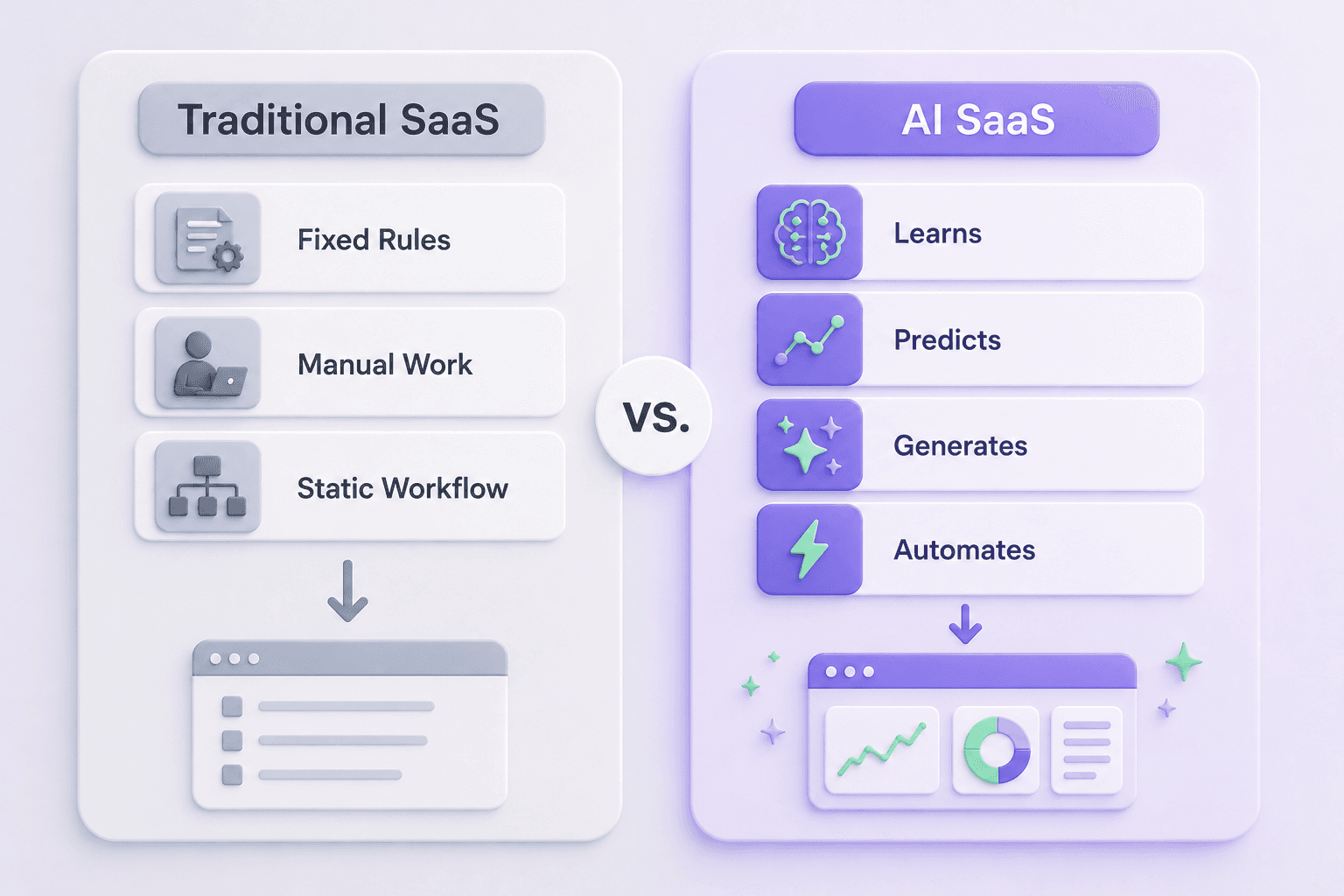
Traditional SaaS platforms follow rules defined by developers. If a user performs a certain action, the application executes a corresponding workflow. This approach works well for structured business processes but becomes limited when software must interpret language, recognize patterns, or make predictions.
AI in SaaS changes this model by adding intelligent capabilities that improve over time or respond dynamically to user input. Instead of relying entirely on fixed logic, AI models can analyze large volumes of data, understand natural language, identify trends, and automate complex decisions.
The following comparison highlights the difference.
Traditional SaaS
AI SaaS
Rule-based automation
AI-powered automation
Static workflows
Adaptive workflows
Manual data analysis
Predictive analytics and AI insights
Limited personalization
Personalized recommendations
Fixed search and filters
Conversational AI and semantic search
This evolution is one reason why AI adoption continues to accelerate across SaaS businesses. Rather than replacing existing SaaS products, artificial intelligence enhances them by making software more proactive, context-aware, and capable of solving increasingly complex problems.
AI SaaS vs AI as a Service (AIaaS)
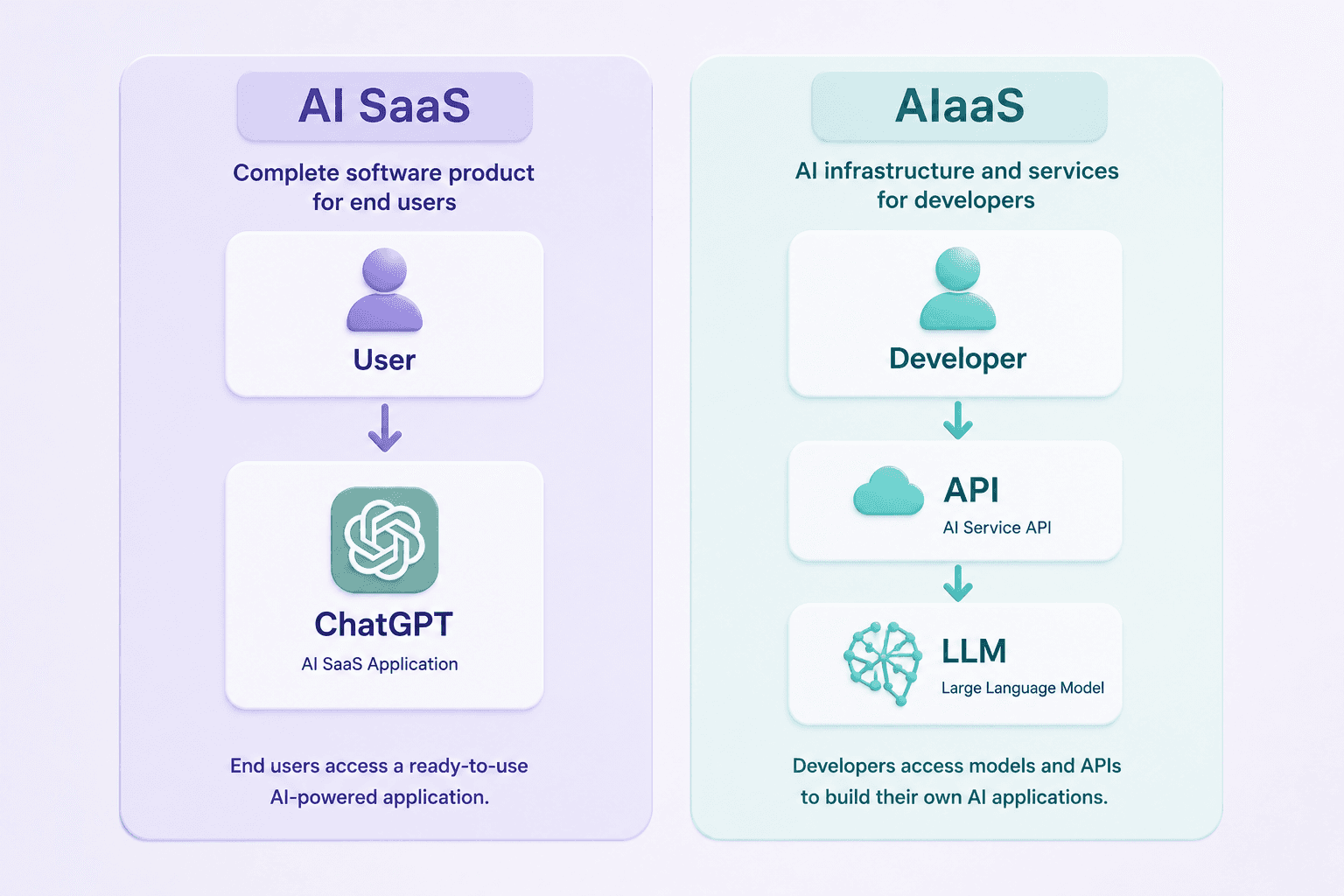
One of the most common misconceptions is treating AI SaaS and AI as a Service (AIaaS) as interchangeable terms. While they are closely related, they serve different audiences.
AI SaaS refers to complete software products that end users access through a browser or application. The artificial intelligence is built into the product itself, and customers use it without worrying about the underlying models or infrastructure.
AIaaS, on the other hand, provides the building blocks that developers use to create AI-powered applications. Instead of delivering a finished product, AIaaS providers offer APIs, machine learning models, and cloud infrastructure that allow companies to integrate AI into their own SaaS products.
AI SaaS
AI as a Service (AIaaS)
Complete software product
AI infrastructure and services
Designed for end users
Designed for developers
Subscription to an application
Access to AI models and APIs
Solves business problems directly
Enables companies to build AI solutions
For example, a writing assistant that generates blog posts is an AI SaaS product. The large language model or API that powers that assistant is typically provided through an AIaaS platform.
Understanding this distinction is important because many SaaS companies combine both approaches. They build AI SaaS products while relying on external AI providers to supply the machine learning models that power their applications.
How Does AI SaaS Work?
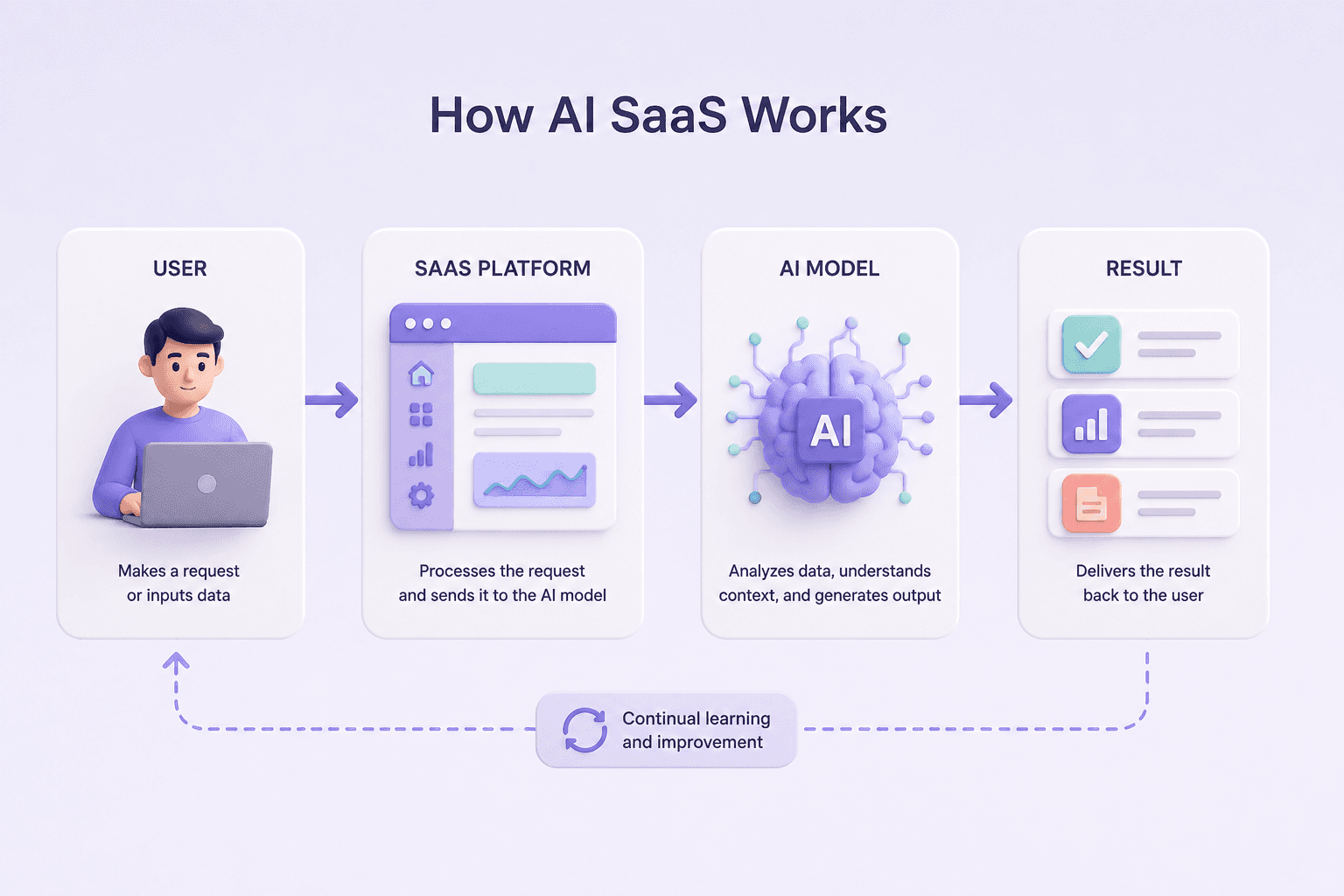
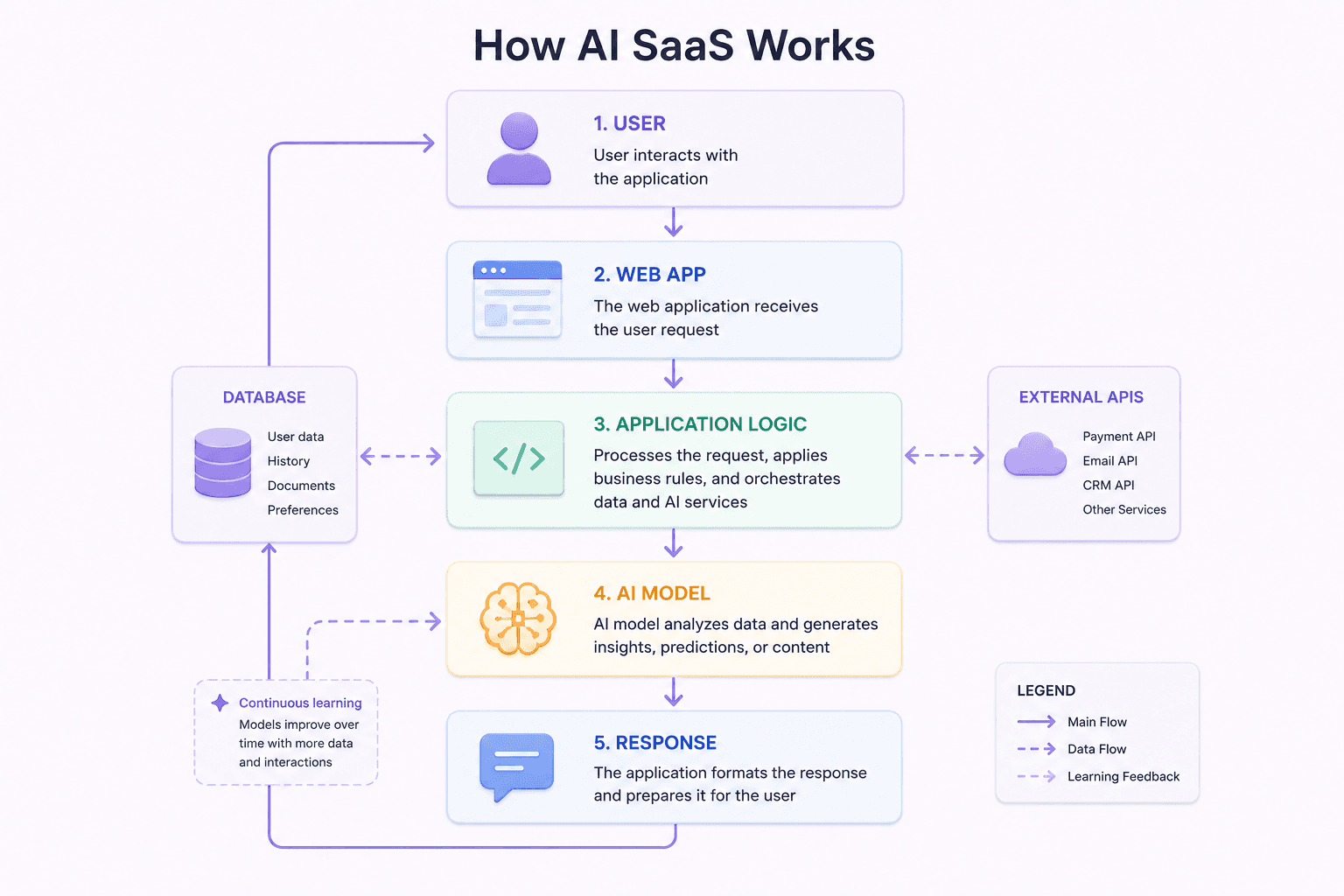
Although AI SaaS products may seem very different on the surface, most follow a similar architecture. A user interacts with a cloud-based application, the application sends data to an AI model, the model processes the request, and the result is returned within seconds. The complexity happens behind the scenes, allowing businesses to benefit from advanced artificial intelligence without managing servers, machine learning pipelines, or AI infrastructure.
A modern AI SaaS platform typically combines traditional software development with AI technologies such as machine learning, natural language processing, and large language models. These components work together to deliver intelligent features while maintaining the scalability and accessibility that define Software as a Service.
Core components of an AI SaaS platform
Although implementations vary between SaaS providers, most AI SaaS solutions include the following components:
Component
Purpose
User interface
Web or mobile application where users interact with the software
Application logic
Handles authentication, billing, workflows, and business rules
AI model
Processes prompts, predictions, recommendations, or generated content
Data layer
Stores customer data, documents, and application information
AI integration
Connects the application to AI models through APIs or internal infrastructure
For example, when a user asks an AI assistant to summarize a meeting, the SaaS platform retrieves the transcript, sends the request to an AI model, receives the summary, and displays it inside the application. The user experiences a seamless workflow without interacting directly with the underlying AI systems.
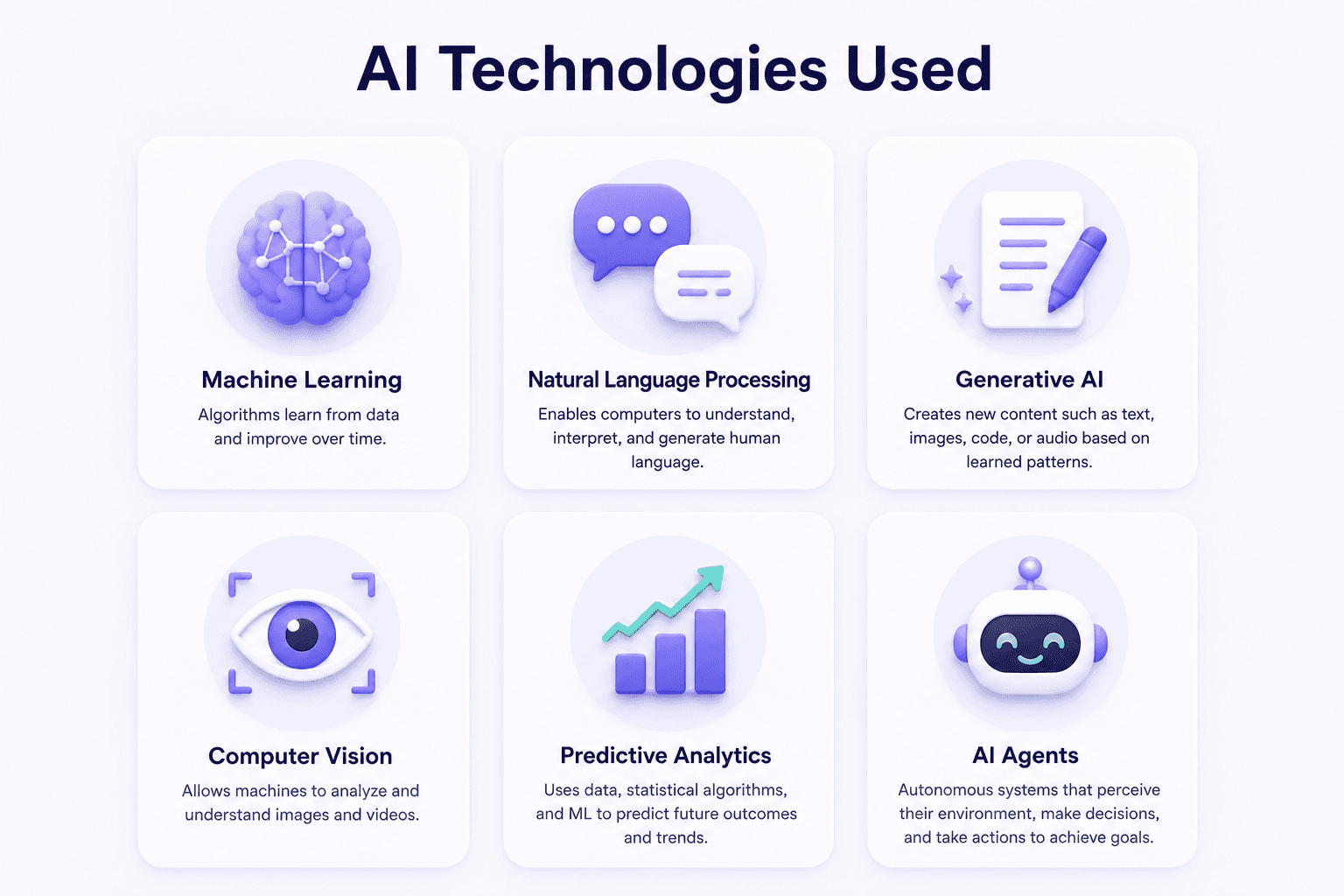
AI technologies used in SaaS
Different AI SaaS products rely on different technologies depending on the problems they solve. Some focus on generating content, while others specialize in prediction, classification, or automation.
The most common AI technologies include:
Machine learning for predictions and recommendations
Generative AI for creating text, images, code, and other content
Natural language processing (NLP) for understanding human language
Predictive analytics for forecasting business outcomes
Computer vision for analyzing images and video
Recommendation engines for personalization
Conversational AI for virtual assistants and customer support
For example, an accounting platform may use machine learning to detect unusual transactions, while a marketing platform uses generative AI to draft email campaigns. Both are AI SaaS products, but they apply different AI capabilities to solve different business problems.
AI integration in SaaS platforms
Most SaaS companies do not build foundation models from scratch. Instead, they integrate AI into existing products using external APIs or specialized AI platforms. This approach reduces development time while allowing teams to focus on user experience and business value.
Depending on the product, AI integration may involve:
Sending prompts to large language models
Embedding semantic search into knowledge bases
Automating document processing
Classifying customer requests
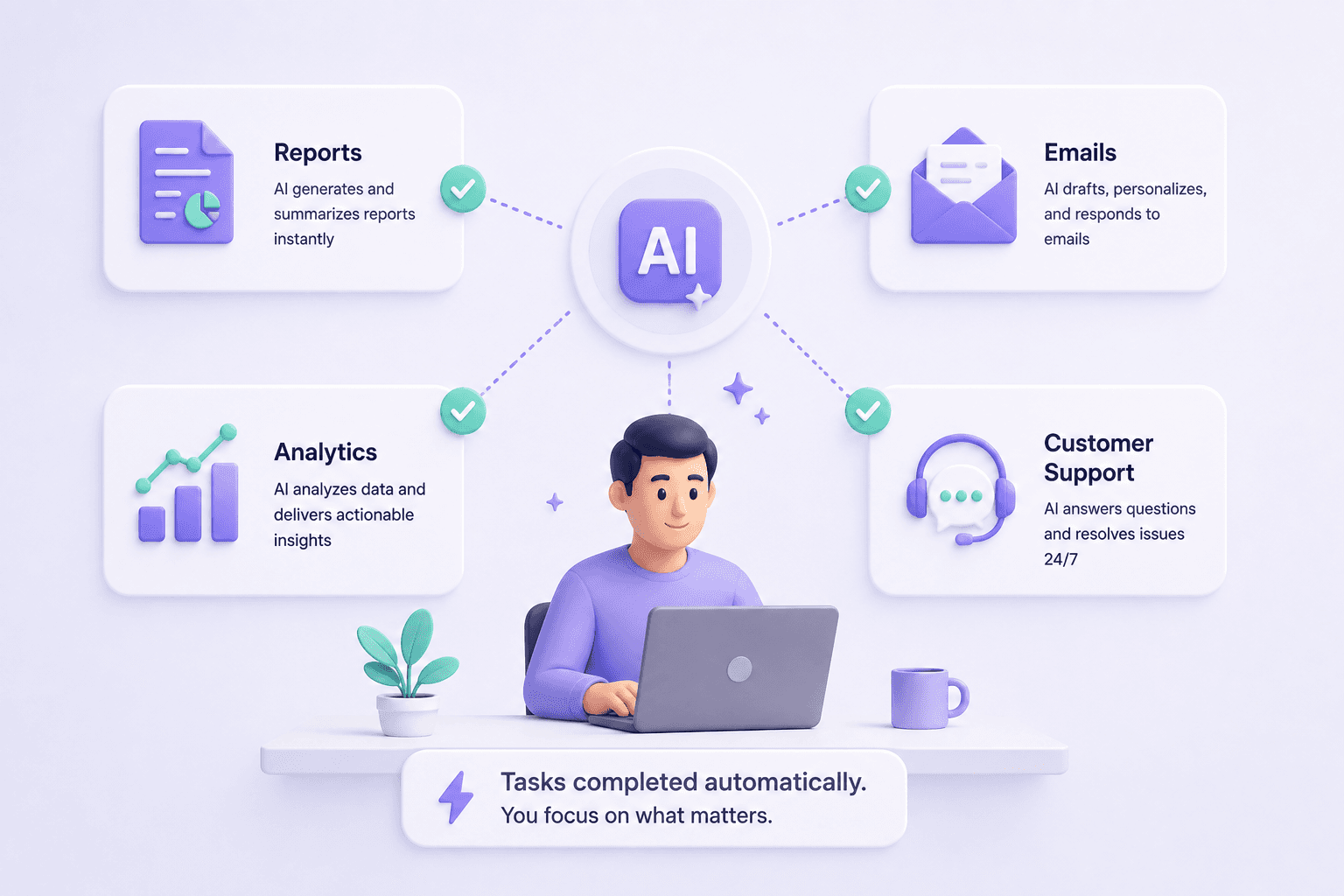
Generating reports from structured data
Creating personalized recommendations
As AI models continue to improve, many SaaS businesses are expanding beyond isolated AI features toward intelligent workflows. Rather than asking users to complete every step manually, software increasingly performs entire sequences of actions with minimal supervision.
Benefits of AI SaaS
The growing adoption of AI SaaS is driven by measurable business outcomes rather than novelty. Organizations invest in AI-powered SaaS because it helps employees work more efficiently, improves customer experiences, and enables software to handle tasks that previously required significant manual effort.
The exact benefits depend on the application, but several advantages appear consistently across industries.
Increased productivity and automation
One of the biggest benefits of AI is its ability to automate repetitive work. AI SaaS platforms can summarize documents, categorize support tickets, generate reports, draft emails, analyze feedback, and perform many other tasks that previously consumed valuable employee time.
Instead of replacing people, these systems typically remove routine work so teams can focus on higher-value activities such as strategy, product development, and customer relationships.
Better decision-making with AI insights
Modern businesses generate enormous amounts of data, but extracting useful insights manually is often difficult. AI SaaS platforms analyze information continuously and identify patterns that might otherwise go unnoticed.
Examples include:
Detecting customer churn risks
Forecasting sales performance
Identifying fraudulent transactions
Prioritizing leads
Recommending next best actions
These AI-powered insights help organizations make faster and more informed decisions without requiring dedicated data science expertise.
Lower costs and faster scalability
Traditional automation often requires custom development and ongoing maintenance. AI SaaS solutions reduce those barriers because businesses can subscribe to software that already includes advanced AI capabilities.
Instead of investing in expensive AI infrastructure, companies gain immediate access to continuously improving models while paying predictable subscription fees. As usage grows, the SaaS platform scales automatically without requiring customers to manage additional hardware or software.
Personalized user experiences
Personalization has become one of the defining characteristics of modern AI-powered SaaS applications.
Rather than showing identical experiences to every customer, AI can tailor recommendations, dashboards, search results, content, and workflows based on user behavior and historical data. This creates software that feels more responsive and relevant over time.
Examples include recommending the next task in a project management platform, suggesting products in an e-commerce application, or generating personalized learning paths in educational software. In each case, AI capabilities improve both usability and customer satisfaction while increasing engagement with the platform.
Common AI SaaS Use Cases
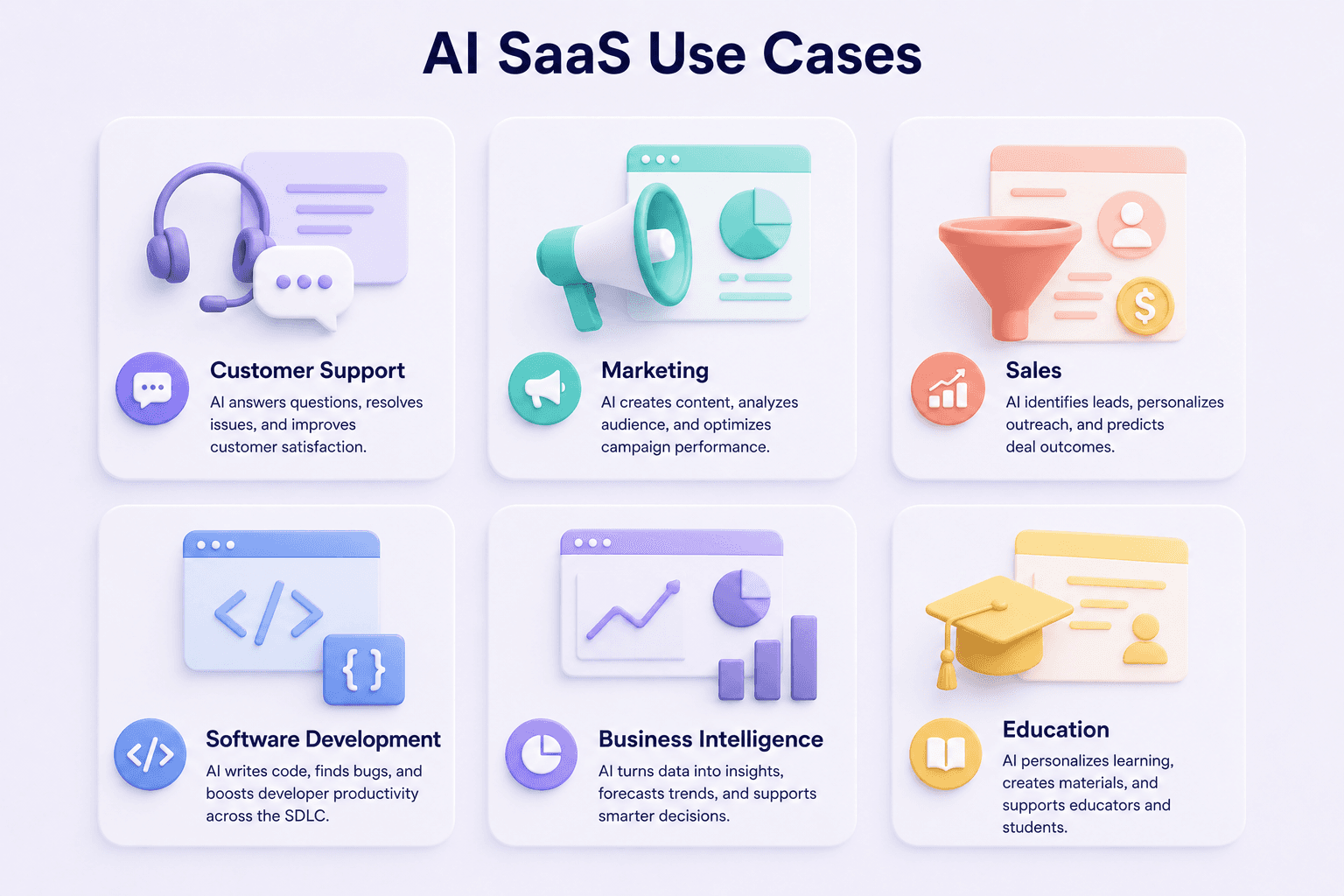
AI SaaS applications are no longer limited to a handful of industries. Today, organizations of every size use AI-powered software to improve productivity, automate repetitive work, and make faster decisions. Whether the goal is reducing manual effort or delivering better customer experiences, AI capabilities are becoming a standard feature across modern SaaS platforms.
Below are some of the most common use cases.
Customer support and AI agents
Customer support was one of the first business functions transformed by AI. Modern AI agents can answer frequently asked questions, summarize conversations, route tickets, and suggest responses for human support representatives.
Unlike traditional chatbots that rely on predefined scripts, conversational AI systems understand natural language and can retrieve relevant information from knowledge bases. This enables faster response times while reducing support costs.
Content creation and marketing
Generative AI has significantly changed how marketing teams create content. AI SaaS tools can generate blog articles, social media posts, product descriptions, email campaigns, ad copy, and landing pages within minutes.
Many platforms also help marketers:
Brainstorm content ideas
Optimize copy for SEO
Personalize marketing campaigns
Repurpose content across channels
Analyze campaign performance
Rather than replacing marketers, these tools automate repetitive writing tasks and accelerate content production.
Sales and CRM automation
Sales teams increasingly use AI to prioritize leads, predict customer behavior, generate personalized outreach, and identify opportunities within CRM systems.
Instead of manually reviewing thousands of records, AI models analyze customer interactions and recommend the next best action. This allows sales representatives to spend more time building relationships and less time managing data.
Software development
AI has become an important part of modern software development. Development teams use AI-powered SaaS products to generate code, explain unfamiliar codebases, detect bugs, write documentation, and automate testing.
While AI does not replace experienced developers, it reduces repetitive work and helps teams build software more efficiently.
Data analysis and business intelligence
Business intelligence platforms increasingly combine predictive analytics with generative AI. Instead of building dashboards manually or writing SQL queries, users can ask questions in plain language and receive visualizations, summaries, or recommendations.
This makes advanced analytics accessible to non-technical teams and improves decision-making throughout an organization.
AI SaaS Examples
The fastest way to understand AI SaaS is to look at products people already use every day. Although these platforms serve different markets, they all integrate AI into their core functionality instead of treating it as an optional add-on.
These examples show that AI SaaS isn't a single category of software. Instead, it spans productivity, marketing, customer support, education, software development, finance, healthcare, and many other industries.
How to Choose an AI SaaS Platform
As AI adoption accelerates, the number of available AI SaaS providers continues to grow. Choosing the right platform requires evaluating more than just the quality of its AI outputs.
Consider the following factors before selecting an AI SaaS solution.
Evaluate AI capabilities
Different platforms specialize in different AI technologies. Some focus on conversational AI, while others emphasize predictive analytics, workflow automation, or content generation.
Before choosing a platform, ask questions such as:
Which business problems does it solve?
Which AI models power the application?
Does it support the workflows your team needs?
Can the AI outputs be customized?
The goal is not to find the platform with the most AI features, but the one that delivers measurable value for your business.
Check integrations and security
AI software rarely operates in isolation. Most businesses need to integrate AI into existing SaaS applications, including CRM systems, project management tools, communication platforms, and data warehouses.
When evaluating an AI SaaS platform, consider:
Available integrations
API support
Data privacy policies
Security certifications
Compliance requirements
User permission controls
Strong AI integration often determines whether adoption succeeds across an organization.
Compare pricing and scalability
Pricing models vary significantly between SaaS providers. Some charge per user, others per AI request, and many combine both approaches.
Businesses should also evaluate whether the platform can scale as adoption grows. A solution that works for a small team today should continue supporting larger workflows, more users, and increasing AI usage without requiring major migration efforts.
Challenges and Limitations of AI SaaS
Despite its rapid growth, AI SaaS is not without limitations. Organizations should understand these challenges before integrating AI into critical business processes.
Common challenges include:
AI models can generate inaccurate or misleading responses.
Data privacy and regulatory compliance remain important concerns.
AI outputs often require human review before publication.
Subscription costs may increase as AI usage grows.
Organizations may become dependent on external AI providers.
For most businesses, these challenges are manageable, but they reinforce the importance of selecting trustworthy SaaS providers and establishing clear governance around AI use.
Frequently Asked Questions
What is AI SaaS?
AI SaaS is cloud-based software that uses artificial intelligence to automate tasks, analyze data, generate content, or assist users. Customers access the software through a subscription without managing the underlying AI infrastructure.
What is the difference between AI SaaS and traditional SaaS?
Traditional SaaS follows predefined rules and workflows, while AI SaaS incorporates artificial intelligence to make predictions, generate content, understand natural language, and automate more complex tasks.
What is AI as a Service (AIaaS)?
AI as a Service provides AI models, APIs, and infrastructure that developers use to build AI-powered applications. AI SaaS delivers complete software products that end users interact with directly.
What are examples of AI SaaS?
Popular AI SaaS examples include ChatGPT, Grammarly, Notion AI, GitHub Copilot, and Jasper. These platforms embed AI into their core functionality to improve productivity and automate workflows.
Is ChatGPT an AI SaaS product?
Yes. ChatGPT is an AI-powered SaaS application that provides conversational AI through a cloud-based subscription model. Users access advanced AI capabilities without deploying or maintaining their own AI infrastructure.
Conclusion
AI SaaS combines the accessibility of Software as a Service with the intelligence of modern AI models. Instead of simply digitizing business processes, today's AI-powered SaaS applications can automate workflows, generate content, analyze information, and support better decision-making across virtually every industry.
As AI technologies continue to evolve, AI will become a standard capability rather than a competitive advantage. SaaS companies that successfully integrate AI into their products will deliver more personalized experiences, increase productivity, and create software that solves increasingly complex problems with less manual effort.
Whether you're evaluating AI SaaS solutions for your business or planning to build your own AI SaaS product, understanding how these platforms work is the first step toward making informed technology decisions.
Subscribe to newsletter that helps SaaS founders get unstuck from mind blocks, blind spots, and skill gaps.
Free newsletter. Unsubscribe anytime.
3,000+
Subscribers
Subscribe to newsletter that helps SaaS founders get unstuck from mind blocks, blind spots, and skill gaps.
Free newsletter. Unsubscribe anytime.
3,000+
Subscribers
Subscribe to newsletter that helps SaaS founders get unstuck from mind blocks, blind spots, and skill gaps.
Free newsletter. Unsubscribe anytime.
3,000+
Subscribers
Subscribe to newsletter that helps SaaS founders get unstuck from mind blocks, blind spots, and skill gaps.