Where can I sell my SaaS company? Best options in 2026

, Community Leader
36 minutes


Selling a SaaS company is no longer limited to finding an M&A advisor and hoping they know the right buyer. SaaS founders now have several routes to an exit, from dedicated acquisition marketplaces and business brokers to strategic buyers, private equity firms, and direct outreach.
The right option depends heavily on what you are selling. A small bootstrapped SaaS with $10,000 in monthly recurring revenue has a very different pool of potential buyers from an established B2B SaaS company doing several million dollars in ARR. Company size, profitability, growth rate, churn, founder involvement, and the type of buyer you want can all affect where you should take the business to market.
If you're asking, "Where can I sell my SaaS company?", this guide covers the main options, the marketplaces and advisors worth considering, what buyers look for, and how to prepare your business for sale.
Where can you sell your SaaS business?
There are four main ways to sell a SaaS business: list it on an acquisition marketplace, work with a broker or M&A advisor, approach strategic buyers directly, or use your founder and investor network.
There is no universally best route. Marketplaces can give smaller SaaS companies direct access to a large buyer pool, while brokers and advisors can manage more of the sale process for you. A direct sale can make sense when there is an obvious strategic buyer willing to pay for technology, customers, market position, or some other asset that has particular value to them.
Selling option | Typically works best for | Main advantage | Main drawback |
|---|---|---|---|
SaaS marketplace | Small to mid-sized SaaS businesses | Access to an existing buyer pool | You may need to manage more of the process |
Broker or M&A advisor | Established and larger SaaS companies | Hands-on support throughout the transaction | Higher fees and selective acceptance |
Direct strategic sale | SaaS with clear strategic value | Potential for a strong strategic valuation | Finding and negotiating with buyers yourself |
Founder/investor network | Founders with strong industry connections | Warm introductions and flexibility | Smaller and less predictable buyer pool |
Your choice also does not have to be based entirely on deal size. How much help you want with valuation, buyer qualification, negotiation, due diligence, and closing should influence the decision.
SaaS acquisition marketplaces
An acquisition marketplace connects founders who want to sell with people actively looking to acquire online businesses. Instead of identifying every potential buyer yourself, you create a listing containing information about the company, its financial performance, SaaS metrics, asking price, and growth opportunities.
This model is particularly useful for smaller SaaS and bootstrapped SaaS businesses that may be too small for traditional investment banks but large enough to attract individual acquirers, entrepreneurs, holding companies, and smaller private equity buyers.
Marketplaces vary considerably in how involved they are. Some primarily provide discovery, communication, and transaction infrastructure. Others vet listings, help determine your SaaS valuation, qualify buyers, and assist with negotiations or closing.
That distinction matters. A marketplace with thousands of registered acquirers is not automatically the best place to sell your SaaS if most of those buyers are looking for a different deal size or business model.
Business brokers and M&A advisors
A broker or M&A advisor takes a more active role in selling your SaaS company. Depending on the firm and deal size, this can include valuation, preparing marketing materials, identifying potential buyers, handling outreach, managing negotiations, coordinating due diligence, and helping move the transaction toward closing.
For example, FE International describes its SaaS service as extending from accounting, valuation and onboarding through M&A and technical transfer. The firm says it has completed more than 1,500 transactions.
This approach can be attractive when the founder wants to continue running the company while someone else manages much of the exit process. It can also become more valuable as the deal gets complicated. A sale involving multiple offers, earnouts, seller financing, private equity firms, or sophisticated strategic buyers requires considerably more work than simply agreeing on a headline price.
The trade-off is cost and selectivity. Advisors earn fees for managing the process, and many will not represent every SaaS business that approaches them. The economics have to make sense for both sides.
Direct sales to strategic buyers
Sometimes the right buyer for your SaaS is already relatively obvious.
A larger software company operating in the same SaaS sector may want your technology, customer base, distribution, team, or position in a particular niche. In that situation, you can pursue a direct sale through outreach rather than publicly list your SaaS.
Strategic buyers can evaluate a company differently from purely financial buyers. An acquirer may be able to cross-sell your product to its existing customer base, eliminate duplicated costs, incorporate your software into a larger product suite, or use the acquisition to enter a market faster than it could by building internally. That can make the SaaS company's value to a specific acquirer different from its standalone financial valuation.
The obvious disadvantage is that you have to find those buyers. You also need to handle negotiations carefully when only one potential buyer is involved. Without competing offers, it is harder to know whether the proposed price and terms reflect the market.
Direct outreach therefore tends to work best when you can identify several plausible acquirers rather than betting the entire SaaS exit on one company.
Founder and investor networks
Not every SaaS acquisition begins with a formal listing. Founders, angel investors, operators, and other people in your industry may already know someone interested in buying a business like yours.
This route can be particularly useful when you want to test buyer interest privately before running a broader sale process. A warm introduction can also establish trust faster than an unsolicited acquisition email.
However, your personal network should not be confused with the entire market. The fact that one founder offers $500,000 for your company does not mean $500,000 is its market value. It means you have one offer.
If maximizing value is the priority, it can make sense to combine network introductions with a more structured process that exposes the company to multiple qualified buyers.
Best marketplaces to list your SaaS business for sale
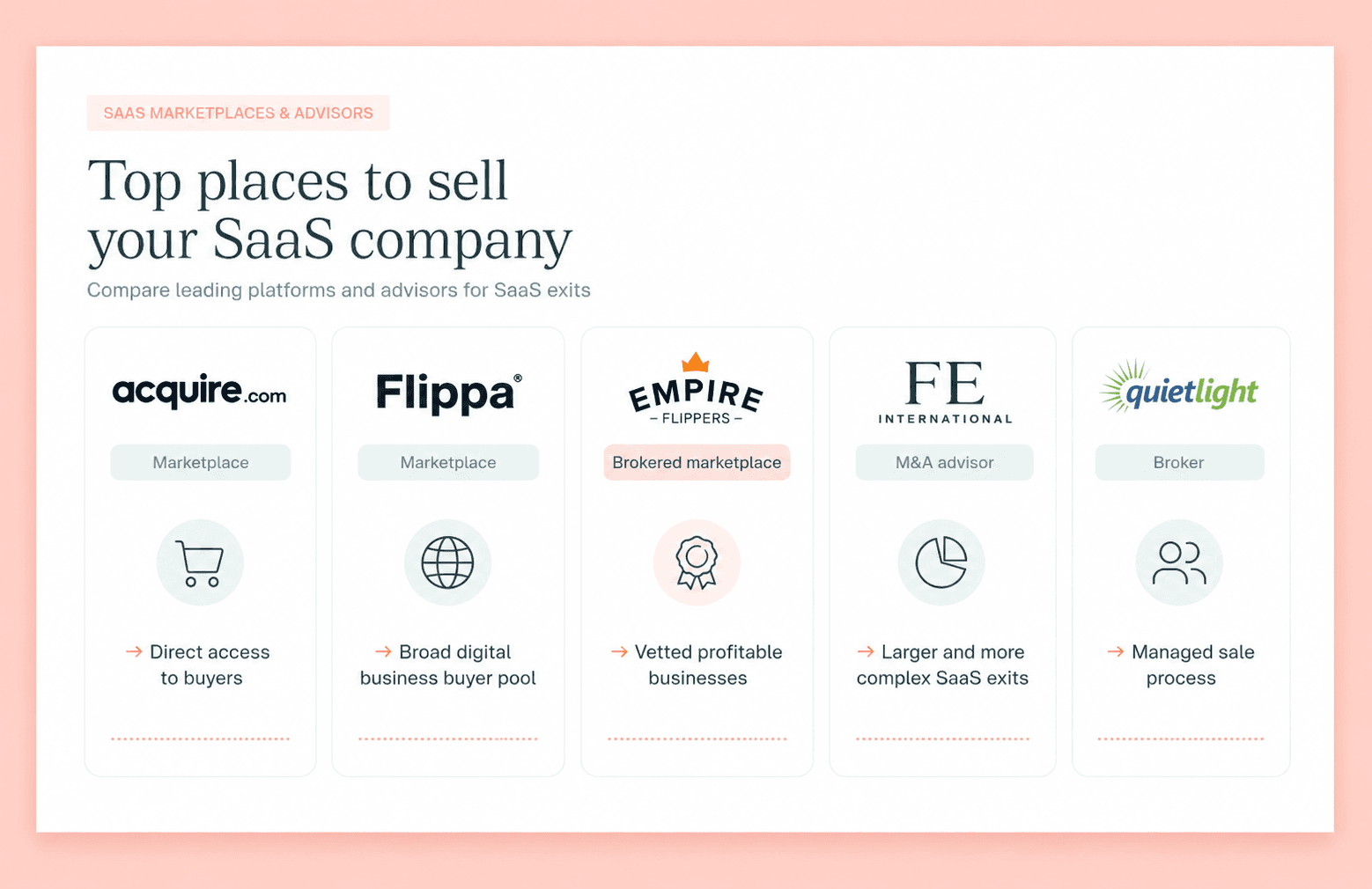
If you decide that a marketplace or intermediary is the right route, the next question is where to list your SaaS business. The major options do not all provide the same service.
Some are closer to self-service acquisition platforms. Others operate more like traditional brokers or M&A advisors. Their fees, listing requirements, level of support, and target deal sizes can also differ substantially.
Acquire.com

Acquire.com is one of the most directly SaaS-oriented options for founders looking to sell an online business. Sellers create a listing, connect with interested buyers, receive offers, and can manage much of the acquisition process through the platform.
As of 2026, seller pricing is based on asking price. Acquire charges a monthly listing fee of $25 for businesses priced below $250,000, $50 for those between $250,000 and $1 million, and $100 for those above $1 million. Its closing fees are 8%, 7%, and 6%, respectively.
That structure makes Acquire particularly relevant to founders who want marketplace access without handing the entire process to a traditional broker. It can accommodate relatively small SaaS businesses while still supporting listings with seven-figure asking prices.
For founders comparing where to sell a SaaS company, Acquire is a logical starting point when direct access to buyers and control over the process are priorities.
Flippa

Flippa is a broad marketplace for digital assets and online businesses, not a SaaS-only marketplace. That breadth can be useful if you want exposure to buyers who consider multiple types of online businesses, not just software companies.
The trade-off is the same breadth. A specialized SaaS buyer evaluating recurring revenue, churn rate, customer acquisition cost, net revenue retention, and other key SaaS metrics may approach a company differently from a general buyer looking across websites, ecommerce stores, apps, and other digital assets.
For a smaller SaaS business, especially one that resembles a relatively simple digital asset, Flippa can still be worth considering. For a more established SaaS with complex metrics or a larger deal size, a more specialized marketplace or advisor may provide a better fit.
Empire Flippers

Empire Flippers sits somewhere between a marketplace and a broker. Businesses go through a vetting process before being accepted, and the company participates more actively in the transaction than a simple listing platform.
Its current requirements state that a business generally needs at least $2,000 in average monthly net profit and at least 12 months of revenue history to qualify.
The service is also priced accordingly. Empire Flippers currently charges a minimum $10,000 commission on sales up to $66,666.66, 15% up to $700,000, then applies lower rates to portions of the deal above that threshold. The company does not charge a separate listing fee.
This makes Empire Flippers more relevant to an established, profitable SaaS than to a brand-new product with little revenue history. The additional vetting may also help filter out businesses and buyers that are not ready to complete a transaction.
FE International
FE International is better described as a technology M&A advisor than a listing marketplace. It works with SaaS and other technology companies and provides support across valuation, marketing, buyer outreach, negotiation, due diligence, and transaction execution.
The company reports more than 1,500 completed transactions and says it rejects more than 90% of the leads it receives before taking businesses to market.
That selectivity illustrates an important distinction for SaaS founders. As deal size increases, the question often changes from "Where can I list my SaaS?" to "Who should manage the process of selling it?"
For a larger established SaaS, particularly where potential buyers include private equity firms or strategic acquirers, the value of an M&A advisor is not simply access to a list of buyers. It is the ability to manage a competitive process, position the business, handle negotiations, and coordinate a complicated transaction while the founder continues operating the company.
Quiet Light

Quiet Light is a brokerage focused on online businesses, including SaaS and software companies. Its process starts with a valuation and continues through preparation, listing, buyer evaluation, offers, and closing.
Quiet Light says 85% of its listings sell within 90 days and notes that smaller transactions generally take 30 to 60 days, while larger deals can take 90 to 150 days. These figures are the company's own reported results rather than an industry-wide benchmark, but they offer a useful indication of the managed sale process it provides.
The brokerage model can make sense for SaaS founders who want more assistance than a self-service marketplace provides but do not necessarily need the investment-banking approach associated with larger M&A transactions.
Ultimately, the best place to sell your SaaS depends less on which platform has the biggest name and more on whether its buyer base, economics, and level of support fit your company. A $100,000 micro-SaaS, a profitable $1 million ARR business, and a rapidly growing B2B SaaS pursuing a multimillion-dollar strategic acquisition should not necessarily use the same sale process.
Which option is best for selling your SaaS company?
Knowing where you can sell your SaaS is only half the decision. You also need to determine which sale process fits your company, your preferred level of involvement, and the type of buyer you want to attract.
A founder selling a small bootstrapped SaaS may value speed and direct access to buyers. Someone selling an established company with several million dollars in recurring revenue may care more about creating competition between acquirers, managing due diligence, and negotiating deal structure.
Before choosing a marketplace, broker, or another route, consider three questions: how complex is the transaction likely to be, how much of the process do you want to manage yourself, and who is the most likely buyer for your company?
Marketplace vs. broker
A marketplace gives you infrastructure and access to potential buyers while leaving more of the sale process in your hands. This can work well when the business is relatively straightforward, and you are comfortable answering buyer questions, comparing offers, handling negotiations, and coordinating professional help when necessary.
A broker takes on more of that work. Brokers can help value the company, prepare the listing, qualify buyers, manage communication, handle negotiations, and keep the transaction moving. For founders who still spend significant time operating the business, that support can be valuable.
An M&A advisor goes further and is generally more relevant as company size and deal complexity increase. Rather than simply list your SaaS business for sale, an advisor can identify likely acquirers and run a structured process designed to generate competing bids.
That competition can matter. In a 2026 case study, FE International reported generating 11 offers for enterprise SaaS company Upright Labs through a structured sale process. One case does not establish what every founder should expect, but it illustrates why a larger SaaS exit may benefit from active buyer outreach rather than a passive listing.
As a general framework:
Choose a marketplace when... | Consider a broker or M&A advisor when... |
|---|---|
You want direct access to buyers | You want someone to manage much of the process |
The business is relatively straightforward | The deal has greater financial or legal complexity |
You are comfortable handling negotiations | You want help handling negotiations |
You want to control buyer communication | You want buyers screened before engaging with them |
Your SaaS is smaller | Your company has reached a larger deal size |
Speed and flexibility are priorities | Maximizing value and buyer competition are priorities |
These categories overlap. A profitable micro-SaaS can still benefit from a broker, while an experienced founder may choose to manage a much larger transaction personally.
Choosing the right buyer for your SaaS
The type of buyer can be just as important as where you find them.
Individual entrepreneurs and searchers often acquire smaller SaaS companies because they want to operate the business themselves. Holding companies may acquire several software companies and operate them as a portfolio. Private equity firms typically become more relevant as deal size increases, while strategic buyers are companies that see additional value in combining your SaaS with their existing business.
A strategic buyer may value your company differently because it can realize synergies that a financial buyer cannot. Your customer base might complement theirs, your product might fill a gap in their software suite, or the acquisition might give them technology that would otherwise take years to build.
Private equity and other financial buyers generally focus more heavily on the economics of the standalone business: recurring revenue, profit margin, retention, growth, cash flow, and the potential return from improving or eventually reselling the company.
The highest offer is not automatically the best offer either. Compare how much is paid at closing, whether part of the price is an earnout, whether seller financing is required, what happens to employees, how long you are expected to remain involved, and what conditions must be met before deferred payments are released.
The right buyer for your SaaS is ultimately the one offering the best combination of valuation, deal certainty, terms, and post-sale outcome for your priorities.
Choosing based on company size and revenue
Company size changes the pool of realistic acquirers.
A small SaaS producing a few thousand dollars in monthly profit can attract an individual operator but may be too small to interest a private equity firm. As ARR and profitability increase, professional acquirers, PE firms, and strategic buyers become more realistic candidates.
There is no single revenue threshold at which you should move from a marketplace to an advisor. Business quality matters alongside size. A smaller SaaS with predictable recurring revenue, strong growth, low founder dependence, and healthy margins can be easier to sell than a larger company with declining revenue and concentrated customers.
Your objective matters too. If speed is the priority, accepting a reasonable offer from a qualified buyer may be preferable to running a long process. If maximizing value matters more, exposing the business to multiple buyer types and letting them compete can be worth the extra work.
What do buyers look for in SaaS companies?
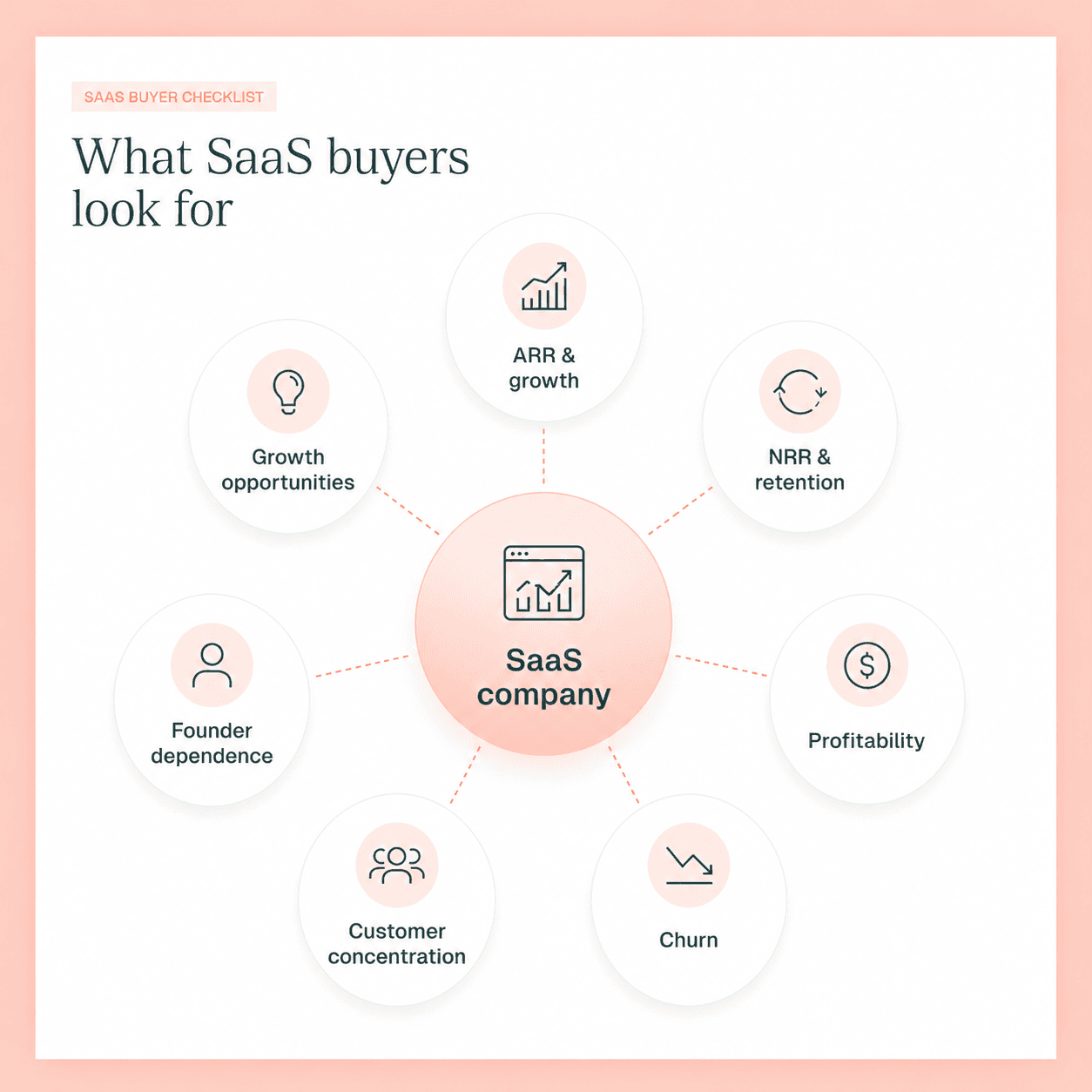
Buyers do not value SaaS companies simply by looking at revenue and applying a fixed multiple. They are trying to determine how durable that revenue will be after the acquisition and how much additional investment will be required to maintain or grow it.
This is why two SaaS companies with identical ARR can receive very different offers.
In 2026, SaaS Capital reported a median growth rate of 22% across more than 1,000 private B2B SaaS companies. Bootstrapped companies had median growth of 20%, compared with 25% for equity-backed companies. These are useful benchmarks, but buyers will examine growth alongside retention, profitability, customer acquisition, and operational risk.
ARR and revenue growth
Annual recurring revenue is one of the first metrics a potential buyer will examine because recurring revenue is fundamental to the SaaS business model. Buyers want to understand not only current ARR, but how reliably it has grown and where that growth comes from.
Consistent organic SaaS growth generally tells a stronger story than a temporary spike. Buyers may break revenue down by cohort, product, customer type, and acquisition channel to determine whether the trajectory is sustainable.
They will also want to reconcile reported ARR and MRR with payment processors, bank statements, and accounting records. During due diligence, discrepancies between a SaaS dashboard and actual financial records can quickly undermine confidence.
Net revenue retention adds another layer. NRR measures what happens to recurring revenue from an existing customer cohort after expansion, downgrades, and churn. An NRR above 100% means existing customers collectively generate more revenue over time, even before adding new customers.
SaaS Capital's 2026 research found a strong relationship between NRR and growth. Moving from the 90–100% NRR range into the 100–110% range was associated with five percentage points of additional growth, while companies with the highest NRR reported median growth 173% above the overall median.
Profitability and cash flow
Growth attracts buyers, but the cost of producing that growth matters.
For a bootstrapped SaaS, healthy profit margins and predictable cash flow can be central to valuation. A buyer acquiring the company as an income-producing asset needs confidence that the reported earnings will remain after the founder leaves.
For a rapidly growing SaaS, buyers may accept lower profitability when investment is clearly producing valuable growth. This is where metrics such as the Rule of 40 can provide additional context. The basic Rule of 40 score combines a company's revenue growth rate and profit margin, with 40% traditionally used as a benchmark for strong combined performance.
It should not be treated as a universal pass/fail test. Company stage, SaaS sector, growth strategy, and buyer type all affect how much weight it receives. A profitable bootstrapped SaaS growing steadily may appeal to a different acquirer than a venture-backed company deliberately sacrificing current profit for expansion.
Churn and customer retention
Recurring revenue is valuable only if it actually recurs.
A high churn rate forces the buyer to continually replace lost customers before the company can grow. Low churn, strong cohort retention, and net revenue retention above 100% make future revenue easier to forecast.
Buyers will therefore look beyond a single headline churn figure. They may examine logo churn, revenue churn, expansion revenue, cohort retention, and whether churn is improving or deteriorating.
Customer lifetime value and customer acquisition cost are relevant for the same reason. If acquiring a customer costs nearly as much as the gross profit that customer will generate before leaving, growth may destroy rather than create value.
The buyer wants evidence that the acquisition engine is repeatable: the company can acquire customers at an economically sensible cost and retain them long enough to produce an attractive return.
Customer concentration
A SaaS company can have excellent ARR and still carry substantial risk if too much of that revenue comes from a handful of customers.
Imagine two businesses with $1 million in ARR. In the first, the largest customer contributes 4% of revenue. In the second, one customer contributes 30%. Losing that account immediately after closing would have dramatically different consequences.
This is why buyers examine the customer base during due diligence. They may also review contracts for renewal dates, cancellation provisions, and change-of-control clauses that could become relevant after an acquisition.
Customer concentration does not necessarily prevent a sale. It does, however, give the buyer a reason to reduce the valuation, require an earnout tied to customer retention, or otherwise structure part of the purchase price around that risk. FE International's 2026 due diligence guidance identifies concentration above roughly 15–20% of ARR from a single customer as a risk factor buyers are likely to address in pricing or deal structure.
Founder dependence
Ask yourself a simple question: what happens if you stop working tomorrow?
If you personally write the code, answer support tickets, close important sales, manage paid acquisition, approve every product decision, and maintain the key customer relationships, a buyer is not acquiring an autonomous company. They are acquiring a company plus a dependency on you.
That creates transition risk.
The goal before selling is not necessarily to remove yourself completely. It is to make the company's important functions transferable. Documented processes, reliable employees and contractors, clear ownership of responsibilities, and systems that do not depend on information stored only in the founder's head all make a SaaS business easier to acquire.
This can also expand the buyer pool. FE International reported that 64% of its most recent 25 SaaS acquisitions covered in its 2026 due diligence analysis went to buyers who described themselves as non-technical. A company that requires its new owner to immediately become lead developer is naturally less attractive to that type of acquirer.
Growth opportunities
Buyers pay for what exists, but they also model what the company could become.
Growth opportunities might include moving into a new geographic market, introducing higher-priced plans, improving conversion, adding an enterprise tier, expanding into adjacent customer segments, developing new acquisition channels, or increasing revenue from the existing customer base.
The strongest opportunities are specific and evidence-backed. "We haven't done any marketing yet" is less compelling than showing that a small test in a new acquisition channel produced customers at an attractive CAC but was never scaled because the founder lacked resources.
The same principle applies to product opportunities. A roadmap containing dozens of speculative features has limited value. Repeated customer requests, successful experiments, expansion revenue, or demonstrated demand give a buyer something more concrete to model.
SaaS valuation: how much can you sell your company for?
No single SaaS valuation multiple determines what your company is worth.
Private B2B SaaS companies are often valued using annualized recurring revenue, particularly when recurring revenue and growth are central to the investment case. SaaS Capital's 2026 valuation methodology, for example, uses ARR as the basis for valuing private B2B SaaS companies and then adjusts for company-specific performance.
Other transactions are valued using seller's discretionary earnings (SDE) or EBITDA. Smaller owner-operated SaaS businesses are more likely to be evaluated based on the cash flow available to an owner, while larger profitable companies may be discussed in terms of EBITDA.
The important point is that a multiple results from the company's characteristics and the market for the asset, not a substitute for analyzing them.
SaaS valuation multiples
A founder may hear that "SaaS companies sell for X times ARR" and assume that multiplying current recurring revenue by X produces a valuation. In practice, buyers adjust their valuation multiple based on growth, retention, profitability, risk, and the quality of the business.
Consider two hypothetical companies:
Metric | SaaS A | SaaS B |
|---|---|---|
ARR | $1M | $1M |
Annual growth | 30% | 5% |
NRR | 110% | 85% |
Largest customer | 5% of ARR | 30% of ARR |
Founder involvement | 10 hours/week | 50 hours/week |
Profitability | Profitable | Break-even |
The companies have identical ARR, but SaaS A offers a buyer faster growth, better retention, less concentration risk, greater transferability, and existing profit. Applying the same valuation multiple to both would ignore most of what determines their economic quality.
Public SaaS valuation multiples can provide context, but founders should be cautious about applying them directly to private companies. Public businesses generally have greater scale, liquidity, reporting maturity, and access to capital. Private transactions also vary significantly by deal size and buyer type.
For that reason, the most useful valuation is usually based on comparable private transactions and your company's specific economics rather than a headline multiple from the public market.
Factors that increase or reduce your valuation
Most of the factors that determine your SaaS valuation ultimately answer one question: how attractive is the company's future cash flow relative to its risk?
Factors that can support a stronger valuation include:
predictable recurring revenue;
consistent SaaS growth;
strong net revenue retention;
low churn rate;
healthy profit margin and gross margin;
diversified customer base;
efficient customer acquisition cost;
low founder dependence;
defensible technology or market position;
documented operations and clean financial records;
several credible growth opportunities.
Factors that can push in the opposite direction include declining revenue, high churn, customer concentration, unresolved technical debt, weak IP documentation, dependence on one acquisition channel, inconsistent financial records, or a company that cannot operate without its founder.
Buyer competition matters as well. A valuation spreadsheet can estimate what a company should be worth, but an actual SaaS acquisition happens when a buyer agrees to pay for it. Several qualified buyers competing for the same asset can produce a very different outcome from negotiating with a single acquirer.
Preparing your business for sale
Ideally, preparing your business for sale begins before you decide to sell.
Waiting until a buyer starts due diligence means discovering problems at exactly the moment when the other side has maximum leverage to use them in negotiations. A cleaner approach is to evaluate the company as though you were the acquirer several months before beginning the sale process.
The objective is not to make the business appear perfect. It is to remove avoidable uncertainty and make its performance easy for a buyer to verify.
Organize your financials and SaaS metrics
Start with the numbers a buyer will eventually request.
Your accounting records should reconcile with bank accounts and payment processors. Clearly separate revenue from one-time income, and categorize expenses consistently. If you are presenting adjusted earnings, every add-back should have a defensible explanation.
For SaaS metrics, prepare historical MRR and ARR, churn rate, NRR, customer acquisition cost, customer lifetime value, gross margin, customer concentration, and growth by period. Depending on company size and buyer type, you may also need cohort retention, CAC payback, deferred revenue, and the Rule of 40 score.
Do not wait for the buyer to discover that the metrics in your pitch deck cannot be recreated from the underlying data. A 2026 guide to quality of earnings in technology M&A notes that buyers can work from general ledger data, bank and payment-processor reconciliations, subscription analytics, cohort retention tables, and contract-level revenue schedules to validate the financial story.
Clean records make due diligence easier, but they also make the company easier to value before you ever list it.
Reduce founder dependence
Write down what you actually do for the company over a typical month.
Then ask which of those responsibilities you must still perform personally.
Some can be automated. Others can be documented and transferred to an employee or contractor. You can share customer relationships with other team members. Technical systems can be documented so a new developer does not have to reverse-engineer the product after closing.
This does not mean hiring a large team immediately before selling. Adding unnecessary payroll can reduce profitability without meaningfully improving transferability. The goal is to eliminate single points of failure.
A potential buyer should be able to understand who runs each part of the company and what happens when ownership changes.
Document operations and processes
Operational documentation turns informal knowledge into a transferable asset.
Depending on the company, this can include:
deployment and infrastructure documentation;
customer support procedures;
sales and onboarding processes;
marketing channel documentation;
vendor and contractor information;
recurring financial tasks;
product development workflows;
security and backup procedures;
access management;
renewal and billing processes.
You do not need a 500-page operating manual. Documentation should be detailed enough that a competent new owner or team member can understand how the business functions without repeatedly asking the founder.
This is especially important for a smaller SaaS, where years of company history may exist primarily in the founder's memory.
Prepare for buyer due diligence
Due diligence is where the claims made during the sale process are verified.
Buyers typically examine financials, customers, legal agreements, intellectual property, technology, security, employees and contractors, tax matters, and the accuracy of SaaS metrics. FE International's 2026 guide says formal SaaS due diligence typically takes around four to six weeks, although the actual timeline will depend on the company and transaction.
Before entering that stage, review your own business for obvious issues. Make sure IP created by employees and contractors has been properly assigned to the company. Locate important customer and vendor contracts. Check whether software licenses can transfer to a buyer. Organize tax and corporate documents. Make sure access to critical infrastructure is controlled and documented.
It is better to tell a potential buyer about a manageable issue and explain how you will resolve it than to have them discover it unexpectedly.
Preparing early also changes your negotiating position. Instead of scrambling to answer requests while trying to keep the company running, you enter the process knowing what buyers are likely to find and having the documentation ready to support your valuation.
How does the SaaS sale process work?
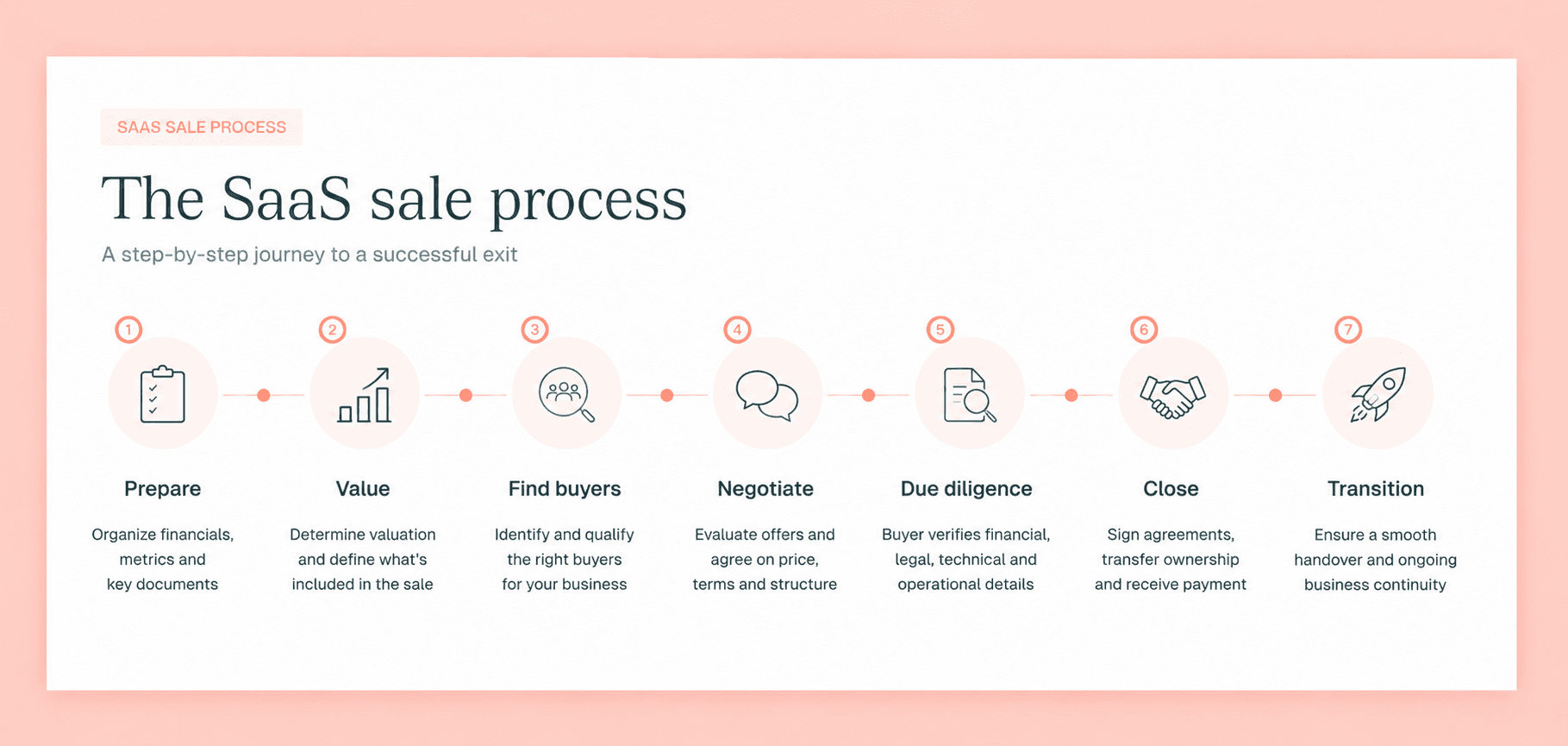
Once you decide to sell your SaaS, the transaction usually moves through several stages: preparing and valuing the business, finding potential buyers, negotiating offers, completing due diligence, and closing the deal.
The exact process varies by buyer type and company size. Selling a small bootstrapped SaaS through a marketplace can be relatively simple, while a larger SaaS acquisition involving private equity firms or strategic acquirers may involve multiple rounds of offers, extensive due diligence, lawyers, accountants, and several months of negotiation.
Understanding the process before you list your SaaS can help you avoid surprises and maintain leverage as buyers ask questions.
Valuation and preparation
Before approaching buyers, determine your SaaS valuation and prepare the information needed to support it.
This usually means organizing financial statements, recurring revenue data, customer metrics, contracts, ownership records, and operational documentation. You should also decide what exactly is included in the sale, such as intellectual property, domains, customer contracts, source code, trademarks, social accounts, and other assets.
At this stage, it is useful to identify weaknesses that could affect valuation. High customer concentration, declining growth, undocumented intellectual property, or significant founder dependence are easier to address before a potential buyer discovers them.
You also need realistic expectations about price. An asking price based entirely on what you personally want from the exit is unlikely to survive negotiations if it cannot be supported by revenue, profitability, growth, retention, comparable transactions, or strategic value.
Finding and qualifying buyers
You can find buyers through a marketplace listing, a broker's network, direct outreach, introductions from SaaS founders and investors, or an M&A advisor contacting potential acquirers.
The objective is not simply to generate as many inquiries as possible. You want qualified buyers who have the financial ability and genuine intent to complete an acquisition.
Before sharing sensitive information, sellers commonly ask buyers to sign a non-disclosure agreement. More detailed information can then be released progressively rather than exposing customer lists, source code, or other confidential information to every person who expresses interest.
Buyer qualification becomes increasingly important as deal size grows. A potential acquirer may be interested in your company but unable to finance the transaction. Others may be exploring the market rather than actively trying to buy.
A serious buyer should be able to explain their acquisition criteria, source of funds, relevant transaction experience, expected timeline, and how they intend to finance the deal.
Negotiating an offer
An initial offer is only the beginning of the negotiation.
Price matters, but so does the structure of that price. A $2 million offer paid entirely at closing is fundamentally different from a $2 million offer consisting of $1.2 million in cash, $400,000 in seller financing, and a $400,000 earnout dependent on future performance.
When comparing offers, consider:
cash paid at closing;
earnouts and their performance conditions;
seller financing;
escrow or holdback requirements;
your required transition period;
employment or consulting obligations;
non-compete provisions;
treatment of employees and contractors;
conditions that allow the buyer to withdraw;
expected closing timeline.
At this point, experienced legal and tax advisors can become particularly important. The structure of a SaaS exit can affect both the amount you ultimately receive and when you receive it.
If several buyers are interested, try to compare offers on the same basis. A higher headline valuation can be less attractive once you account for financing contingencies, deferred consideration, and other conditions.
Due diligence
After the parties agree on the main commercial terms, the buyer begins a deeper investigation of the company.
As discussed earlier, SaaS due diligence often covers financial performance, recurring revenue, customers, technology, security, legal matters, intellectual property, employees, contractors, taxes, and operational processes. The buyer is effectively testing whether the business they are acquiring matches the one that was presented during negotiations.
Expect questions about unusual changes in metrics. If churn suddenly improved, the buyer may ask why. If customer acquisition cost increased, they may investigate the underlying channel. If a large percentage of ARR comes from one customer, they may review that contract in detail.
Due diligence can also change a deal's terms. If the buyer discovers previously unknown risks, they may attempt to renegotiate the purchase price, introduce an earnout, increase escrow, or withdraw entirely.
This is why preparing your business for sale before accepting an offer matters. Clean documentation does not guarantee that due diligence will uncover no problems, but it makes the process easier to manage and reduces the chance that avoidable issues undermine the transaction.
Closing and ensuring a smooth transition
Once due diligence is complete and definitive agreements are signed, the transaction moves toward closing.
The exact mechanics depend on whether the deal is structured as an asset sale, stock sale, merger, or another form of acquisition. Ownership of relevant assets or shares is transferred, funds are released according to the purchase agreement, and control of the business passes to the buyer.
For many SaaS companies, the founder does not disappear on closing day. A transition period may be included so the seller can introduce the new owner to employees, contractors, important customers, vendors, and partners. The founder may also transfer institutional knowledge and help the buyer understand product, marketing, support, and operational systems.
A well-documented company makes this transition considerably easier. The goal is for the business to continue operating normally while ownership changes behind the scenes.
How long does selling your SaaS company take?
There is no fixed timeline for a SaaS exit.
A relatively small business with clean financials, a straightforward ownership structure, and a motivated buyer can move quickly. Larger transactions involving multiple acquirers, financing, extensive negotiation, and detailed due diligence usually take longer.
The process can be thought of in several phases:
Phase | What happens |
|---|---|
Preparation | Financials, metrics, valuation, documentation, and sale materials are prepared |
Buyer search | The business is listed, or potential acquirers are contacted |
Offers and negotiation | Buyers evaluate the company and negotiate price and terms |
Due diligence | The preferred buyer verifies financial, legal, technical, and operational information |
Closing | Final agreements are executed, payment is made, and ownership transfers |
Transition | The founder helps transfer knowledge and responsibilities when required |
Some intermediaries publish their own transaction timelines. Quiet Light, for example, says 85% of its listings sell within 90 days, with smaller deals often taking 30–60 days and larger transactions 90–150 days. These are Quiet Light's own results, not a guarantee for the broader market.
The fastest possible sale is not necessarily the best outcome. If speed is the priority, you may accept an attractive offer from the first qualified buyer. If maximizing value matters more, giving several acquirers time to evaluate the company can create competition and strengthen your negotiating position.
Preparation also affects speed. If your financials, key SaaS metrics, contracts, and due diligence materials are already organized, a buyer can move much faster than if every request requires you to find or recreate information.
What fees should SaaS founders expect when selling?
The cost of selling a SaaS business depends heavily on how you choose to sell.
A marketplace may charge listing and closing fees. Brokers typically earn a success fee based on the sale price. M&A advisors may charge retainers, success fees, or a combination of both. You may also need lawyers, accountants, tax advisors, or other specialists.
Common costs can include:
marketplace listing fees;
marketplace or broker success fees;
M&A advisor fees;
legal fees;
accounting or quality-of-earnings work;
tax advice;
escrow and transaction costs;
technical or security work required before closing.
The fee percentage alone should not determine which route you choose. Paying an advisor 10% is obviously more expensive than paying 5% if both produce the same transaction. But if one process attracts stronger buyers, creates competition, improves the deal structure, or materially increases the sale price, the net outcome may still be better.
Calculate what you expect to receive after fees, taxes, deferred payments, and other transaction costs rather than comparing headline sale prices alone.
Frequently asked questions about selling a SaaS company
Can I list my SaaS if it is not profitable?
Yes. A SaaS company does not necessarily need to be profitable to attract a buyer.
Growth-stage software companies are frequently valued based on recurring revenue and future growth rather than current profit alone. A strategic buyer may also acquire an unprofitable company because it values the technology, customer base, team, intellectual property, or market position.
For a smaller SaaS business, however, profitability often matters more. Individual buyers and small holding companies frequently acquire businesses for cash flow, so a company consistently losing money may have a smaller buyer pool.
If your SaaS is not profitable, be prepared to explain why. Deliberately reinvesting profit into customer acquisition is different from having weak unit economics. Buyers will want to understand whether profitability can realistically be achieved and what would need to change.
Can I sell my SaaS business with low revenue?
Yes, although the lower the revenue, the more limited your options are likely to be.
A small SaaS with paying customers, recurring revenue, and evidence of demand can still have acquisition value. Buyers may see an opportunity to grow a product that has already passed the difficult initial stage of finding customers.
At very low revenue levels, however, valuation may depend more heavily on the product, technology, customer base, traffic, brand, or growth potential than on a traditional revenue multiple.
This is also where marketplaces tend to be more practical than traditional M&A advisors. The potential fee on a very small transaction may simply be too low for an advisor to justify running a full sale process.
If you have no meaningful revenue at all, you may effectively be selling a software asset rather than an established SaaS business. That does not mean it has no value, but buyers will evaluate it differently.
Can I sell my SaaS without a broker?
Yes. You can sell your SaaS through a marketplace, direct outreach, your professional network, or directly to an acquirer that approaches you.
Selling without a broker can reduce transaction fees and give you complete control over communication with potential buyers. For a straightforward smaller acquisition, that may be entirely reasonable.
The trade-off is that you need to manage the process yourself. That includes preparing the business for sale, determining valuation, screening buyers, answering questions, handling negotiations, organizing due diligence, and coordinating lawyers and accountants.
There is also a difference between selling without a broker and selling without professional advice. Even when you find and negotiate with the buyer yourself, an experienced M&A attorney and tax professional can be valuable before you sign a letter of intent or purchase agreement.
When should I choose to sell my SaaS?
The best time to sell is usually when both the business and the founder are ready, rather than when circumstances force a sale.
From a valuation perspective, buyers generally prefer positive signals: growing recurring revenue, stable or improving retention, healthy margins, diversified customers, and credible growth opportunities. A company with several years of clean history and predictable performance is easier to evaluate than one whose metrics change dramatically every quarter.
Your personal reasons to sell matter too. SaaS founders decide to sell because they want to start another company, reduce financial risk, pursue a different career, bring in an owner better positioned to grow the business, or simply realize the value they have created.
If you already know that you want an exit, waiting indefinitely for the "perfect" valuation can create its own risk. Markets change, competitors emerge, growth slows, and founder motivation can decline.
A more useful question is whether the company is currently attractive to buyers and whether the likely proceeds and terms are attractive enough for you to choose to sell.
Where can I sell a micro-SaaS business?
For a micro-SaaS, an acquisition marketplace is often the most accessible starting point.
Platforms such as Acquire.com and Flippa let founders reach buyers interested in relatively small online businesses, while Empire Flippers can be an option for established businesses that meet its revenue history and profitability requirements.
You can also approach potential strategic buyers directly. For a narrowly focused micro-SaaS, the most logical acquirer may be another software company serving the same customer base rather than an investor searching marketplaces.
Before choosing where to list, determine what you are actually selling. Even a smaller SaaS becomes more attractive when it has recurring revenue, low churn, a diversified customer base, clean financials, documented operations, and limited founder dependence.
The answer to "Where can I sell my SaaS company?" therefore depends on the company itself. Smaller SaaS businesses can often start with acquisition marketplaces, established profitable companies may benefit from a broker, and larger or more complex SaaS exits can justify working with an M&A advisor. Strategic buyers and direct outreach remain viable at almost any company size when there is a clear acquisition rationale.
Whichever route you choose, the marketplace or advisor is only one part of the outcome. Strong SaaS metrics, realistic valuation expectations, clean documentation, qualified buyers, and preparation for due diligence will ultimately have more influence on whether you complete a profitable exit.