Finance
How to Evaluate a SaaS Company: Metrics & Valuation Guide

, Community Leader
29 minutes


Evaluating a SaaS company means looking beyond revenue to understand the quality and durability of the business behind it. Because SaaS companies rely on recurring revenue, their value depends heavily on customer retention, how efficiently new customers are acquired, and whether the company can continue growing without costs rising just as quickly.
A good evaluation therefore combines financial metrics such as ARR and gross margin with retention, customer acquisition, product strength, and market opportunity. These factors also form the foundation of SaaS valuation, since two companies with identical revenue can have very different company values depending on their growth, efficiency, and risk.
How to evaluate a SaaS company and its value
A practical SaaS evaluation can be organized around five areas: revenue and growth, retention, customer acquisition, unit economics, and product and market quality. Together, they answer a more useful question than simply “How much revenue does this company generate?” They show how likely that revenue is to grow and remain profitable over time.
Consider two SaaS companies with $2 million in annual recurring revenue. One grows 40% annually, has strong retention, and acquires customers efficiently. The other grows 10%, loses a significant portion of its customers every year, and spends heavily replacing them. Their ARR is identical, but the first business would generally be considered healthier and potentially more valuable.
What makes a SaaS business valuable?
The SaaS business model is attractive largely because of predictable recurring revenue. Once customers subscribe, the company does not need to generate every dollar of future revenue through a new sale.
But recurring revenue has different levels of quality. A SaaS business becomes more attractive when it combines several characteristics:
consistent revenue growth;
low customer and revenue churn;
high net revenue retention;
efficient customer acquisition;
strong gross margins;
a diversified customer base;
opportunities for expansion revenue;
a product that can scale efficiently.
These factors influence both financial performance and SaaS company valuation. A smaller business with strong retention and sustainable growth can sometimes justify a higher valuation multiple than a larger company with stagnant revenue or high churn.
Which SaaS metrics matter most?
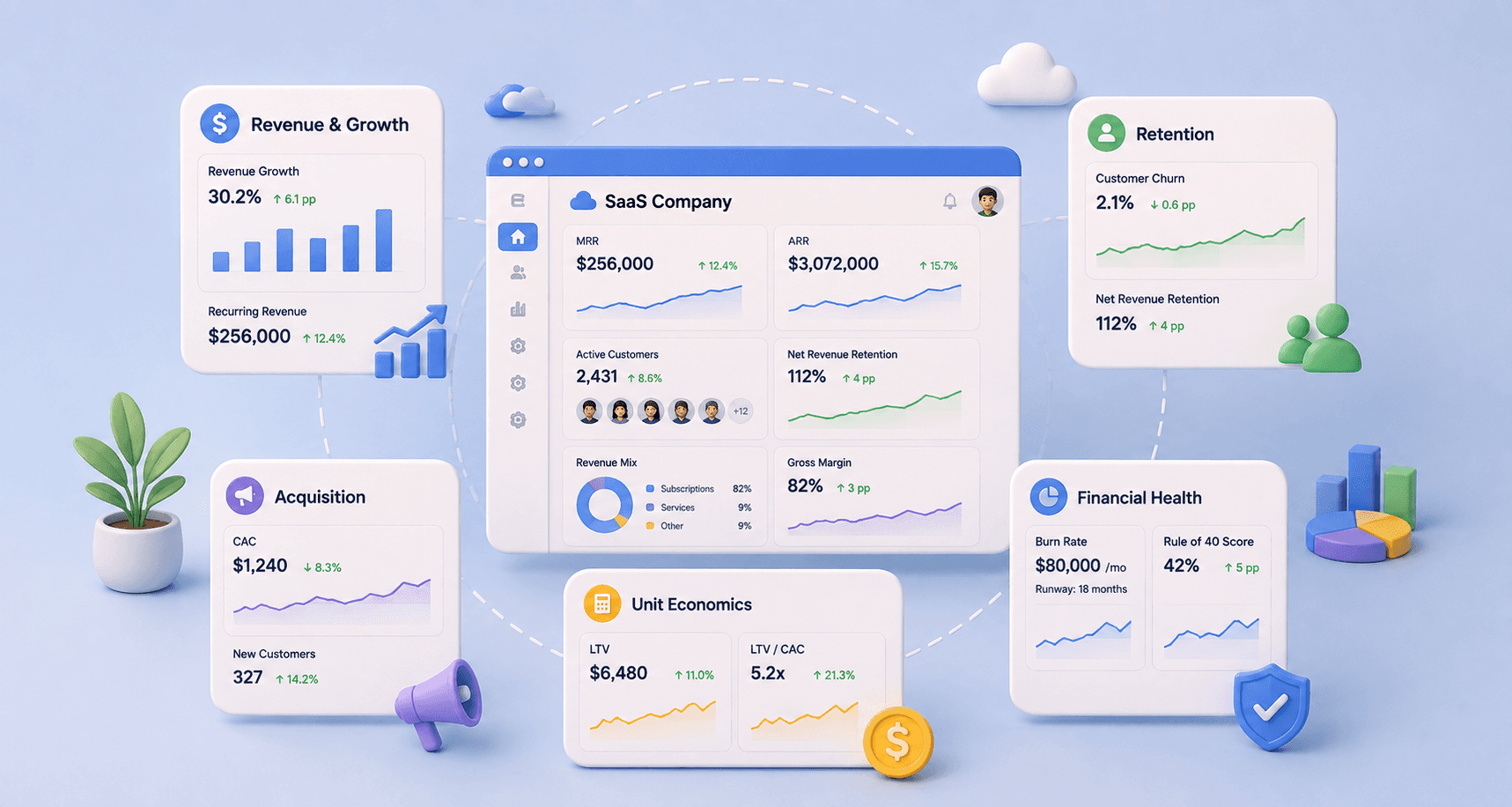
There is no single SaaS metric that can tell you whether a company is healthy. The most useful approach is to look at several groups of metrics together.
Area | Key SaaS metrics | What they show |
|---|---|---|
Revenue | MRR, ARR, growth rate | Scale and pace of growth |
Retention | Churn, NRR, GRR | Durability of recurring revenue |
Acquisition | CAC, LTV, CAC payback | Efficiency of customer growth |
Unit economics | Gross margin, ARPA | Economic quality of revenue |
Financial health | Burn rate, free cash flow | Sustainability of growth |
Context matters as much as the metric itself. A 20% annual growth rate may be excellent for a mature SaaS company but disappointing for a small startup. Similarly, customer acquisition cost means little until it is compared with customer lifetime value and gross margin.
Evaluate the SaaS business model
Before analyzing individual metrics, understand how the SaaS company makes money and who pays for the product. A $20-per-month self-service tool and a $50,000-per-year enterprise platform may both use the SaaS business model, but their sales cycles, churn rates, acquisition costs, and customer relationships will look very different.
This context prevents misleading comparisons and helps determine which metrics deserve the most attention.
Revenue model and pricing
Start with how customers pay. SaaS companies may use flat subscriptions, per-user pricing, usage-based pricing, tiered plans, annual contracts, or a combination of several models.
The pricing structure affects revenue predictability and expansion potential. Per-seat pricing can generate additional revenue as a customer's team grows, while usage-based pricing can increase revenue as customers rely more heavily on the product. Annual contracts can make future revenue more predictable and may improve cash flow.
It is also important to separate recurring software revenue from implementation, consulting, and other one-time services. A company may report strong total revenue while a much smaller percentage actually comes from the repeatable subscription business.
Target market and ideal customer profile
Who buys the product can have a major effect on SaaS metrics. Enterprise SaaS companies typically have higher contract values and longer sales cycles, while products aimed at small businesses may acquire customers faster but experience higher churn.
Look at the number of potential customers, average contract value, purchasing process, and concentration of revenue among major accounts. A narrow SaaS market is not necessarily a problem if the company has a strong position and attractive economics, but it can limit long-term growth.
A mature SaaS business should also have a reasonably clear ideal customer profile. Knowing which customers retain longest, expand most often, and can be acquired efficiently makes growth more predictable and helps the company focus sales and marketing resources.
Product maturity and competitive position
Product quality affects how defensible recurring revenue will be. Reliability, integrations, onboarding, security, customer support, and the pace of product development can all influence whether customers remain with the company.
Competitive advantage does not have to come from proprietary technology. Switching costs, unique data, distribution, brand, network effects, integrations, or deep specialization in a particular industry can also make a SaaS product difficult to replace.
This becomes relevant during the valuation process because today's financial metrics do not guarantee tomorrow's results. If competitors can easily replicate the product and customers can switch with little friction, future revenue carries more risk.
Evaluate revenue and growth rate
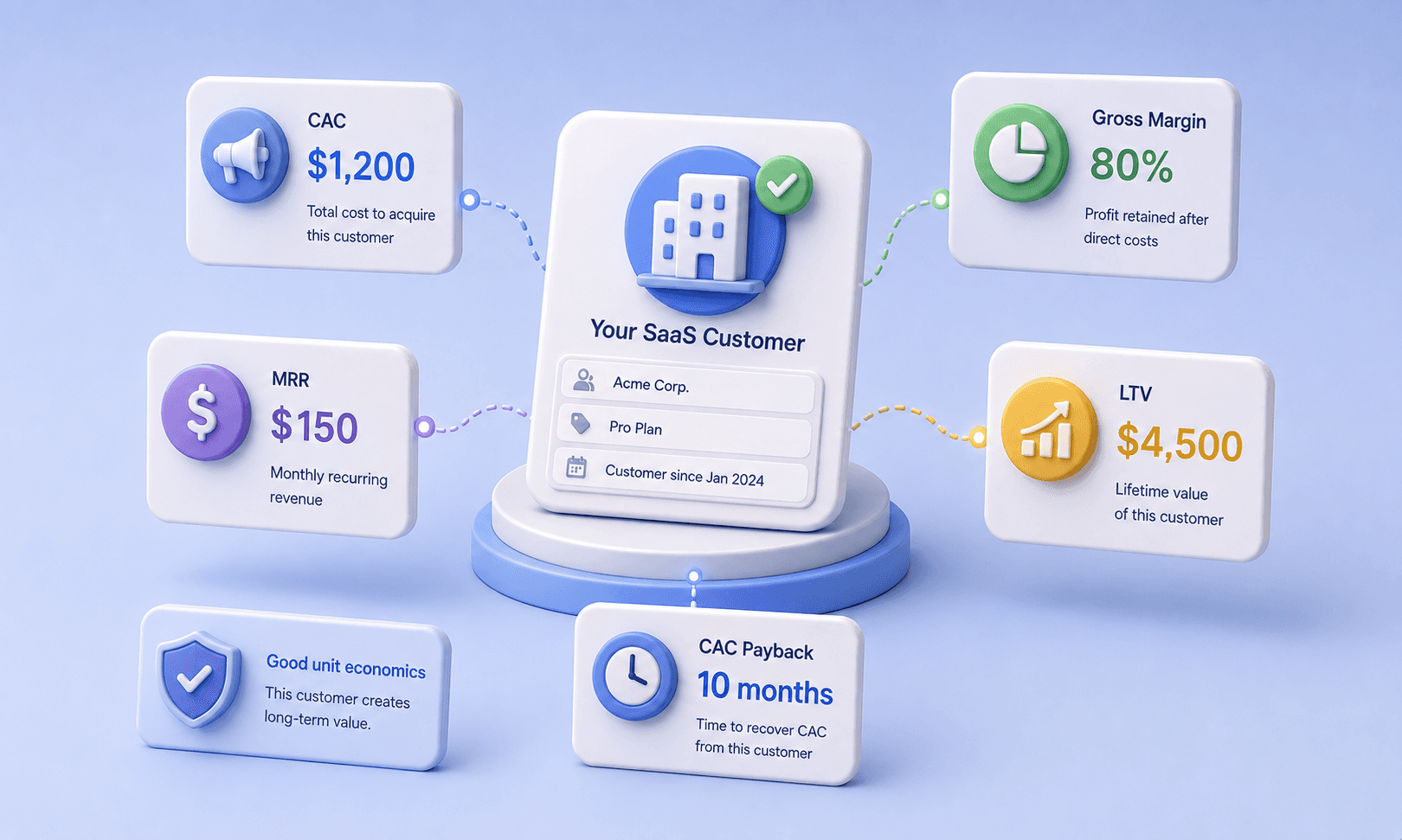
Once the business model is understood, the next step is to analyze recurring revenue. For SaaS companies, MRR and ARR are usually more informative than total revenue because they isolate the subscription base that should continue generating income.
Revenue growth should then be examined alongside the sources of that growth. A company growing through both new customers and expansion of existing accounts is generally in a stronger position than one that relies entirely on continually replacing churned customers.
Monthly recurring revenue (MRR)
Monthly recurring revenue represents normalized subscription revenue generated in a month. If 500 customers each pay $100 per month, the company has $50,000 in MRR.
MRR can be broken into new revenue, expansion, contraction, and churn. This helps explain what is happening beneath the headline number. Adding $20,000 of new MRR while losing $15,000 through churn indicates a much weaker growth engine than adding the same amount while losing only $2,000.
MRR is particularly useful for smaller SaaS companies and businesses where monthly subscriptions represent a large share of the customer base.
Annual recurring revenue (ARR)
Annual recurring revenue expresses the recurring revenue base on an annualized basis. For a company with relatively stable monthly subscriptions:
ARR = MRR × 12
A company generating $100,000 in MRR would therefore have approximately $1.2 million in ARR.
ARR is widely used when comparing B2B SaaS companies and discussing SaaS valuation. However, it should not include consulting, setup fees, or other non-recurring income. This distinction matters because an ARR or revenue multiple assumes that the underlying revenue is likely to continue.
Revenue growth rate
Growth rate measures how quickly revenue is increasing over time:
Revenue growth rate = (Current revenue − Previous revenue) / Previous revenue × 100
If ARR increases from $2 million to $2.6 million, the company has grown 30% over the period.
Growth should always be considered relative to company size. Adding $1 million of ARR represents 50% growth for a company starting at $2 million but only 10% for a company starting at $10 million. This is one reason SaaS valuation multiples cannot be compared without considering the stage and size of the businesses involved.
The quality of growth matters as well. Rapid expansion funded by inefficient sales and marketing or accompanied by high churn may be less valuable than somewhat slower growth supported by strong retention and healthy unit economics.
Expansion revenue
SaaS companies can grow not only by acquiring new customers but also by increasing revenue from existing ones. Expansion revenue can come from additional users, higher usage, upgrades, add-ons, or cross-selling other products.
This is an important characteristic of many successful SaaS businesses because expansion usually requires less acquisition spending than winning a completely new account. If expansion exceeds revenue lost through cancellations and downgrades, net revenue retention can rise above 100%.
That brings us to the next part of the evaluation. Revenue tells us how quickly the company is growing, but retention and unit economics reveal how much of that growth is likely to survive and how expensive it is to produce.
Evaluate SaaS company retention metrics
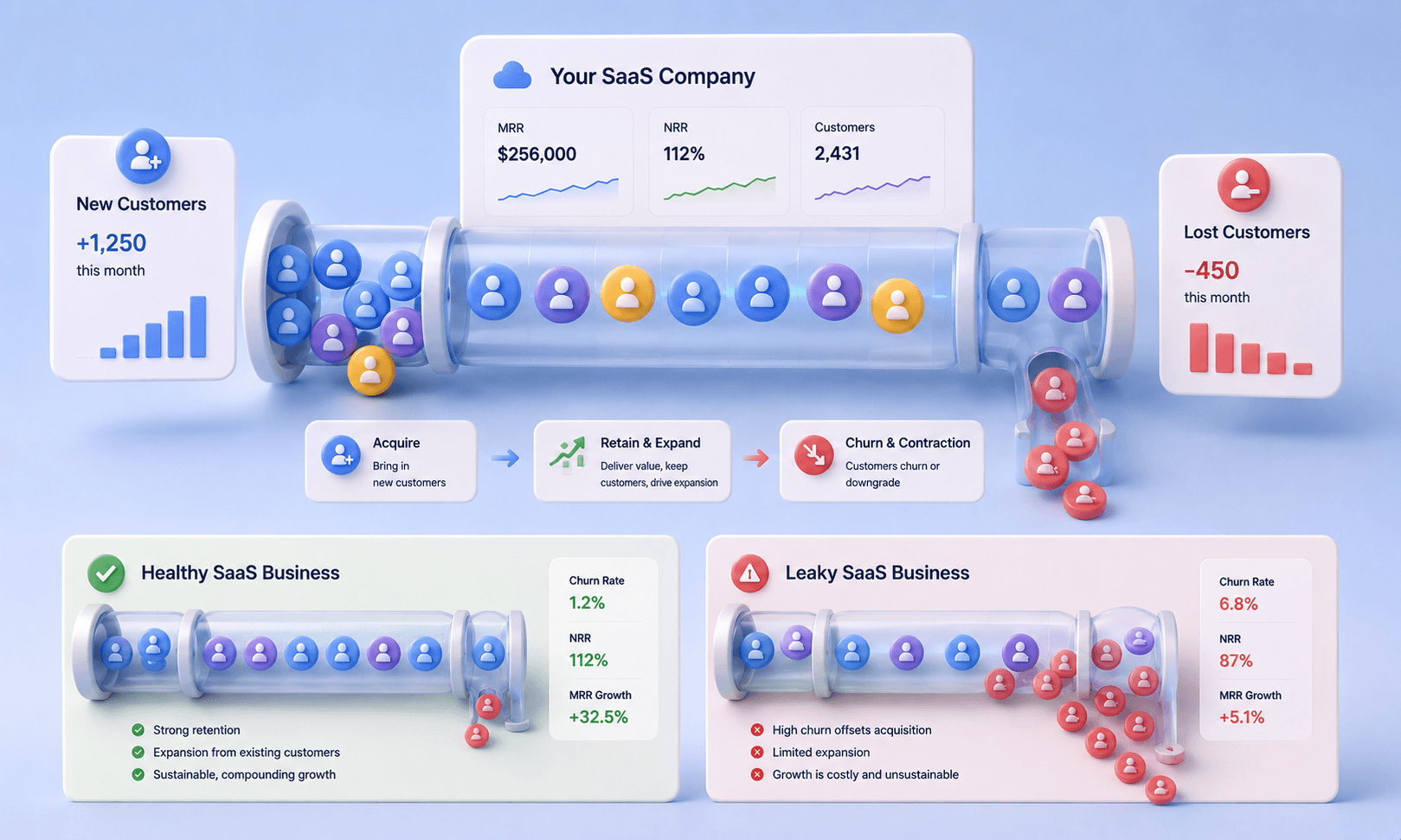
Recurring revenue is valuable only when customers continue paying. A SaaS company can acquire customers quickly and still struggle to grow if a large portion of them cancel every year. Retention metrics help reveal whether growth is accumulating over time or constantly replacing lost revenue.
They can also serve as evidence of product quality. When customers renew and expand their accounts, it suggests that the SaaS product continues to provide enough value to justify its cost.
Customer churn rate
Customer churn measures the percentage of customers who cancel during a given period:
Customer churn rate = Customers lost / Customers at the beginning of the period × 100
If a SaaS company starts a month with 1,000 customers and loses 30, its monthly churn rate is 3%.
There is no universally good churn rate. Enterprise SaaS companies with annual contracts usually behave differently from low-cost self-service products. The most useful comparisons are therefore between SaaS businesses with similar pricing, customers, and contract structures.
Churn should also be monitored over time and by customer cohort. Strong customer acquisition can temporarily hide poor retention, but replacing an increasing number of lost customers makes sustainable revenue growth progressively harder.
Revenue churn rate
Customer churn gives every account equal weight, which can hide important information. Losing ten customers paying $20 per month has a much smaller impact than losing one enterprise customer paying $10,000.
Revenue churn measures the recurring revenue lost through cancellations and, depending on the calculation, downgrades. Comparing customer churn with revenue churn can reveal which customers are leaving.
If customer churn is relatively high but revenue churn remains low, the company may primarily be losing smaller accounts. If revenue churn exceeds customer churn, the loss of larger customers may represent a more serious problem.
Net revenue retention (NRR)
Net revenue retention measures how recurring revenue from existing customers changes after churn, downgrades, and expansion:
NRR = (Starting revenue − Churn − Contraction + Expansion) / Starting revenue × 100
Suppose a SaaS company begins the year with $1 million in recurring revenue. It loses $100,000 through churn and downgrades but generates $150,000 in expansion revenue. Its NRR is 105%.
NRR above 100% means the existing customer base is generating more revenue over time even before new customers are added. This is particularly attractive for B2B SaaS companies because it creates an additional growth engine and can support a higher SaaS valuation multiple.
Gross revenue retention (GRR)
Gross revenue retention is similar to NRR but excludes expansion:
GRR = (Starting revenue − Churn − Contraction) / Starting revenue × 100
Because expansion is excluded, GRR cannot exceed 100%. It provides a clearer view of how much recurring revenue the company retains before upgrades compensate for customer losses.
NRR and GRR are therefore best considered together. Strong NRR can indicate excellent expansion opportunities, but weak GRR may reveal substantial underlying churn that the expansion revenue is masking.
Evaluate customer acquisition metrics
Retention shows whether a SaaS company keeps its customers. The next question is how much it costs to acquire them.
Rapid growth is much less attractive if every new customer requires excessive spending on sales and marketing. Customer acquisition metrics connect growth with its economic cost and help determine whether the business can scale efficiently.
Customer acquisition cost (CAC)
Customer acquisition cost measures the average amount spent to acquire a new customer:
CAC = Sales and marketing costs / New customers acquired
If a SaaS company spends $150,000 on sales and marketing and acquires 300 customers, its average CAC is $500.
CAC by itself tells us relatively little. A $5,000 CAC might be unsustainable for a SaaS product generating $100 per month but attractive for an enterprise account producing tens of thousands of dollars in annual recurring revenue.
For this reason, customer acquisition cost should be evaluated alongside customer lifetime value, gross margin, and the time required to recover the acquisition investment.
Customer lifetime value (LTV)
Customer lifetime value estimates how much economic value an average customer generates throughout their relationship with the business. One simplified formula is:
LTV = Average revenue per customer × Gross margin / Customer churn rate
LTV is useful for understanding whether customer acquisition spending can generate attractive long-term returns. However, it should be treated as an estimate rather than a precise prediction, particularly for younger SaaS companies with limited retention data.
Segmenting LTV can make the metric more useful. Enterprise customers, small businesses, different pricing plans, and customers from different acquisition channels may have substantially different retention and lifetime economics.
LTV to CAC ratio
The LTV-to-CAC ratio compares customer lifetime value with the cost of acquiring that customer. If LTV is $9,000 and CAC is $3,000, the ratio is 3:1.
A 3:1 ratio is frequently used as a rule of thumb for healthy SaaS unit economics, but it should not be treated as a universal benchmark. The appropriate ratio depends on margins, growth strategy, capital availability, and the reliability of the LTV calculation.
A low ratio may indicate expensive customer acquisition or weak retention. An unusually high ratio can sometimes mean the company has room to spend more aggressively on growth while still maintaining attractive economics.
CAC payback period
CAC payback measures how long it takes for the gross profit generated by a customer to recover customer acquisition cost.
If acquiring a customer costs $1,200 and that customer generates $100 in monthly gross profit, the CAC payback period is approximately 12 months.
This metric is particularly useful for evaluating cash efficiency. Even a company with strong LTV to CAC can face financing pressure if it must spend substantial amounts today and wait several years to recover that investment.
Evaluate SaaS business unit economics
Unit economics help determine whether growth creates economic value at the customer level. This is particularly useful when evaluating an early-stage SaaS business that is growing quickly but has not yet reached company-wide profitability.
A SaaS company can intentionally operate at a loss while building a healthy business if individual customers generate attractive economics. The opposite is also possible: impressive revenue growth can hide a model in which serving and acquiring each additional customer remains too expensive.
Gross margin
Gross margin measures how much revenue remains after the direct cost of delivering the service:
Gross margin = (Revenue − Cost of goods sold) / Revenue × 100
For SaaS companies, cost of goods sold may include hosting, cloud infrastructure, third-party services, and some customer support costs. Products that depend heavily on external APIs, AI inference, data providers, or manual services may have a substantially different cost structure from traditional software products.
Higher gross margins generally give a SaaS business more room to invest in product development, sales, and marketing while eventually generating profit. When comparing gross margin across companies, however, make sure they classify their costs in similar ways.
Average revenue per account (ARPA)
Average revenue per account shows how much recurring revenue the average customer account generates:
ARPA = Recurring revenue / Number of active accounts
Tracking ARPA over time can reveal whether customers are moving to higher-priced plans or expanding their usage. Rising ARPA can allow a SaaS company to grow even when customer acquisition begins to slow.
It is often more useful to calculate ARPA separately for different customer segments. An overall average may hide substantial differences between self-service, mid-market, and enterprise customers.
Contribution margin
Contribution margin measures how much revenue remains after variable costs associated with serving customers. It can be especially useful for SaaS businesses with significant usage, onboarding, implementation, or support costs.
The exact definition can vary between companies, so the underlying calculation should always be checked. The important question is whether additional revenue contributes progressively more toward fixed costs and eventual profitability as the company grows.
Evaluate profitability and cash efficiency
Many SaaS companies deliberately reinvest earnings into growth, so current profitability should not be evaluated in isolation. A growing company with strong unit economics may reasonably operate at a loss, while a business with poor economics may remain unprofitable regardless of scale.
The goal is to understand the relationship between revenue growth, cash consumption, and the company's ability to eventually generate sustainable cash flow.
Burn rate and runway
Burn rate measures how quickly a company consumes cash. If a SaaS startup spends $500,000 per month while generating $400,000 in cash inflows, its net monthly burn is approximately $100,000.
Runway estimates how long the company can continue at that rate before exhausting its available cash. With $1.8 million available and $100,000 of monthly net burn, the company has roughly 18 months of runway.
Burn is not automatically negative. A fast-growing SaaS company may intentionally spend heavily when customer acquisition produces attractive returns. What matters is whether the investment produces sufficient growth and whether the company has enough capital to reach profitability or its next financing milestone.
Free cash flow
Free cash flow shows how much cash the business generates after operating expenses and necessary capital expenditures. It becomes increasingly important when evaluating mature SaaS companies.
A company with durable revenue growth and positive free cash flow has greater flexibility to fund product development, acquire customers, make acquisitions, or return capital without relying on external financing.
Cash flow can also provide a clearer picture than accounting profit in some SaaS businesses, particularly when customers pay annual subscriptions upfront.
Rule of 40
The Rule of 40 combines growth and profitability into a simple benchmark:
Revenue growth rate + Profit margin ≥ 40%
A SaaS company growing 30% annually with a 12% profit margin would score 42%. A faster-growing company could have a negative margin and still exceed the benchmark.
Different analyses may use EBITDA margin, operating margin, or free cash flow margin, so the methodology should be consistent when comparing SaaS companies.
The Rule of 40 is best used as a quick comparison tool rather than a valuation method. It reflects an important principle in the SaaS industry: strong growth can justify lower current profitability, while slower-growing companies are generally expected to produce more cash.
How to value a SaaS company
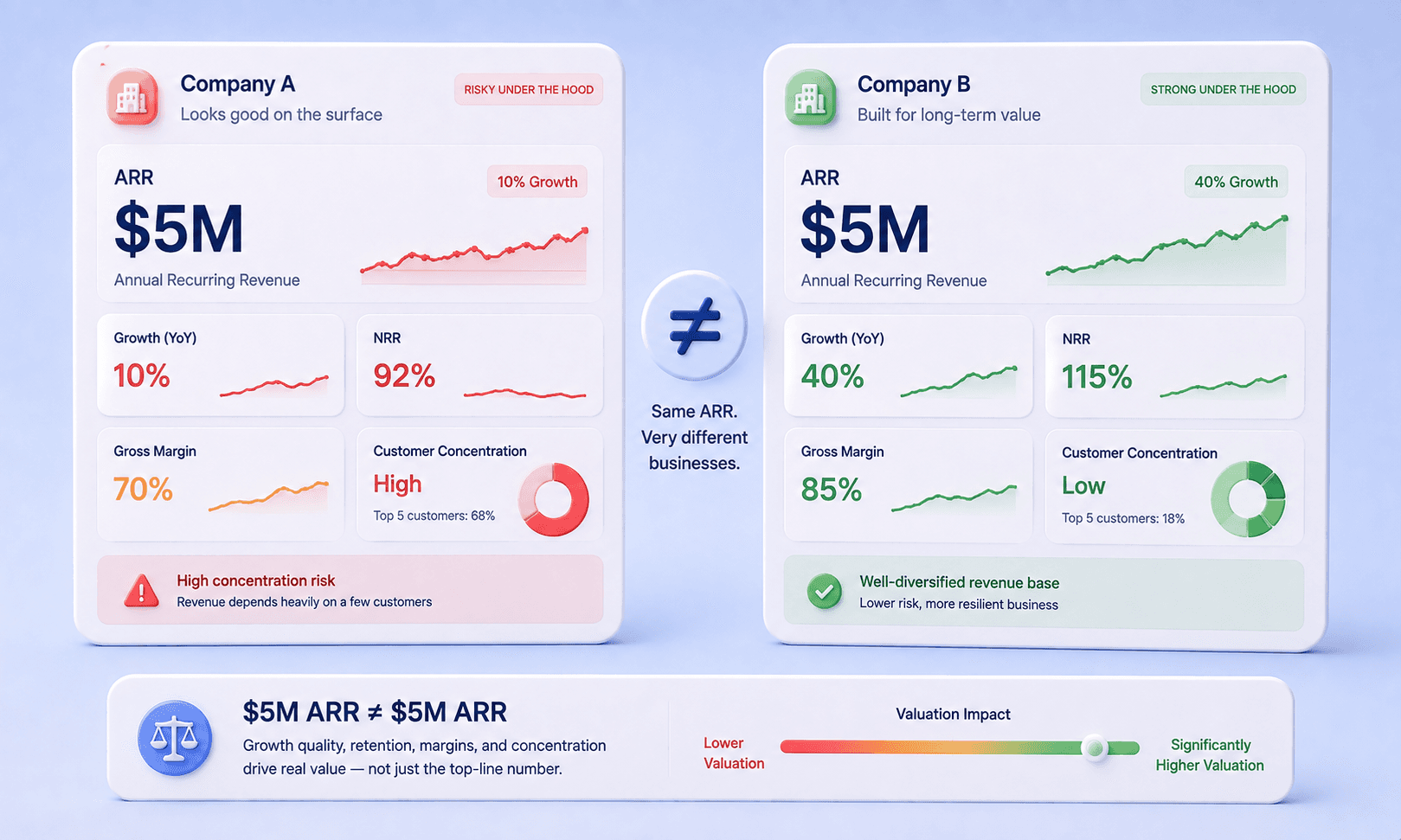
Evaluating business quality and determining SaaS valuation are closely connected. Metrics such as ARR provide the starting point, while growth, retention, profitability, market opportunity, and risk help determine what that revenue is worth.
There is no single valuation method that works for every company. Growing subscription businesses are frequently evaluated using revenue or ARR multiples, while EBITDA valuation and cash flow become more relevant as companies mature and become consistently profitable.
How SaaS company valuation works
A simplified company valuation can be expressed as:
Company value = Financial metric × Valuation multiple
For example, a SaaS business with $3 million in ARR and a 5× ARR valuation multiple would have an implied enterprise value of approximately $15 million.
The multiplication is easy. Choosing an appropriate valuation multiplier is the difficult part.
Growth rate, NRR, gross margin, customer concentration, CAC efficiency, market position, and profitability can all influence the multiple. This is why SaaS company valuation should follow business analysis rather than begin with a generic industry multiple.
Revenue multiple and ARR multiple
Revenue multiples express company value relative to annual revenue, while ARR multiples focus specifically on annual recurring revenue. The latter can be particularly useful for SaaS companies because it isolates the subscription component of the business.
Consider two hypothetical companies:
Metric | SaaS Company A | SaaS Company B |
|---|---|---|
ARR | $5M | $5M |
Growth rate | 10% | 40% |
NRR | 92% | 115% |
Gross margin | 70% | 85% |
Illustrative ARR multiple | 3× | 7× |
Implied company value | $15M | $35M |
The valuation multiples here are illustrative, but the example shows why ARR alone cannot determine company value. Company B has the same annual recurring revenue but combines faster growth with better retention and stronger margins.
What affects a SaaS valuation multiple?
Most of the analysis performed throughout this guide ultimately feeds into the valuation multiple. Important valuation drivers include:
revenue growth and its sustainability;
customer churn, GRR, and NRR;
gross margin and cash flow;
customer acquisition efficiency;
market size and competitive position;
customer concentration;
percentage of recurring revenue;
company size and maturity;
founder or channel dependence.
These factors should not be considered independently. High growth becomes less attractive when it requires unsustainable spending, while moderate growth can still support a healthy valuation when the SaaS business produces strong margins and predictable cash flow.
SaaS valuation multiples by growth and business quality
There is no universal SaaS valuation multiple. Public SaaS companies can provide useful reference points because their financial information and market values are readily available, but their multiples should not be applied directly to private SaaS companies.
Public companies are generally larger, more diversified, and more liquid. Smaller private SaaS businesses may carry additional risks related to customer concentration, founder dependence, limited management teams, or less predictable growth.
Company size also affects valuation within the private SaaS market. As a business becomes larger and more diversified, some of these risks can decline, potentially supporting a different valuation multiple even if its growth rate slows.
Valuation trends in the SaaS industry
SaaS valuation is also influenced by broader market conditions. Interest rates, availability of capital, investor appetite for growth, and public software valuations can change the multiples buyers and investors are willing to pay.
As a result, the same SaaS company can receive different business valuations at different points in the market cycle without a major change in its underlying financial performance.
Current comparable transactions are therefore more useful than historical rules of thumb when an accurate valuation is required. General SaaS valuation multiples are best used to estimate a range rather than determine an exact selling price.
SaaS company valuation example
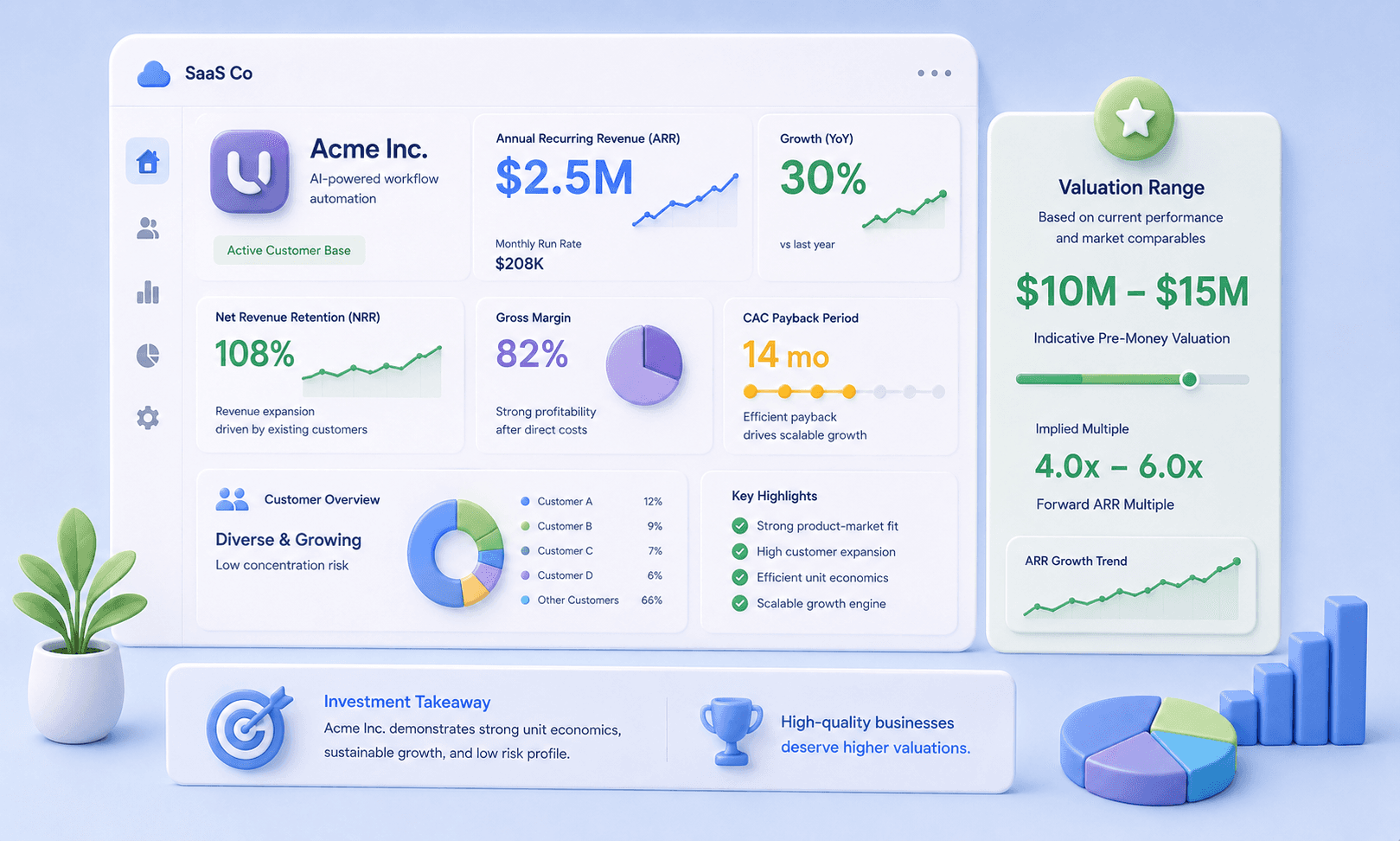
Consider a B2B SaaS company with the following metrics:
Metric | Example |
|---|---|
ARR | $2.5M |
Annual growth rate | 30% |
Gross margin | 82% |
NRR | 108% |
Largest customer | 6% of ARR |
CAC payback | 14 months |
Free cash flow | Approximately break-even |
The company appears relatively healthy. It combines meaningful growth with strong gross margin, NRR above 100%, manageable customer concentration, and reasonable acquisition economics.
The next step in the valuation process would be to compare the business with similar SaaS companies and examine whether these metrics are improving or deteriorating. A company with accelerating growth and stable retention may deserve a higher valuation multiplier than one whose growth and NRR have been falling.
How to estimate the value of your SaaS company
A practical valuation process can be reduced to six steps:
Calculate reliable MRR and annual recurring revenue.
Separate recurring revenue from services and other one-time income.
Evaluate growth, retention, gross margin, CAC, and cash flow.
Identify risks such as customer concentration and founder dependence.
Find comparable SaaS companies or recent transactions.
Apply an appropriate valuation range based on business quality and market conditions.
The result should usually be treated as a range rather than a precise number. SaaS company valuation contains assumptions about future performance, and relatively small changes in those assumptions can materially affect company value.
Applying a valuation multiplier to annual recurring revenue
Suppose the example SaaS company with $2.5 million in ARR is estimated to deserve a hypothetical 4× to 6× ARR multiple based on comparable businesses.
At 4× ARR, the implied value is $10 million. At 5×, it is $12.5 million, and at 6× it reaches $15 million.
The purpose of evaluating the business is to determine where within such a range it belongs. Stronger growth, retention, margins, and competitive positioning can push the valuation higher, while customer concentration, weak retention, or excessive founder dependence can push it lower.
In other words, a revenue multiple is the output of SaaS evaluation, not a substitute for it.
SaaS company evaluation checklist
A useful final evaluation combines quantitative SaaS metrics with the qualitative characteristics of the business.
Area | What to evaluate |
|---|---|
Revenue | MRR, ARR, and growth rate |
Retention | Churn, GRR, and NRR |
Acquisition | CAC, LTV, and CAC payback |
Unit economics | Gross margin and ARPA |
Financial health | Burn rate and free cash flow |
Customers | Growth, concentration, and contracts |
Product | Product market fit and engagement |
Market | Market size and competitive advantage |
Operations | Sales efficiency and scalability |
Valuation | Appropriate ARR, revenue, or earnings multiples |
The central idea is to avoid judging a SaaS company by one impressive number. The strongest SaaS businesses combine recurring revenue growth with high retention, healthy unit economics, a defensible market position, and the ability to eventually convert scale into cash flow.