Finance
Where Do SaaS Founders Find Investors? 15 Proven Ways to Raise Funding

, Community Leader
18 minutes

Most SaaS founders find investors through warm introductions, founder communities, angel investors, venture capital firms, startup accelerators, and targeted networking rather than mass cold outreach. The most successful fundraising processes usually combine several of these channels instead of relying on just one.
The right funding source depends on your stage. A founder with an MVP and a handful of early users should approach different investors than a company with $50k MRR and proven product-market fit. Understanding where to look first saves time and dramatically improves your chances of raising capital.
In this guide, you'll learn 15 proven ways to find investors for your SaaS startup, discover when each channel makes the most sense, and see real examples of firms, accelerators, and platforms you can explore immediately.
Where do SaaS founders find investors?
Successful founders rarely raise money through a single conversation or platform. More often, fundraising is a process of building relationships over time.
For example, you might discover a VC firm through an investor database, notice that one of its portfolio founders belongs to your community, receive a warm introduction, and eventually begin fundraising conversations. Each channel plays a different role.

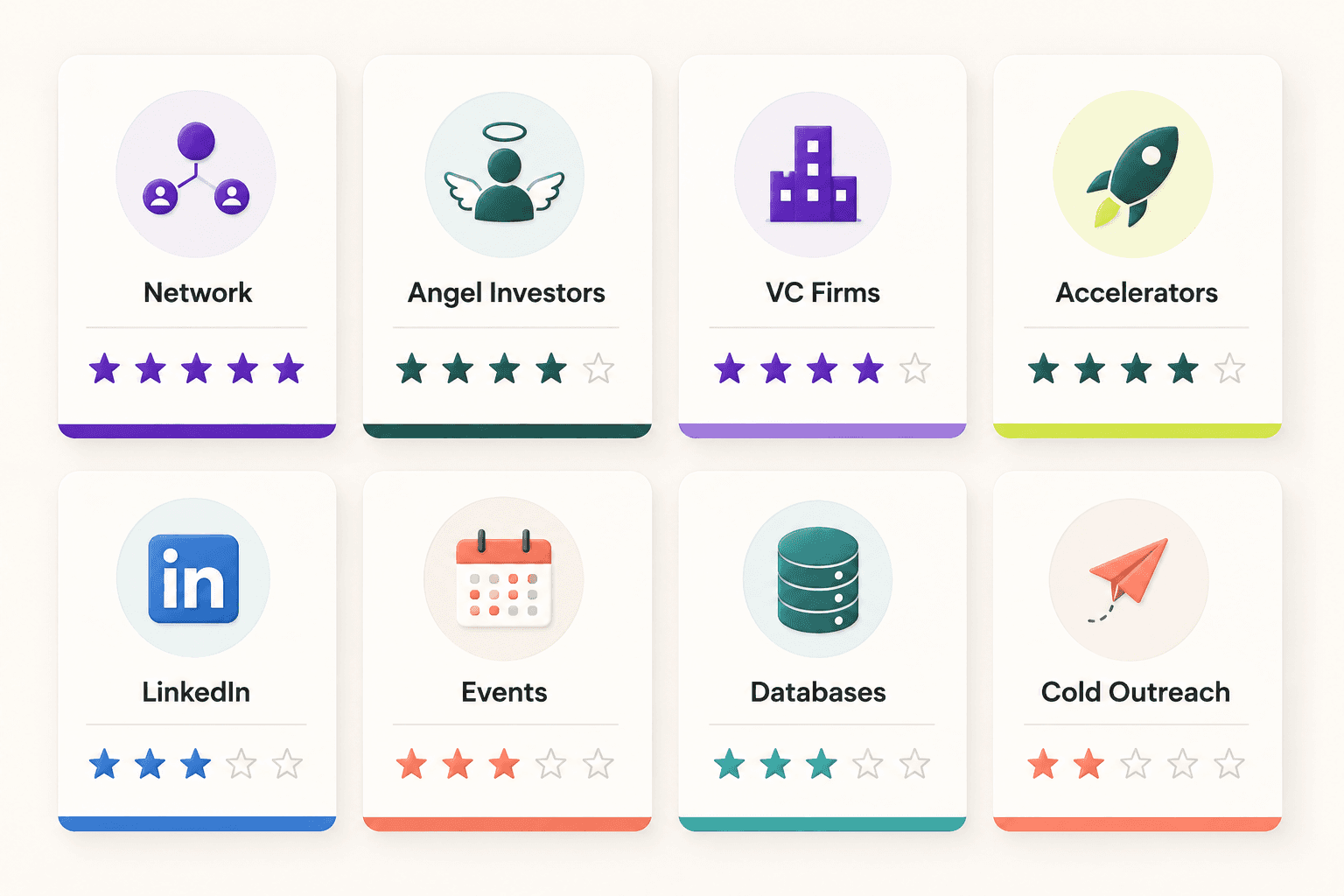
The 15 methods in this guide can be grouped into five categories:
Category | Methods | Best for |
|---|---|---|
Your existing network | Warm introductions, founder communities, LinkedIn, customers, advisors | Building trust and getting introductions |
Angel funding | Angel investors, angel networks, syndicates | Pre-seed and seed funding |
Venture capital | SaaS-focused VC firms | Seed, Series A, and growth rounds |
Startup ecosystem | Accelerators, Demo Days, startup events, competitions | Networking and investor exposure |
Investor research | Investor databases and cold outreach | Building a fundraising pipeline |
The first category consistently produces the highest-quality opportunities. Investors trust recommendations from founders, operators, and portfolio companies far more than unsolicited emails.
Build your network first

If there's one principle that consistently appears in successful fundraising stories, it's this:
Founders raise money through relationships.
That doesn't mean you need to know investors personally before launching your company. It means the strongest fundraising conversations usually begin long before the founder starts asking for capital.
Building relationships early gives investors an opportunity to watch your execution over time. They see product launches, customer growth, hiring decisions, and milestones instead of hearing about them for the first time during a pitch.
The following five channels are among the best ways to build those relationships.
1. Warm introductions from other founders
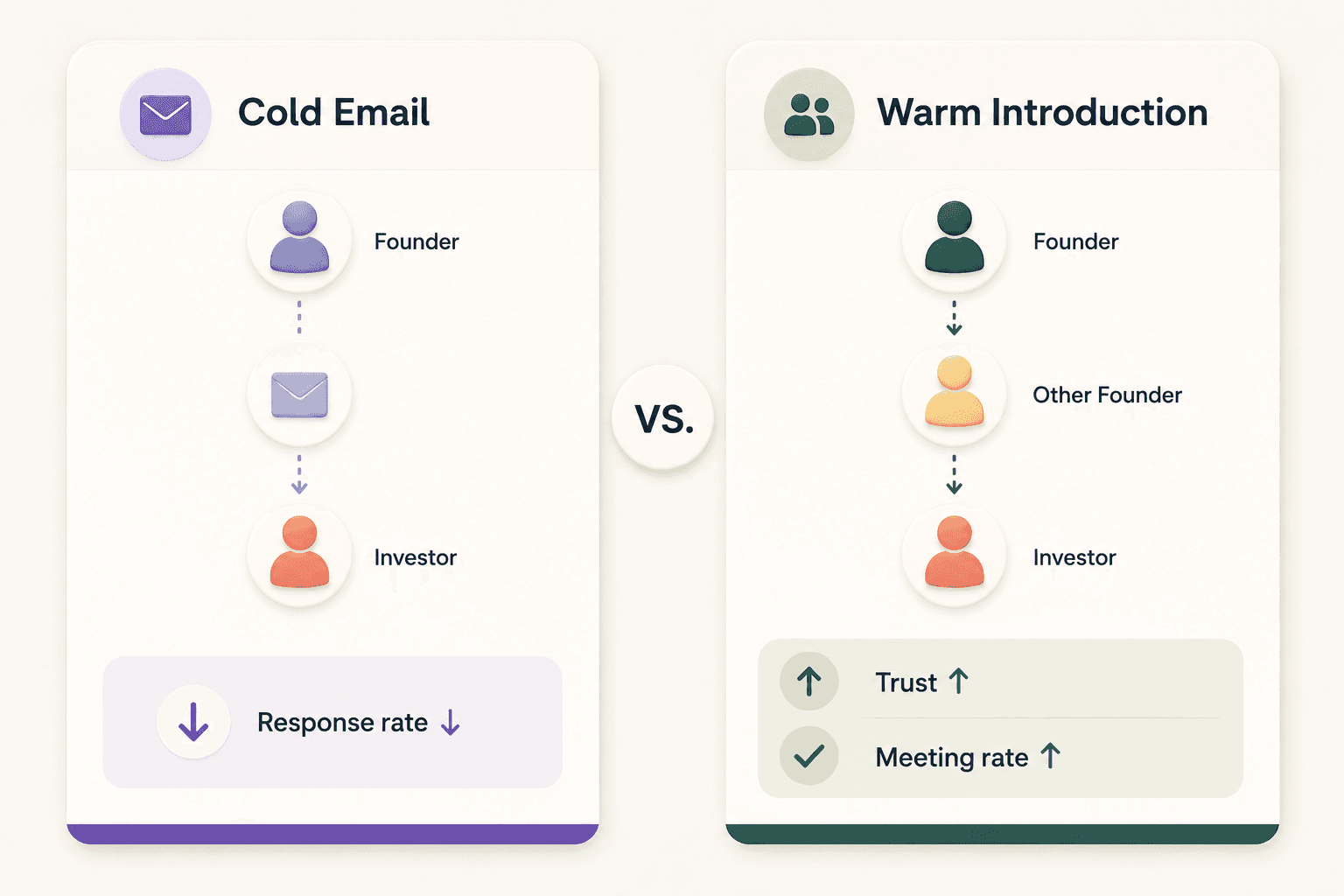
Warm introductions remain one of the most effective ways to meet investors.
When another founder introduces you, they're effectively lending part of their reputation to your company. Investors know that experienced founders rarely recommend startups they don't genuinely believe deserve attention.
Portfolio founders are often especially valuable because they already understand how a particular investor thinks and what types of businesses they fund.
Before asking for an introduction, make sure the investor is actually relevant.
Check whether they:
invest at your stage;
fund SaaS companies;
typically write checks of the size you're raising;
invest in your geography;
don't already back a direct competitor.
Making the introduction easy is equally important. Instead of asking someone to "tell them about my startup," prepare a short summary they can forward in less than a minute.
2. Founder communities
Founder communities are often underestimated as fundraising channels.
Most communities aren't filled with investors. They're filled with founders who already know investors.
That's an important distinction.
Experienced founders regularly introduce companies to angels and VC firms, recommend investors who were helpful during their own fundraising, and warn others about investors who weren't a good fit.
Communities also provide something equally valuable: fundraising feedback.
Before meeting investors, founders can receive input on:
pitch decks;
fundraising strategy;
SaaS metrics;
pricing;
positioning;
investor lists.
Over time, these conversations naturally lead to introductions.
Instead of joining communities only when you're raising capital, become an active participant early. Helping other founders creates relationships that often become valuable months later.
3. LinkedIn
LinkedIn has become one of the best platforms for building relationships with investors before fundraising begins.
Rather than thinking of LinkedIn as a place to send fundraising messages, think of it as a place to become visible.
Many investors regularly publish about the industries they're interested in, comment on market trends, and share recent investments. Following these conversations helps founders identify investors whose interests genuinely align with their companies.
LinkedIn is also one of the easiest ways to research investors before reaching out.
For example, you can review:
recent investments;
portfolio companies;
posts and comments;
mutual connections;
speaking engagements;
areas of expertise.
Instead of sending the same message to every investor, tailor your outreach around their investment thesis.
4. Existing customers
Customers can become much more than paying users.
Some become angel investors.
Others introduce founders to investors in their own network.
Even when neither happens, satisfied customers provide something investors value tremendously: validation.
Reference calls with real customers often become an important part of due diligence because they demonstrate that the product solves a meaningful business problem.
Strategic customers may also introduce founders to executives, operators, or angel investors with deep industry expertise.
5. Advisors and mentors
The right advisor can shorten months of fundraising into a handful of well-targeted introductions.
Because advisors already understand your business, they can identify investors who genuinely fit your company instead of introducing you to everyone in their network. They can also review your pitch, challenge your assumptions, prepare you for difficult investor questions, and help evaluate term sheets once offers begin arriving.
Specific requests almost always produce better results than general ones. Instead of asking whether an advisor knows any investors, explain exactly what you're looking for. A request such as "Do you know anyone investing in B2B SaaS companies raising $1 million seed rounds?" is much easier to answer and often leads to significantly better introductions.

Raise money from angel investors
Angel investors are often the first professional investors backing SaaS startups. Unlike venture capital firms, they invest their own capital, which usually allows them to move faster and support companies earlier in their journey.
Many experienced angels are former founders or operators who have already built software businesses themselves. As a result, they often contribute much more than funding. The right angel may introduce enterprise customers, help recruit early employees, review pricing decisions, or connect founders with future venture capital firms.
There are three primary ways SaaS founders typically raise angel funding.
6. Individual angel investors
Individual angel investors are usually the most accessible source of early-stage capital.
Rather than looking for the biggest names, focus on investors with experience in your market. Someone who has previously built or invested in enterprise software is far more likely to understand recurring revenue, long sales cycles, and customer retention than a generalist investor.
Founders often meet individual angels through founder communities, LinkedIn, startup events, accelerator alumni networks, or introductions from other entrepreneurs. You can also identify active angels by reviewing recent funding announcements for startups similar to your own.
The most valuable angels rarely contribute only money. They become long-term partners who open doors to customers, experienced operators, and future investors.
7. Angel investor networks
Angel investor networks allow founders to present their companies to groups of accredited investors instead of approaching individuals one by one.
Some of the best-known examples include:
These organizations typically review applications before inviting selected founders to pitch.
While acceptance can be competitive, one presentation may introduce your company to dozens of active angel investors simultaneously.
8. Investor syndicates
Investor syndicates have become increasingly popular over the past decade.
Rather than raising from one angel at a time, founders work with a lead investor who brings together multiple backers into a single round.
Platforms such as AngelList have helped make syndicates a common funding option for early-stage startups.
For founders, syndicates offer several advantages:
larger combined investments;
one lead investor coordinating the process;
access to broader investor networks;
potential introductions to future VC firms.
As with any investor, evaluate the syndicate lead carefully. Their experience, reputation, and willingness to support the company after closing the round are often more important than the amount of capital they contribute.
Approach venture capital firms
Venture capital firms become relevant once your startup has demonstrated enough traction to justify outside investment. While some pre-seed funds invest before revenue, most VCs look for evidence that customers value the product and that additional capital will accelerate an already growing business.
That doesn't mean you should pitch every well-known firm. The best investors are usually those whose investment thesis closely matches your company.
9. SaaS venture capital firms

Instead of searching for "the biggest VC firms," start by identifying investors that regularly back companies similar to yours.
Review their portfolio, investment stage, check size, geography, and recent investments. If a firm has already invested in several B2B SaaS companies targeting a similar customer segment, there's a much better chance they'll understand your business.
Some of the world's best-known SaaS-focused venture capital firms include:
VC firm | Known for |
|---|---|
One of the most active SaaS investors, with investments in Shopify, Twilio, PagerDuty, and many cloud software companies. | |
Early investor in Slack, Atlassian, Dropbox, and many enterprise SaaS startups. | |
Invests across AI, enterprise software, fintech, and cloud infrastructure. | |
Specializes in scaling software companies from growth through IPO. | |
Active investor in SaaS, developer tools, and infrastructure software. |
Smaller specialist funds can be equally valuable. A VC that focuses exclusively on vertical SaaS or developer tools may provide more relevant advice and introductions than a globally recognized multi-stage fund.
Once you've identified potential investors, study their existing portfolio. If you can clearly explain why your company fits alongside businesses they've already backed, your outreach becomes much stronger.
When should SaaS companies raise venture capital?
There's no universal revenue threshold for raising venture capital.
Some founders secure pre-seed funding before launching their product, while others wait until they reach meaningful recurring revenue. What matters is whether the company has enough evidence to convince investors that additional capital will create significantly more growth.
For many SaaS startups, that evidence comes in the form of growing MRR or ARR, improving customer retention, expanding usage, successful enterprise pilots, or a repeatable customer acquisition process.
Timing also affects negotiating power.
Founders who begin fundraising with only a few weeks of runway often feel pressured to accept the first reasonable offer. Companies that start building investor relationships several months before they need capital usually have more flexibility, more conversations running in parallel, and more leverage when discussing terms.
Join startup accelerators and pitch events
Accelerators and startup events are among the fastest ways to meet investors, experienced founders, and operators.
While the initial funding offered by many accelerators is relatively modest, the long-term value often comes from mentorship, alumni networks, and introductions to investors.
10. Startup accelerators
Startup accelerators combine funding, education, mentorship, and investor access into a structured program.
Some of the most respected accelerator programs include:
These programs have helped launch thousands of startups and maintain extensive networks of founders, operators, and investors.
Before applying, it's worth speaking with recent alumni rather than relying solely on marketing materials. Ask whether mentors remained involved after the program, whether investor introductions resulted in meaningful conversations, and whether the accelerator continued supporting founders once Demo Day was over.
11. Demo Days
Most major accelerators conclude with a Demo Day, where founders present their companies to hundreds of investors during a single event.
Examples include:
Y Combinator Demo Day
Techstars Demo Day
500 Global Demo Day
Many founders assume the presentation itself determines success. In practice, Demo Days are primarily conversation starters.
The goal isn't to explain every feature or answer every possible question. It's to create enough interest that investors ask for another meeting.
Founders who prepare thoughtful follow-ups often gain more value from Demo Day than those who focus exclusively on the presentation itself.
12. Startup events and conferences
Startup conferences remain one of the best places to build relationships face-to-face.
Rather than attending every large conference, prioritize events where your target investors are likely to participate.
Well-known examples include:
The most valuable networking often happens outside the keynote sessions. Side events, founder dinners, workshops, and informal meetups usually provide much better opportunities to build meaningful relationships.
Rather than trying to pitch every investor you meet, focus on starting conversations you'll be able to continue after the conference.
13. Startup competitions
Startup competitions can help founders gain visibility, media coverage, and investor attention while occasionally providing non-dilutive funding.
Some of the best-known competitions include:
Winning isn't the only objective.
Being selected as a finalist can increase credibility, generate press coverage, and create additional reasons to reconnect with investors you've already met.
Choose competitions carefully, however. Preparing applications and presentations takes time, so prioritize those that provide meaningful investor exposure rather than publicity alone.
Use investor databases and targeted outreach
Even founders with strong networks eventually need a systematic way to discover new investors.
Investor databases help identify firms and angels that match your company, while targeted outreach expands your fundraising pipeline beyond existing relationships.
14. Investor databases and startup funding platforms
Instead of manually searching the web, use specialized platforms that organize investors by industry, funding stage, geography, and check size.
Some of the most useful resources include:
Platform | Best for |
|---|---|
Researching startups, investors, and recent funding rounds | |
Institutional fundraising research and market intelligence | |
Free searchable database of venture capital firms | |
Startup ecosystem, hiring, and investor discovery |
These platforms are most valuable when combined with manual research. After identifying a potential investor, visit the firm's website, read about recent investments, and look for portfolio companies that resemble your own.
Over time, you'll build a much more focused pipeline than simply collecting hundreds of investor names.
15. Cold outreach
Cold outreach should complement your fundraising strategy, not define it.
Once you've exhausted warm introductions, communities, and existing relationships, targeted cold outreach can help you reach investors who are genuinely relevant but outside your network.
A good outreach email answers four questions within a few sentences:
What does your company do?
Who is your customer?
What traction have you achieved?
Why are you contacting this investor?
Avoid long product descriptions or attaching a pitch deck immediately.
Instead, include one or two meaningful metrics, such as:
current MRR;
revenue growth;
paying customers;
enterprise pilots;
customer retention.
Most importantly, explain why you selected that investor. Mentioning a relevant portfolio company or investment thesis demonstrates that you've done your research.
Cold outreach rarely outperforms warm introductions, but when it's personalized and backed by strong traction, it can still become an effective way to start conversations with the right investors.
How to increase your chances of getting funded
Knowing where to find investors is only half of the fundraising process. The other half is giving them a compelling reason to invest.
Successful fundraising isn't about having the most polished pitch deck or the longest investor list. It's about showing that your startup is solving an important problem, attracting customers, and making consistent progress.
The following practices can significantly improve your chances of raising capital.
Build relationships before you need funding
One of the simplest ways to improve your fundraising odds is to start talking to investors before you need capital.
That doesn't mean asking for meetings every month. It means giving investors opportunities to see your progress over time.
A short quarterly update about new customers, product launches, revenue milestones, or hiring decisions helps investors understand how quickly your company executes. By the time you officially begin raising money, they already have context instead of seeing your startup for the first time.
Many founders are surprised to discover that investors who ignored their company six months earlier become much more interested after seeing steady progress.
Build traction before raising capital
Investors fund momentum.
While every startup is different, traction reduces uncertainty by showing that customers already value the product.
Depending on your stage, meaningful traction might include:
Traction signal | Why it matters |
|---|---|
Paying customers | Confirms real demand |
Growing MRR or ARR | Demonstrates sustainable growth |
High customer retention | Suggests customers receive ongoing value |
Enterprise pilots | Indicates commercial interest |
Product usage | Shows engagement beyond signups |
Qualified sales pipeline | Demonstrates future growth potential |
Not every company needs impressive revenue before fundraising. A pre-seed startup with exceptional customer validation may still be attractive to investors. The important point is demonstrating that the business is moving in the right direction.
Prepare a pitch deck investors actually want to read
Your pitch deck should answer an investor's biggest questions quickly.
Most successful SaaS decks include:
The problem
The solution
Market opportunity
Business model
Traction
Go-to-market strategy
Competition
Team
Financial outlook
Fundraising ask
Keep the presentation focused on the business rather than the product.
Investors aren't evaluating whether every feature is perfect. They're deciding whether this company has the potential to become significantly larger over the next five to ten years.
Know the metrics investors expect
As fundraising progresses, conversations become increasingly data-driven.
While every stage has different expectations, most SaaS investors want founders to understand the core health of their business.
Some of the most important metrics include:
Metric | Why investors care |
|---|---|
MRR / ARR | Revenue growth |
Revenue growth rate | Business momentum |
Customer churn | Product quality and retention |
Net Revenue Retention (NRR) | Expansion potential |
Customer Acquisition Cost (CAC) | Sales efficiency |
Customer Lifetime Value (LTV) | Long-term economics |
Gross Margin | Scalability |
Burn Rate | Cash efficiency |
Runway | Time before additional funding is needed |
You don't need perfect metrics.
You do need to understand them, explain them confidently, and show how they're improving.
Common fundraising mistakes SaaS founders make
Even strong startups fail to raise capital because they make avoidable mistakes during the fundraising process.
Here are the ones investors see most often.
Raising too early
Many founders assume they should raise as soon as they launch.
In reality, spending another few months talking to customers, improving retention, or increasing recurring revenue can dramatically strengthen both investor interest and valuation.
Capital should accelerate momentum, not replace it.
Pitching the wrong investors
Not every investor is a potential investor.
Before reaching out, verify that they:
invest at your stage;
back SaaS companies;
write checks that fit your round;
invest in your geography;
are actively making investments.
A shortlist of fifty highly relevant investors is usually far more valuable than a spreadsheet containing five hundred names.
Treating fundraising like a numbers game
Sending hundreds of identical emails rarely produces meaningful results.
Instead, focus on building a smaller pipeline of investors who genuinely match your company.
Quality research almost always produces better meetings than mass outreach.
Waiting until cash is running out
Fundraising frequently takes several months.
Starting the process when your runway is already limited reduces negotiating power and increases pressure to accept unfavorable terms.
Whenever possible, begin fundraising while you still have enough capital to continue executing your roadmap.
Frequently asked questions
How do SaaS founders find investors without an existing network?
Most founders build their network over time through founder communities, startup accelerators, LinkedIn, startup events, and introductions from other entrepreneurs. Warm introductions usually come after consistently participating in the startup ecosystem rather than from existing personal connections.
Should I raise from angel investors or venture capital firms?
For many SaaS startups, angel investors are the best starting point because they invest earlier and often make faster decisions. Venture capital firms typically become a better fit once the company has demonstrated stronger traction and is preparing to scale.
What do SaaS investors look for?
Although every investor has a different thesis, most evaluate:
the founding team;
market opportunity;
customer traction;
recurring revenue;
growth potential;
competitive advantage;
capital efficiency.
Do cold emails to investors work?
Yes, but they usually perform much worse than warm introductions.
Cold outreach is most effective when it's personalized, targeted, and supported by meaningful traction.
How long does fundraising usually take?
Most institutional fundraising processes take between three and six months from the first conversation to closing a round.
Founders who begin building relationships before opening a round often move through the process more efficiently.
Final thoughts
There isn't a single place where SaaS founders find investors.
The strongest fundraising outcomes usually come from combining multiple channels: building relationships with founders, earning warm introductions, participating in startup communities, meeting investors through accelerators and events, researching relevant VC firms, and using targeted outreach to expand your pipeline.
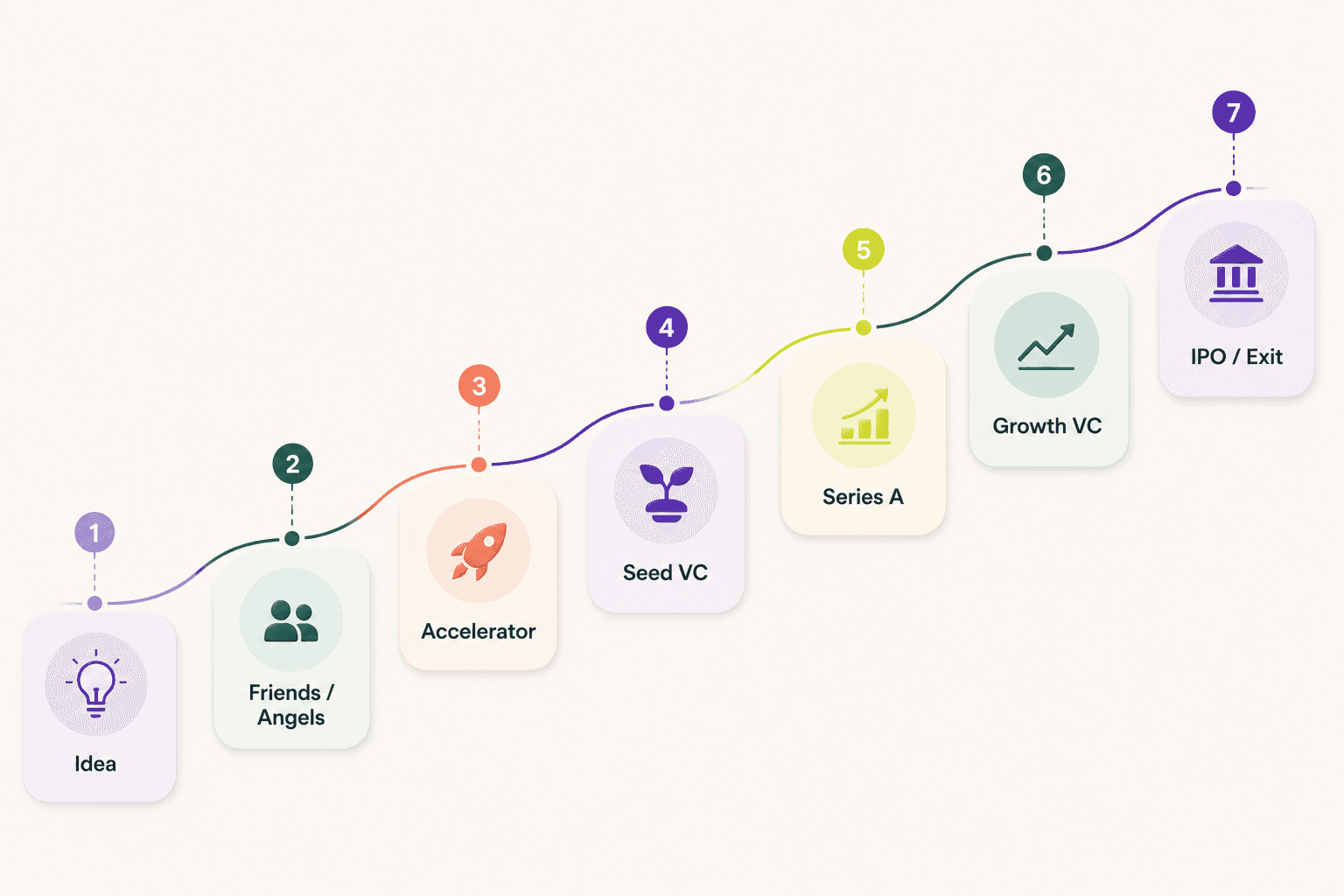
The right strategy also changes as your company grows. Early-stage startups often begin with angel investors, accelerators, and founder referrals, while companies with stronger traction become attractive to institutional venture capital firms.
If there's one lesson that applies to every stage, it's this:
Start building relationships before you need funding.
By the time you're ready to raise capital, investors should already know who you are, understand what you're building, and have seen evidence that your company continues to make progress. That's what turns fundraising from a cold sales process into a natural next step in an existing relationship.