Finance
How to value a SaaS company: methods & multiples

, Community Leader
38 minutes


Valuing a SaaS company looks simple until you try to do it. Take annual recurring revenue, apply a multiple, and you have a valuation. In practice, that calculation is only the starting point. Two SaaS companies with $2 million in ARR can have very different values if one is growing 40% a year with strong retention while the other is barely growing and losing customers.
That is why an accurate SaaS valuation requires looking beyond revenue. Growth rate, retention, gross margin, customer acquisition economics, profitability, customer concentration, and the predictability of future cash flows can all influence what investors or buyers are willing to pay. The appropriate valuation method also changes depending on whether you are valuing a small owner-operated SaaS business, a fast-growing startup, or a mature software company.
This guide explains how to value a SaaS company, which valuation metrics matter most, how SaaS valuation multiples work, and how to turn those inputs into a realistic valuation range.
Understanding SaaS valuation and company value
SaaS valuation is the process of estimating the economic value of a software-as-a-service business. Depending on the purpose, that value might represent what an acquirer could reasonably pay for the company, what investors might accept in a funding round, or what a business owner could expect when considering a sale.
There is rarely one objectively correct number. A valuation is better understood as a range supported by the company's financial performance, revenue quality, growth prospects, risk profile, and current market conditions. Different buyers can also assign different values to the same company because they have different return requirements, strategic priorities, and assumptions about future performance.
For a simple example, suppose a SaaS business has $2 million in ARR. If comparable businesses are valued between 4× and 6× ARR, an initial valuation range would be:
$2M ARR × 4–6 = $8M–$12M enterprise value
That does not mean the company is automatically worth $8 million to $12 million. The next question is where it belongs within that range, or whether its characteristics justify moving outside it. That is where SaaS valuation metrics become important.
Why SaaS companies are valued differently
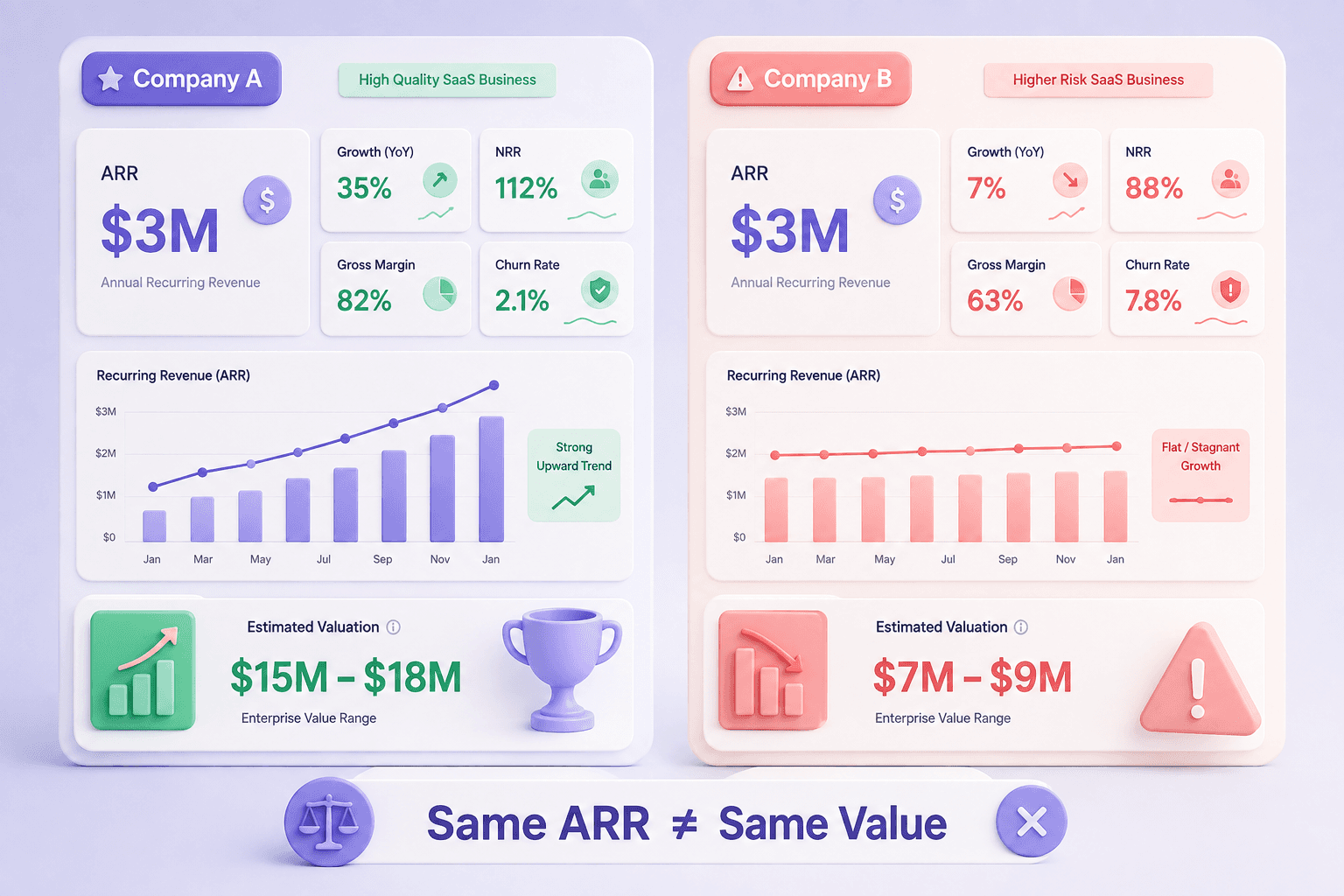
The SaaS business model has several characteristics that can make its revenue more predictable than revenue from a traditional project-based software company. Customers typically pay recurring subscription fees, contracts can renew automatically or periodically, and the marginal cost of serving additional customers can be relatively low once the product and infrastructure are in place.
This means a buyer is not simply purchasing the company's current revenue. They are purchasing an existing base of recurring customer relationships and the cash flows those relationships may produce in the future. If customers stay for years, expand their accounts, and require relatively little incremental cost to serve, each dollar of current ARR can potentially support considerable long-term value.
But recurring revenue alone does not make a SaaS company valuable. A business with high churn may have to replace a significant part of its customer base every year simply to maintain its current ARR. Another SaaS company might retain nearly all of its customers and generate additional revenue as existing accounts add users, upgrade plans, or increase usage.
This difference in revenue quality is one reason SaaS companies with similar revenue can receive very different valuation multiples. Modern SaaS valuation frameworks therefore tend to combine recurring revenue with growth, retention, margins, capital efficiency, profitability, and other measures of business quality.
How the SaaS business model affects valuation
The subscription model changes how investors think about both current performance and future value. Instead of asking only how much revenue the company generated last year, an investor can examine how much recurring revenue enters the next period already attached to existing customers.
Consider two software companies that each generated $3 million in revenue:
Company | Revenue | Recurring revenue | Growth | NRR | Gross margin |
|---|---|---|---|---|---|
Company A | $3M | 90% | 30% | 110% | 82% |
Company B | $3M | 40% | 5% | 85% | 60% |
Company A has a much more predictable starting point for the next year. Its 110% net revenue retention (NRR) also means that revenue from its existing customer base has increased after accounting for expansion, contraction, and churn. Company B has to replace more lost revenue and relies much more heavily on generating new sales.
An investor would therefore be unlikely to value these businesses at the same multiple simply because their reported revenue is identical.
The same principle applies within the SaaS industry itself. Enterprise SaaS with multi-year contracts can have a different risk profile from a low-priced self-service SaaS startup with monthly subscriptions. Usage-based products can behave differently from traditional per-seat subscriptions, while AI software can introduce substantial variable inference costs that affect gross margins. The business model determines how predictable and economically valuable the revenue actually is.
SaaS company valuation vs. traditional business valuation
Traditional businesses are often valued primarily around earnings and cash flow. For a mature company with relatively stable growth, EBITDA can provide a useful representation of the operating earnings available to its owners.
SaaS businesses create a complication because many growing companies deliberately sacrifice current profit to acquire customers, develop the product, and expand into new markets. A company could therefore have little or negative EBITDA while building a recurring revenue base with substantial economic value.
This is why revenue multiple valuation is common for growing SaaS companies. Mature and profitable SaaS companies can increasingly be evaluated using EBITDA multiples, while smaller owner-operated SaaS businesses may be valued using seller's discretionary earnings (SDE). In actual transactions, buyers can compare several valuation methods rather than relying on a single formula.
The distinction matters when trying to understand how to value a SaaS business. Applying a generic small-business earnings multiple to a rapidly growing SaaS company could undervalue its recurring revenue and growth. Applying a high public SaaS revenue multiple to a small private SaaS company could produce the opposite problem by ignoring differences in scale, liquidity, customer concentration, and risk.
Key SaaS valuation metrics
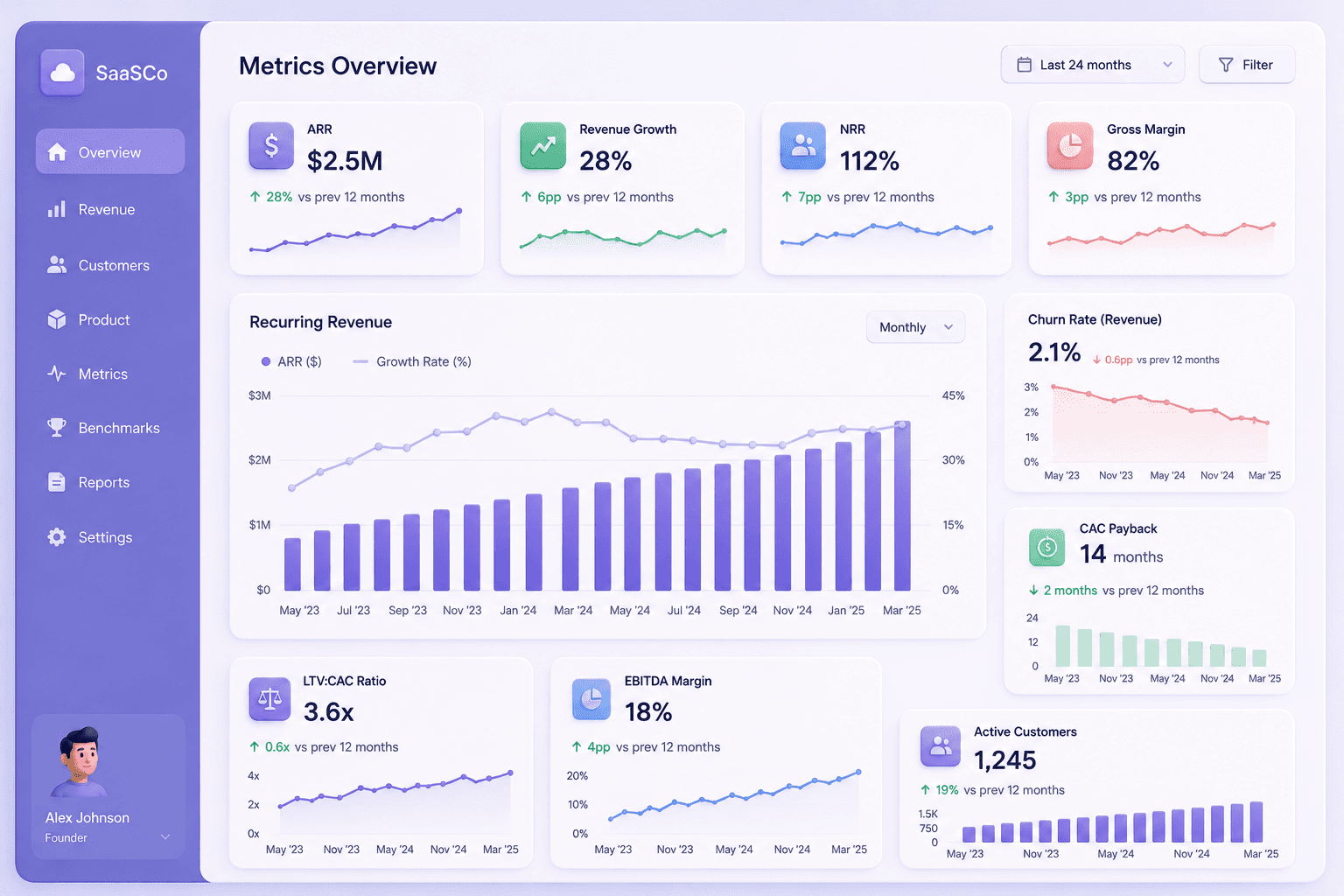
A valuation multiple tells you how the market converts a financial metric into company value. It does not tell you which multiple a particular company deserves. To determine that, investors and buyers examine the characteristics of the underlying business.
The most important valuation metrics generally answer four questions: How large is the recurring revenue base? How quickly is it growing? How much of that revenue stays with the company? And how efficiently can the business turn growth into future profit?
Annual recurring revenue and revenue growth
Annual recurring revenue (ARR) is one of the most important metrics for valuing SaaS companies because it measures the recurring subscription revenue the business expects to generate over a year from its current customer base.
For businesses with relatively stable monthly subscriptions, a simplified calculation is:
ARR = MRR × 12
If a SaaS company has $150,000 in monthly recurring revenue, for example, its annual recurring revenue would be approximately $1.8 million.
ARR should not automatically include every dollar the company earns. One-time implementation fees, consulting work, hardware sales, and other non-recurring revenue usually need to be separated from genuine subscription revenue. A buyer interested in the value of a SaaS business wants to understand how much revenue is likely to repeat without having to be sold again from scratch.
Growth rate adds the second part of the picture. Suppose two SaaS companies each have $5 million in ARR, but one grew 35% over the past year while the other grew 5%. Assuming their other valuation factors are similar, investors will generally expect the faster-growing company to generate substantially more revenue in future years, which can justify a higher multiple.
Growth quality matters as well. A company that doubles ARR by spending unsustainably on customer acquisition is different from one growing at the same rate with efficient acquisition and strong retention. Valuation therefore cannot be based on growth rate in isolation.
Net revenue retention and customer churn
Retention reveals what happens to revenue after customers have been acquired. This is particularly important in SaaS because the economics of the business depend on customers continuing to pay over time.
Net revenue retention measures how recurring revenue from an existing cohort changes after accounting for churn, downgrades, and expansion:
NRR = (Starting recurring revenue − churn − contraction + expansion) ÷ starting recurring revenue × 100
Imagine a SaaS company begins the year with $1 million in ARR from an existing group of customers. During the year, it loses $80,000 through churn and downgrades but gains $180,000 through upgrades and expansion. Its NRR is 110%.
An NRR above 100% means the existing customer base is generating more revenue over time even before new customers are added. That can be particularly valuable because growth does not depend entirely on continually replacing lost customers with new ones.
Churn shows the other side of the equation. High customer or revenue churn reduces the lifetime value of customers and makes future revenue less predictable. It can also force the business to spend more aggressively on acquisition simply to replace revenue that disappears each year.
For valuation purposes, retention therefore helps distinguish recurring revenue on paper from genuinely durable recurring revenue.
Gross margin and profitability
Gross margin measures how much revenue remains after the direct costs required to deliver the service. For a SaaS company, these costs can include hosting infrastructure, third-party services, customer support associated with service delivery, and other components of cost of goods sold.
A SaaS business generating $5 million in revenue at an 85% gross margin has $4.25 million in gross profit. At a 60% gross margin, the same revenue produces only $3 million.
That difference affects valuation because gross margin influences how efficiently additional revenue can eventually become operating profit and cash flow. It also demonstrates why investors should not treat all recurring revenue as economically identical.
Profitability becomes increasingly important as a SaaS company matures. Fast-growing startups may reasonably operate at a loss while reinvesting heavily, but slower-growing businesses generally have less justification for sustained negative margins. Buyers evaluating mature SaaS companies may therefore place considerably more weight on EBITDA and free cash flow than investors evaluating an early-stage SaaS startup.
This relationship between growth and profitability will become important later when we examine the Rule of 40 and how investors decide whether growth is efficient enough to justify a premium multiple.
CAC, LTV, and CAC payback
Customer acquisition cost (CAC) measures how much a company spends to acquire a new customer. Customer lifetime value (LTV) estimates the economic value that a customer can generate over the relationship with the business.
Taken together, these metrics help answer a fundamental question: Does spending money to acquire another customer create value?
A SaaS company might have impressive ARR growth while hiding poor unit economics. If acquiring $1 of new recurring revenue requires excessive sales and marketing spending, and customers churn before those costs are recovered, continued growth can consume rather than create capital.
CAC payback makes this relationship easier to see by measuring how long it takes the gross profit generated by a customer to recover the acquisition cost. A shorter payback period generally gives the company more flexibility to reinvest its cash into additional growth. LTV: CAC provides a longer-term view by comparing the estimated lifetime economics of a customer with what it costs to acquire that customer.
These metrics should be interpreted carefully rather than against one universal benchmark. CAC and lifetime value can vary substantially depending on whether a SaaS company sells a $20 self-service subscription or a six-figure enterprise contract. What matters for valuation is whether the economics are sustainable within the company's particular SaaS business model.
Other key metrics that impact valuation
ARR, growth, retention, and margins provide a strong starting point, but they do not capture every source of risk. Buyers evaluating a private SaaS company will usually look deeper into the composition and durability of its revenue.
Important additional factors include:
Customer concentration: losing one customer is much more dangerous if that customer represents 25% of ARR rather than 1%.
Contract length: annual and multi-year commitments can provide more revenue visibility than easily canceled monthly subscriptions.
Expansion revenue: customers who naturally spend more over time can support growth without proportional increases in acquisition spending.
Revenue concentration by product or market: dependence on a single integration, platform, geography, or narrow customer segment can increase risk.
Burn and cash generation: two companies with identical growth can have very different capital requirements.
Founder dependence: a business that cannot operate without the founder may be less attractive to an acquirer.
Market position: competitive differentiation, switching costs, proprietary technology, and market size can influence expectations about long-term value.
The key point is that valuation metrics should be considered together. ARR establishes scale, growth indicates momentum, retention reveals durability, margins show the underlying economics, and risk factors influence how confident a buyer can be that those economics will continue.
That combination ultimately determines not only the value of a SaaS company, but also which valuation method and multiple make sense. In the next part, we can move from the underlying metrics to the actual mechanics of SaaS valuation methods and multiples.
SaaS valuation methods
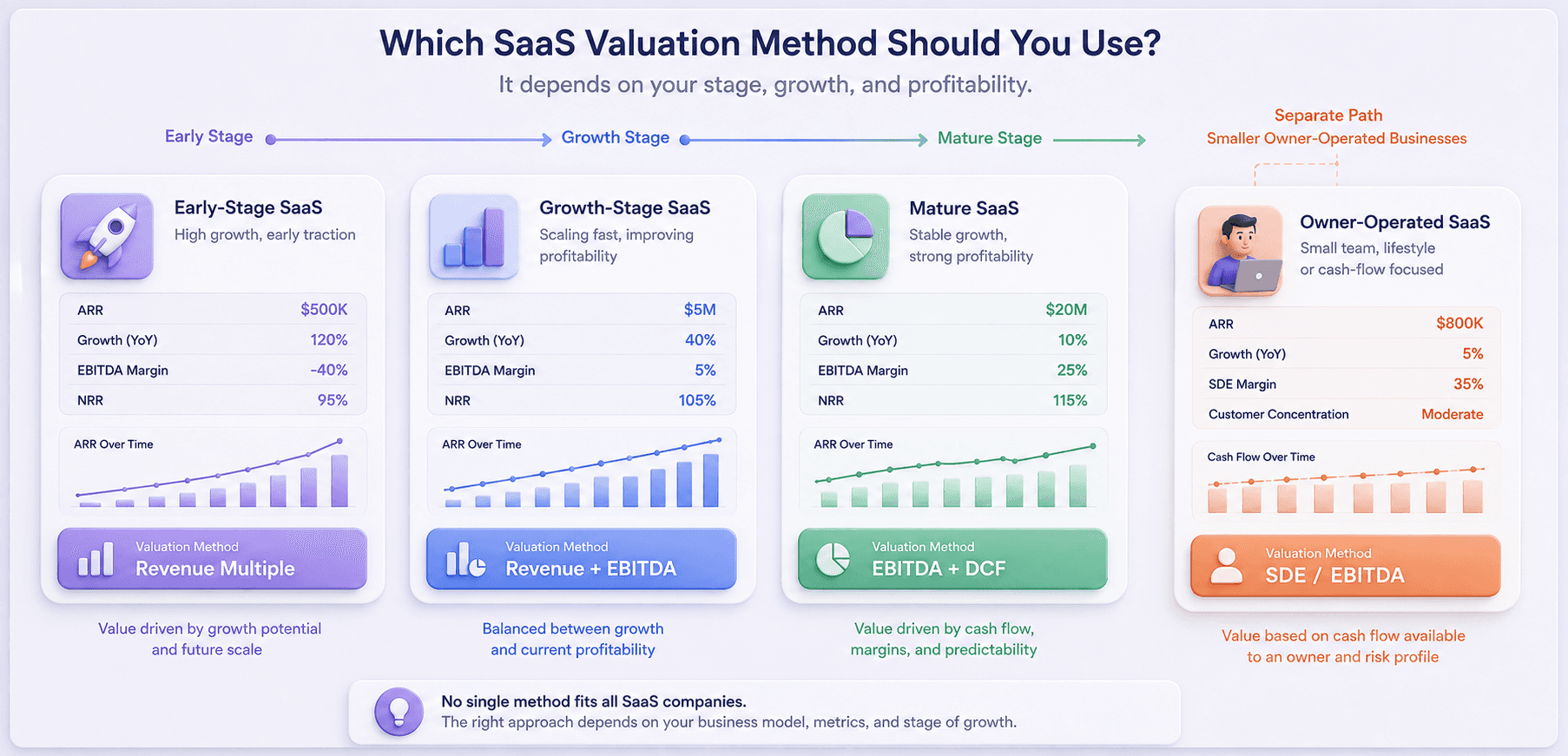
Once you understand the underlying metrics, the next step is choosing a valuation method. There is no single formula that works for every SaaS company. The appropriate approach depends on the company's size, growth rate, profitability, maturity, and the reason for the valuation.
A fast-growing SaaS startup may be valued primarily on recurring revenue because current earnings understate its potential. A mature, profitable SaaS business may be valued on EBITDA or cash flow. Investors evaluating a larger company may also use comparable public SaaS companies, precedent transactions, and discounted cash flow analysis to test whether the resulting valuation makes sense.
In practice, an accurate valuation often comes from using several methods and comparing the results rather than treating any one calculation as definitive.
Revenue multiple valuation
Revenue multiple valuation is one of the most common ways to value a SaaS company, particularly when the business is growing quickly and reinvesting enough that current profit is not yet representative of its long-term economics.
The basic calculation is straightforward:
Enterprise value = ARR × revenue multiple
Suppose a company generates $3 million in annual recurring revenue and an appropriate multiple is 5× ARR:
$3M × 5 = $15M enterprise value
The difficult part is not the calculation. It is determining whether 5× is actually the right multiple.
A higher-growth company with strong NRR, attractive gross margins, efficient customer acquisition, and low concentration risk may justify a higher revenue multiple. A slower-growing business with high churn and weak margins may deserve a considerably lower one even if both companies generate the same ARR.
Revenue multiples are especially useful when comparing SaaS companies with different levels of reinvestment. One company might spend heavily on sales and product development and report little EBITDA, while another prioritizes short-term profitability. Looking at revenue provides a common starting point, although it still needs to be adjusted for the quality of that revenue.
EBITDA multiple valuation
As SaaS companies mature and become consistently profitable, EBITDA can become more useful. Instead of asking how much recurring revenue the company generates, an EBITDA multiple focuses on the operating earnings produced by the business.
The basic calculation is:
Enterprise value = EBITDA × EBITDA multiple
For example, a mature SaaS business with $2 million in adjusted EBITDA valued at 8× EBITDA would have an estimated enterprise value of:
$2M × 8 = $16M
This method can be particularly relevant for smaller SaaS businesses where buyers care more about cash generation than venture-style growth. It is also useful when growth has slowed enough that a revenue multiple alone would give an incomplete picture of the company's value.
EBITDA does have limitations. Two companies generating the same EBITDA today can have very different prospects if one is growing 30% and the other is shrinking. Conversely, a company can increase EBITDA temporarily by cutting sales, marketing, or product investment in ways that damage future growth.
For owner-operated smaller SaaS businesses, buyers may sometimes use seller's discretionary earnings (SDE) rather than EBITDA. SDE adjusts earnings to reflect the financial benefit available to a single owner, including certain owner compensation and discretionary expenses. The appropriate metric therefore depends heavily on who is buying the business and why.
Discounted cash flow valuation method
Discounted cash flow (DCF) takes a fundamentally different approach. Rather than applying a market multiple to current revenue or earnings, it estimates the cash flows a SaaS business could generate in the future and discounts those cash flows back to their present value.
Conceptually:
Company value = present value of expected future cash flows
A DCF requires assumptions about revenue growth, margins, reinvestment, taxes, future cash flows, the discount rate, and terminal value. Small changes in those assumptions can produce large changes in the resulting valuation.
That sensitivity makes DCF difficult to use for an early-stage SaaS startup. Predicting cash flows five or ten years into the future is inherently uncertain when the company is growing rapidly, its market is evolving, and its long-term margin structure has not yet been established.
DCF becomes more useful for mature SaaS companies with predictable revenue, established margins, and a meaningful operating history. Even then, it is often better used alongside market-based valuation methods rather than as a source of false precision.
Comparable SaaS companies
Comparable company analysis asks what similar businesses are worth and uses those valuations as a reference point. For SaaS companies, this commonly means comparing metrics such as enterprise value to revenue or enterprise value to EBITDA.
A useful peer group should resemble the company being valued in several dimensions, including:
revenue scale and growth rate
target market and customer size
gross margin and profitability
retention characteristics
business model and revenue mix
geographic exposure
capital requirements
This matters because simply labeling two businesses "SaaS" does not make them comparable. A $500 million public enterprise software company growing 25% annually has a very different risk profile from a private SaaS company with $2 million in ARR and ten employees.
Public SaaS companies are nevertheless useful because their market values are observable. They can show how investors currently price different combinations of growth and profitability. The resulting public multiples then need to be interpreted carefully before being applied to a smaller private SaaS company.
Precedent transactions
Precedent transaction analysis looks at prices actually paid for comparable SaaS companies in acquisitions. Instead of asking how the stock market currently values similar businesses, it asks what buyers have historically been willing to pay to acquire them.
This can be especially useful when the purpose of the valuation is a potential sale. Acquisition prices can incorporate factors that public-market valuations do not, including control premiums and strategic value to a particular buyer.
The challenge is finding genuinely comparable transactions with enough disclosed financial information. Private acquisition terms are often confidential, and headline purchase prices do not always reveal ARR, EBITDA, growth, retention, or the deal structure.
For that reason, precedent transactions work best as another reference point rather than a mechanical formula for determining the value of your SaaS business.
How SaaS valuation multiples work
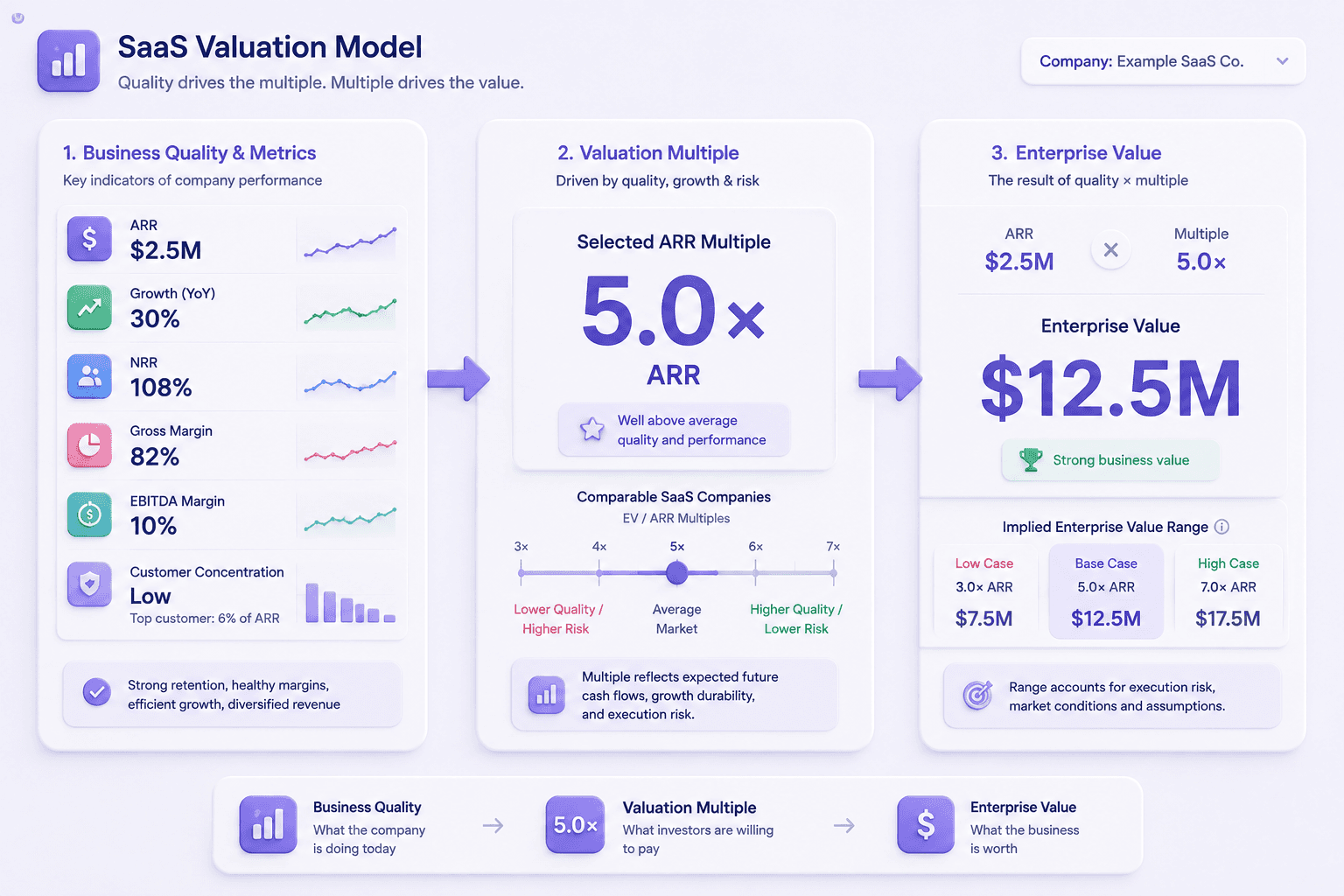
A valuation multiple is essentially a shorthand for a much larger set of expectations. When an investor pays 6× ARR rather than 3× ARR, they are not paying more simply because they prefer a larger number. They are usually expressing greater confidence in the company's future growth, retention, margins, and eventual cash generation.
This is why there is no universal SaaS valuation multiple. Multiples vary between companies and also change as interest rates, public-market valuations, investor risk appetite, and expectations about the SaaS market change.
Choosing the right SaaS valuation multiple
The starting point for choosing a multiple is usually a set of comparable companies or transactions. The next step is determining whether the company being valued deserves a discount or premium relative to those benchmarks.
Imagine three SaaS companies that each generate $4 million in ARR:
Metric | Company A | Company B | Company C |
|---|---|---|---|
ARR | $4M | $4M | $4M |
Growth rate | 10% | 30% | 50% |
NRR | 92% | 105% | 120% |
Gross margin | 65% | 80% | 85% |
EBITDA margin | 20% | 5% | -10% |
Customer concentration | High | Low | Low |
Company A is profitable but has slow growth, weak NRR, and customer concentration, which reduces the quality of its revenue. Company C is losing money, but rapid growth, strong expansion, and high gross margins could support a substantially higher valuation if investors believe that growth can eventually translate into profit. Company B sits somewhere between the two.
The appropriate multiple therefore reflects both current performance and expectations about what the business can become.
Revenue multiple vs. EBITDA multiple
Whether revenue or EBITDA should be the primary valuation metric depends largely on the company's stage.
Company profile | Metric likely to be more useful | Why |
|---|---|---|
Early-stage, high-growth SaaS | ARR/revenue | Current profit may be intentionally low or negative |
Growth-stage SaaS | ARR + EBITDA | Both growth and operating efficiency matter |
Mature profitable SaaS | EBITDA/cash flow | Earnings are established and more predictable |
Small owner-operated SaaS | SDE/EBITDA | Buyers often focus on owner cash flow |
Declining SaaS business | EBITDA/cash flow | Revenue alone can overstate long-term value |
This does not mean an investor should ignore profitability when using a revenue multiple. If two SaaS companies grow at similar rates but one burns significant amounts of cash to achieve that growth, the difference should eventually appear in their valuation multiples.
Likewise, an EBITDA multiple should not cause investors to ignore growth. A profitable SaaS company that is shrinking may generate attractive cash flow today while having much less long-term value than its current earnings suggest.
Public vs. private SaaS company valuation multiples
Public SaaS companies provide the most visible valuation data because their enterprise values and financial results are publicly available. However, applying a public SaaS multiple directly to a private company can lead to an inflated valuation.
Public companies tend to be larger, more diversified, more liquid, and subject to extensive financial reporting. They may have hundreds or thousands of customers, established management teams, stronger access to capital, and less dependence on individual founders or customers.
A smaller private SaaS company can carry additional risks:
greater customer concentration
shorter operating history
dependence on founders or key employees
less predictable access to financing
limited liquidity for shareholders
narrower product and market diversification
As a result, the valuation of a private SaaS company may require a discount relative to superficially similar public SaaS companies. There is no fixed "private company discount" that can simply be applied to every case. The magnitude depends on the specific risks of the business.
This distinction is especially important for founders trying to value smaller SaaS businesses. Seeing a public software company trade at a high revenue multiple does not mean a buyer will offer the same multiple for a $1 million ARR company.
Why valuation multiples change over time
Valuation multiples are not permanent properties of SaaS companies. They reflect what investors are willing to pay under current market conditions.
Interest rates are one important factor. Much of the value of a high-growth SaaS company comes from profits expected years into the future. When the discount rate applied to those future cash flows rises, their present value falls. That can put downward pressure on revenue multiples even if the underlying SaaS companies continue growing.
Market sentiment also matters. During periods when investors strongly prioritize growth, rapidly expanding software companies can command premium multiples despite weak current profitability. When capital becomes more expensive, investors may shift toward efficient growth, free cash flow, and proven profitability.
This is why using an old benchmark can produce an inaccurate valuation. A multiple observed during a strong SaaS market several years ago may have little relevance to what buyers and investors will pay today.
How growth and profitability impact valuation
Growth and profitability can appear to pull a SaaS company in opposite directions. Spending more on sales, marketing, and product development can accelerate growth while reducing current earnings. Cutting those investments can improve EBITDA while slowing the company down.
The valuation question is therefore not simply whether growth or profitability is better. It is whether the company is creating enough future value to justify what it spends today.
The Rule of 40
The Rule of 40 provides a simple way to examine that trade-off. It adds a company's revenue growth rate to a profitability margin, commonly free cash flow margin or EBITDA margin depending on the analysis.
Growth rate + profit margin = Rule of 40 score
For example:
Growth | Profit margin | Combined score |
|---|---|---|
50% | -10% | 40% |
30% | 10% | 40% |
15% | 25% | 40% |
10% | -5% | 5% |
The first three companies arrive at the same 40% score through very different combinations of growth and profitability. The fourth is both slow-growing and unprofitable, which is much harder to justify economically.
The Rule of 40 should not be treated as a valuation formula. A company does not automatically deserve a specific multiple because its score exceeds 40%. It is better viewed as a quick measure of whether the balance between growth and profitability looks healthy.
Growth vs. profitability
Growth usually has the greatest impact on valuation when investors believe it can eventually produce profitable scale. That means the source of growth matters.
A SaaS company growing 40% with strong retention and attractive gross margins has a plausible path toward larger future cash flows. Another company growing at the same rate while losing customers rapidly and replacing them through expensive acquisition may have much weaker economics.
Profitability becomes more important as growth slows. A mature SaaS business growing 8% annually cannot rely on rapid expansion to justify years of substantial losses. Investors are more likely to expect that company to convert its established recurring revenue into EBITDA and free cash flow.
This creates a natural evolution in how SaaS companies are valued. Early-stage businesses are often judged primarily on growth and revenue quality. Growth-stage companies need to demonstrate increasingly efficient expansion. Mature SaaS businesses are expected to produce meaningful profit and cash.
Why efficient growth can increase the value of a SaaS business
Efficient growth is valuable because it reduces the amount of outside capital required to create additional recurring revenue. A company that can add $1 million of ARR while burning $500,000 is economically different from one that needs $3 million of additional capital to generate the same increase.
Retention can make this effect even stronger. When existing customers expand their spending, part of the company's growth occurs without acquiring entirely new accounts. Strong NRR can therefore make growth more durable and potentially more capital efficient.
This helps explain why valuation factors cannot be considered independently. Higher growth can support a higher multiple, but only when the economics behind that growth are credible. Strong margins are valuable, but maximizing short-term margins by eliminating productive growth investment can reduce long-term value.
The objective when valuing SaaS is to understand how these factors work together. Once that relationship is clear, the analysis can move from market concepts to the practical valuation process: selecting benchmarks, calculating a range, and adjusting it for the company's specific strengths and risks.
How to value a SaaS company step by step
At this point, the individual pieces of SaaS valuation can be combined into a practical process. The objective is not to produce a number with false precision, but to determine a defensible valuation range based on the company's actual performance and the prices investors or buyers are willing to pay for comparable businesses.
The process below works particularly well for private SaaS companies with an established recurring revenue base. Earlier startups with little revenue require more judgment, while mature businesses may place greater weight on EBITDA and cash flow.
Step 1: Calculate recurring revenue
Start by determining how much of the company's revenue is genuinely recurring. For most subscription SaaS businesses, this means calculating MRR and annual recurring revenue while separating implementation fees, consulting, hardware, and other one-time revenue.
If a company has $200,000 in normalized MRR:
$200,000 × 12 = $2.4 million ARR
This $2.4 million becomes the starting point for a revenue-based valuation. However, it is important to normalize the figure rather than simply taking the latest month's revenue and multiplying it by twelve when the business has significant seasonality, temporary discounts, unusual contracts, or other distortions.
You should also understand the composition of that ARR. $2.4 million distributed across 500 customers represents a different risk profile from $2.4 million where one enterprise account contributes $800,000. The amount of recurring revenue establishes scale, while its composition helps determine its quality.
Step 2: Review SaaS valuation metrics
Next, evaluate the key metrics that determine whether the business should receive a lower or higher multiple. At minimum, the analysis should include growth, retention, gross margin, profitability, and customer acquisition economics.
A practical valuation scorecard might look like this:
Metric | What to examine | Why it matters |
|---|---|---|
ARR | Current recurring revenue | Establishes the revenue base |
Growth rate | YoY ARR growth | Indicates future revenue potential |
NRR | Expansion, contraction, and churn | Measures durability of existing revenue |
Gross margin | Gross profit ÷ revenue | Indicates underlying SaaS economics |
EBITDA margin | Operating profitability | Shows current earnings capacity |
CAC payback | Months to recover CAC | Measures acquisition efficiency |
Customer concentration | ARR from largest customers | Reveals revenue risk |
Rule of 40 | Growth + profit margin | Provides a quick growth-efficiency check |
Do not turn this into a mechanical scoring system where every metric receives a fixed number of points. The significance of each metric depends on the business model. Retention may deserve greater weight in an enterprise SaaS business, while acquisition efficiency can be particularly important for a self-service product dependent on paid acquisition.
Step 3: Evaluate the SaaS business and its unit economics
The next step is to understand what is driving the headline metrics. A company growing 35% annually may initially look attractive, but that growth becomes less valuable if customer churn is increasing, CAC has doubled, or sales efficiency has deteriorated.
Look at trends rather than a single snapshot. Ideally, examine several years or at least several quarters of data to determine whether growth, NRR, gross margin, and acquisition efficiency are improving or deteriorating.
This is also where customer lifetime value can provide useful context. If customers remain for a long time, produce high gross margins, and cost relatively little to acquire, the company can reinvest in growth with attractive economics. If the business continually spends large amounts to replace customers who leave quickly, its reported ARR may overstate the long-term value of the underlying customer base.
A buyer will also want to know whether these economics can survive a change in ownership. If most sales come directly through the founder's relationships or customer retention depends heavily on the founder personally managing key accounts, the historical metrics may not fully represent what the business will look like after a sale.
Step 4: Choose a valuation method
The company's stage should determine which valuation method receives the most weight.
A simplified framework is:
SaaS company profile | Primary valuation approach |
|---|---|
Early-stage with limited revenue | Funding comparables, market approach, strategic value |
High-growth recurring-revenue SaaS | ARR/revenue multiple |
Growth-stage and approaching profitability | Revenue multiple + EBITDA/DCF cross-check |
Mature profitable SaaS | EBITDA multiple + DCF |
Smaller owner-operated SaaS | SDE or EBITDA multiple |
Potential strategic acquisition | Market valuation + strategic premium analysis |
Using more than one method is useful whenever the data allows it. If a revenue multiple implies a $20 million valuation while a reasonable DCF produces $8 million, the discrepancy deserves investigation rather than automatically averaging the two numbers.
The purpose of multiple methods is to challenge your assumptions. They should help explain why a company is worth what you think it is worth.
Step 5: Select a valuation multiple
Now identify comparable SaaS companies and transactions and establish a reasonable multiple range. This is where current market data matters most because SaaS valuation multiples can change substantially over time.
Suppose relevant private SaaS businesses suggest a range of 4× to 6× ARR. Instead of immediately choosing the midpoint, compare the target company with the businesses behind that benchmark.
Factors that could justify moving toward the upper end include strong growth, NRR above 100%, high gross margins, efficient acquisition, diversified customers, and a defensible market position. Weak growth, high churn, customer concentration, founder dependence, or deteriorating unit economics would push the valuation toward the lower end.
The result might look like this:
Market range: 4×–6× ARR
Target company assessment: above average
Selected range: 5×–5.5× ARR
This is more defensible than declaring that "SaaS companies are worth 5× revenue" without explaining why that multiple applies to this particular company.
Step 6: Estimate the value of your SaaS company
Once you have selected the metric and multiple range, calculate the implied enterprise value.
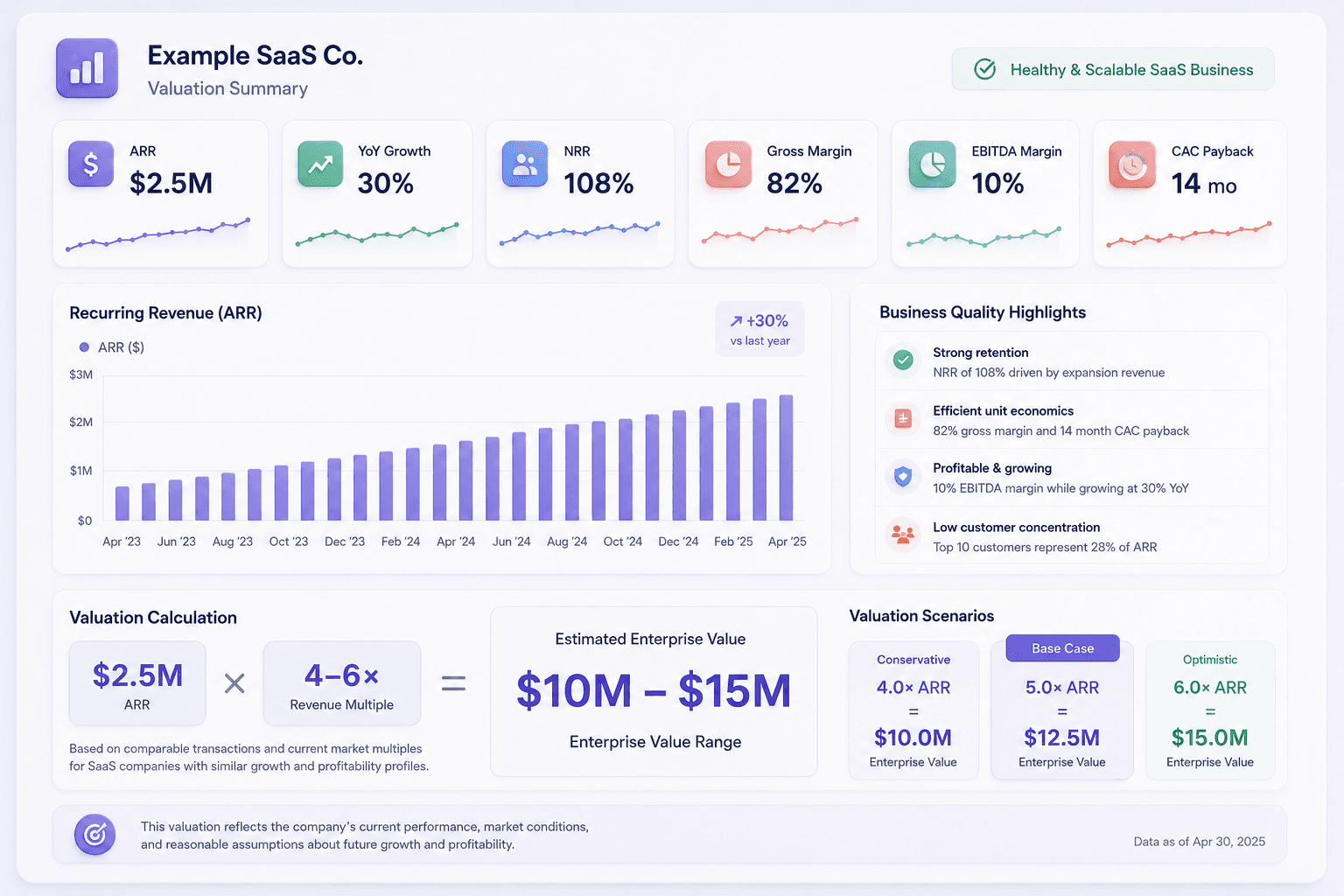
If the company has $2.5 million in ARR and deserves a 4× to 6× revenue multiple:
Low case: $2.5M × 4 = $10M
Base case: $2.5M × 5 = $12.5M
High case: $2.5M × 6 = $15M
The estimated enterprise value is therefore $10 million to $15 million, with approximately $12.5 million as a reasonable midpoint under the assumptions used.
This range is much more useful than pretending the company is worth exactly $12,487,500. SaaS company valuation contains too many assumptions about future performance and market conditions to support that degree of precision.
It is also important to distinguish enterprise value from equity value. Enterprise value represents the value of the operating business independent of its financing structure. A simplified conversion is:
Equity value = enterprise value + cash − debt
A company with a $12.5 million enterprise value, $1 million of cash, and $500,000 of debt would therefore have an implied equity value of approximately $13 million, subject to transaction-specific adjustments.
Step 7: Adjust the company value for risk
The initial valuation range still needs to account for factors that may not be visible in ARR, EBITDA, or other headline metrics.
Imagine discovering during due diligence that the largest customer represents 35% of ARR and its contract expires in four months. The revenue multiple derived from otherwise comparable SaaS companies may no longer be appropriate because the target carries substantially greater revenue risk.
The same applies to legal disputes, weak intellectual property ownership, dependence on a third-party platform, unusually high infrastructure costs, declining cohorts, cybersecurity problems, or a product that requires significant redevelopment.
Positive adjustments are possible too. Proprietary technology, exceptionally strong retention, long-term enterprise contracts, an experienced management team, valuable distribution relationships, or a strategically important market position can support a premium.
This final adjustment is where valuation becomes less mechanical. The spreadsheet provides a baseline, but the true value depends on the probability that the company's revenue, growth, and cash flows will continue after the transaction.
SaaS company valuation example
Consider a private B2B SaaS company that has moved beyond the startup stage and is generating meaningful recurring revenue. We can use the same process to estimate what the company might be worth.
The example is intentionally simplified, but it shows how valuation metrics, market multiples, and business quality come together.
Key SaaS metrics in the example company
Assume the business has the following profile:
Metric | Company |
|---|---|
ARR | $2.5M |
YoY growth rate | 30% |
NRR | 108% |
Gross margin | 82% |
EBITDA margin | 10% |
CAC payback | 14 months |
Largest customer | 7% of ARR |
Top 10 customers | 28% of ARR |
The company has several attractive characteristics. Growth is meaningful, NRR above 100% indicates expansion within the existing customer base, gross margin is strong, and no individual customer represents an extreme concentration risk.
The company is also profitable while continuing to grow. Its simplified Rule of 40 score would be 40% based on 30% growth plus a 10% EBITDA margin.
None of these metrics determines valuation independently. Together, however, they suggest a relatively healthy SaaS business with predictable revenue and credible unit economics.
Choosing a SaaS valuation multiple
Suppose analysis of relevant private transactions and market benchmarks suggests that broadly comparable SaaS businesses trade between 3.5× and 6× ARR.
The company's growth, retention, gross margin, and customer diversification argue against placing it at the bottom of that range. At the same time, it is still a relatively small private SaaS company, so applying premium multiples observed among large public SaaS companies would be difficult to justify.
A reasonable working range might therefore be 4× to 6× ARR.
The objective is not to claim that every company with these metrics deserves exactly this range. Actual market conditions, industry, competitive position, buyer demand, and many other valuation factors could move the result considerably.
Calculating the value of a SaaS business
Applying the selected multiples produces:
Scenario | ARR | Multiple | Enterprise value |
|---|---|---|---|
Conservative | $2.5M | 4× | $10M |
Base | $2.5M | 5× | $12.5M |
Strong | $2.5M | 6× | $15M |
The resulting valuation range is approximately $10 million to $15 million.
Notice how different this conclusion is from simply saying that the business has $2.5 million ARR and therefore must be worth five times revenue. The valuation process explains both the range and the assumptions behind it.
If growth dropped to 10%, NRR fell below 90%, or one customer suddenly represented 30% of revenue, the appropriate multiple could change even though ARR remained exactly $2.5 million. Conversely, stronger growth and retention could support a higher valuation without any immediate change in current ARR.
Valuation factors that increase or decrease SaaS company value
Financial metrics explain much of a SaaS company's value, but they do not capture every risk a buyer assumes. Two businesses with nearly identical financial statements can command different prices because one has more durable revenue, stronger competitive positioning, or fewer operational dependencies.
These qualitative factors become particularly important when valuing smaller SaaS businesses, where individual customers, employees, integrations, and founders can have an outsized impact.
Customer concentration and revenue quality
Customer concentration is one of the clearest examples. If a SaaS company generates $3 million in ARR and one customer contributes $1 million, losing that account would immediately remove a third of recurring revenue.
A diversified customer base reduces this risk. Contract length, renewal history, payment behavior, and customer satisfaction can further help determine how predictable that revenue really is.
Revenue quality also includes the distinction between subscription and non-recurring revenue. A company generating $5 million in total revenue with $3 million from subscriptions and $2 million from consulting should not necessarily receive the same revenue multiple as a company generating the full $5 million from recurring software subscriptions.
Market size and competitive position
A company's future growth ultimately depends on the market available to it. Investors may assign a higher valuation to a SaaS business that has captured a small portion of a large expanding market than to one that already dominates a small niche with limited room to grow.
Market size alone is not enough. The company also needs a credible value proposition and a defensible position within that market.
Switching costs, proprietary data, integrations, network effects, brand, distribution advantages, and product differentiation can all influence how easily competitors can take customers away. A SaaS company operating in an attractive market but selling an easily replicated product may deserve a lower multiple than its growth rate initially suggests.
Founder dependence and operational risk
Founder dependence matters particularly when a business owner wants to sell a SaaS company. If the founder personally closes most sales, manages major accounts, approves every product decision, and holds important technical knowledge, a buyer is not purchasing a fully independent business.
Reducing that dependence can increase the value of your SaaS business even without immediately increasing revenue.
Documented processes, a capable management team, distributed customer relationships, reliable financial reporting, and clear ownership of code and intellectual property make the business easier to transfer. They also reduce the perceived probability that performance will deteriorate once the founder leaves.
Product and technology risk
Technology can create value, but it can also create liabilities. Buyers will want to understand the quality of the codebase, security practices, infrastructure, technical debt, intellectual property ownership, and dependence on third-party platforms.
A SaaS company built almost entirely around an external API, for example, may face substantial platform risk if that provider changes pricing, functionality, or access terms. Similarly, a product with years of accumulated technical debt may require significant investment after acquisition.
AI-powered SaaS businesses introduce another consideration: variable model and inference costs can materially affect gross margin. A company may appear to have attractive software economics until the cost of delivering each additional unit of usage is properly included.
These risks do not necessarily make the business unattractive. They simply need to be reflected in the valuation rather than hidden behind headline ARR.
Long-term value and revenue predictability
Ultimately, many valuation factors point toward the same underlying question: How confident can a buyer be about the future cash flows of the SaaS business?
Recurring contracts, strong retention, diversified customers, healthy margins, efficient growth, a defensible product, and an independent operating team all increase that confidence. Churn, concentration, weak economics, technological dependence, and declining growth reduce it.
This is why the value of a SaaS business cannot be determined by one metric. The multiple is ultimately a compressed expression of expectations about future growth, profitability, and risk.
How to increase the value of your SaaS business
Founders preparing for a funding round or acquisition often focus on increasing ARR because revenue is highly visible in the valuation process. Growing revenue certainly helps, but improving the quality and economics of that revenue can sometimes have an equally important impact on valuation.
A founder considering a sale should therefore think about both sides of the equation: increasing the financial metric being multiplied and improving the valuation multiple applied to it.
Improve retention and recurring revenue
Reducing churn improves the economics of nearly every customer acquired. Customers remain longer, lifetime value increases, and the business needs fewer new acquisitions simply to replace lost revenue.
Expansion revenue can be even more powerful. If customers naturally add seats, upgrade plans, or increase usage, the company can grow part of its existing revenue base without acquiring a new logo for every additional dollar of ARR.
Improving NRR can therefore influence both growth and revenue predictability. That combination can make the business more attractive to investors and potential acquirers.
Increase growth without sacrificing efficiency
Growth generally supports a higher valuation when the economics behind it remain healthy. Simply spending more on advertising or sales to accelerate ARR does not necessarily create value if CAC rises faster than customer lifetime value.
Founders should therefore examine where growth comes from and how much capital it consumes. Improvements in conversion, pricing, expansion, organic acquisition, sales productivity, and CAC payback can allow a company to grow faster without proportionally increasing spending.
This is also why maximizing EBITDA immediately before a sale is not always the best strategy. Cutting productive sales and marketing expenses can make current profit look better while damaging the growth rate a buyer uses to determine the multiple.
Reduce founder dependence before a sale
A transferable business is generally more valuable than one that depends heavily on its current owner. If you plan to sell your SaaS, reducing founder dependence should begin well before the transaction process.
That can mean transferring key customer relationships to the team, documenting operational procedures, delegating product decisions, strengthening financial reporting, and ensuring that contracts and intellectual property belong clearly to the company.
The goal is straightforward: a buyer should be able to imagine owning the business without needing the founder to continue performing every critical function indefinitely.
Strengthen the business before you sell your SaaS
Preparing a SaaS business before a sale also means removing uncertainties that could become problems during due diligence. Clean financial statements, documented metrics, customer cohort data, employment agreements, intellectual property assignments, and clear contracts can make the company's performance easier to verify.
Founders should also understand their sale options before entering negotiations. A strategic buyer may value the company differently from a private equity buyer, individual operator, or financial investor because each sees different opportunities after the acquisition.
Improving the business before a sale is therefore not just about maximizing a single metric. It is about making the company's future performance easier to understand, believe, and transfer to a new owner.
How much is a SaaS company worth?
There is no universal multiple that determines what every SaaS company is worth. A small profitable SaaS business, a VC-backed SaaS startup, and a mature public software company can all require different valuation methods even though they share the same basic subscription model.
A practical valuation starts with recurring revenue and financial performance, then asks how durable and efficient that performance is. ARR, growth rate, NRR, gross margin, profitability, CAC, customer lifetime value, and customer concentration help establish the quality of the business. Comparable companies and transactions provide a market benchmark, while DCF or earnings-based approaches can provide additional checks.
For many private SaaS companies, the most useful result is therefore not a single number but a valuation range. If a company has $2.5 million in ARR and comparable businesses support 4× to 6× revenue, $10 million to $15 million provides the starting range. The company's growth, retention, margins, customer concentration, market position, and operational risks then determine where within that range a buyer is likely to place it.
That is the central principle behind SaaS valuation: the metric provides the base, the multiple reflects the quality and expectations, and the market determines what someone is ultimately willing to pay.