Finance
What Are the Best Online Banks for SaaS Founders in 2026?

, Community Leader
13 minutes

If you're looking for the best online bank for your SaaS business, Mercury is our top overall recommendation thanks to its modern business banking platform, startup-friendly features, and seamless integrations with tools like Stripe and QuickBooks. Relay is an excellent choice for founders who need advanced cash management and team spending controls, while Wise Business stands out for international payments and multi-currency accounts.
Best for | Recommendation |
|---|---|
Best overall | Mercury |
Best for cash management | Relay |
Best for international business | Wise Business |
Best for corporate cards | Brex |
Best for high-yield banking | Bluevine |
The best option ultimately depends on how your company operates. A bootstrap SaaS founder may value a free business checking account with low fees, while a venture-backed startup might prioritize corporate cards, treasury management, and advanced financial controls. If your customers and contractors are spread across multiple countries, international transfers and multi-currency support can become just as important as your everyday banking experience.
In this guide, we'll compare the best online banks for SaaS founders in 2026, explain the strengths and weaknesses of each platform, and help you choose the right business bank account based on your company's stage, location, and banking needs.
Why SaaS founders need an online business bank

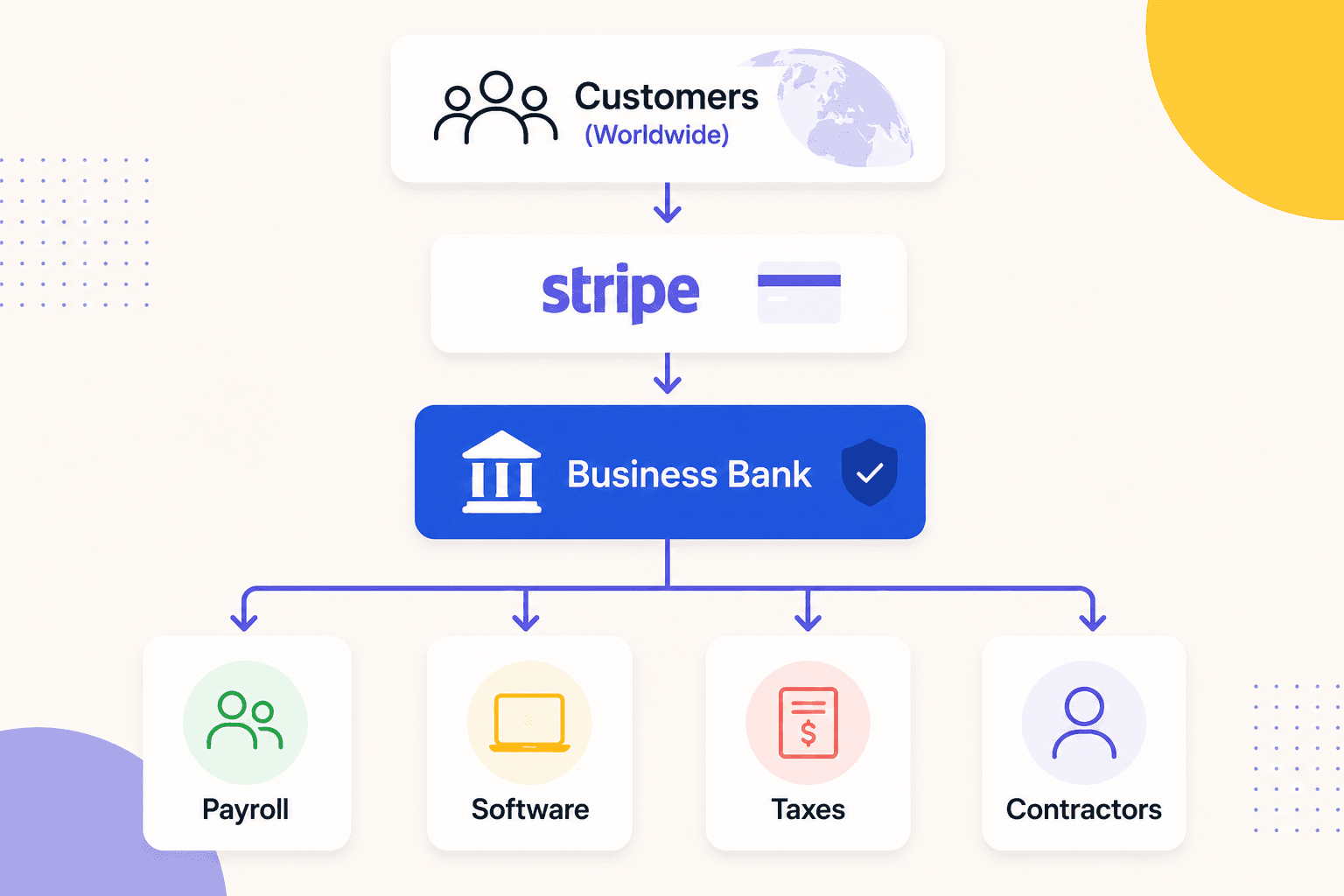
Unlike many traditional businesses, SaaS companies rarely operate within a single country. Even an early-stage startup may accept payments from customers worldwide, pay international contractors, subscribe to dozens of software tools, and hold funds in multiple currencies. As a result, banking quickly becomes part of your company's infrastructure rather than just a place to store money.
Modern business banking should support the way SaaS companies actually operate. That often includes integrations with payment processors, accounting software, expense management tools, and payroll platforms. Many founders also prefer banks that allow them to create virtual cards, automate recurring payments, and manage permissions for different team members.
Choosing the right business bank early can also save significant time later. Migrating your banking stack after your company has grown, integrated dozens of services, and established financial workflows is much more complicated than selecting the right platform from the beginning.
Common banking challenges for SaaS businesses

Most founders eventually run into similar banking problems as their business grows.
Some of the most common challenges include:
Receiving payments from customers in different countries.
Sending international wire transfers with low fees.
Managing multiple currencies.
Connecting bank accounts with Stripe, QuickBooks, Xero, and other accounting tools.
Issuing virtual or physical corporate cards for employees and contractors.
Separating operating cash from taxes or payroll using multiple business accounts.
Scaling banking services as the company grows from a solo founder to a larger team.
Many startups also discover that traditional banks were designed primarily for local businesses with predictable banking needs. Online-first companies often need faster onboarding, better APIs, modern expense management, and integrations that reduce manual financial work.
What to look for in a business bank account
Not every online bank is built for every startup. Some focus on US-incorporated companies, while others specialize in international payments or enterprise expense management. Before choosing a provider, consider which features will matter most as your business grows.
Here are the most important factors to evaluate:
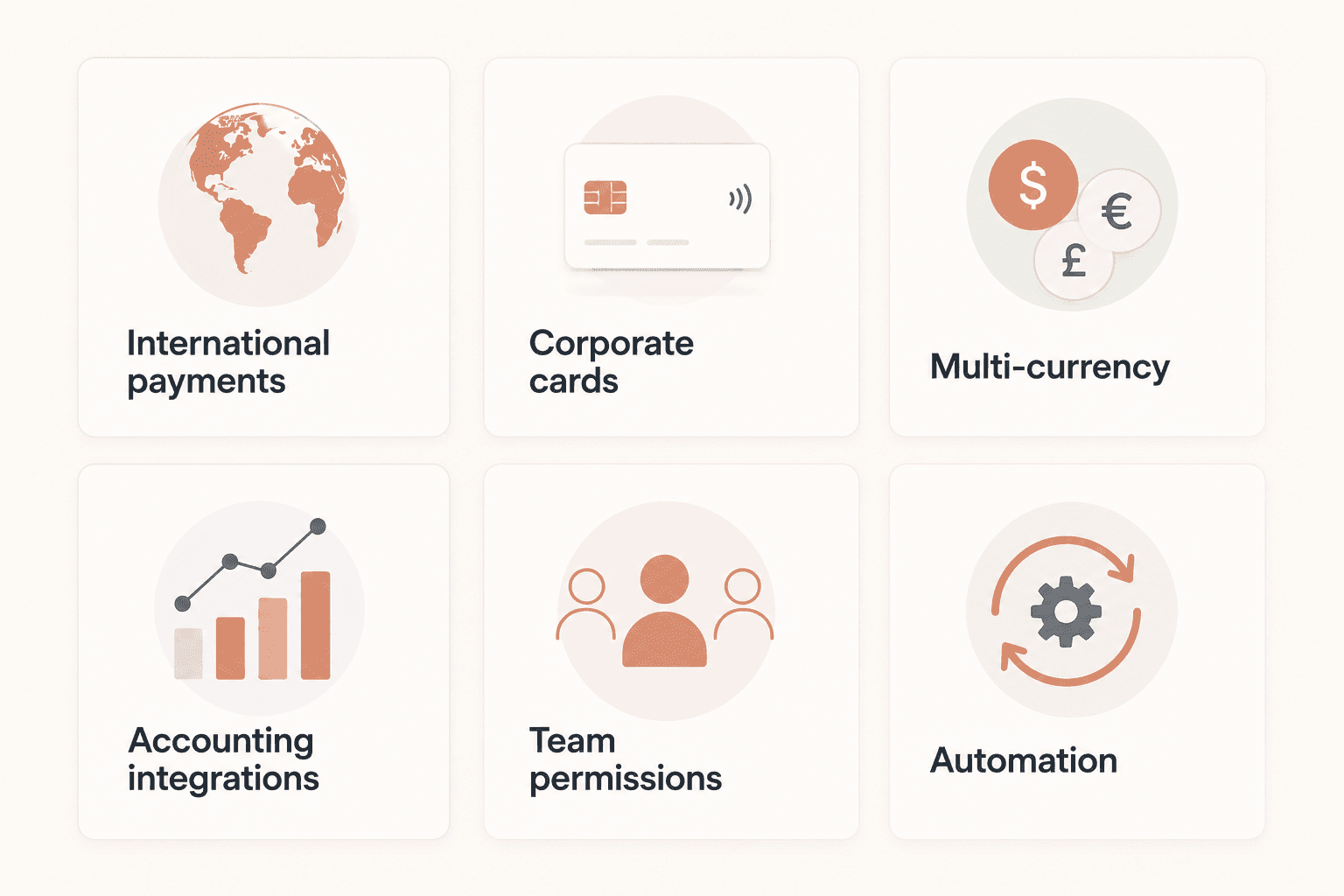
Feature | Why it matters |
|---|---|
Business checking account | The foundation of your daily banking operations. |
International payments | Essential if you have global customers, contractors, or vendors. |
Multi-currency support | Helps reduce conversion costs and simplifies international business. |
Business cards | Virtual and physical cards make expense management easier. |
Integrations | Native connections with Stripe, QuickBooks, Xero, payroll, and accounting software save time. |
Team permissions | Allows employees or finance teams to access only what they need. |
Fees | Compare monthly costs, wire fees, foreign exchange fees, and ATM charges. |
FDIC insurance | Protects eligible deposits through partner banks where applicable. |
The best choice ultimately depends on your startup needs. A solo bootstrap founder may prioritize a free business checking account with simple integrations, while a venture-backed company might care more about treasury management, corporate cards, and advanced financial controls.
In the next section, we'll compare the best online banks for SaaS founders in 2026 and explain where each platform performs best.
The best online banks for SaaS founders in 2026
No single bank is the best choice for every startup. Some platforms focus on fast company formation and simple business banking, while others specialize in international payments, corporate cards, or treasury management.
The banks below were selected based on the features that matter most to SaaS founders, including ease of opening an account, support for remote businesses, integrations with modern financial tools, international capabilities, pricing, and overall startup friendliness.
Mercury

Best for: US-incorporated SaaS startups and remote-first companies.
Mercury has become one of the most popular banking platforms among startup founders. Instead of trying to replicate a traditional bank, Mercury focuses on building modern business banking software for technology companies. Opening an account is generally straightforward for eligible businesses, and the platform integrates well with tools that many SaaS companies already use.
Mercury offers business checking accounts, savings products, virtual and physical debit cards, team permissions, and automated financial workflows. It also includes treasury products for companies with larger cash balances, making it attractive as startups grow.
Pros
Excellent user experience.
Fast onboarding for eligible startups.
Strong integrations with Stripe, QuickBooks, Xero, and accounting tools.
Virtual cards and team expense controls.
Built specifically for startups.
Cons
Available primarily to US companies.
No cash deposits.
Lending products remain limited compared to traditional banks.
Relay

Best for: Small businesses that need collaborative money management.
Relay focuses on helping founders organize their finances instead of managing everything through a single bank account. Users can create multiple business accounts for different purposes, such as operating expenses, payroll, taxes, or marketing budgets.
This approach is particularly useful for bootstrap founders who want better cash flow visibility without relying on spreadsheets. Relay also offers approval workflows, accounting integrations, and detailed user permissions for growing teams.
Pros
Create multiple business accounts.
Excellent budgeting workflow.
Strong QuickBooks and Xero integrations.
Team permissions and approval controls.
Cons
Available primarily to US businesses.
Fewer international banking features than some competitors.
Wise Business

Best for: International SaaS companies.
If your company regularly sends or receives payments in different currencies, Wise Business is one of the strongest options available. Rather than focusing on traditional banking, Wise specializes in international transfers with transparent exchange rates.
Businesses can receive local bank details in multiple countries, hold balances in dozens of currencies, and pay contractors worldwide with relatively low conversion costs.
Pros
Excellent exchange rates.
Multi-currency business account.
Local receiving accounts in several regions.
Strong international payment capabilities.
Cons
Not a complete replacement for every business bank.
Limited lending and treasury products.
Brex

Best for: Venture-backed startups.
Brex originally became known for corporate cards designed specifically for startups. Today, it offers a broader financial platform that combines business banking, spend management, travel, reimbursements, and financial automation.
Companies that have raised venture capital often benefit most from Brex because its product suite is designed for businesses with larger teams and more complex financial operations.
Pros
Powerful corporate card program.
Advanced expense management.
Strong automation features.
Excellent integrations.
Cons
Less suitable for solo founders.
Many features target larger companies.
Novo

Best for: Solo founders and small startups.
Novo provides a simple business checking account with no monthly maintenance fees and a clean interface. While it doesn't include as many advanced finance tools as Mercury or Brex, it's a solid option for founders looking for straightforward business banking.
Pros
Easy to use.
No monthly maintenance fees.
Good integrations with small business tools.
Cons
Fewer advanced features.
Limited international capabilities.
Found

Best for: Solo entrepreneurs and small founder-led businesses.
Found combines business banking with bookkeeping, invoicing, and tax planning features. Although it targets freelancers as well as business owners, some early-stage SaaS founders may appreciate having financial management in one platform.
Pros
Built-in bookkeeping.
Tax estimation tools.
Invoicing features.
Cons
Less focused on scaling startups.
Limited enterprise functionality.
Airwallex

Best for: Global SaaS companies.
Airwallex has built its platform around international business. It offers multi-currency accounts, global payment collection, corporate cards, foreign exchange services, and APIs for companies operating across multiple markets.
For SaaS companies serving customers worldwide, Airwallex can significantly reduce the complexity of international banking.
Pros
Strong international infrastructure.
Excellent multi-currency support.
Competitive foreign exchange rates.
API-driven platform.
Cons
Some features vary by country.
Can be more complex than simpler banking platforms.
Revolut Business

Best for: European startups and international teams.
Revolut Business combines business banking with foreign exchange, expense management, corporate cards, and international transfers. It is particularly attractive for startups operating across Europe or managing teams in several countries.
Pros
Multi-currency support.
Competitive exchange rates.
Business cards.
Strong mobile experience.
Cons
Some advanced features require paid plans.
Availability varies by region.
Payoneer

Best for: Businesses receiving international marketplace payments.
Payoneer is widely used by companies working with global clients, marketplaces, and international partners. While it isn't designed to replace a full business bank account, it can simplify receiving payments from customers in different countries.
Pros
Global payment network.
Multiple receiving accounts.
Widely accepted by international platforms.
Cons
Not a complete banking platform.
Limited financial management features.
Bluevine

Best for: Small businesses that want banking and access to credit.
Bluevine combines a business checking account with financing products, including a line of credit for eligible companies. This makes it attractive for founders who value both day-to-day banking and flexible funding options from the same provider.
Pros
Competitive business checking account.
Access to a line of credit for qualified businesses.
Simple online experience.
Cons
Primarily focused on US businesses.
International capabilities are more limited than platforms like Wise or Airwallex.

Comparison table

The table below summarizes the strengths of each platform. While every business has different priorities, this comparison can help narrow down your options based on your startup's stage and banking needs.
Bank | Best for | Multi-currency | Corporate cards | International payments | Business checking account |
|---|---|---|---|---|---|
Mercury | US-incorporated SaaS startups | Limited | ✓ | ✓ | ✓ |
Relay | Cash flow management | Limited | ✓ | Basic | ✓ |
Wise Business | Global payments | ✓ | Limited | ✓ | Limited |
Brex | Venture-backed startups | ✓ | ✓ | ✓ | ✓ |
Novo | Solo founders | Limited | ✓ | Basic | ✓ |
Found | Founder-led businesses | Limited | ✓ | Basic | ✓ |
Airwallex | Global SaaS companies | ✓ | ✓ | ✓ | ✓ |
Revolut Business | European startups | ✓ | ✓ | ✓ | ✓ |
Payoneer | International payouts | ✓ | Limited | ✓ | Limited |
Bluevine | Banking with access to credit | Limited | ✓ | Basic | ✓ |
Best banks for startups compared
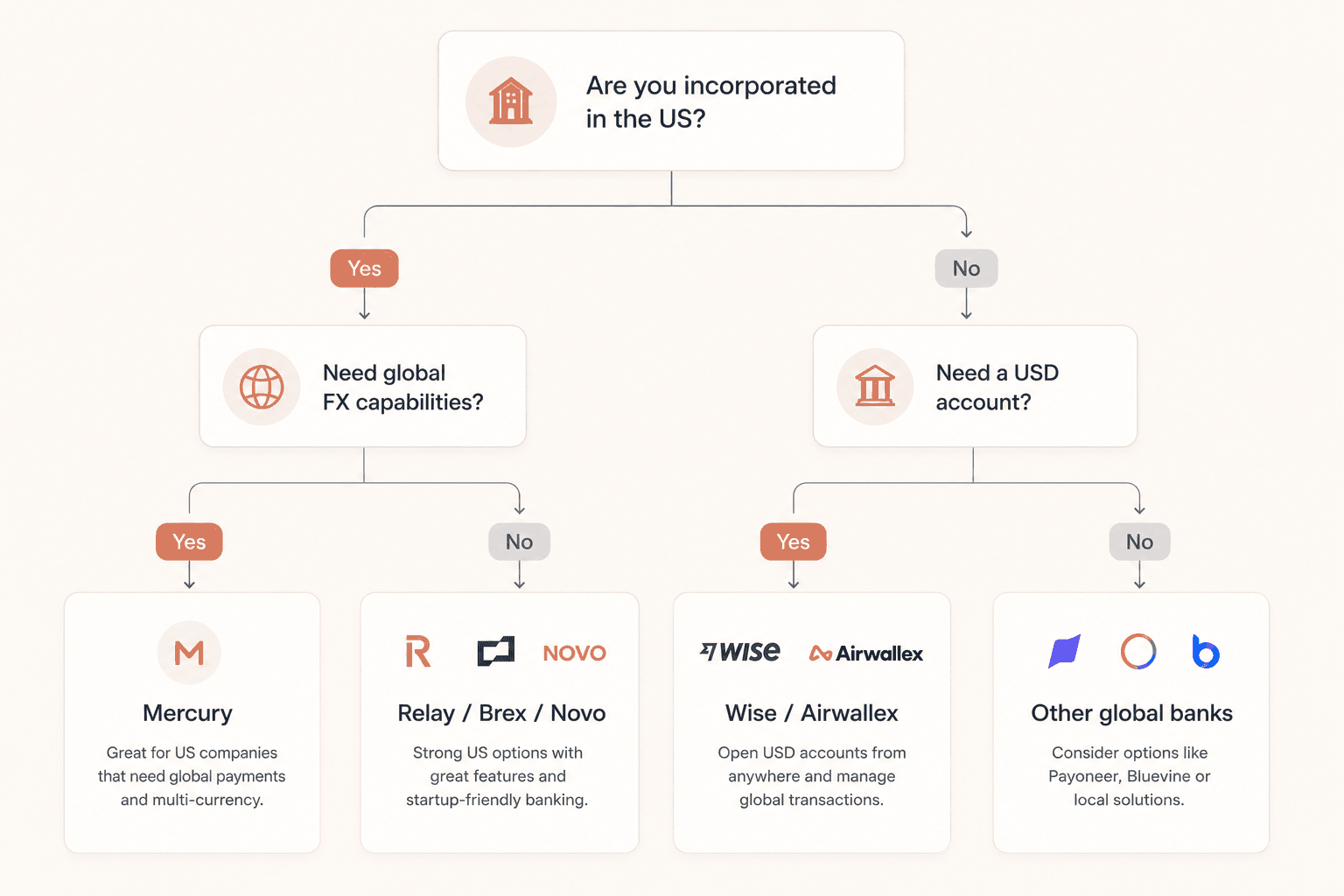
If you're looking for the best overall platform, Mercury remains one of the strongest choices for US-incorporated SaaS companies. It combines modern business banking, excellent integrations, and startup-focused features in a clean, intuitive interface.
Founders operating internationally may find Wise Business or Airwallex more suitable thanks to their multi-currency capabilities and lower costs for cross-border payments. Meanwhile, companies planning to scale rapidly after raising funding may benefit from Brex's broader financial platform, particularly its corporate cards and expense management tools.
Rather than searching for a single "best" startup bank, think about which platform best matches your company's current stage. Banking needs often change as startups grow, and many founders eventually use multiple banks instead of relying on just one provider.
Which startup bank is best for different founders?
Here's a quick recommendation based on different startup scenarios.
If you are... | Consider... |
|---|---|
A bootstrap SaaS founder | Mercury, Relay, Novo |
Running a remote team | Mercury, Relay, Brex |
Selling internationally | Wise Business, Airwallex, Revolut Business |
Raising venture capital | Brex, Mercury |
Paying contractors worldwide | Wise Business, Airwallex, Payoneer |
Looking for business banking with access to credit | Bluevine |
How to choose a business bank for your startup
The best business bank account isn't necessarily the one with the most features. It's the one that removes friction from your daily operations and supports the way your company actually works.
As you evaluate different providers, ask yourself a few practical questions:
Where are your customers located?
Which countries will you pay contractors or employees in?
Do you need multiple business accounts to separate taxes, payroll, and operating expenses?
Which accounting software do you use?
Will you need corporate cards for your team?
Is access to a line of credit important in the near future?
Answering these questions usually narrows the list much faster than comparing dozens of feature checklists.
Bootstrap founders
Bootstrap founders typically benefit from simple pricing, low fees, and strong automation. Platforms like Mercury, Relay, and Novo offer a modern banking experience without unnecessary complexity.
Remote SaaS companies
If your team works across multiple countries, prioritize banks that offer flexible permissions, virtual cards, and integrations with payroll and accounting platforms. Expense management becomes increasingly important as your company grows.
Founders selling internationally
Companies serving customers worldwide should pay close attention to foreign exchange costs and international transfer fees. Multi-currency support alone can save a growing SaaS business thousands of dollars over time.
Venture-backed tech startups
Companies backed by venture capital often have more advanced financial requirements, including treasury management, corporate spending controls, approval workflows, and higher transaction volumes. Platforms like Brex and Mercury are particularly well suited to these needs.
Frequently asked questions
Can non-US founders open a US business bank account?
Yes, in many cases. Several online banking platforms support non-US founders who have incorporated a US company, although eligibility requirements vary. Most providers require business formation documents, tax information, and identity verification.
What is the best startup bank?
There isn't a universal answer. Mercury is often considered one of the best startup banks for US-incorporated SaaS companies, while Wise Business and Airwallex are stronger choices for companies with significant international operations.
Which bank account is best for a SaaS business?
The ideal business bank account depends on how your company operates. Founders serving global customers usually benefit from platforms with multi-currency support, while domestic startups may prioritize integrations, automation, and business checking features.
Which business checking account has the lowest fees?
Fee structures vary widely between providers. Some online banks charge no monthly maintenance fees but apply fees for wire transfers or premium features. Always compare the total cost based on how your company actually uses banking services.
Which bank is best for international payments?
Wise Business and Airwallex are widely recognized for their international payment capabilities thanks to competitive exchange rates and extensive multi-currency support.
Can I use more than one business bank?
Absolutely. Many startups maintain multiple business accounts for different purposes. For example, one account may handle daily operations, another may hold tax reserves, and a third may be used for international payments or treasury management.
Does every startup need FDIC insurance?
If your business keeps cash in US-based financial institutions, understanding FDIC insurance is important. FDIC coverage protects eligible deposits held at participating banks up to applicable limits. Many fintech platforms partner with FDIC-insured banks, allowing founders to access modern banking interfaces while maintaining deposit protection.
Final thoughts
The best online bank for SaaS founders ultimately depends on your company's stage, geography, and financial workflows. A solo founder building a bootstrapped product has very different banking needs than a venture-backed startup managing international payroll and millions in annual recurring revenue.
The good news is that founders today have far more options than they did just a few years ago. Modern business banking platforms have replaced much of the paperwork, slow onboarding, and limited functionality traditionally associated with business banks.
Before making your decision, compare not only pricing but also integrations, international capabilities, business checking features, customer support, and how well each platform fits your startup needs. Choosing the right banking partner early can save time, reduce operational complexity, and give your company a financial foundation that scales as your business grows.