Activation rate measures the percentage of new users who complete a meaningful action that demonstrates they have experienced your product's core value. It is one of the most important SaaS metrics because it shows whether your onboarding process is successfully turning signups into engaged users.
The formula is simple:
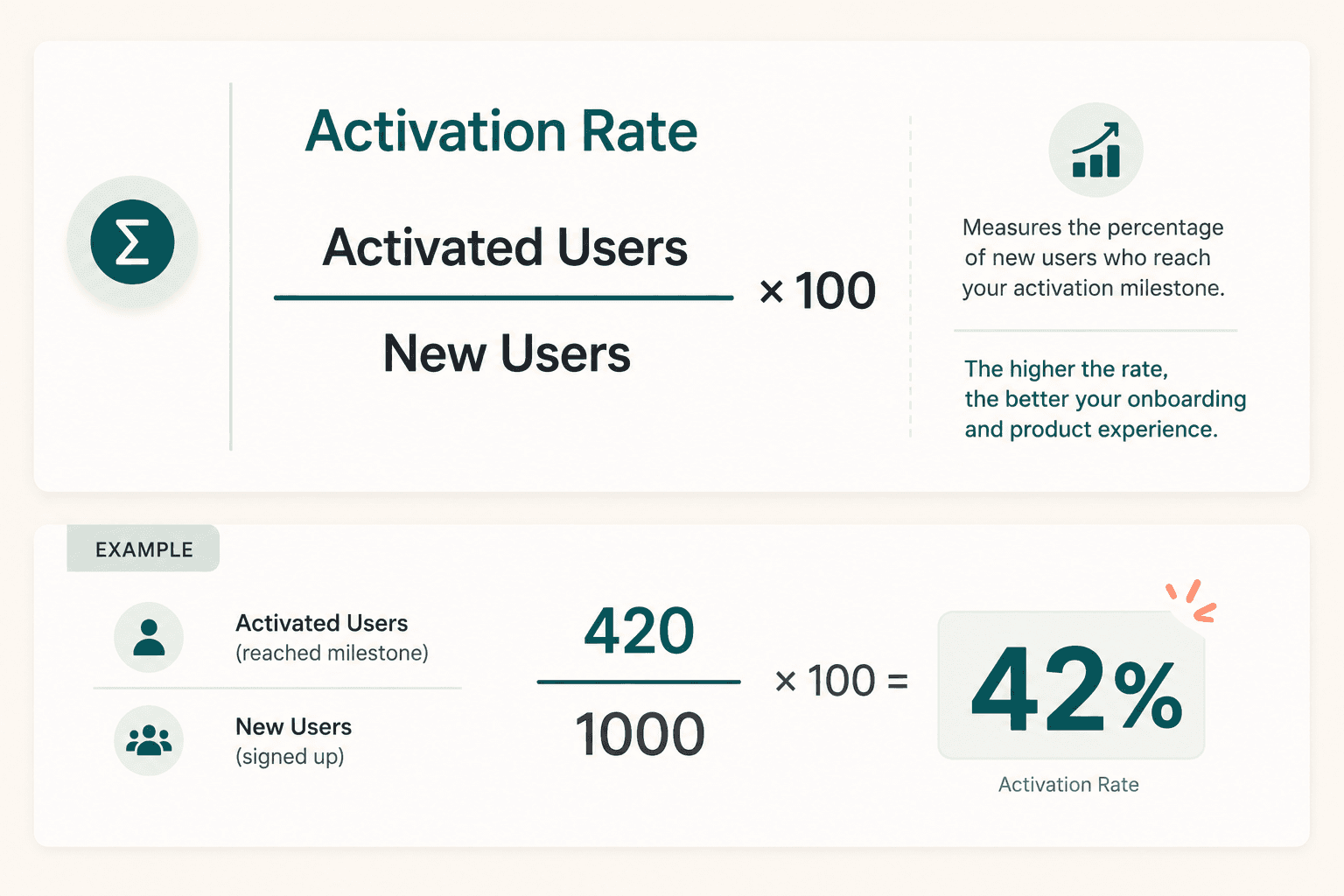
Activation Rate = (Activated Users ÷ New Users) × 100
While calculating activation rate takes only a few seconds, defining the right activation milestone is far more challenging. Every SaaS product delivers value differently, so successful SaaS founders focus on identifying the earliest moment users experience that value rather than tracking vanity metrics like account registrations or page views.
In this guide, you'll learn how to calculate activation rate, define activation events, measure user activation across different SaaS products, compare your results against common benchmarks, and improve activation through better onboarding and product design.
What is activation rate in SaaS?
Activation rate is the percentage of new users who complete a meaningful action that demonstrates they have experienced your product's core value.
Unlike vanity metrics such as total registrations, a SaaS activation rate focuses on whether users actually reached an important milestone in their journey. This milestone should represent the moment a user understands why your product is useful and is likely to continue using it.
For example:
SaaS product
Example activation milestone
Project management tool
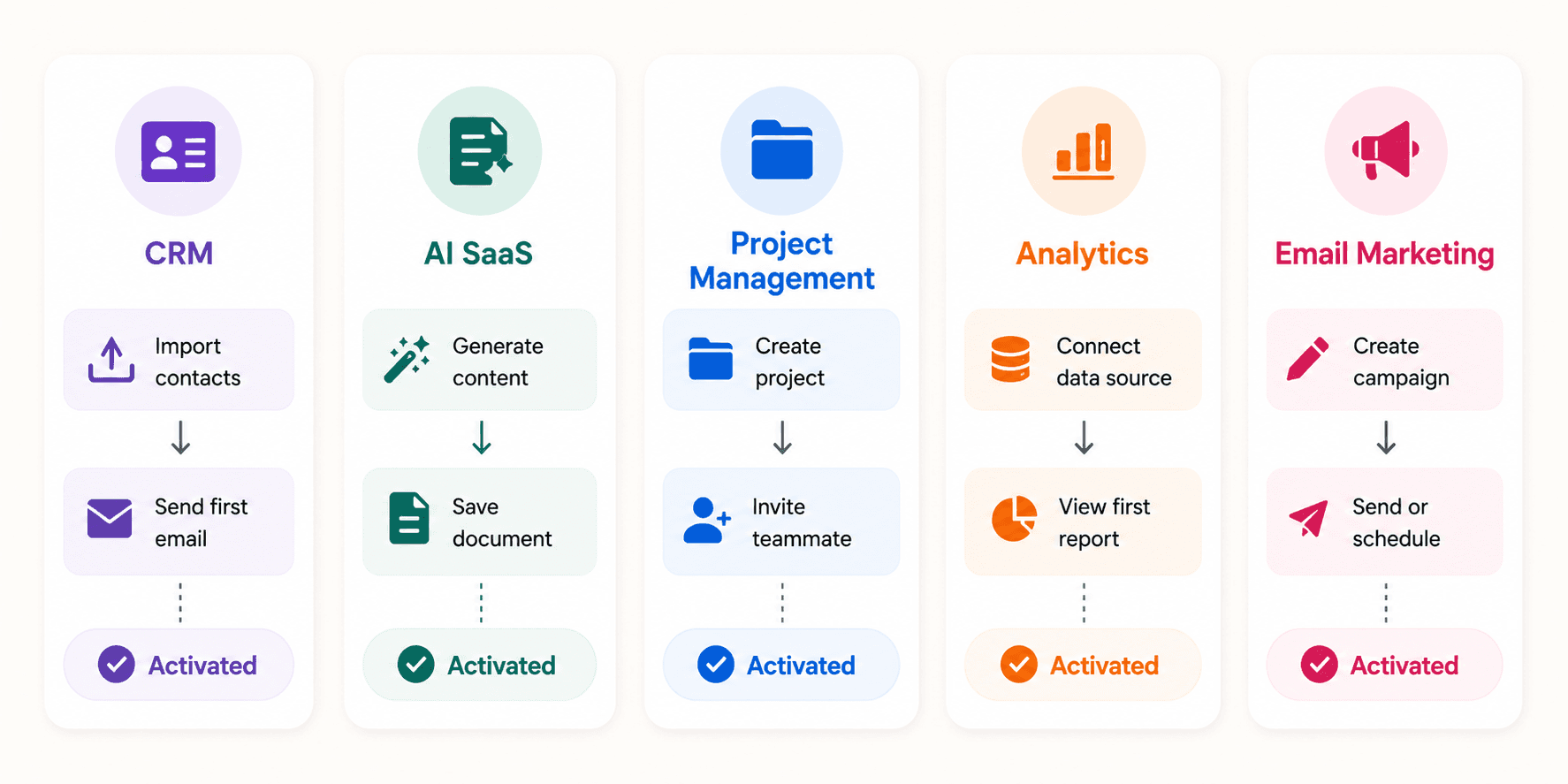
Creates the first project and invites a teammate
CRM platform
Imports contacts and sends the first email
AI writing tool
Generates and saves the first document
Email marketing platform
Creates and schedules the first campaign
Analytics platform
Connects a data source and views the first dashboard
The exact activation milestone differs across SaaS companies because every product delivers value differently. What matters is choosing an event that reflects genuine product adoption rather than a simple click or page view.
What counts as an activated user?
An activated user is someone who has completed the key activation event that proves they have received value from the product.
Many founders confuse account creation with user activation. Creating an account simply means someone was interested enough to register. It does not mean they understood the product or incorporated it into their workflow.
A useful way to think about the activation process is to ask one simple question:
"What is the earliest moment when a new user clearly understands why they should come back?"
For Slack, that moment is not creating a workspace. It is exchanging messages with teammates.
For Dropbox, it is successfully syncing files across devices.
For Notion, it might be creating the first workspace and adding meaningful content.
Each SaaS product has its own activation process, but every successful activation milestone shares three characteristics:
It represents real user value.
It happens relatively early in the user journey.
Users who reach it are significantly more likely to return.
When founders define activation this way, user activation metrics become much more useful than simple signup numbers.
Why activation matters more than signups
Imagine two SaaS businesses each acquire 10,000 new users this month.
Metric
Company A
Company B
New users
10,000
10,000
Activated users
2,500
6,000
Activation rate
25%
60%
At first glance, both companies appear equally successful because their user base grew by the same amount.
In reality, Company B has built a much healthier onboarding process. More users discover the product's value, making them more likely to stay engaged, upgrade to paid plans, and generate higher customer lifetime value.
This is why investors and experienced product teams pay close attention to activation rates. Improving activation often produces a larger business impact than simply acquiring more traffic.
A higher activation rate typically leads to:
better user engagement;
stronger retention;
more efficient acquisition spending;
increased conversion rate from free to paid;
healthier long-term SaaS growth.
For many SaaS companies, activation becomes the bridge between marketing and retention. Marketing brings new users into the funnel, while effective user onboarding determines how many actually become successful customers.
How to calculate activation rate
Once you've defined what activation means for your SaaS product, measuring the metric becomes straightforward. The challenge is rarely the calculation itself. It is choosing the right users and the right activation event.
The activation rate formula
The standard formula is:
Activation Rate = (Number of Activated Users ÷ Number of New Users) × 100
The important detail is that both numbers should come from the same time period and the same group of users.
For example, if 1,000 new users signed up during July and 420 of them reached your activation milestone within your chosen onboarding window, your SaaS activation rate would be 42%.
While the formula is simple, founders should avoid mixing different user cohorts or measuring activation across the entire user base. Doing so makes the metric much less useful for understanding whether recent onboarding improvements are working.
A simple activation rate example
Suppose an AI SaaS product defines activation as generating and exporting the first document.
During one week, the company acquires:
Metric
Value
New users
2,000
Users who generated a document
1,100
Users who exported the document
760
If exporting the first document is the chosen activation milestone, then:
Activation Rate = 760 ÷ 2,000 × 100 = 38%
If the company later redesigns its onboarding flow and the same metric increases to 48%, it has strong evidence that the new onboarding experience helps more users reach product value.
Notice that the company did not need more traffic to improve SaaS growth. It simply helped a larger percentage of new users activate successfully. That is why activation is one of the most closely monitored metrics in modern product-led SaaS businesses.
How to define your activation event
Choosing the right activation event is the most important part of measuring activation. Two SaaS companies can have identical activation rates while one tracks a meaningful milestone and the other measures an event that has little connection to long-term success.
A common mistake is selecting the first action users complete instead of the first moment they receive real value. Opening the dashboard, clicking a button, or completing a profile may increase activation rates on paper, but these actions rarely predict retention or product adoption.
The best activation milestone represents the point where users begin solving the problem they came to your product for.
Choose the first moment users experience value
A helpful framework is to work backward from your product's value proposition.
Ask yourself these questions:
Why did users sign up?
What action proves they achieved their first success?
Which users are most likely to return a week later?
What event separates curious visitors from engaged users?
For example, imagine a project management SaaS. Creating an account is only the beginning. Creating an empty workspace is slightly better, but still does not demonstrate value.
A stronger activation milestone might be:
creating the first project;
inviting a teammate;
completing the first task.
Those actions indicate that users have moved beyond exploration and started integrating the product into their workflow.
The same principle applies across different SaaS products.
SaaS category
Weak activation event
Strong activation milestone
CRM
Creates an account
Imports contacts and sends the first email
AI SaaS
Opens the editor
Generates content and saves it
Analytics
Visits the dashboard
Connects a data source and views reports
Customer support
Creates a workspace
Resolves the first customer conversation
Email marketing
Confirms email
Launches the first campaign
Notice that each activation milestone represents completed value rather than completed setup.
Common activation events for different SaaS products
There is no universal activation process because every SaaS product solves a different problem. However, successful SaaS companies usually define activation around one of several common patterns.
Product type
Typical activation event
Collaboration software
Invites teammates
Design software
Exports the first design
Finance platform
Connects a bank account
Developer tools
Deploys the first project
Marketing platform
Publishes the first campaign
Knowledge management
Creates and shares the first document
Although the events differ, they all answer the same question:
Has the user already received enough value to justify coming back?
If the answer is yes, you probably have a strong activation event.
Activation rate examples by SaaS category
Looking at real-world examples makes it easier to understand why activation differs across SaaS businesses. Every product has a unique user journey, yet all successful companies measure the moment users begin adopting the product instead of simply exploring it.
Project management software
A project management tool often attracts users who want better collaboration and task organization. Creating a workspace is necessary, but it does not guarantee that the product will become part of the team's daily routine.
A more meaningful activation milestone could include:
creating the first project;
adding tasks;
inviting at least one teammate.
This sequence measures actual collaboration instead of basic account setup.
CRM software
For CRM platforms, user activation usually happens after customers begin managing real sales activity.
Good activation events include:
importing contacts;
creating the first sales pipeline;
logging the first customer interaction.
These actions demonstrate that the CRM is becoming part of the company's sales process rather than remaining an empty database.
AI SaaS
AI products often experience very high signup numbers because users are curious to experiment. The challenge is identifying which new users become regular users.
An AI writing assistant, for example, might define activation as generating content, editing the output, and exporting or saving the final document. A coding assistant might instead measure whether users integrate the tool into their development workflow.
Simply opening the interface or sending one prompt may not be enough to qualify as user activation.
Developer tools
Developer-focused SaaS products often require a longer onboarding process because users must integrate APIs, SDKs, or infrastructure before experiencing value.
A typical activation flow might include:
Creating a project.
Connecting the development environment.
Making the first successful API request.
Deploying a working application.
Although this activation process contains several steps, the activation milestone should still represent the first successful outcome rather than every intermediate action.
How successful SaaS founders measure activation
Measuring activation rates is not just about calculating a percentage. The most effective product teams analyze activation from several perspectives to understand why users succeed or fail.
Instead of relying on one dashboard, they combine user activation metrics with behavioral data to uncover opportunities for improvement.
Track cohorts instead of all users
One of the biggest mistakes is measuring activation across the entire user base.
Imagine you launch a new onboarding flow today. If you compare today's users with customers who signed up six months ago, the metric becomes difficult to interpret because every cohort experienced a different product.
Instead, measure activation by signup cohorts.
For example:
Signup month
New users
Activated users
Activation rate
May
2,400
840
35%
June
2,650
1,060
40%
July
2,800
1,316
47%
This approach makes it much easier to analyze whether recent product improvements are increasing activation rates.
Measure activation by acquisition channel
Not all users behave the same way.
Someone arriving through Google Search may have a completely different level of intent than someone clicking a social media advertisement. Likewise, referral traffic often produces higher activation rates because users already trust the recommendation.
Segmenting activation by acquisition source helps SaaS companies identify which marketing channels attract users who are genuinely interested in the product.
Instead of asking, "Which channel brings the most users?", ask, "Which channel brings users who activate?"
That shift often changes how marketing budgets are allocated and creates stronger alignment between marketing and product teams.
Connect activation with retention and revenue
Activation is powerful because it predicts future business outcomes.
Many SaaS companies discover that users who reach the key activation milestone are significantly more likely to:
remain active after 30 or 90 days;
convert to paying customers;
generate higher lifetime value;
recommend the product to others.
For this reason, activation should not be viewed as an isolated metric. It becomes much more valuable when analyzed alongside retention, churn, conversion rate, and revenue. Looking at these metrics together provides deeper insight into whether improvements in the onboarding process are creating lasting business impact rather than temporary engagement.
Common activation rate mistakes
Many SaaS founders understand that activation matters, but they still measure it incorrectly. In most cases, the problem is not the formula. It is selecting the wrong metric or interpreting it without enough context.
Avoiding these common mistakes will make your user activation metrics far more valuable and help you identify real opportunities for improvement.
Using signups as a success metric
One of the most common mistakes is celebrating growth in new users without looking at how many users actually activate.
Imagine your SaaS business doubles its monthly signups from 5,000 to 10,000 users. At first glance, this looks like strong growth. However, if the activation rate falls from 45% to 20%, the business now has fewer activated users than before.
Month
New users
Activation rate
Activated users
January
5,000
45%
2,250
February
10,000
20%
2,000
This is why experienced product teams rarely optimize for registrations alone. Instead, they monitor the percentage of new users who reach the activation milestone.
Choosing an activation event that is too easy
Some SaaS companies define activation as completing an action that requires almost no effort.
Examples include:
verifying an email address;
logging in for the first time;
opening the dashboard;
completing a user profile.
These actions usually produce higher activation rates, but they provide very little insight into whether users actually experienced value.
If almost everyone activates, the metric becomes less useful because it no longer predicts retention or product adoption.
Choosing an activation event that is too difficult
The opposite problem is selecting an activation milestone that happens too late in the user journey.
For example:
purchasing a subscription;
inviting ten teammates;
completing twenty projects.
These events certainly indicate success, but they are influenced by many factors beyond onboarding. As a result, the activation process becomes difficult to analyze because users may abandon the product long before reaching the chosen milestone.
A strong activation event sits between these two extremes. It should happen early enough to measure onboarding success while still representing meaningful user value.
What is a good activation rate?
One of the first questions founders ask is whether their activation rate is good enough.
The honest answer is that benchmarks provide useful context, but they should never become the primary goal. Every SaaS product has a different onboarding process, sales motion, pricing model, and user journey.
Typical SaaS activation benchmarks
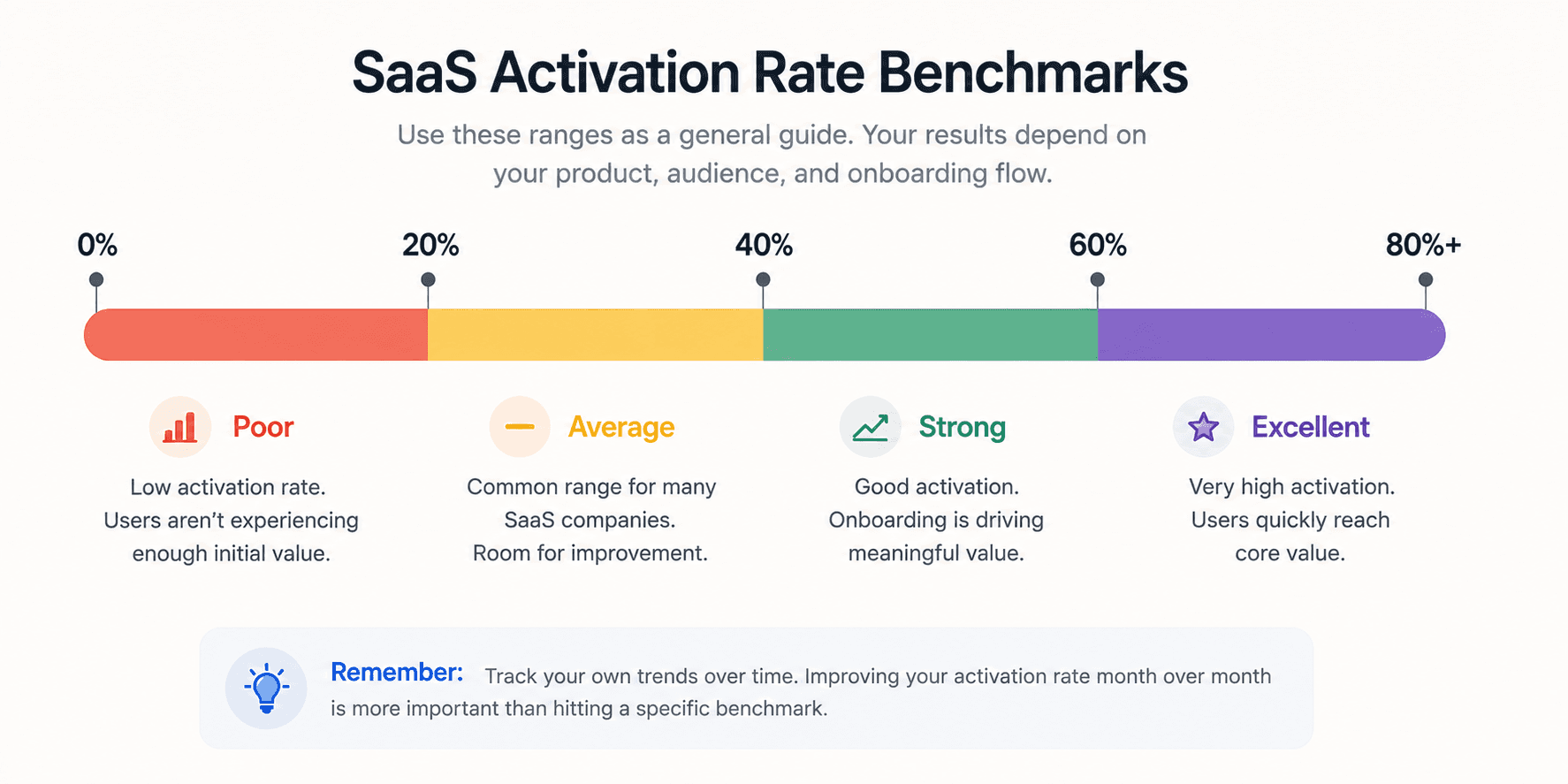
Although there is no universal benchmark, many SaaS companies use ranges like these as a starting point.
Activation rate
General interpretation
Below 25%
Low activation rate that usually indicates onboarding or product friction
25% to 40%
Common for many SaaS businesses
40% to 60%
Strong activation for many self-serve SaaS products
Above 60%
High activation rates that often reflect an excellent onboarding experience or a very well-defined target audience
These numbers should not be treated as strict targets. A developer platform with a complex setup process may naturally have lower activation rates than a simple AI writing tool.
Why benchmarks can be misleading
Instead of comparing yourself with every SaaS company, compare today's activation rate with last month's.
If your activation rate increases from 32% to 41%, that improvement is far more meaningful than matching an industry average.
The most useful benchmark is your own historical data.
By analyzing activation rates over time, founders can measure whether product updates, onboarding improvements, or changes in messaging actually help more users reach the activation milestone.
How to improve your activation rate
Improving activation rarely requires dramatic product redesigns. In many cases, small improvements throughout the onboarding flow produce meaningful increases in activation.
Successful SaaS companies focus on removing friction, shortening the time to value, and helping users complete the key activation event as quickly as possible.
Reduce time to first value
The faster users experience value, the more likely they are to activate.
Look for unnecessary steps between signup and the first successful outcome.
Questions worth asking include:
Can users import existing data automatically?
Can setup be simplified?
Are there unnecessary forms or configuration screens?
Can users reach the activation milestone within their first session?
Every additional step creates another opportunity for users to leave before understanding your product.
Improve onboarding
Effective user onboarding guides people toward success instead of expecting them to discover everything independently.
Strong onboarding often includes:
interactive product tours;
contextual in-app guidance;
onboarding checklists;
templates that reduce setup time;
personalized recommendations based on user segments.
Rather than explaining every feature, the onboarding experience should focus on helping users complete the activation process.
Guide users to the activation milestone
The activation funnel should be continuously analyzed to identify friction points and drop off points.
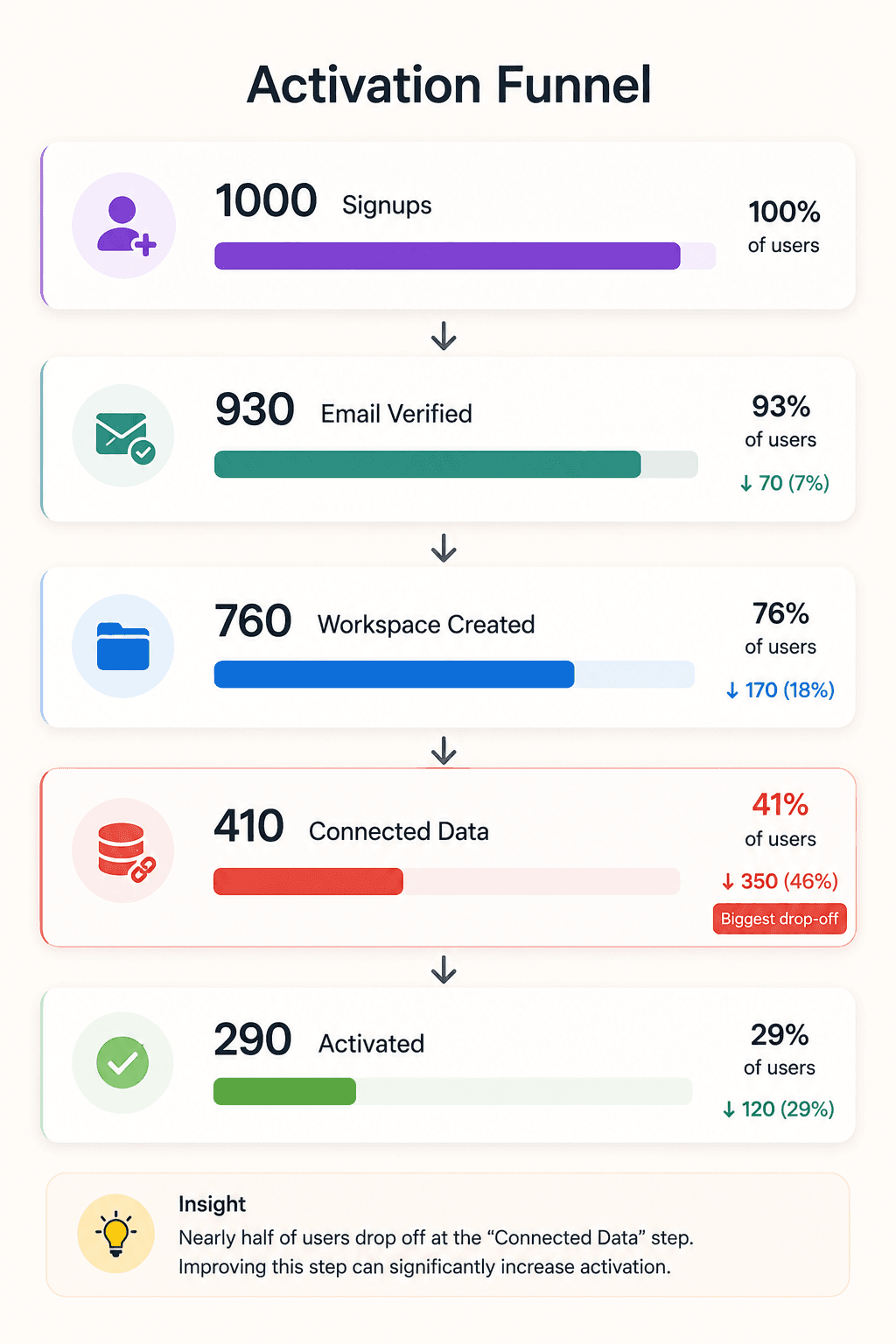
For example, suppose your onboarding flow looks like this:
Step
Users remaining
Sign up
1,000
Verify email
930
Create workspace
760
Connect data
410
Reach activation milestone
290
The largest drop occurs when users connect their data. That insight immediately tells the product team where improvements are most likely to boost your activation rate.
Instead of guessing, analyze user behavior and user feedback to understand why users abandon the process. Often, a clearer value proposition, fewer setup requirements, or better in-app guidance can transform your activation results.
Frequently asked questions
What is the difference between activation rate and user activation?
User activation refers to the process of helping users reach their first meaningful success inside a SaaS product. Activation rate measures the percentage of new users who complete that milestone.
Is activation rate the same as product adoption?
No. Activation is an early milestone in the user journey, while product adoption describes sustained and repeated product usage over time. Activation often leads to adoption, but the two metrics measure different stages of customer behavior.
How often should SaaS companies measure activation rate?
Most SaaS companies monitor activation continuously and review it weekly or monthly using signup cohorts. This makes it easier to identify whether onboarding changes improve activation over time.
Which analytics tools can track activation rate?
Most modern product analytics platforms support activation tracking, including Mixpanel, Amplitude, PostHog, Heap, and Google Analytics when configured with custom events. The specific tool matters less than having a clearly defined activation milestone and measuring it consistently.
Final thoughts
Activation is one of the most valuable metrics in SaaS because it measures the moment users begin experiencing your product's value. While signups indicate interest, activation reveals whether your onboarding process successfully turns curiosity into meaningful engagement.
The strongest SaaS companies do not treat activation as a single dashboard number. They analyze user behavior, monitor cohorts, identify friction points, and continuously refine the activation process. Over time, even modest improvements in activation rates can lead to stronger retention, higher conversion rates, greater lifetime value, and more sustainable SaaS growth.
Subscribe to newsletter that helps SaaS founders get unstuck from mind blocks, blind spots, and skill gaps.
Free newsletter. Unsubscribe anytime.
3,000+
Subscribers
Subscribe to newsletter that helps SaaS founders get unstuck from mind blocks, blind spots, and skill gaps.
Free newsletter. Unsubscribe anytime.
3,000+
Subscribers
Subscribe to newsletter that helps SaaS founders get unstuck from mind blocks, blind spots, and skill gaps.
Free newsletter. Unsubscribe anytime.
3,000+
Subscribers
Subscribe to newsletter that helps SaaS founders get unstuck from mind blocks, blind spots, and skill gaps.