Personal Development
Why Founders Feel Lonely Even When They're Surrounded by Advice

, Community Leader
12 minutes


Founder loneliness isn't caused by a lack of advice. Modern founders have access to more knowledge than any previous generation of entrepreneurs, yet many still struggle with a persistent sense of isolation. The reason is simple: information can reduce uncertainty, but it cannot replace conversations with people who understand the weight of your decisions.
A startup founder has never had more resources available. Podcasts, newsletters, YouTube channels, founder communities, AI assistants, mentors, investors, and thousands of LinkedIn posts offer advice on almost every business problem imaginable. Whether you're validating an idea, hiring your first employee, raising capital, or preparing for a pivot, someone has probably shared a framework explaining what to do.
Yet the feeling of founder loneliness remains remarkably common.
This isn't just anecdotal. Multiple studies have found that entrepreneurs experience significantly higher levels of stress, anxiety, and isolation than the general population. One study by the National Institute of Mental Health found entrepreneurs were substantially more likely to report symptoms associated with mental health challenges than non-entrepreneurs. Although the causes vary, researchers consistently point to one recurring factor: responsibility that cannot easily be shared.
That distinction matters because founders rarely struggle with a lack of opinions. They struggle with deciding which opinion applies to their unique situation.
This article explores why founders feel lonely despite being surrounded by advice, why the problem becomes more noticeable as a company grows, and what successful founders do to reduce that sense of isolation without relying on endless content consumption.
Why founders feel lonely despite being surrounded by people
Many people assume that loneliness is simply the absence of social interaction. For founders, the experience is often very different.
A founder might spend the entire day talking with customers, employees, investors, advisors, and partners. Their calendar is full, their inbox never reaches zero, and Slack notifications continue long after working hours. From the outside, they appear highly connected. Internally, however, they may still feel as though every important decision ultimately rests on their shoulders.
The difference becomes clearer when we look at how responsibility is distributed inside most companies.
Role | Primary responsibility | Carries the final business risk? |
|---|---|---|
Employees | Execute specific work | No |
Managers | Coordinate teams | No |
Advisors and mentors | Share experience and recommendations | No |
Investors | Evaluate progress and allocate capital | No |
Founder | Make strategic decisions and accept the consequences | Yes |
Everyone around the founder can contribute valuable insight, but only one person is accountable when a decision turns out to be wrong. That asymmetry explains why startup founders feel alone even while working closely with talented teams.
The problem becomes even more apparent when advice conflicts. An investor recommends accelerating growth. A mentor suggests preserving runway. Customers ask for new features, while the product team argues that technical debt should take priority. Each recommendation can be reasonable in its own context, but none absolves the founder of the responsibility to choose.
As the business grows, the decisions simply become more expensive.
Early on, a startup founder worries about validating an idea. Later, the questions become more complex. Is it time to hire? Should the company expand into another market? Is this a temporary slowdown or the beginning of a larger crisis? Can payroll still be covered six months from now? These are decisions that affect employees, customers, investors, and often the founder's own livelihood. Advice can inform those decisions, but it cannot make them.
Why founder loneliness is different from ordinary isolation

When people hear the word isolation, they often imagine someone working alone for long hours. Founder loneliness is different because it has less to do with physical solitude and much more to do with psychological responsibility.
Leadership researchers have long described this phenomenon as the "loneliness of leadership." The higher someone moves within an organization, the fewer people they can speak with candidly about uncertainty. A startup founder experiences an even stronger version of this dynamic because there is no larger organization absorbing the consequences of a poor decision.
A useful way to think about it is this:
Ordinary loneliness | Founder loneliness |
|---|---|
Lack of social contact | Lack of peers who share the same responsibility |
Solved by spending more time with people | Solved by talking to people who understand the context |
Emotional isolation | Decision-making isolation |
This distinction explains why founders often continue to feel lonely after joining another online community or consuming more business content. The missing ingredient is rarely information. It is context.
Someone who has never hired employees, managed payroll, negotiated with investors, or decided whether to pivot cannot fully appreciate the tradeoffs behind those choices, regardless of how knowledgeable they are. That is why many founders eventually stop looking for more advice and start seeking conversations with fellow founders who have faced similar decisions.
What successful founders do instead
One of the biggest misconceptions about founder loneliness is that the solution is simply finding more people to talk to.
In practice, the opposite is often true.
Every week, founders consume podcasts, watch conference talks, read newsletters, and scroll through hundreds of opinions on LinkedIn. The volume of information is rarely the bottleneck. The real challenge is identifying which ideas apply to a business with its own market, customers, team, and constraints.
This is why successful founders gradually shift their focus from collecting advice to improving their decision-making process.
Rather than asking, "Who has the answer?", they start asking, "Who understands the context well enough to challenge my thinking?"
That distinction changes the quality of every conversation.
Advice vs. peer discussion

Advice | Peer discussion |
|---|---|
Often based on general best practices | Built around your specific situation |
Usually leads to recommendations | Leads to better questions |
One person teaches | Both people learn |
Can create dependency | Builds independent thinking |
Ends after the answer | Continues as the company evolves |
Notice that none of these differences imply that advice is bad. Mentors, advisors, and investors can provide enormous value. The limitation is that they usually see only part of the picture.
A fellow founder who is currently dealing with similar uncertainty often understands details that never appear in a LinkedIn post or a podcast interview. They know what it feels like to wonder whether a product has real traction or whether early customer enthusiasm is misleading. They understand why hiring one person can completely change a company's runway, or why a single enterprise customer can reshape an entire roadmap.
Shared experience creates a level of context that general advice cannot replicate.
Conversations that create clarity
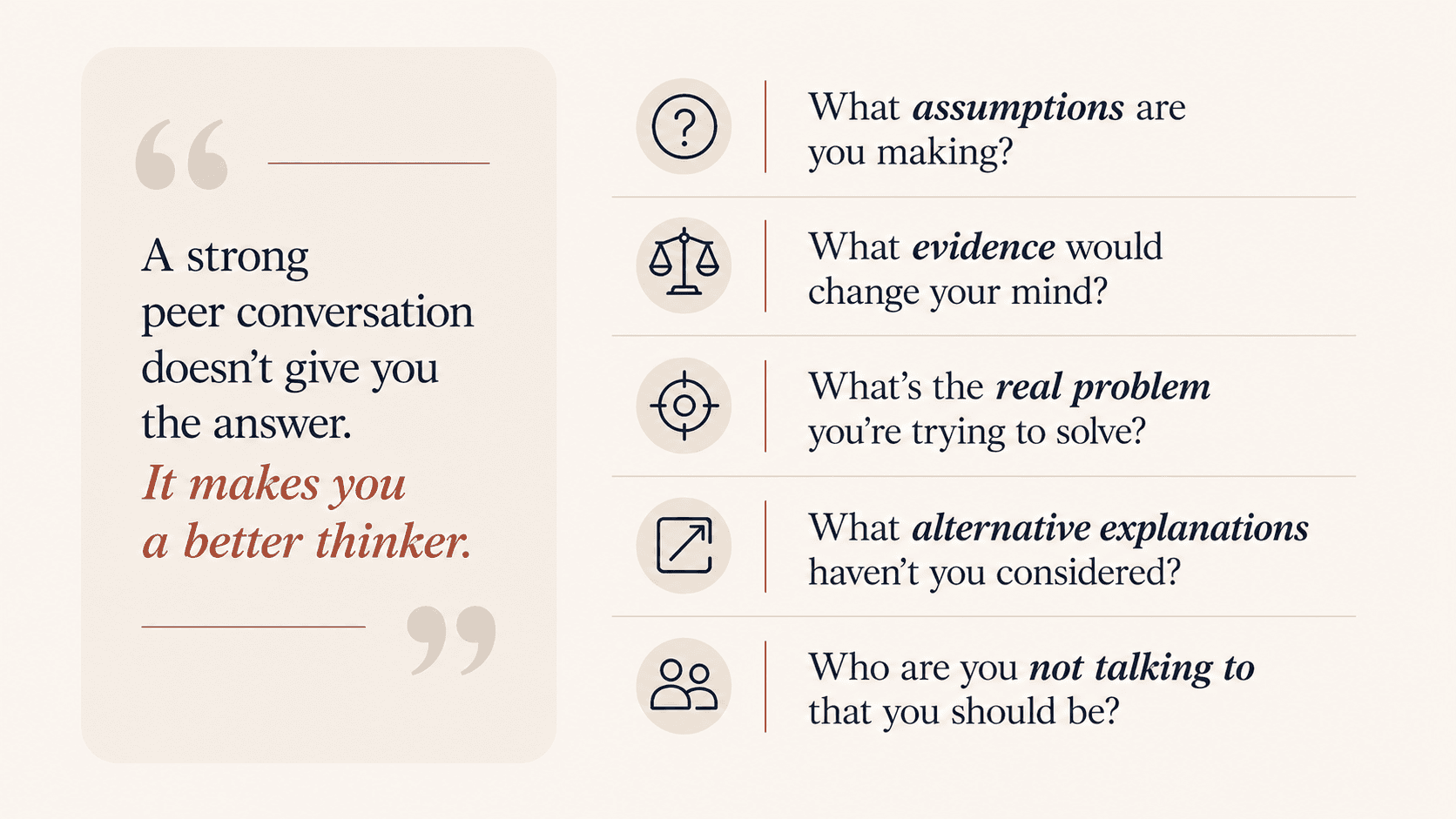
The most valuable founder conversations rarely end with someone saying, "Here's exactly what you should do."
Instead, they often sound like this:
"What assumptions are you making?"
"What evidence would change your mind?"
"Have you considered the downside if this doesn't work?"
"What's the opportunity cost of waiting another three months?"
"What metric are you optimizing for?"
Questions like these do something advice often cannot. They create clarity.
A useful conversation helps founders organize uncertainty, identify blind spots, and understand the tradeoffs behind each option. The decision still belongs to the founder, but it is more informed.
This approach is consistent with research on decision quality. Studies in organizational behavior have shown that high-performing leadership teams generally make better strategic decisions not because individuals possess more knowledge, but because they question assumptions before making major commitments.
For startup founders, those conversations are particularly valuable because many important decisions have no objectively correct answer. Whether to hire, raise funding, pivot, expand into a new market, or stay focused depends on dozens of variables that are unique to each company.
How startup founders can overcome founder loneliness
Founder loneliness cannot be eliminated completely.
Building a company means accepting a level of uncertainty that most careers never require. Every startup founder eventually encounters situations where the available information is incomplete, the consequences are significant, and no framework provides a guaranteed answer.
What can change is how those situations are experienced.
Many founders discover that the strongest protection against isolation is not a larger professional network, but a small group of fellow founders who meet consistently over time. Trust develops through repeated conversations rather than one-off interactions.
When evaluating a founder community, consider whether it provides these characteristics.
Characteristic | Why it matters |
|---|---|
Founders at a similar stage | Discussions stay relevant to current challenges. |
Regular conversations | Trust and openness increase over time. |
Honest feedback | Different perspectives improve strategic thinking. |
Mutual support | Everyone contributes rather than only asking for help. |
Long-term relationships | Members understand how the business evolves between meetings. |
This explains why many experienced entrepreneurs value recurring mastermind groups over large online communities.
A mastermind is not valuable because someone always has the answer. It works because members accumulate context over time. They remember previous discussions, understand the founder journey, notice recurring patterns, and recognize when something is different from the last conversation.
That accumulated context makes feedback more useful than advice from someone encountering the business for the first time.
The same principle applies to relationships with mentors, advisors, co-founders, and investors. Their value increases dramatically as they gain a deeper understanding of the business rather than evaluating isolated situations.
Ultimately, founder loneliness is less about the number of people around you and more about whether anyone truly understands the decisions you carry.
The most resilient founders are rarely the ones who know the most. They are usually the ones who have built relationships in which uncertainty can be discussed openly, assumptions can be challenged respectfully, and difficult decisions no longer have to be carried out entirely alone.
Frequently asked questions about founder loneliness
Why do founders feel lonely?
Founders feel lonely because responsibility cannot be delegated the way work can. Employees can own projects, managers can lead teams, advisors can offer recommendations, and investors can share their perspective. The founder still makes the final decision and lives with its consequences. That combination of responsibility and uncertainty creates a unique sense of isolation that is closely associated with entrepreneurship.
Why do startup founders feel alone even when they have a team?
A growing team solves operational problems, but it doesn't eliminate strategic responsibility. As a company grows, founders often become responsible for hiring, payroll, fundraising, pricing, product direction, and long-term vision simultaneously.
Employees usually focus on their own area of responsibility, while the founder must balance every part of the business simultaneously. This is why startup founders feel alone, even within successful companies with dozens or hundreds of employees.
Can a mentor solve founder loneliness?
A mentor can provide valuable guidance, introduce new perspectives, and help founders avoid common mistakes. However, mentorship alone rarely solves founder loneliness.
Most mentoring relationships are occasional and centered around specific questions. Loneliness is often reduced through continuous relationships with fellow founders who understand how your company evolves over months or years. Context accumulates over time, making every conversation more relevant.
Does having a co-founder eliminate loneliness?
Not necessarily.
Many successful companies have two or more founders, yet co-founders often experience different responsibilities. One may focus on engineering while the other manages customers, fundraising, investor relationships, or sales. They share the business, but they do not always share the same pressures.
A co-founder is one of the strongest sources of support a startup founder can have, but additional relationships with fellow founders often remain valuable throughout the founder journey.
Why do experienced founders recommend mastermind groups?
Most mastermind groups are built around one simple principle: every member contributes experience instead of only consuming advice.
Over time, members become familiar with each other's companies, milestones, goals, and recurring challenges. That shared context leads to deeper discussions than one-time conversations with strangers.
The objective isn't to tell founders what to do. It's to help founders think more clearly, recognize blind spots, and navigate uncertainty with greater confidence.
Final thoughts
Founder loneliness is one of the least visible challenges of building a company.
From the outside, entrepreneurship often appears highly social. Founders attend conferences, meet investors, publish on LinkedIn, participate in communities, and speak with customers every day. Yet those interactions don't always create the kind of relationships that help during difficult decisions.
The challenge isn't a lack of information. Modern founders have access to more knowledge than ever before. The challenge is finding people who understand the context behind those decisions.
As businesses grow, the stakes become higher. Hiring the wrong person, raising capital too early, delaying a pivot, expanding into the wrong market, or misjudging traction can have long-term consequences. These are questions that cannot be answered by a single framework or another podcast episode.
What consistently helps founders is building relationships before they urgently need them.
That may mean joining a peer group, participating in regular mastermind sessions, staying connected with fellow founders, or creating a small circle of trusted people who can challenge assumptions and openly discuss uncertainties. The exact format matters less than the quality and consistency of the conversations.
Successful founders rarely succeed because they never experience loneliness.
They succeed because they create an environment where important decisions don't have to be made in complete isolation. Over time, that environment improves clarity, strengthens confidence, and makes the founder journey more sustainable.
In the end, every founder signs off on the final decision. The goal is not to remove that responsibility. The goal is to make sure you don't have to carry it entirely on your own.