Personal Development
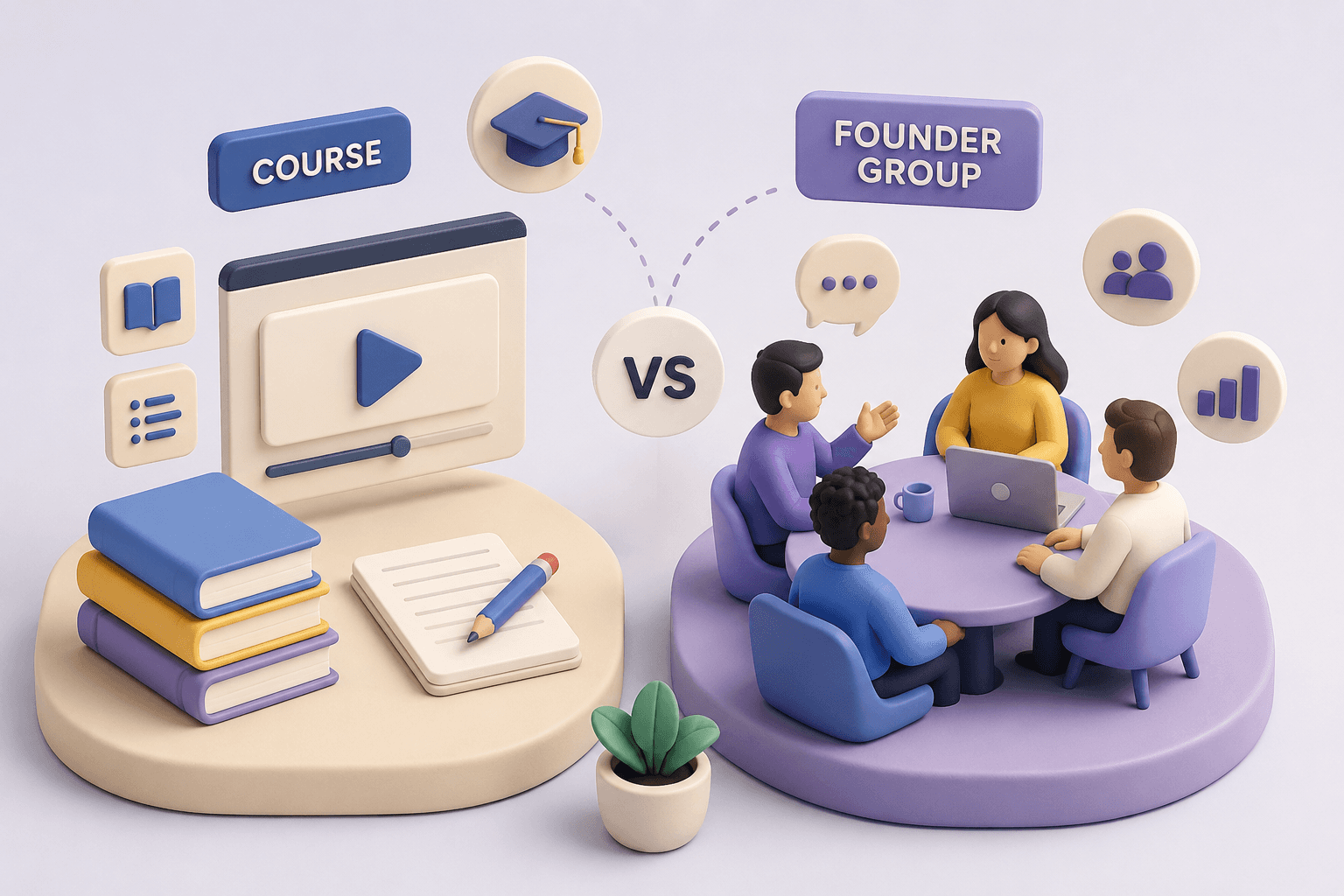
The difference between a founder community and a real peer group

, Community Leader
14 minutes

Bottom line: Communities create access. Peer groups create recurring context.
Most founders use the terms community, peer group, mastermind, and network almost interchangeably. They shouldn't.
A founder community and a peer group solve different problems. Communities help you discover people, ideas, and opportunities. Peer groups help you make better decisions over time because the same people see your progress, challenge your assumptions, and hold you accountable.
If your goal is to expand your network, ask occasional questions, or stay informed, a community is often enough. If your goal is to become a better founder, navigate difficult decisions, and avoid repeating the same mistakes, a peer group usually creates far more value.
The mistake isn't joining the wrong type of group. The mistake is expecting one to deliver the benefits of the other.
This article explains the differences, the strengths and limitations of each model, and how to decide which one fits your current stage as a founder.
Why founders confuse communities and peer groups
At first glance, they look remarkably similar.
Both bring founders together. Both create opportunities to ask questions, exchange ideas, and build relationships. Both often use the same tools, whether that's Slack, Circle, Discord, WhatsApp, or regular Zoom calls. From the outside, they can appear almost identical.
That similarity is exactly why many founders develop unrealistic expectations.
Someone joins a founder community hoping to find long-term accountability. Another founder signs up for a mastermind expecting hundreds of networking opportunities. A third assumes that simply paying for access will automatically produce meaningful relationships.
None of these expectations match how these environments actually work.
Why they look similar at first
Imagine two different founders.
The first joins a Slack community with 8,000 startup founders. Every day, dozens of conversations appear about fundraising, pricing, hiring, AI tools, product launches, and marketing. Questions receive answers within minutes. New members introduce themselves constantly. The community feels active and valuable.
The second joins a peer group consisting of seven SaaS founders. There are no hundreds of daily messages. Instead, the same seven people meet every other week. They discuss customer churn, difficult hiring decisions, pricing experiments, personal motivation, and strategic priorities. Every conversation builds on the previous one.
Both founders belong to "a community" in everyday language.
In reality, they are participating in completely different systems.
One system is optimized for breadth.
The other is optimized for depth.
That difference influences everything else.
Where the similarities end
The biggest distinction isn't the platform, the meeting frequency, or whether the group charges a membership fee.
The real difference is shared context.
Shared context means participants gradually accumulate knowledge about each other's businesses, goals, strengths, weaknesses, and decision-making patterns.
Without context, every conversation starts from zero.
Someone asks how to improve activation.
People reply based only on today's question.
Next month, the founder asks about pricing.
The same explanation happens again because nobody remembers what happened after the activation experiment. Every discussion becomes an isolated event.
A peer group works differently.
Members already know the product, previous experiments, customer profile, team structure, and recurring challenges. Instead of spending twenty minutes explaining the background, they immediately discuss what actually changed since the last conversation.
Over months, the quality of advice improves because context compounds.
This is one of the biggest misconceptions about founder communities. Many people believe better advice comes from having more experts available.
In practice, advice often becomes better because less explanation is required.
What a founder community is designed to do
Founder communities are incredibly valuable, but not always for the reasons people assume.
Their primary purpose is not accountability.
It is access.
Access to founders.
Access to specialists.
Access to investors.
Access to opportunities.
Access to conversations you would never have found on your own.
This is where large communities outperform almost every other format.
Suppose you're deciding between two payment providers, looking for recommendations for an SEO agency, or trying to understand how other founders structure customer onboarding. A large founder community can produce dozens of perspectives within hours.
That diversity is difficult to replicate inside a small peer group.
Large communities also create what sociologists call weak ties. These are relationships with people you don't know particularly well but who expose you to new ideas, industries, and opportunities. Research has consistently shown that weak ties play a major role in discovering jobs, partnerships, and information because they connect you to networks different from your own.
For founders, weak ties often lead to:
introductions to investors or potential customers;
recommendations for tools and service providers;
hiring referrals;
partnership opportunities;
distribution channels;
fresh perspectives from outside your immediate circle.
These outcomes are difficult to engineer on one's own.
Large communities make them happen naturally because thousands of people are connected through one shared space.
That is their superpower.
However, this strength also creates an important limitation, one that explains why founders often feel isolated despite belonging to multiple communities.
The hidden limitation of founder communities
The same characteristic that makes communities valuable also limits what they can achieve.
Most conversations inside a community are transactional.
You ask a question.
Someone answers.
You thank them.
Everyone moves on.
The interaction may be useful, but it rarely changes how you think or how you make decisions. By the time you face your next challenge, you're often asking a completely different group of people who know nothing about your previous situation.
This isn't a flaw in the community model. It's simply what large networks are optimized for.
The larger the community becomes, the harder it is to maintain continuity. Thousands of members create an incredible flow of ideas, but they also create constant context switching. Yesterday's discussion disappears beneath today's announcements, product launches, and new member introductions.
As a result, founders often mistake activity for progress.
You can spend hours reading discussions, commenting on posts, and helping other members while making very little progress on the few strategic decisions that actually determine your company's future.
This is one reason founder loneliness often persists even inside highly active communities.
Loneliness isn't always about having nobody to talk to.
More often, it's about having nobody who fully understands your situation.
If every conversation starts with a ten-minute explanation of your business model, target customers, current revenue, hiring challenges, and previous experiments, you'll naturally avoid asking the harder questions. The emotional cost of bringing someone up to speed becomes too high.
Eventually, founders stop looking for advice altogether and try to solve increasingly complex problems alone.
What makes a peer group fundamentally different
A peer group is not simply a smaller community.
It is a different operating model.
The defining characteristic is not exclusivity, pricing, or meeting frequency. It is the expectation that the same people will continue working together over time.
That expectation changes the incentives for everyone involved.
Members invest more effort into understanding each other's businesses because they know the relationship is ongoing. Feedback becomes more thoughtful because people expect to revisit the outcome in future conversations. Advice becomes more practical because participants are accountable for the quality of their recommendations.
Instead of optimizing for the number of interactions, peer groups optimize for the quality of relationships.
That shift has profound consequences.
Shared context over shared interests
Many founder communities are built around shared interests.
Everyone is building a startup.
Everyone wants to grow revenue.
Everyone is interested in AI, SaaS, fundraising, or product development.
While these shared interests create common ground, they don't create context.
Context develops through repeated exposure.
Imagine telling a friend about your company every two weeks for an entire year.
Eventually, they know more than just what your company does. They recognize your thinking patterns.
They notice when you're avoiding difficult conversations with customers.
They remember pricing experiments that failed six months ago.
They know which hiring mistakes you've repeated before.
They can tell the difference between a temporary setback and a recurring pattern because they've seen both.
That kind of insight cannot emerge from a single conversation, no matter how experienced the other person is.
The quality of feedback becomes a function of accumulated context rather than individual expertise.
Why consistency matters more than group size
Many founders assume that larger groups naturally create more value because they contain more expertise.
That logic makes sense when your goal is finding answers to isolated questions.
It becomes much weaker when your goal is making better long-term decisions.
Consider the following comparison.
Founder Community | Peer Group |
|---|---|
Hundreds or thousands of members | Usually 5 to 10 members |
New conversations every day | Ongoing conversations over months |
Advice from people who know today's question | Advice from people who know your business |
Easy to join and participate occasionally | Requires consistent participation |
Optimized for discovering opportunities | Optimized for improving decisions |
The difference is similar to the difference between visiting a new doctor every month and working with the same physician for years.
A new doctor may be exceptionally qualified, but they still need to learn your medical history before making informed recommendations.
Your long-term physician picks up where the previous conversation left off.
Peer groups work the same way.
The value compounds because context compounds.
Founder community vs. peer group: A side-by-side comparison
The clearest way to understand these models is to compare what each one is designed to optimize.
Dimension | Founder Community | Peer Group |
|---|---|---|
Primary goal | Access | Long-term growth |
Relationships | Many weak connections | Few strong relationships |
Feedback | Broad and diverse | Deep and contextual |
Accountability | Usually optional | Expected |
Knowledge sharing | High | Moderate |
Personal context | Low | High |
Decision support | Occasional | Continuous |
Learning style | Discover new ideas | Improve judgment over time |
Best for | Expanding your network | Becoming a better founder |
Neither column is objectively better.
A founder raising their first round might benefit enormously from a large community, as they need introductions, recommendations, and exposure to diverse perspectives.
A founder leading a growing company with twenty employees may receive far more value from five peers who understand the business well enough to challenge strategic decisions.
The mistake is evaluating both formats using the same criteria.
Communities succeed when they maximize reach.
Peer groups succeed when they maximize trust.
Those objectives naturally lead to very different experiences.
Why recurring context changes the quality of advice
One of the biggest advantages of a peer group isn't better advice. It's better questions.
When someone has followed your business for months, they rarely jump straight into solutions. Instead, they challenge assumptions that you've stopped noticing yourself.
A founder might say they're struggling with customer acquisition. Someone who has just met them will likely suggest new marketing channels or growth tactics.
A peer who's watched the company evolve might respond differently.
"Six months ago, your biggest problem wasn't acquisition. It was activation. Are you sure you've solved that, or are you trying to scale a funnel that still leaks?"
That question changes the entire conversation.
The goal shifts from generating more ideas to identifying the real constraint.
Over time, peer groups become less focused on solving individual problems and more focused on improving decision-making. Members begin to recognize recurring patterns, such as delaying difficult conversations, constantly changing priorities, or chasing new opportunities before validating the previous one.
Those observations are difficult to make in a community because no single member has enough history to see them.
In other words, communities transfer knowledge.
Peer groups develop judgment.
Which problems each format actually solves
Many founders frame the decision as choosing between a community and a peer group.
In practice, that's usually the wrong question.
The better question is: What problem are you trying to solve right now?
The answer often makes the choice obvious.
If your goal is... | The better fit is... |
|---|---|
Meet other founders | Founder community |
Find service providers | Founder community |
Get diverse opinions quickly | Founder community |
Build industry relationships | Founder community |
Stay informed about trends | Founder community |
Improve strategic decisions | Peer group |
Stay accountable to your goals | Peer group |
Work through difficult leadership challenges | Peer group |
Receive feedback from people who know your business | Peer group |
Neither format replaces the other because they create value in different ways.
A founder community expands your network horizontally.
A peer group strengthens your support system vertically.
The most effective founders tend to use both.
They discover opportunities through communities while relying on a trusted peer group to evaluate which opportunities are actually worth pursuing.
That combination reduces one of the biggest risks founders face: confusing new information with good decisions.
Common misconceptions founders have about peer groups
Many founders dismiss peer groups before they've experienced a well-run one. In most cases, the problem isn't the concept. It's that they've encountered something labeled a "peer group" that didn't actually function like one.
Here are three misconceptions worth challenging.
"A Slack group is basically a peer group."
It isn't.
Slack, Discord, Circle, or WhatsApp are communication tools, not operating models.
A Slack workspace can host an outstanding peer group, just as it can host a community of ten thousand members. What determines the experience isn't the platform but the structure behind it.
Without consistent participants, recurring conversations, and clear expectations, you're simply looking at another communication channel.
"A mastermind is just networking with meetings."
Networking is about meeting new people.
A mastermind or peer group is about working with the same people repeatedly.
The objective isn't to increase the number of contacts in your network. It's to improve the quality of thinking behind your most important decisions.
If every meeting introduces a completely different set of participants, you're networking.
If every meeting builds on previous conversations, you're participating in a peer group.
"The more members, the more valuable the group."
That assumption makes sense for communities.
It often works against peer groups.
As groups become larger, participation naturally becomes less balanced. Some members contribute less, conversations become more superficial, and accountability weakens because responsibility becomes diffused.
Many experienced facilitators intentionally keep peer groups small, often between five and eight founders.
The limitation isn't accidental.
It's what allows every member to remain visible, heard, and accountable.
How to choose the right environment for your current stage
If you're unsure which model fits your needs, use this simple framework.
Choose a founder community if you primarily need to:
expand your professional network;
learn from a wide variety of founders;
discover tools, resources, and opportunities;
ask occasional questions without making an ongoing commitment.
Choose a peer group if you primarily need to:
make better strategic decisions;
receive honest feedback from people who know your business;
stay accountable to long-term goals;
avoid solving the same problems over and over again.
Choose both if you're actively growing your company.
Many experienced founders naturally separate these functions.
Communities become their source of new ideas, introductions, and opportunities.
Peer groups become the place where those ideas are tested, challenged, and transformed into better decisions.
That combination creates both exploration and focus, two qualities that are difficult to sustain in a single environment.
Actionable takeaways for founders
If there's one idea worth remembering, it's this:
Communities help you discover opportunities. Peer groups help you capitalize on them.
They are complementary, not competing, formats.
A community gives you access to people you don't know yet.
A peer group gives you continuity with people who know your business well enough to challenge your thinking.
As your company grows, the value of context often increases faster than the value of access. New introductions remain important, but the hardest founder decisions rarely depend on meeting another person. They depend on making better judgments with the information you already have.
If you're evaluating where to invest your time, don't ask which format is better.
Ask which capability you're currently missing.
If you need more opportunities, join a great founder community.
If you need better decisions, find a peer group that will still be asking you about today's goals six months from now.