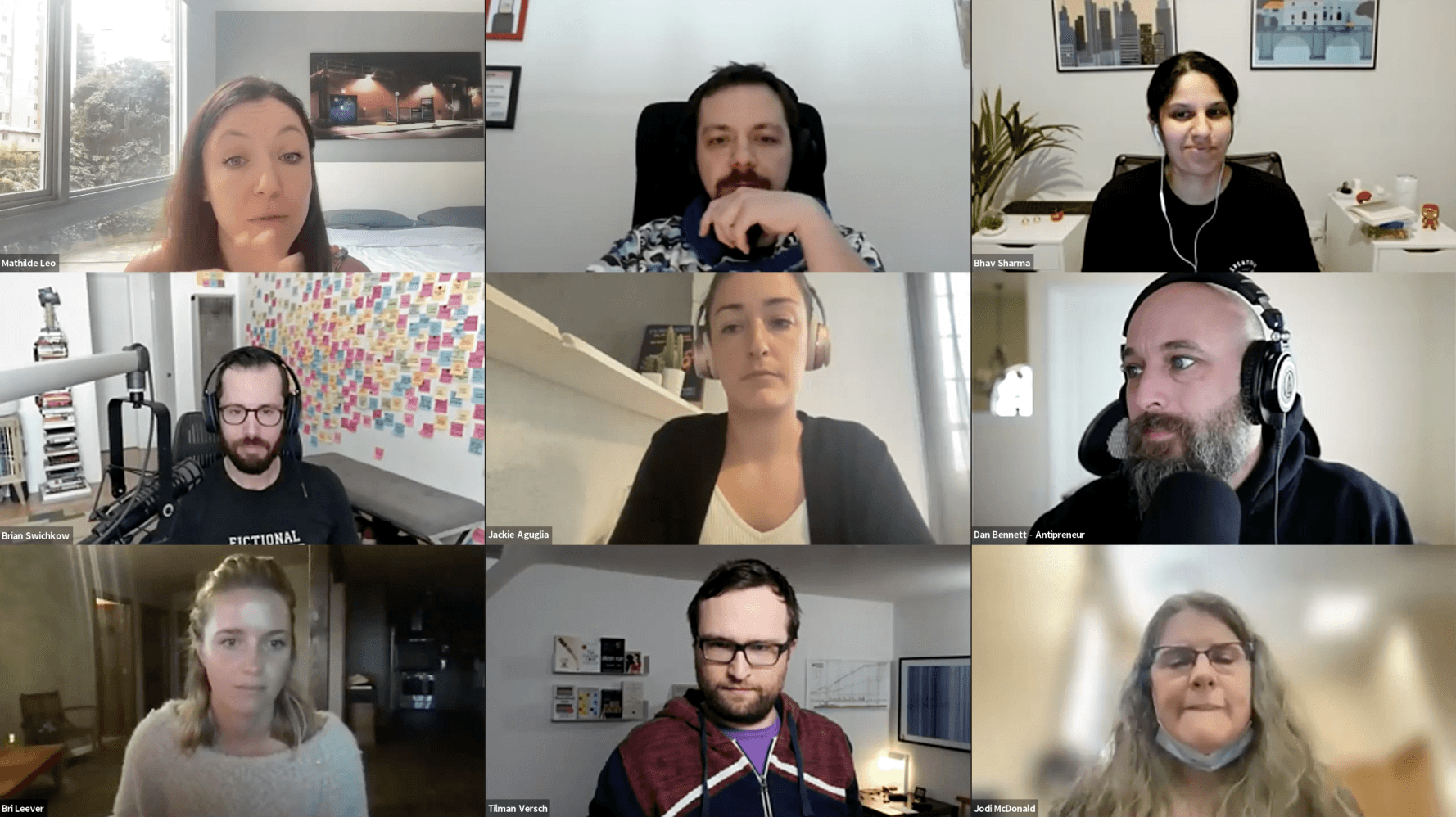
If you've ever wished you had a trusted group of experienced people to help you solve difficult business problems, challenge your assumptions, and keep you accountable, you're already thinking about what a mastermind group provides.
A mastermind group is a small group of like-minded professionals who meet regularly to discuss challenges, brainstorm ideas, share experiences, and hold one another accountable for meaningful progress. While mastermind groups are popular among entrepreneurs, they are also widely used by executives, consultants, creators, and business leaders who want to accelerate both personal and professional growth.
Unlike networking events, where conversations are often brief and superficial, or coaching programs, where advice typically comes from one expert, a mastermind group relies on the collective knowledge and effort of every member. Each participant contributes their own experience, creating insights that would be difficult to reach alone.
In this guide, you'll learn what a mastermind group is, how a typical mastermind session works, the benefits of joining one, real-world examples, and how to choose or start a mastermind group that fits your goals.
What Is a Mastermind Group?
A mastermind group is a small peer advisory group whose members meet regularly to help each other solve problems, make better decisions, and stay accountable to their goals. Rather than relying on a single mentor or consultant, every group member contributes ideas, asks thoughtful questions, and shares relevant experience.
The underlying principle is simple: a diverse group of experienced people can often arrive at better solutions than any individual working alone. Different backgrounds, industries, and perspectives help uncover blind spots that would otherwise go unnoticed.
Most mastermind groups consist of five to ten members and are led by a facilitator who keeps discussions focused, ensures everyone participates, and maintains confidentiality throughout each mastermind session.
The exact format varies, but successful mastermind groups usually share several characteristics.
Characteristic
Typical Approach
Group size
5–10 members
Meeting frequency
Weekly or biweekly
Session length
60–120 minutes
Facilitator
Keeps discussions productive and balanced
Main focus
Solving problems, accountability, and business growth
The Mastermind Idea and Its Origins
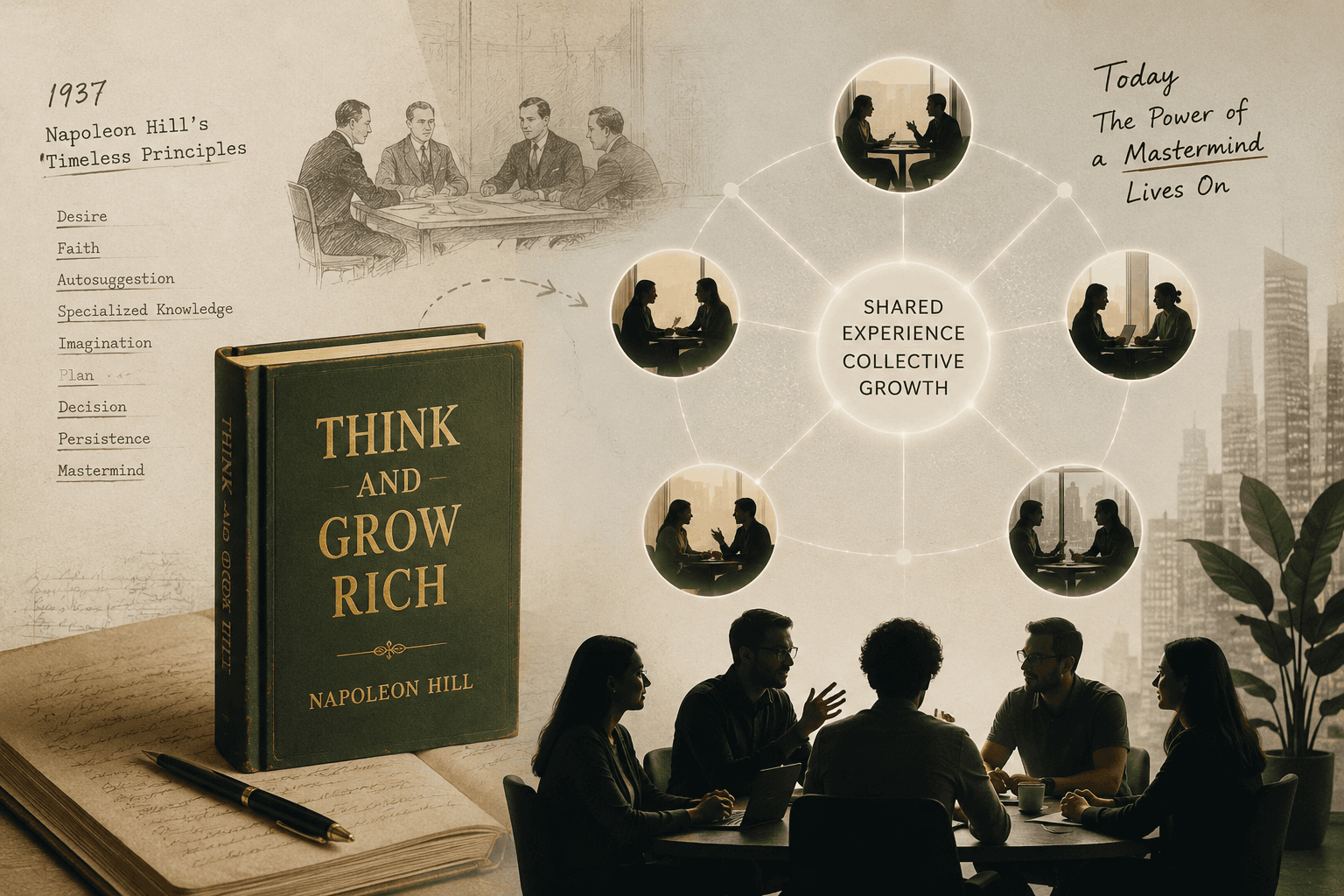
The mastermind idea became widely known through Napoleon Hill's books, particularly Think and Grow Rich, published in 1937. Hill described the mastermind as the "coordination of knowledge and effort" between two or more people working toward a definite purpose.
According to Hill, when people collaborate with complete trust and a spirit of harmony, they create something greater than the sum of their individual abilities. He referred to this as the "Master Mind," suggesting that collaboration can generate better ideas than any one person could develop independently.
Hill wrote:
"No two minds ever come together without thereby creating a third, invisible intangible force."
Whether interpreted literally or simply as a metaphor for effective collaboration, the concept has influenced generations of entrepreneurs, executives, and business leaders.
Many readers also associate the mastermind concept with influential figures such as Andrew Carnegie and Henry Ford, whom Hill cited as examples of people who surrounded themselves with trusted advisors instead of making important decisions alone. Today, that same principle continues in modern mastermind groups, where members regularly exchange knowledge, challenge assumptions, and help each other grow.
Mastermind Group vs. Advisory Group
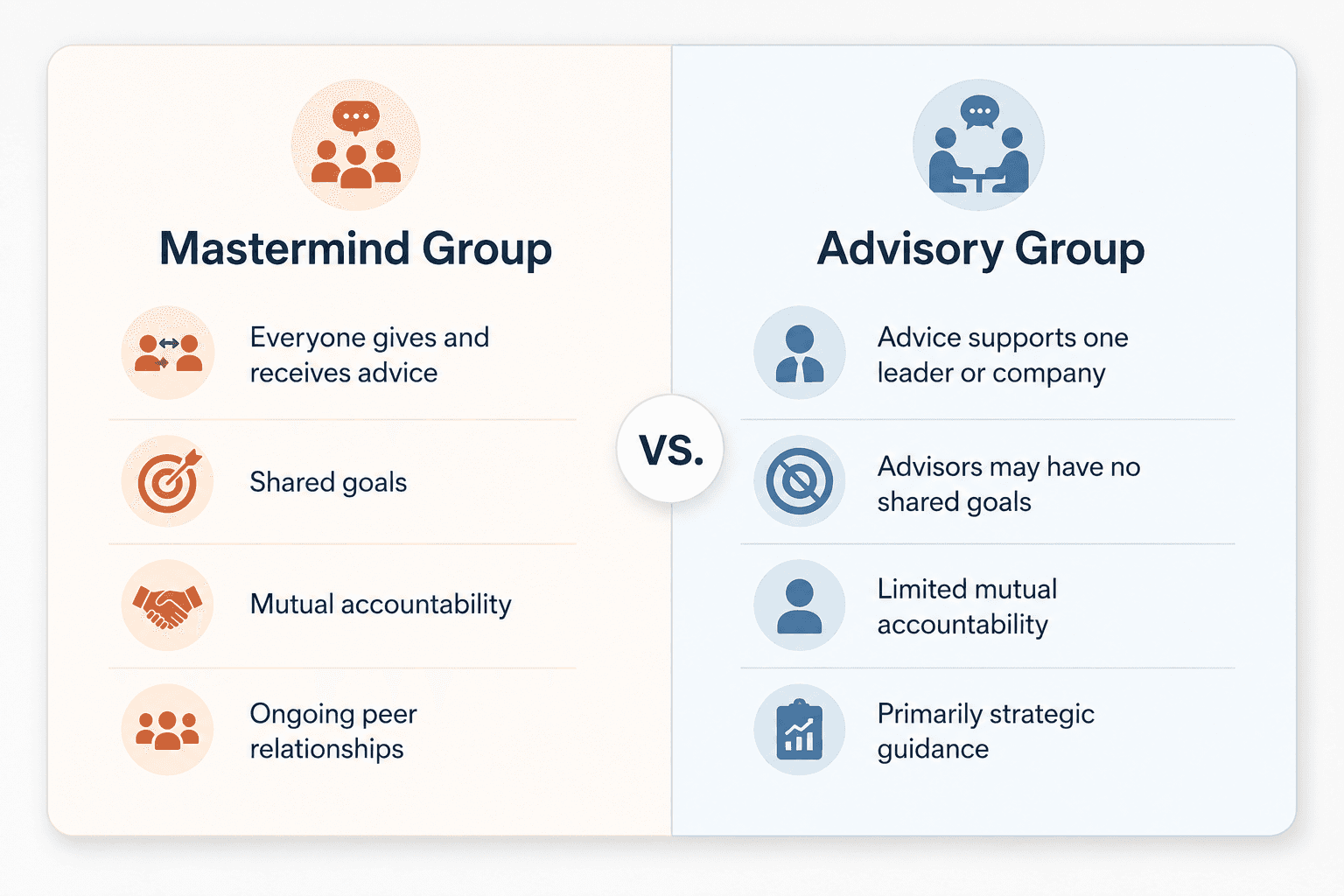
The terms mastermind group and advisory group are sometimes used interchangeably because both involve experienced people helping one another make better decisions. However, there are important differences.
An advisory group is usually assembled around a business or organization. Members provide strategic guidance to a founder or leadership team, but they may not share their own goals or receive support in return.
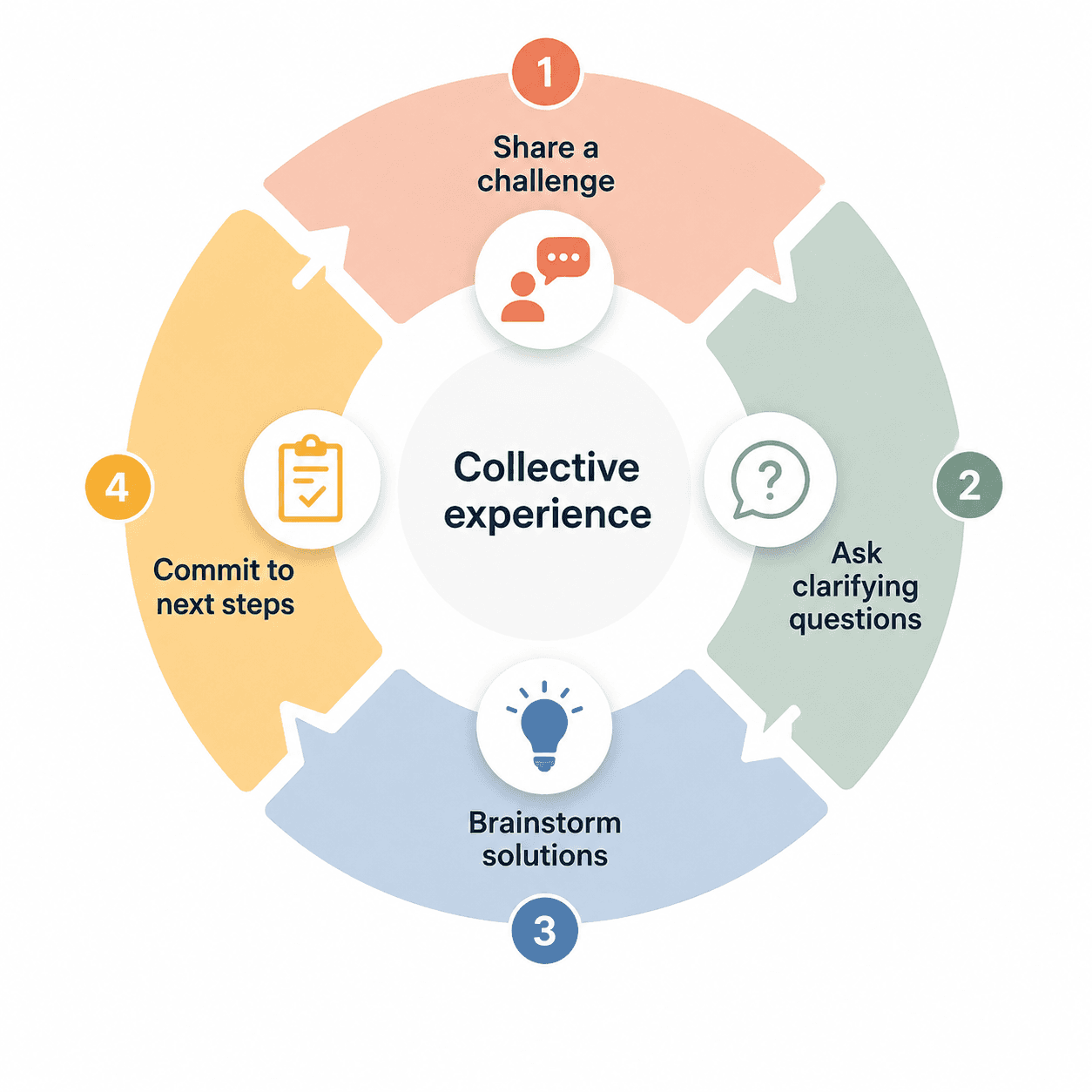
A mastermind group works differently. Every participant is both a contributor and a beneficiary. Members take turns presenting challenges, receiving feedback, brainstorming solutions, and committing to actions before the next meeting. The relationship is reciprocal rather than one-directional.
Because everyone participates equally, a mastermind group often builds stronger accountability and deeper long-term relationships than a traditional advisory group.
Mastermind Group Structure
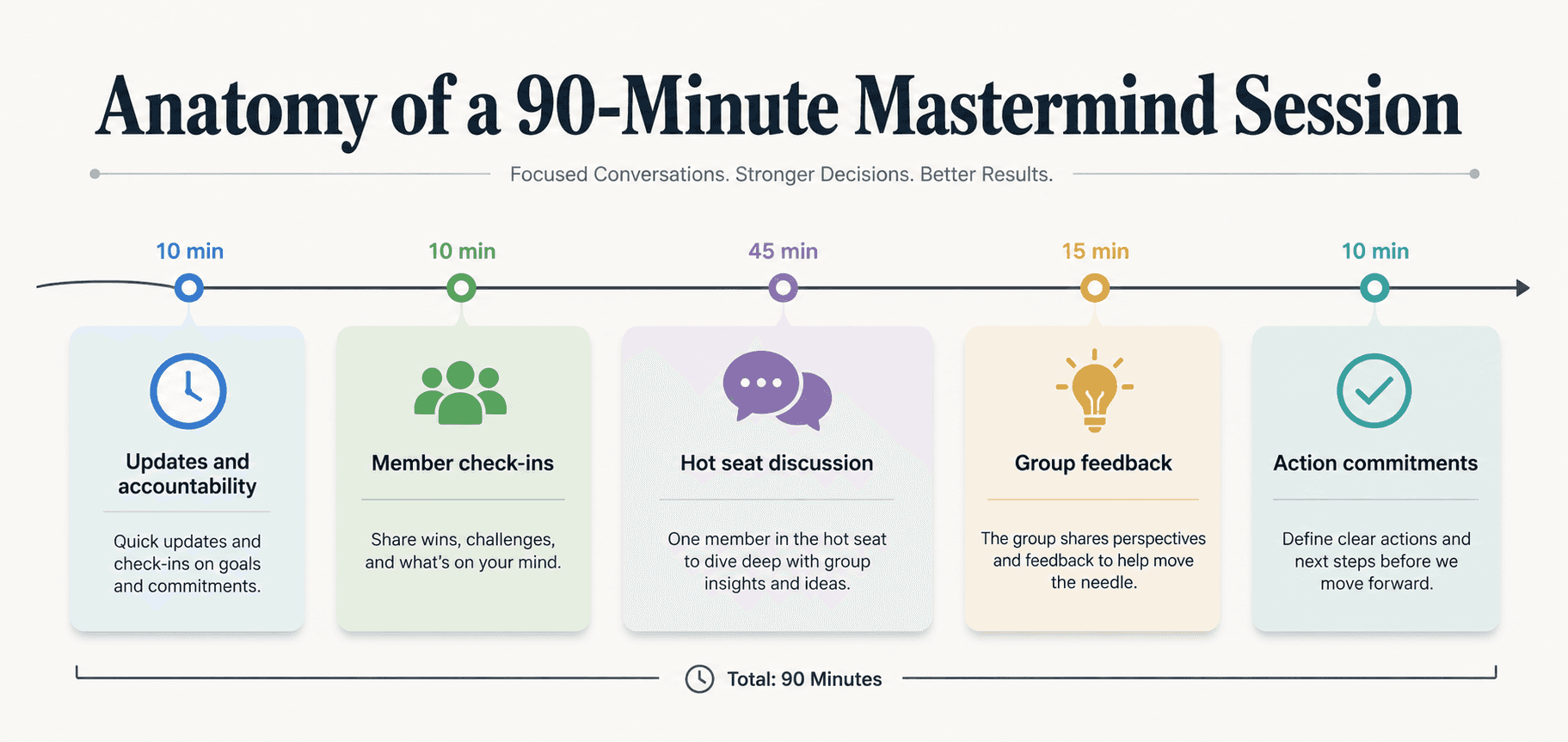
Although every group develops its own rhythm, most successful mastermind groups follow a predictable structure. A consistent format helps meetings stay focused while ensuring every member has an opportunity to contribute.
The Role of the Mastermind Facilitator
The facilitator is responsible for guiding the discussion rather than providing all the answers. Their job is to keep conversations on track, encourage balanced participation, manage time, and ensure confidentiality.
In some groups, one member serves as facilitator on a rotating basis. In others, a professional facilitator starts and runs every session. Both approaches can work well as long as the facilitator maintains a productive group setting where everyone feels comfortable sharing challenges openly.
How a Typical Mastermind Session Is Structured
While formats vary, a typical mastermind session often follows a structure similar to this:
Quick updates and accountability check-ins.
One or more hot seat discussions where members present current business challenges.
Brainstorming and peer feedback from the rest of the group.
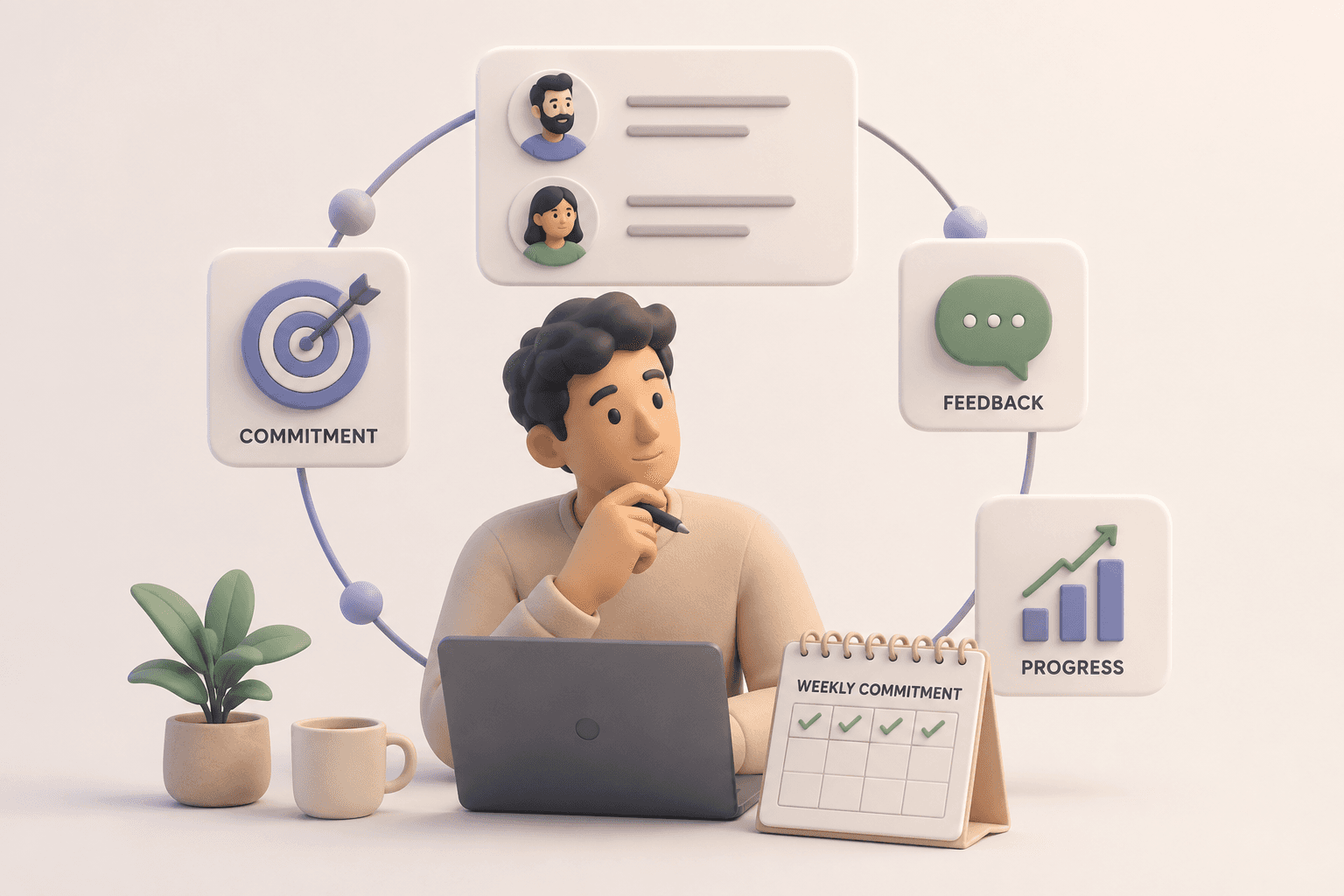
Action commitments for the coming week or month.
This structure ensures meetings remain practical rather than becoming casual conversations. Members leave each session with concrete next steps instead of general inspiration.
Accountability and Peer Advisory
One of the biggest reasons people join a mastermind group is accountability.
Knowing that you'll meet regularly with people who understand your goals makes it much more likely that you'll follow through on important commitments. Members don't simply ask whether tasks were completed. They help identify obstacles, suggest alternatives, and encourage consistent progress.
This combination of accountability and peer advisory often becomes more valuable over time as trust grows within the group.
Collective Mastermind Problem Solving
The greatest strength of a mastermind group is collective problem solving.
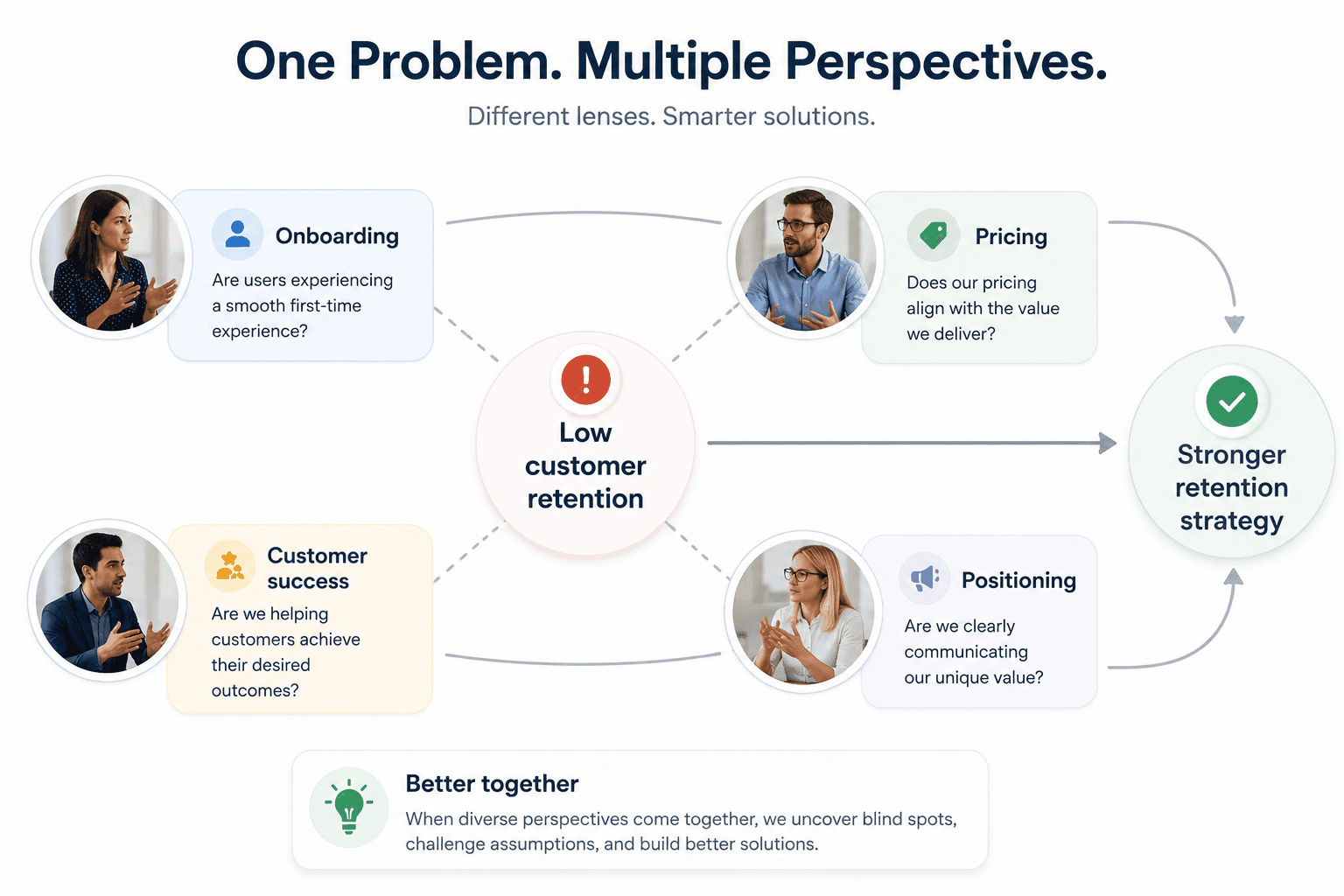
Imagine a founder struggling with customer retention. Another member has already solved a similar problem through onboarding improvements. A third has experience with pricing strategy. A fourth sees a positioning issue that nobody else noticed.
Instead of relying on a single opinion, the founder benefits from multiple perspectives that build on one another. This collective wisdom helps members solve problems faster while avoiding mistakes others have already made.
As a result, mastermind groups don't simply generate more ideas. They often produce better decisions because those ideas have been challenged, refined, and improved through discussion.
Mastermind Group Examples
While the core principles remain the same, mastermind groups can look very different depending on their members' goals. Some focus on startup growth, while others help executives, consultants, or creators navigate professional challenges. The best mastermind group is not necessarily the one with the most experienced members, but the one where participants face similar problems and can offer relevant insights.
Here are a few common examples.
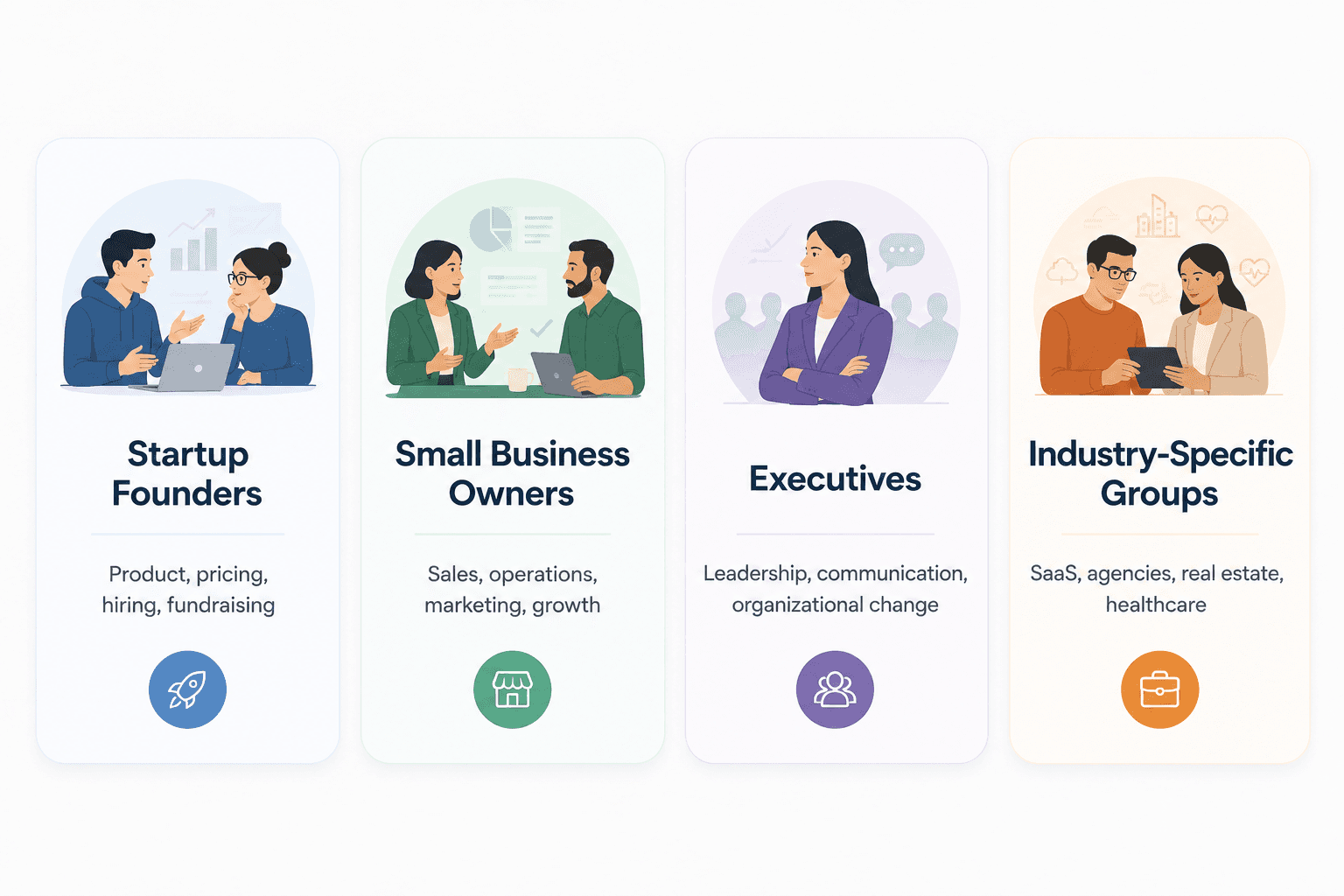
Startup Founder Mastermind
Startup founders often face challenges that are difficult to discuss with employees, investors, or even friends. Topics such as product strategy, hiring, fundraising, pricing, customer acquisition, and leadership require honest feedback from people who understand the realities of building a company.
A startup mastermind group provides a confidential environment where founders can openly discuss business challenges, validate ideas, and receive practical advice from peers who have experienced similar situations.
Small Business Owner Mastermind
Business owners often find themselves making every important decision alone. A mastermind group gives them access to a trusted network of peers who can provide outside perspectives on hiring, operations, sales, marketing, and long-term strategy.
Because members meet regularly, discussions go beyond one-time advice. The group becomes familiar with each member's business, allowing feedback to become increasingly specific and valuable over time.
Executive Leadership Mastermind
Leadership positions can be surprisingly isolating. Senior executives frequently manage large teams but have few opportunities to discuss their own challenges openly.
Executive mastermind groups create a space where business leaders can explore organizational change, communication, decision-making, and leadership development with other experienced professionals operating at a similar level.
Industry Specific Mastermind Groups
Some mastermind groups focus on a particular profession or industry, such as SaaS founders, agency owners, real estate investors, or healthcare professionals.
Industry-specific groups allow members to dive deeper into technical discussions because everyone shares similar business models, customer expectations, and market dynamics. General groups, on the other hand, often provide more diverse perspectives and can uncover solutions that specialists might overlook.
Benefits of Joining a Mastermind Group
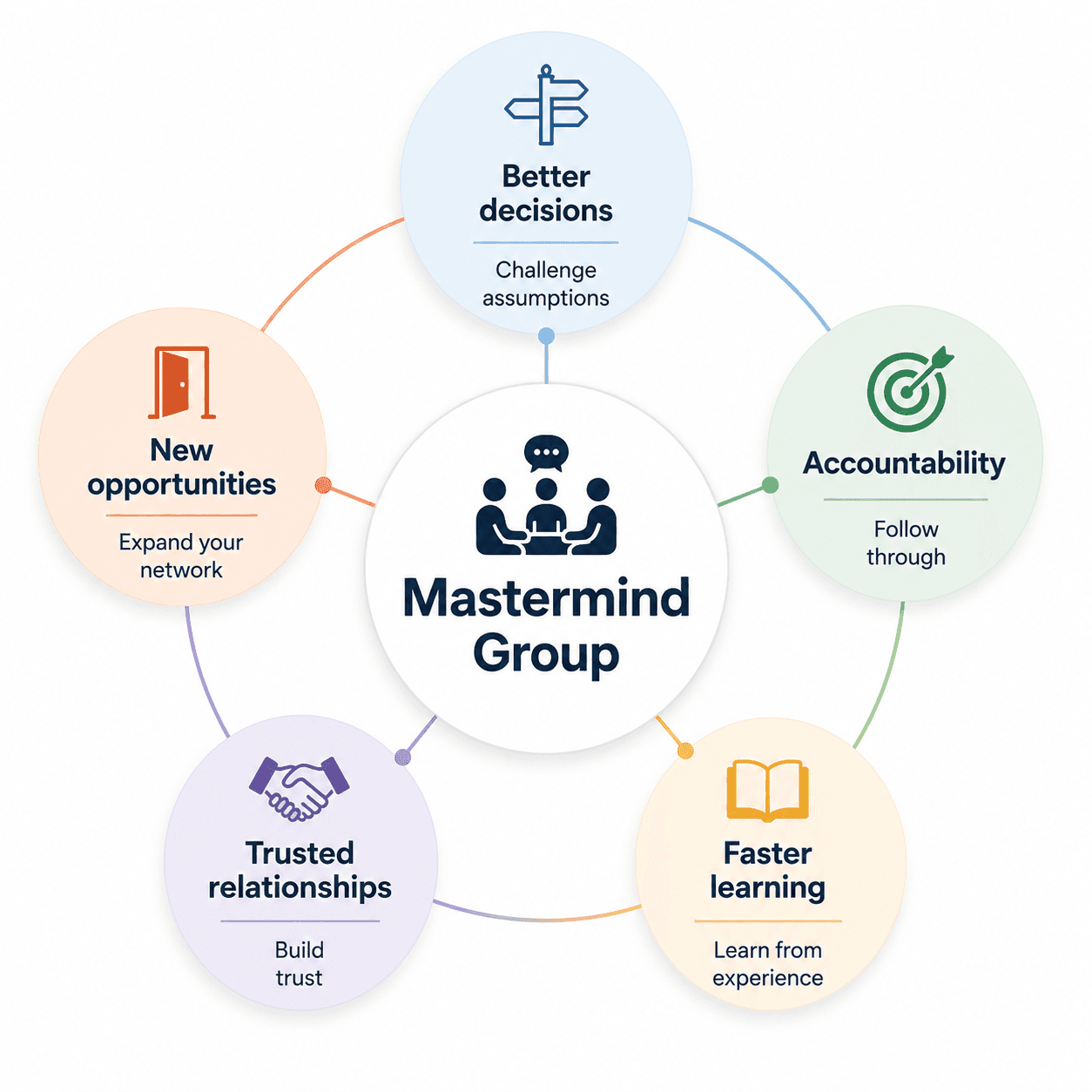
People rarely join a mastermind group simply to exchange ideas. They join because they want to make better decisions, stay accountable, and grow faster than they could alone.
Although every group is different, the most successful mastermind groups offer several consistent benefits.
Better Decision Making
When facing an important decision, it's easy to become trapped by your own assumptions. A mastermind group challenges those assumptions by introducing multiple viewpoints from experienced members.
Instead of receiving advice from one expert, you benefit from several independent perspectives. Members ask questions you may not have considered, identify potential risks, and suggest alternatives based on their own experience.
Accountability and Consistent Progress
Many ambitious professionals know exactly what they should do. The challenge is doing it consistently.
Meeting regularly with the same group creates accountability that is difficult to replicate alone. Members review previous commitments, celebrate progress, and encourage one another to follow through on priorities instead of constantly chasing new ideas.
Research on goal achievement consistently shows that sharing goals with others and reporting progress increases the likelihood of completing them. A mastermind group turns that principle into an ongoing habit rather than a one-time exercise.
Learning From Other Members
One of the greatest advantages of a mastermind group is learning from mistakes you never have to make yourself.
Every member brings different experiences, successes, and failures. Instead of spending months discovering solutions through trial and error, you gain access to lessons that other members have already learned.
This exchange of knowledge becomes increasingly valuable as trust develops within the group.
Building a Strong Professional Network
Unlike traditional networking events, mastermind groups emphasize long-term relationships rather than brief introductions.
Over months or even years, members often become trusted advisors who introduce each other to customers, partners, investors, employees, and new business opportunities. These relationships frequently extend well beyond scheduled mastermind sessions.
The table below summarizes how mastermind groups differ from traditional networking.
Mastermind Group
Networking Group
Small, consistent membership
Large and constantly changing attendance
Deep discussions
Short conversations
Accountability
Few follow-ups
Confidentiality
Public interactions
Long-term relationships
New introductions
Members help each other grow
Members primarily exchange contacts
Who Should Join a Mastermind Group?
A mastermind group can benefit almost anyone who regularly makes important decisions. However, the format tends to be most valuable for people who actively pursue ambitious personal or professional goals.
Startup Founders
Founders often carry the full responsibility for product, hiring, sales, marketing, fundraising, and company strategy. Having a trusted peer group reduces isolation while providing practical advice from people who understand startup realities.
Business Owners
Running a business requires making hundreds of decisions each year. A mastermind group offers an external perspective that can improve strategic thinking while helping business owners avoid costly mistakes.
Freelancers and Consultants
Independent professionals rarely have colleagues to discuss pricing, difficult clients, positioning, or business development. A mastermind group fills that gap by creating a reliable advisory group of peers.
Creators and Independent Professionals
Content creators, authors, coaches, designers, and other independent professionals often work alone. Meeting with like-minded people who share similar ambitions can improve both motivation and decision-making while creating valuable professional relationships.
Not everyone benefits equally from a mastermind group. Members who are willing to share openly, receive constructive feedback, and contribute to other people's success usually gain the most value.
How to Find a Mastermind Group
Finding a good mastermind group takes more than searching online. The quality of the members matters far more than the name of the program.
If you're evaluating different options, consider the following criteria.
The strongest groups often grow through invitations rather than public advertising because existing members carefully protect the group's quality.
How to Evaluate a Good Mastermind
Before you join a mastermind group, ask yourself these questions:
Do members have similar goals and experience?
Do they meet regularly?
Is there a facilitator?
Are expectations for participation clearly defined?
Is confidentiality taken seriously?
Does everyone contribute, or do only a few people dominate discussions?
A good mastermind creates balanced participation where every group member both gives and receives value.
Questions to Ask Before You Join a Mastermind Group
Before committing to any mastermind, ask the organizer:
Who typically joins this mastermind group?
How large is the group?
How often do meetings take place?
What does a typical mastermind session look like?
Are meetings virtual or in person?
How is accountability handled?
What happens if someone regularly misses meetings?
Clear expectations from the beginning usually lead to stronger engagement later.
Free vs. Paid Mastermind Groups
Both free and paid mastermind groups can be highly effective.
Free groups often emerge organically among peers who already know one another. Paid mastermind groups typically include professional facilitation, a structured process, member screening, and stronger long term commitment.
The right choice depends less on price than on the quality of the members and the consistency of participation. A well-managed group with engaged members will almost always outperform a larger group with little accountability.
How to Start a Mastermind Group
If you can't find a mastermind group that fits your goals, consider starting one yourself. Many of the most successful groups begin with just a handful of motivated people who share similar ambitions and are committed to helping one another grow.
The key is not assembling as many members as possible. Instead, focus on bringing together people who are willing to contribute, accept feedback, and consistently show up prepared. A smaller group of engaged participants will almost always outperform a larger group with low participation.
Choosing the Right Members
The quality of a mastermind group depends largely on its members.
Look for people who have comparable levels of experience or face similar business challenges. A SaaS founder, agency owner, and consultant may all benefit from the same discussion if they share similar growth goals, but mixing early-stage founders with executives managing thousand-person organizations can create conversations that are less relevant for everyone.
When selecting members, consider whether they:
Have clear personal or professional goals.
Are willing to share experiences honestly.
Respect confidentiality.
Enjoy helping other people solve problems.
Can commit to attending meetings consistently.
Perhaps most importantly, choose people who are collaborative rather than competitive. The strongest mastermind groups are built on trust, not comparison.
Defining the Purpose and Format
Before inviting anyone, define what the group exists to accomplish.
A mastermind focused on business growth will naturally have different conversations than one centered on leadership development or personal productivity. Establishing a clear purpose helps attract the right members and keeps discussions focused.
You should also decide on the basic structure, including:
Decision
Recommendation
Group size
5–10 members
Meeting frequency
Weekly or biweekly
Session length
60–120 minutes
Meeting format
Online or in person
Hot seats per meeting
1–3 depending on group size
Having these expectations in place from the beginning reduces confusion as the group grows.
Selecting a Mastermind Facilitator
Every successful mastermind benefits from someone who guides the discussion.
A facilitator does not need to be the smartest person in the room. Their responsibility is to manage time, encourage balanced participation, keep discussions productive, and make sure everyone has an opportunity to contribute.
Some groups rotate this role among members, while others prefer one consistent facilitator. Both approaches can work well, provided the facilitator remains neutral and focused on helping the entire group succeed.
Starting Your Own Mastermind
Launching your first mastermind does not need to be complicated.
Start by inviting a small number of people you already respect professionally. Schedule a trial meeting, explain the group's purpose, and gather feedback afterward. Most groups refine their format over time as members discover what creates the most value.
As trust develops, members become more comfortable discussing difficult decisions, asking for honest feedback, and sharing lessons from both successes and failures.
Mastermind Group vs. Coaching, Mentoring, and Peer Advisory Groups
Because mastermind groups involve learning from others, they are often confused with coaching, mentoring, or advisory groups. While these formats share similarities, they serve different purposes.
Format
Primary Source of Advice
Relationship
Mastermind group
Peer group
Everyone contributes equally
Coaching
Professional coach
One expert guides participants
Mentoring
Experienced mentor
One experienced individual supports another
Advisory group
Advisors
Advice flows primarily toward one business or leader
A coach helps clients improve specific skills through structured guidance. A mentor shares personal experience to help someone navigate a career or business journey. An advisory group typically supports one founder or organization with strategic recommendations.
A mastermind group is unique because every member participates as both teacher and learner. Members share knowledge, challenge assumptions, brainstorm solutions, and help each other grow through ongoing collaboration.
Rather than replacing coaching or mentoring, many professionals combine these approaches. A founder, for example, might work with an executive coach while also participating in a mastermind group for accountability and peer feedback.
Common Mastermind Group Mistakes to Avoid
Even experienced professionals can struggle to build an effective mastermind group. Fortunately, most problems are predictable and can be avoided with clear expectations.
Choosing Members With Incompatible Goals
A group works best when members face similar challenges and can contribute relevant experience.
If one member is launching a first business while another manages a multinational company, discussions may become too broad to benefit either participant.
Running Sessions Without a Facilitator
Without someone guiding the conversation, meetings often drift away from meaningful discussion.
A facilitator keeps conversations balanced, ensures everyone participates, and prevents individual members from dominating the session.
Giving Advice Too Quickly
Many people respond to problems by immediately offering solutions.
Strong mastermind groups spend time asking thoughtful questions first. Understanding the situation usually leads to much better advice than reacting to incomplete information.
Ignoring Accountability
The value of a mastermind comes from action, not conversation alone.
Each meeting should end with clear commitments that members review during the next session. Without accountability, discussions become interesting but rarely lead to measurable progress.
Frequently Asked Questions About Mastermind Groups
What Is the Purpose of a Mastermind Group?
The purpose of a mastermind group is to help members solve problems, make better decisions, stay accountable, and achieve their goals through regular collaboration with trusted peers.
How Many People Should Be in a Mastermind Group?
Most mastermind groups include between five and ten members. This size is large enough to provide diverse perspectives while remaining small enough for everyone to participate actively.
How Often Should a Mastermind Group Meet?
Many groups meet every week or every two weeks. The ideal schedule depends on members' goals, but consistency is generally more important than frequency.
How Long Does a Mastermind Session Last?
A typical mastermind session lasts between 60 and 120 minutes, depending on the number of members and the number of hot seats scheduled for each meeting.
How Much Does It Cost to Join a Mastermind?
Some mastermind groups are completely free, especially when organized among peers. Others charge monthly or annual fees to cover professional facilitation, member screening, educational resources, or community management.
Are Mastermind Groups Worth It?
For people who value accountability, honest feedback, and learning from experienced peers, mastermind groups can provide significant long-term value. The return often comes not from one breakthrough idea, but from consistently making better decisions over months or years.
Subscribe to newsletter that helps SaaS founders get unstuck from mind blocks, blind spots, and skill gaps.
Free newsletter. Unsubscribe anytime.
3,000+
Subscribers
Subscribe to newsletter that helps SaaS founders get unstuck from mind blocks, blind spots, and skill gaps.
Free newsletter. Unsubscribe anytime.
3,000+
Subscribers
Subscribe to newsletter that helps SaaS founders get unstuck from mind blocks, blind spots, and skill gaps.
Free newsletter. Unsubscribe anytime.
3,000+
Subscribers
Subscribe to newsletter that helps SaaS founders get unstuck from mind blocks, blind spots, and skill gaps.