Personal Development
Why Generic Startup Advice Makes Founder Loneliness Worse

, Community Leader
12 minutes

Generic startup advice often makes founder loneliness worse by removing the one thing every important business decision depends on: context. Articles, podcasts, and LinkedIn posts can teach useful principles, but they cannot account for your customers, your market, your resources, or your company's stage. As a result, founders often begin to question themselves rather than asking whether the advice actually applies to their situation.
This is not simply a perception. According to the 2024 Startup Snapshot Founder Report, 72% of founders said entrepreneurship had negatively affected their mental health, while 37% reported experiencing burnout. Many respondents also described isolation and decision fatigue as recurring challenges. Instead of struggling to find information, founders were struggling to find relevant guidance.
Only after introducing that core idea does it make sense to ask why this happens.
Every founder has heard the same recommendations. Talk to customers. Raise your prices. Hire faster. Delegate more. Build in public. Focus on product-led growth. Find product-market fit before scaling. Raise venture capital only if you need it.
None of these recommendations are wrong. Many have helped build successful companies. The problem is that they are usually presented as universal principles instead of context-dependent decisions.
A founder reading a popular LinkedIn post or listening to a podcast rarely knows whether the advice comes from a bootstrapped SaaS company, a venture-backed startup, a solo entrepreneur, or the CEO of a company with hundreds of employees. Those details matter because they determine whether a recommendation is relevant or completely inappropriate for another business.
Why generic startup advice increases founder loneliness instead of reducing isolation
At first glance, startup advice appears universal. Growth strategies, fundraising frameworks, hiring principles, and productivity systems are often presented as if they work equally well for every company.
In practice, every recommendation depends on context.
A SaaS founder with twenty paying customers operates under completely different constraints than the CEO of a venture-backed company preparing for a Series A. An ecommerce business measures success differently from a B2B software company. A startup selling to enterprise customers cannot follow the same playbook as one selling self-serve subscriptions.
The difference becomes obvious once you compare the recommendation with the assumptions behind it.
Common startup advice | The context that often goes unstated |
|---|---|
Hire before you need to | Assumes predictable revenue and available capital |
Raise venture capital | Assumes the business is designed for rapid scale |
Build in public | Assumes your audience matches your target customers |
Focus on product-led growth | Assumes customers can adopt the product without sales |
Delegate earlier | Assumes experienced people are already available to hire |
None of this advice is inherently wrong.
The problem is that founders naturally compare themselves with businesses operating under completely different conditions. When the expected results fail to appear, they rarely question the recommendation. Instead, they question themselves.
Most founders eventually begin asking the same questions.
Am I growing too slowly?
Am I solving the wrong problem?
Why does everyone else seem more confident?
What am I missing?
Should I completely change my strategy?
These questions are perfectly rational. The problem is that they often arise when founders compare themselves to businesses operating under entirely different circumstances.
Startup founders need understanding, not endless information
When uncertainty increases, most founders respond in the same way. They consume even more content, hoping the next article or podcast will provide the missing piece.
They subscribe to another newsletter. Save another LinkedIn post. Watch another founder interview. Buy another course. The assumption is understandable. If the answer has not appeared yet, perhaps it is hidden in the next source of information.
Unfortunately, information has diminishing returns.
Every new opinion introduces another perspective. One entrepreneur recommends hiring earlier. Another argues for staying lean as long as possible. One investor believes venture capital accelerates growth. Another claims bootstrapping produces stronger businesses. Each recommendation may be valid on its own. Together, they often increase uncertainty rather than reduce it.
This happens because information and understanding are fundamentally different things.
Understanding requires context. It requires someone who can ask follow-up questions, challenge your assumptions, and evaluate your decision in light of your customers, market, product, and current constraints. An article cannot do that. Neither can a podcast or a LinkedIn post.
That is why founders can spend hours consuming high-quality content and still feel isolated. They are surrounded by information but lack meaningful validation. What they need is not another framework. They need conversations with people who understand the reality behind the decisions they are trying to make.
Peer conversations solve founder loneliness better than generic startup advice
If generic startup advice creates uncertainty by removing context, then the obvious question becomes: what actually helps?
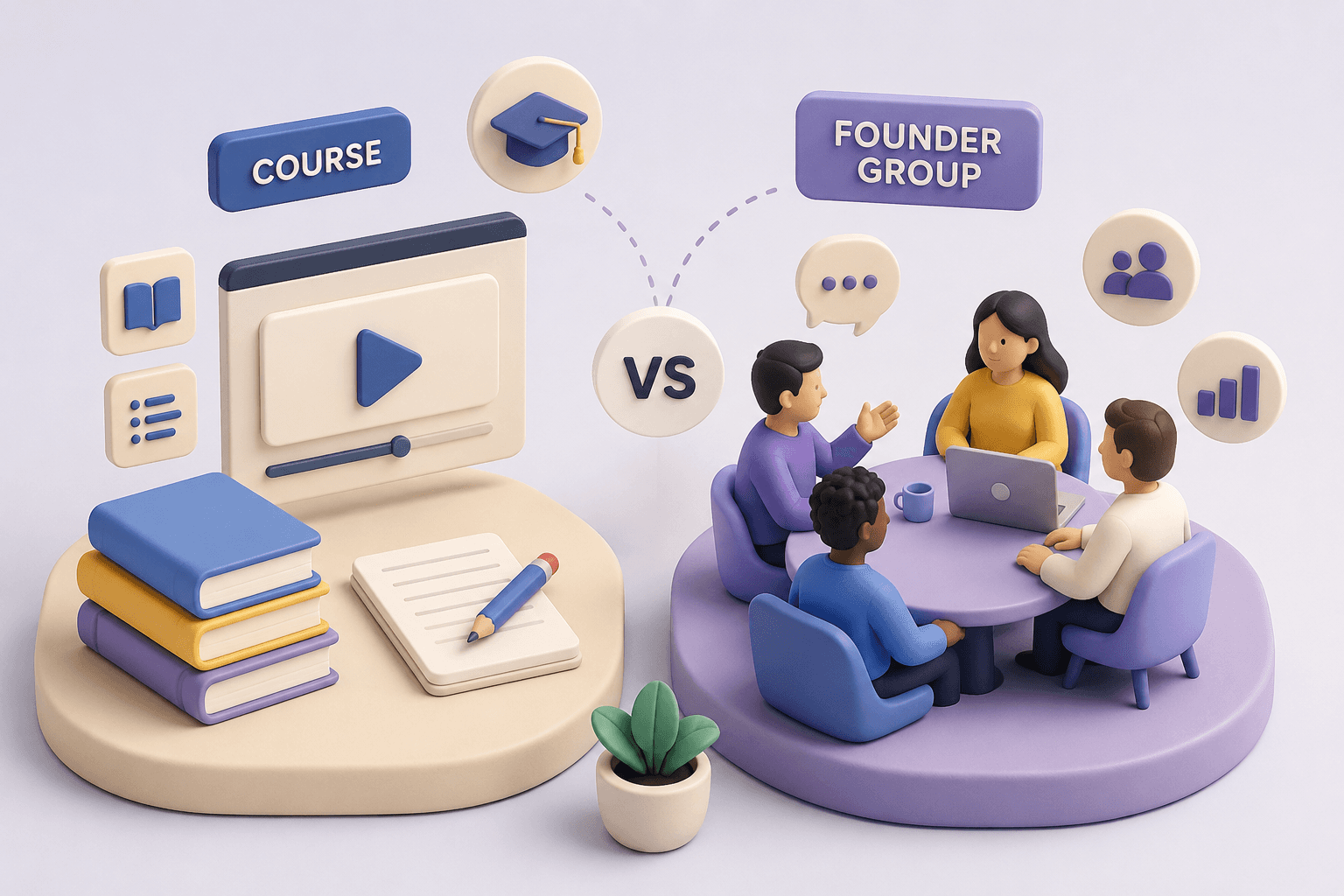
The answer is surprisingly simple. Founders need conversations, not just content.
Articles, books, podcasts, and LinkedIn posts are excellent for discovering new ideas. They expose founders to different strategies, frameworks, and ways of thinking. However, they all share the same limitation. They communicate in one direction. They cannot ask follow-up questions, challenge assumptions, or adapt their recommendations to your business.
A conversation works differently.
It begins with context rather than conclusions. Instead of offering a generic recommendation, another founder first tries to understand the business, the customers, the market, and the constraints behind the decision. That small difference often produces better outcomes dramatically because the discussion becomes specific rather than theoretical.
For many founders, a thirty-minute conversation with someone facing similar challenges creates more clarity than several hours spent consuming startup content.
Peer feedback provides validation instead of assumptions
One of the biggest advantages of a peer group is validation.
Founders often think they need answers, but more often they need confidence that they are asking the right questions. Building a startup involves constant uncertainty, and very few decisions come with immediate confirmation that they were correct.
Consider how the same recommendation changes when context is added.
Generic advice | Context-driven feedback |
|---|---|
Raise your prices. | Your churn is low, customers consistently mention value, and acquisition remains healthy. This is a good moment to test higher pricing. |
Hire your first salesperson. | Your acquisition process is still unpredictable. Fixing that bottleneck will make future hires far more effective. |
Build more features. | Customer interviews suggest the problem is onboarding, not missing functionality. |
Expand into enterprise. | Your current pricing and sales process are better suited to SMB customers. |
The recommendation itself is almost secondary.
The real value comes from someone understanding why that recommendation makes sense, or why it does not.
That is something generic startup advice cannot provide. A similar conclusion appears in leadership research published by Harvard Business Review, which argues that senior leaders often lack honest, context specific feedback because employees, investors, customers, and advisors all see only part of the picture. Peer discussions help close that gap by creating an environment where uncertainty can be discussed openly.
Founders feel less isolated when talking to founders at the same stage
Founders naturally seek advice from successful entrepreneurs, investors, mentors, and startup coaches. All of those people bring valuable experience, but they often look at the business from a different perspective.
Someone operating at a similar stage understands something else entirely.
They remember what it felt like to sign the first paying customers, increase prices for the first time, worry about runway, lose an important client, or debate whether to pivot a product. Those decisions are still fresh because they recently solved similar problems.
That shared experience changes the quality of the conversation.
Instead of explaining every detail of the business, founders can focus immediately on the problem itself. Both participants understand the trade-offs, the uncertainty, and the emotional pressure behind the decision.
Perhaps even more importantly, these conversations normalize uncertainty.
Social media creates the impression that successful founders always know what to do next. Reality looks very different. Most entrepreneurs make decisions with incomplete information, test assumptions, and adjust their strategy as they learn more about customers and the market.
Recognizing that uncertainty is normal immediately reduces the feeling of isolation.
A peer group offers context that guides better decisions
The purpose of a peer group is not to tell founders what to do.
Its purpose is to improve the quality of thinking behind every important decision.
The best discussions rarely end with someone saying, "Here is the answer."
Instead, they usually help founders:
identify assumptions they have not questioned;
discover blind spots before they become expensive mistakes;
compare multiple approaches based on similar experiences;
prioritize the next experiment instead of trying to solve everything at once;
gain enough clarity to move forward with confidence.
That process is difficult to reproduce through articles or videos because every startup operates under different constraints.
Over time, these conversations create a powerful feedback loop. Better discussions lead to better decisions. Better decisions increase confidence. Confidence reduces unnecessary anxiety and helps founders maintain momentum through the inevitable uncertainty of entrepreneurship.
Generic startup advice introduces ideas.
Peer conversations determine which of those ideas are actually worth implementing.
How startup founders can avoid isolation and find relevant advice
Founder loneliness is often treated as an emotional challenge. In reality, it is usually a structural one.
Most founders spend years building systems for sales, marketing, customer support, hiring, and product development. They create processes that make the business more predictable and sustainable.
Very few apply the same thinking to decision-making.
Instead, feedback happens randomly. A founder might ask a friend for advice, schedule an occasional call with a mentor, or post a question on LinkedIn hoping someone knowledgeable will respond. Sometimes that works. More often than not, important decisions are made in isolation simply because there is no reliable support system.
A much better approach is to build one intentionally.
Choose founders one step ahead instead of celebrity entrepreneurs
Many founders assume that the best advice always comes from the most successful people in the industry.
That sounds logical, but it is often not true.
The larger the gap between two businesses, the less applicable the advice usually becomes. A CEO running a company with hundreds of employees solves different problems than a founder trying to acquire their first fifty customers. The same applies to venture-backed startups versus bootstrapped companies, B2B versus B2C products, and enterprise software versus self-serve SaaS.
Advice becomes more valuable when experience is close enough to be transferable.
Rather than asking, "Who is the most successful entrepreneur I can learn from?", a more useful question is, "Who solved the problem I am facing six or twelve months ago?"
That simple shift dramatically increases the relevance of the feedback.
Build a structural support system before founder loneliness becomes a problem
Support should not depend on luck.
The founders who make consistently better decisions usually receive feedback from multiple perspectives rather than relying on a single source.
A healthy support system often looks something like this.
Source | Primary purpose |
|---|---|
Customers | Validate product and market assumptions |
Mentor | Long-term perspective and career guidance |
Advisor | Specialized expertise in a specific domain |
Investor | Financial strategy and company growth |
Peer group | Practical feedback from founders facing similar challenges |
Each source contributes something different.
Customers explain what they need. Mentors help founders think further ahead. Advisors solve specialized problems. Investors evaluate business opportunities from a portfolio perspective.
Peers occupy a unique position because they combine relevance with shared experience. They understand both the strategic challenge and the emotional weight behind the decision.
That combination is difficult to find anywhere else.
Why every startup founder needs a trusted peer ecosystem
The most valuable peer groups are not built around networking.
They are built around trust.
When founders know that conversations remain private and judgment is replaced by curiosity, they become willing to discuss topics they would never share publicly.
Those conversations often include:
pricing decisions that could affect revenue;
customer churn that nobody else knows about;
hiring mistakes;
uncertainty around positioning;
disagreements between co-founders;
concerns about cash flow or runway;
possible product pivots.
Very little of that appears on social media.
Platforms such as LinkedIn encourage visibility, personal branding, and polished success stories. Those are valuable activities, but they serve a different purpose. They help founders build relationships and reach new audiences. They are not designed to facilitate honest discussions about uncertainty.
That is one reason founder loneliness persists even among entrepreneurs with large online audiences. Visibility should never be confused with meaningful connection.
Research on founder communities points to several recurring benefits of regular peer discussions:
founders receive faster feedback on important decisions;
blind spots are identified before they become expensive mistakes;
uncertainty becomes easier to manage because challenges are normalized;
accountability increases, making it more likely that founders execute on their plans instead of endlessly consuming content.
Founder loneliness is rarely solved by more content
Every week brings another collection of startup books, newsletters, podcasts, AI-generated articles, LinkedIn posts, and productivity frameworks. Most of them contain useful ideas, and many are worth reading.
The problem begins when founders expect content to replace conversation.
Content scales because it gives the same recommendation to thousands of people.
Good decisions rarely work that way.
Every important startup decision depends on context. The right pricing strategy depends on your customers. The right hiring plan depends on your revenue. The right go-to-market strategy depends on your product, your competition, and your available resources.
That is why conversations consistently outperform generic advice when the stakes become higher.
If there is one takeaway from this article, it is this:
The goal is not to consume more startup advice. The goal is to discuss your business with people who understand the context behind your decisions.
Founders who build those relationships early rarely eliminate uncertainty. Entrepreneurship will always involve risk, difficult choices, and imperfect information.
What they do eliminate is unnecessary isolation.
And in the long run, that often becomes a competitive advantage. Better conversations lead to better decisions. Better decisions compound into stronger businesses. At the same time, founders gain something that is far more difficult to measure than revenue or growth.
They gain the confidence that they are no longer building alone.
References
Startup Snapshot. Founder Mental Health Report 2024.
Harvard Business Review. The Loneliness of the CEO.
Endeavor Insight. Research on entrepreneurial networks and peer learning.
First Round Review. Articles on founder decision-making and peer support.