Personal Development
When a Founder Group Becomes More Valuable Than Another Course

, Community Leader
11 minutes
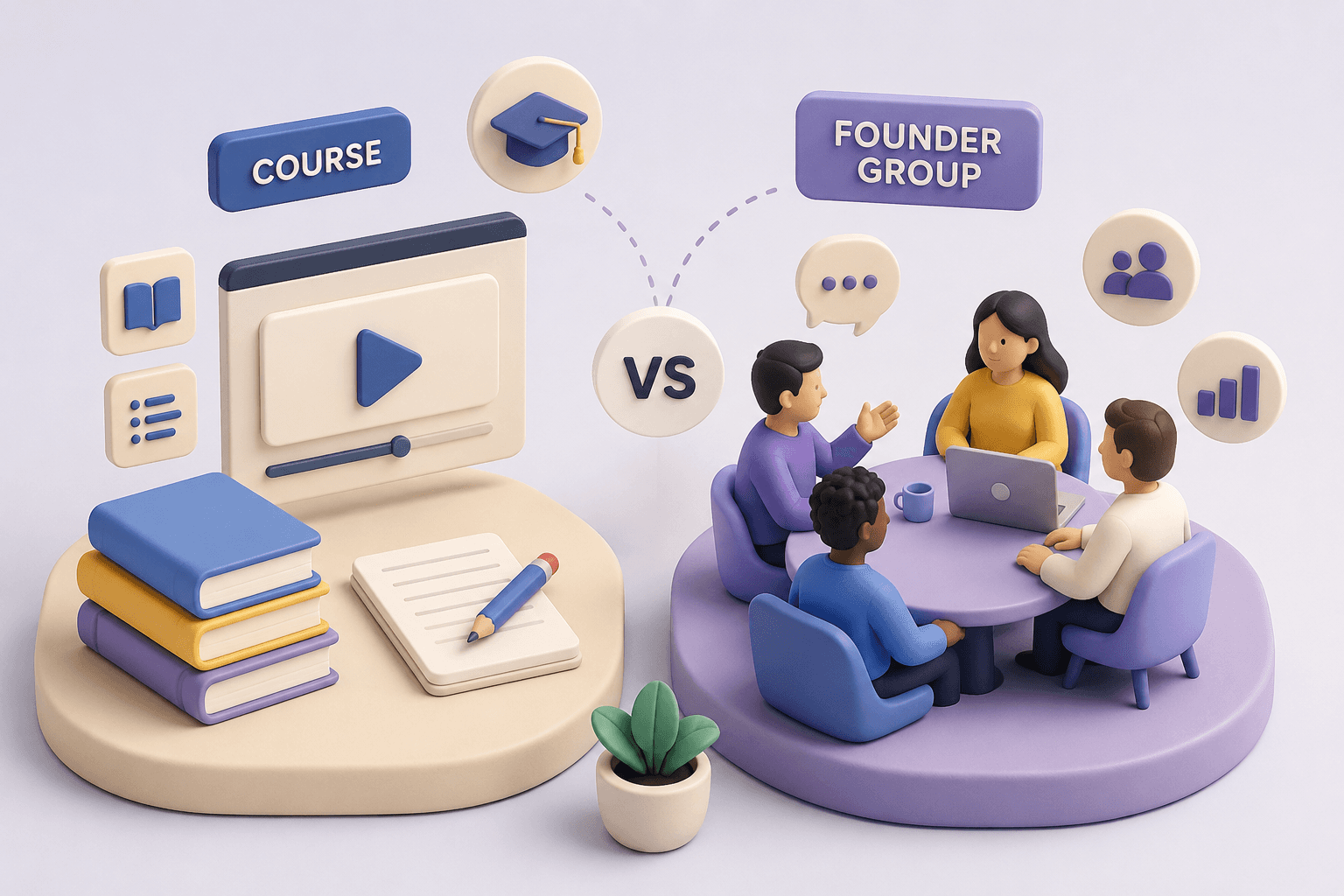
If you're deciding between joining a founder group or buying another course, the answer depends on one question: Is your biggest bottleneck knowledge or execution?
Courses are the better investment when you need to learn a new skill or understand an unfamiliar topic. Founder groups become more valuable once you already know the fundamentals but need better decisions, faster feedback, and accountability to turn ideas into results.
Many founders reach this point sooner than they expect.
Why founders keep buying courses but still struggle to make progress
The internet has solved the problem of access to information.
Whether you want to learn SaaS pricing, product marketing, cold outreach, SEO, or fundraising, you can find hundreds of books, courses, podcasts, and YouTube channels explaining exactly how successful companies approached those problems.
Yet founder forums are still filled with questions like:
"Should I raise my prices?"
"Why isn't anyone buying?"
"Which customer segment should I focus on first?"
"Should I keep building this feature or pivot?"
Notice something interesting.
These are not questions about knowledge. They are questions about judgment.
A course can explain how to interview customers. It cannot tell you whether the feedback from your five biggest customers should outweigh the requests from fifty free users. A book can teach positioning frameworks. It cannot tell you which message is most likely to resonate with your specific market.
That distinction is easy to overlook, but it changes how founders should invest in learning.
The scarcest resource for most founders is no longer information. It is context.
Knowledge problems vs decision problems
One of the simplest ways to decide whether you need another course or something else is to identify the type of problem you're trying to solve.
If you're asking... | You probably need... |
|---|---|
"How does SEO work?" | A course or structured learning resource |
"Which SEO strategy fits my SaaS?" | Feedback from experienced founders |
"How do I build a sales process?" | A course |
"Which part of my sales process is broken?" | A founder group or mentor |
"What is product-led growth?" | Educational content |
"Why isn't product-led growth working for me?" | Contextual discussion with people who have faced similar challenges |
Many founders continue buying courses because every new problem feels like a knowledge gap.
In reality, the gap often appears somewhere else.
They already understand the available options. They simply lack enough context to choose between them.
This pattern is common in entrepreneurship because startups rarely have a single correct answer. The same pricing strategy, hiring decision, or go-to-market plan can produce completely different outcomes depending on the market, customer profile, competitive landscape, and the business's stage.
That is why founders with access to exactly the same information often make very different decisions.
The hidden cost of solving the wrong problem
Buying another course when you actually need feedback has a cost that goes beyond the purchase price.
You spend hours consuming content instead of validating assumptions. You postpone difficult decisions because another lesson might reveal the "right" answer. Gradually, learning begins to replace execution.
This phenomenon is sometimes called analysis paralysis, in which additional information reduces confidence rather than increasing it. Research published in the Journal of Consumer Research found that excessive choice and information can make decision-making more difficult rather than easier, especially when outcomes are uncertain.
For founders, uncertainty is the default.
The result is a cycle that looks familiar:
Encounter a difficult business problem.
Buy a course hoping for clarity.
Learn several useful frameworks.
Discover that your situation doesn't quite match the examples.
Start looking for another resource.
Each step feels productive, but the business often changes very little.
The founders who break this cycle usually stop asking, "Where can I learn more?"
Instead, they ask a different question:
"Who can help me apply what I already know?"
That is the point where founder groups begin to outperform even excellent courses.
What a founder group provides that a course cannot
The biggest advantage of a founder group is not networking.
It is decision support.
Every founder eventually reaches problems where multiple options seem reasonable. The challenge is no longer learning another framework. The challenge is choosing the right action with incomplete information.
That is where a group of experienced founders becomes valuable.
Unlike a course, a founder group can react to your specific situation. Members can ask follow-up questions, challenge your assumptions, point out blind spots, and share what happened when they faced a similar decision.
Instead of learning another best practice, you gain something far more useful: context.
Courses provide answers. Founder groups provide judgment.
The difference becomes obvious when comparing how each solves the same problem.
Scenario | Course | Founder group |
|---|---|---|
Pricing your SaaS | Explains pricing models and strategies | Challenges your assumptions based on your customers, positioning, and competitors |
Low trial conversion | Covers common optimization techniques | Helps identify the most likely bottleneck in your specific funnel |
Choosing a marketing channel | Teaches acquisition frameworks | Shares recent experience about what is working today in similar businesses |
Hiring your first employee | Explains hiring processes | Helps evaluate whether you should hire at all |
Neither approach is universally better.
They solve different problems.
Courses answer "What generally works?"
Founder groups answer "What is most likely to work here?"
The four advantages that compound over time
The value of a founder group comes from several mechanisms working together. Individually, each one is useful. Combined, they can significantly accelerate decision-making.
1. Faster feedback
Founders often spend days debating decisions internally.
Sometimes a fifteen-minute conversation with someone who has already solved the same problem eliminates that uncertainty.
For example, imagine you're considering moving from monthly to annual pricing. A course can explain the pros and cons.
A founder who introduced annual plans six months ago can tell you:
what objections customers raised
how existing users reacted
what they would do differently
which metrics improved and which did not
That kind of practical feedback rarely appears inside prerecorded content.
2. Accountability that survives motivation
Motivation fades.
Systems do not.
Research on implementation intentions by psychologist Peter Gollwitzer has consistently shown that people are more likely to complete meaningful goals when they commit to specific actions rather than vague intentions.
Founder groups naturally reinforce this behavior.
When you tell other founders,
"I'll launch the new pricing page before next week's meeting,"
there is a social expectation that you'll return with an update.
The accountability comes from consistency rather than pressure.
3. Exposure to different mental models
One overlooked benefit of founder groups is that they expose you to businesses unlike your own.
A B2B SaaS founder may solve customer onboarding very differently from someone building a developer tool.
An agency owner may have discovered a sales process that also works surprisingly well for software companies.
These conversations expand the number of mental models you can draw from.
Many breakthrough ideas come from adapting solutions across industries rather than inventing something entirely new.
4. Pattern recognition
Individual founders see one company.
Communities see hundreds.
Over time, experienced founder groups begin noticing recurring patterns:
why launches fail despite strong products
which pricing mistakes repeatedly slow growth
when founders hire too early
why some acquisition channels stop scaling
This collective pattern recognition is difficult to obtain on your own because your own experience is naturally limited.
Common misconception: founder groups are mainly for networking
Many people imagine founder communities as Slack workspaces where everyone introduces themselves, exchanges LinkedIn profiles, and occasionally asks for feedback.
Some communities work exactly like that.
The strongest founder groups operate very differently.
Members join because they expect to solve problems faster, make better decisions, and stay accountable between meetings. Relationships develop as a consequence of repeated collaboration, not as the primary objective.
That distinction matters.
If networking is the goal, attending conferences or local meetups may provide a higher return.
If improving decision quality is the goal, a small, active founder group usually delivers far more value than a large community with thousands of passive members.
The best founder groups are not built around conversations. They are built around helping members make better business decisions, week after week.
When a course is the better investment
Founder groups are powerful, but they are not a replacement for learning.
If you're entering an unfamiliar field, structured education is almost always the fastest path forward. Trying to learn everything through discussions is inefficient because you'll spend valuable time asking questions that already have well-documented answers.
A course gives you a shared vocabulary, proven frameworks, and a mental model for understanding a topic before you begin experimenting.
Use a course when you need to:
learn a completely new skill
understand the fundamentals of a discipline
follow a structured learning path
build technical expertise independently
For example, if you've never run Google Ads, no founder group can replace a well-designed course. You'll get far more value by learning the platform first and bringing specific optimization questions to experienced founders later.
The strongest founders rarely choose between education and community. They use both at different stages of the same problem.
When a founder group delivers a higher return
As your company grows, the value of another course gradually declines while the value of better decisions increases.
A useful way to think about it is this:
Your current bottleneck | Better investment |
|---|---|
You don't know how something works | Course |
You know several possible solutions but can't choose one | Founder group |
You need accountability to finish important work | Founder group |
You need a structured introduction to a new topic | Course |
You want feedback before making an expensive decision | Founder group |
You want to improve an existing skill | Usually both |
One common mistake is assuming that founder groups are only useful once a product has reached product-market fit.
In reality, every stage benefits from different types of discussions.
Company stage | Most valuable support |
|---|---|
Idea | Customer discovery, validation, founder fit |
MVP | Product feedback, early acquisition, pricing |
First customers | Sales process, onboarding, retention |
Product market fit | Hiring, operations, scaling systems |
Growth | Leadership, organizational design, strategic decisions |
The topics change, but the need for contextual feedback remains.
That is why experienced founders often stay in peer groups for years, even after they no longer need beginner-level educational content.
A simple decision framework
If you're still unsure which option is right for you, use these four questions.
Question 1: Do I lack knowledge or confidence?
If you genuinely don't understand a topic, buy a course.
If you understand the options but hesitate to act, you probably need feedback.
Question 2: Is my problem universal or specific?
Universal problems usually have documented solutions.
Specific problems require context.
For example:
"How do I price SaaS?" is a universal question.
"Should I increase prices after losing three enterprise deals?" is specific.
The second question is far less likely to have a useful answer inside a prerecorded course.
Question 3: Will this decision have long-term consequences?
The higher the cost of making the wrong decision, the more valuable external perspectives become.
Pricing, hiring, positioning, fundraising, and selecting a target market are all decisions where experienced feedback can save months of unnecessary work.
Question 4: Am I learning instead of executing?
This is perhaps the most important question.
If you've purchased several courses in the past year but implemented very little, another course is unlikely to change the outcome.
Changing the environment around your decision-making probably will.
Common mistakes when choosing a founder group
Not every founder community creates meaningful value.
Before joining one, evaluate how members actually interact.
A healthy founder group usually has these characteristics:
✅ Members regularly share real business challenges rather than promotional content.
✅ Feedback comes from founders with relevant experience, not from people trying to sell services.
✅ Discussions continue after meetings instead of ending with generic encouragement.
✅ Accountability exists through regular check-ins, working sessions, or recurring conversations.
✅ Members are at similar stages, making advice more relevant.
On the other hand, these are warning signs:
thousands of members but almost no meaningful discussions
conversations dominated by self-promotion
little or no moderation
feedback consisting only of encouragement instead of constructive critique
no recurring interaction between members
A small group with twenty engaged founders often creates more value than a community of twenty thousand passive members.
Actionable takeaways
Choosing between a founder group and another course is not really about education versus community.
It is about identifying your current bottleneck.
Before spending money, ask yourself these questions:
Am I trying to learn something new or solve a specific business problem?
Would another framework change my decision, or do I need someone to challenge my assumptions?
Am I consistently implementing what I already know?
Who can provide informed feedback before I make this decision?
If your answers point toward learning, invest in a high-quality course.
If they point toward better decisions, faster execution, and accountability, a founder group will usually generate a higher return.
The most successful founders rarely stop learning. They simply change how they learn as their businesses evolve. Early on, knowledge is the competitive advantage. Later, judgment becomes the scarce resource, and surrounding yourself with thoughtful peers is often one of the highest-leverage investments you can make.