Personal Development

How to Run a Mastermind Group: A Step-by-Step Guide

, Community Leader

17 minutes

Running a mastermind group is more than scheduling recurring meetings. The best groups create an environment where entrepreneurs openly discuss challenges, receive valuable feedback, and leave every session with clear action items. Poorly organized groups, on the other hand, often turn into casual networking calls with little accountability or measurable progress.

Whether you want to create a mastermind group for startup founders, business owners, executives, or other entrepreneurs, the group's long-term success depends on a few key decisions made before the first meeting. Choosing the right members, establishing clear expectations, and defining the group's purpose will have a much greater impact than any meeting agenda or software you use later.

This guide walks through the entire process of running a mastermind group, from selecting members and setting ground rules to facilitating discussions and keeping everyone accountable over time.

How to start a mastermind group

Many people focus on the logistics first. They think about Zoom, Slack, calendars, or meeting agendas before they've answered a much more important question: why should this group exist in the first place?

Every successful mastermind group begins with a clearly defined purpose. Without one, members bring different expectations, discussions become unfocused, and attendance gradually declines. Before inviting anyone, decide exactly what outcome your mastermind group should help members achieve.

For example:

Group type

Primary focus

SaaS founders

Product strategy, growth, hiring, fundraising

Agency owners

Client acquisition, operations, profitability

Coaches and consultants

Marketing, offers, positioning

Local business owners

Leadership, expansion, operations

The narrower the focus, the easier it becomes to attract the right people and facilitate productive conversations. A mastermind designed for early-stage SaaS founders will naturally discuss different challenges than one built for established entrepreneurs managing large teams.

Another important decision is whether members should be at similar stages. While diversity of perspectives creates better brainstorming, large differences in experience can reduce the value for everyone involved. A founder building their first product usually has different priorities than someone running an eight-figure company.

Before you start a mastermind group, write down three simple questions:

  • Who is this group for?

  • What problems will members solve together?

  • What results should members expect after six months?

If those questions are easy to answer, you're already building a much stronger foundation than most new mastermind groups.

Start with the right members

The quality of a mastermind group is almost entirely determined by its members. Even an experienced facilitator cannot compensate for participants who aren't committed, don't contribute, or have completely different goals.

When evaluating potential members, look beyond experience or revenue. Consider whether they are willing to participate consistently, share honest feedback, and hold others accountable. The most valuable members often aren't the loudest people in the room—they're the ones who arrive prepared and actively help others solve problems.

A strong group member typically demonstrates several qualities:

  • They regularly show up to meetings.

  • They openly discuss both successes and challenges.

  • They give thoughtful, constructive feedback.

  • They follow through on commitments before the next session.

  • They genuinely want other members to succeed.

It's equally important to know who shouldn't join a mastermind group. People looking only to sell their services, dominate conversations, or promote themselves usually reduce the value for everyone else. A mastermind works best when every member contributes roughly as much as they receive.

Define who the mastermind group is for

One of the biggest mistakes organizers make is trying to appeal to everyone.

A mastermind group could technically include entrepreneurs from different industries, but that doesn't necessarily mean it should. The more similar members are in goals, challenges, or business stage, the more relevant the discussions become.

Instead of describing your audience broadly, define it with clear criteria. For example:

Broad audience

Better definition

Entrepreneurs

SaaS founders with paying customers

Business owners

Agency owners with teams of 3–20 people

Startup founders

Pre-Series A B2B SaaS founders

Coaches

Full-time coaches earning over $100k annually

Specific criteria also make it much easier for prospective members to determine whether the group is the right fit.

Choose the ideal group size

Most experienced facilitators recommend keeping a mastermind relatively small.

With too few people, discussions can become repetitive, and there's less diversity of experience. With too many participants, not everyone has enough time to receive meaningful feedback during each mastermind session.

For most groups, these ranges work well:

Group size

Typical experience

4–6 members

More personal, deeper discussions

6–8 members

Good balance between diversity and speaking time

9–12 members

Requires stronger facilitation and stricter time management

Many successful mastermind groups operate with six to eight members because this provides enough perspectives while still allowing everyone to participate in each meeting.

Select the right members

Rather than accepting everyone who expresses interest, consider having a simple application process.

This doesn't need to be complicated. A short questionnaire or introductory call is usually enough to understand a person's goals, experience, and expectations. It also gives you an opportunity to explain how the group works and confirm that they're willing to meet regularly and contribute consistently.

During these conversations, ask questions such as:

  • Why do you want to join a mastermind?

  • What challenge are you hoping the group can help solve?

  • What experience or perspective can you contribute to other members?

  • Can you commit to attending meetings consistently?

Selecting members carefully takes more effort upfront, but it dramatically increases the chances that the mastermind group will remain active, valuable, and engaging long after the first meeting.

Set clear rules from the beginning

Even the best group of entrepreneurs will eventually run into problems if expectations are never discussed. Clear ground rules create consistency, reduce misunderstandings, and help members feel comfortable sharing challenges they wouldn't discuss elsewhere.

These rules don't need to be long or complicated. In fact, the most effective mastermind groups usually operate with a short document that every member agrees to before the first session.

At a minimum, your ground rules should cover:

  • Confidentiality

  • Attendance expectations

  • Participation

  • Accountability

  • Respectful communication

When expectations are clear from day one, the facilitator spends less time resolving conflicts and more time helping the group make progress.

Establish confidentiality

A mastermind only works if members feel safe discussing real business problems.

Entrepreneurs should be able to talk openly about failed product launches, hiring mistakes, difficult clients, financial concerns, or strategic decisions without worrying that those conversations will be shared elsewhere.

A simple confidentiality agreement is usually enough. Many groups follow a variation of the Chatham House Rule, allowing members to discuss ideas outside the meeting while keeping the identity of the speaker private.

It's also worth reminding everyone that confidentiality builds over time. Members become significantly more open once they see that sensitive discussions stay inside the group.

Define attendance expectations

Consistency is one of the biggest differences between an effective mastermind and an occasional networking call.

When people frequently miss meetings, discussions lose momentum. Accountability becomes difficult because members aren't present to report progress or receive feedback on previous commitments.

Before your first mastermind session, define expectations such as:

  • How often members meet regularly.

  • How much notice should be given before missing a meeting.

  • Whether repeated absences may result in losing membership.

  • Whether meetings will be recorded for absent members.

Having these conversations early prevents uncomfortable situations later.

Encourage equal participation

One common challenge in group work is unequal participation.

Some entrepreneurs naturally enjoy speaking, while others prefer listening. Left unmanaged, one or two members may dominate every discussion, leaving less experienced participants with little opportunity to contribute.

A good facilitator creates an environment where everyone has a chance to speak. This doesn't mean forcing equal speaking time every minute, but it does mean making sure quieter members are regularly invited into the conversation.

Simple techniques include:

  • Asking each member for their perspective before moving on.

  • Limiting uninterrupted speaking time during hot seats.

  • Redirecting conversations when one person dominates.

  • Rotating the order in which members share updates.

Over time, this creates a healthier balance where every member feels heard and valued.

Handle conflicts and difficult conversations

Disagreement isn't necessarily a problem. In fact, respectful disagreement often produces the most valuable discussions.

Problems arise when conversations become personal, defensive, or argumentative. That's why it's helpful to establish communication norms before conflict ever occurs.

Encourage members to challenge ideas rather than individuals. Feedback should be honest but constructive, with the goal of helping another entrepreneur make better decisions rather than proving someone wrong.

When disagreements happen, the facilitator should guide the discussion back toward the original problem and ensure the conversation remains productive for everyone in the group.


Choose a meeting format that works

The format of your mastermind group should support meaningful discussion rather than create unnecessary structure.

Some organizers spend hours designing complicated schedules, only to discover that members ignore half of them after a few meetings. A simple format that everyone understands is almost always more sustainable.

The most successful mastermind groups typically keep three elements consistent:

  • A predictable meeting schedule.

  • A fixed meeting duration.

  • A repeatable structure that members quickly become familiar with.

Once these elements become routine, participants can focus on solving problems instead of figuring out how each meeting will work.

Decide how often to meet

There isn't a universal schedule that works for every mastermind group.

Meeting too frequently leaves little time for members to make meaningful progress between sessions. Meeting too infrequently makes accountability much less effective because people lose momentum.

For most entrepreneur groups, one of these schedules works well:

Frequency

Best for

Weekly

Early-stage founders moving quickly

Every two weeks

Most business mastermind groups

Monthly

Senior executives or long-term strategic discussions

Meeting every two weeks is often a practical balance. Members have enough time to complete meaningful action items while still maintaining accountability and continuity.

Set the meeting length

Longer meetings don't automatically produce better outcomes.

Once discussions extend beyond about ninety minutes, attention naturally begins to decline. Participants become less engaged, and conversations often drift away from the original objectives.

A useful guideline is:

Meeting length

Suitable for

60 minutes

Four to six members

75–90 minutes

Six to eight members

90–120 minutes

Larger groups with multiple hot seats

Rather than extending the meeting, consider reducing the number of topics covered. Fewer discussions with greater depth usually produce better decisions than trying to solve every problem in a single session.

Choose an online or in-person format

Both formats can work extremely well when managed properly.

Online mastermind groups make it easier to bring together entrepreneurs from different cities or countries. They reduce travel time and generally make it easier for members to attend consistently.

In-person meetings often create stronger personal relationships and more natural conversations, but they're also more difficult to organize and usually limit the pool of potential members.

Many groups successfully combine both approaches. They meet online throughout the year and occasionally organize in-person events or retreats to strengthen relationships.

Whichever format you choose, consistency matters far more than location. Members are much more likely to stay engaged when meetings happen on the same day and at the same time every cycle.

Create a simple mastermind group meeting agenda

An agenda keeps discussions focused without making the meeting feel overly formal.

The goal isn't to follow a rigid script. Instead, it's to create a repeatable structure that ensures everyone receives attention, important topics aren't rushed, and every meeting ends with clear next steps.

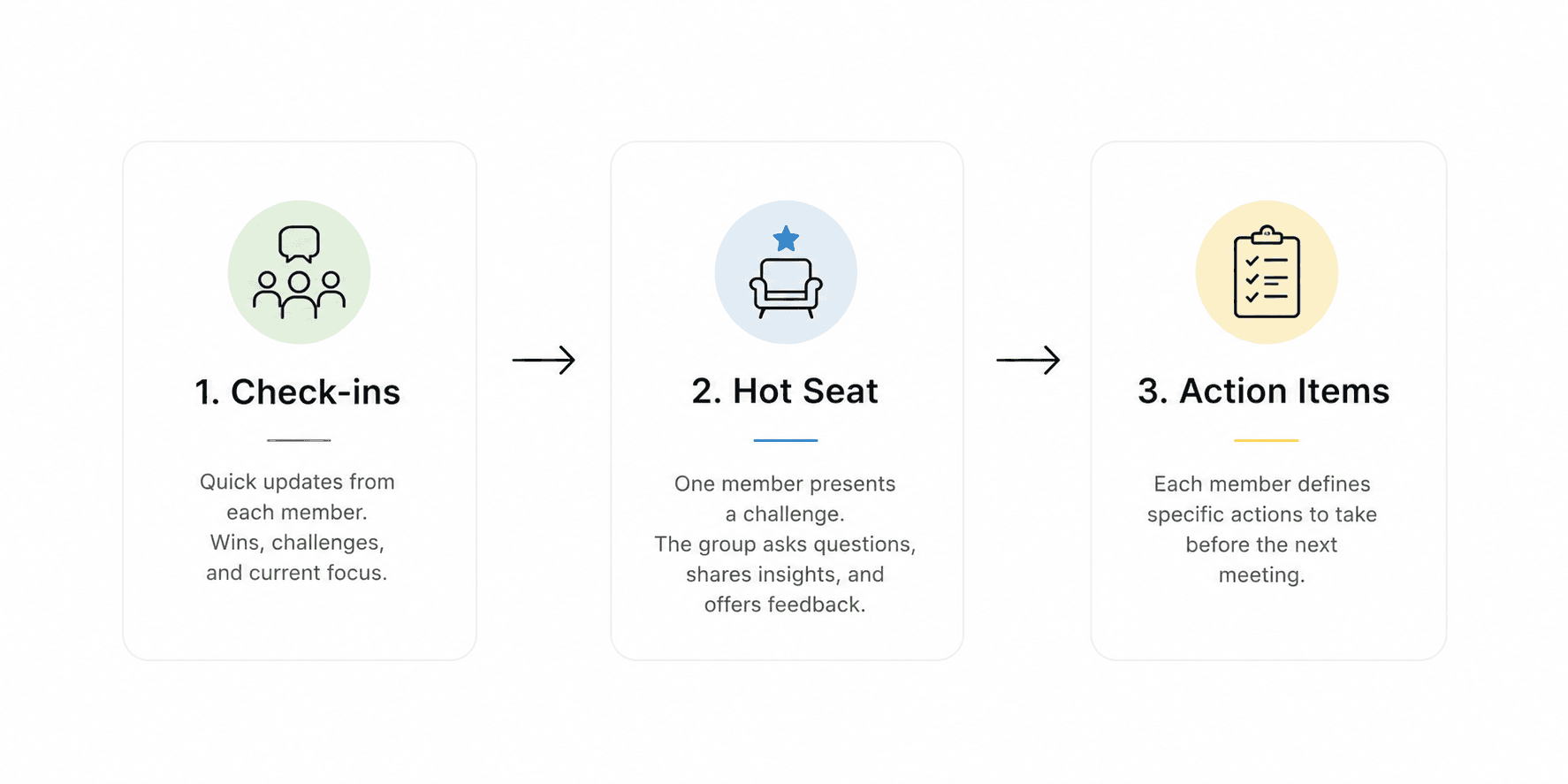
A typical mastermind group meeting can be divided into three parts:

Member updates

Begin by giving each member a few minutes to share recent progress.

Updates should focus on commitments made during the previous meeting, significant wins, current challenges, and anything that requires context before deeper discussion.

Keeping these updates brief ensures there is enough time for more detailed problem-solving later in the session.

Hot seat discussion

The hot seat is usually the most valuable part of the meeting.

One member presents a specific challenge, explains the relevant background, and asks the group for feedback. Other members ask clarifying questions before offering ideas, alternative perspectives, or possible solutions.

The strongest hot seat discussions stay focused on one clearly defined problem instead of trying to solve several unrelated issues at once.

Action items and accountability

Every meeting should end with clear commitments.

Before closing the session, ask each member to state the actions they plan to complete before the next meeting. These action items should be specific, realistic, and measurable whenever possible.

Documenting commitments also makes accountability much easier during the following meeting because everyone can review what was promised and discuss what actually happened.

How to facilitate a mastermind group

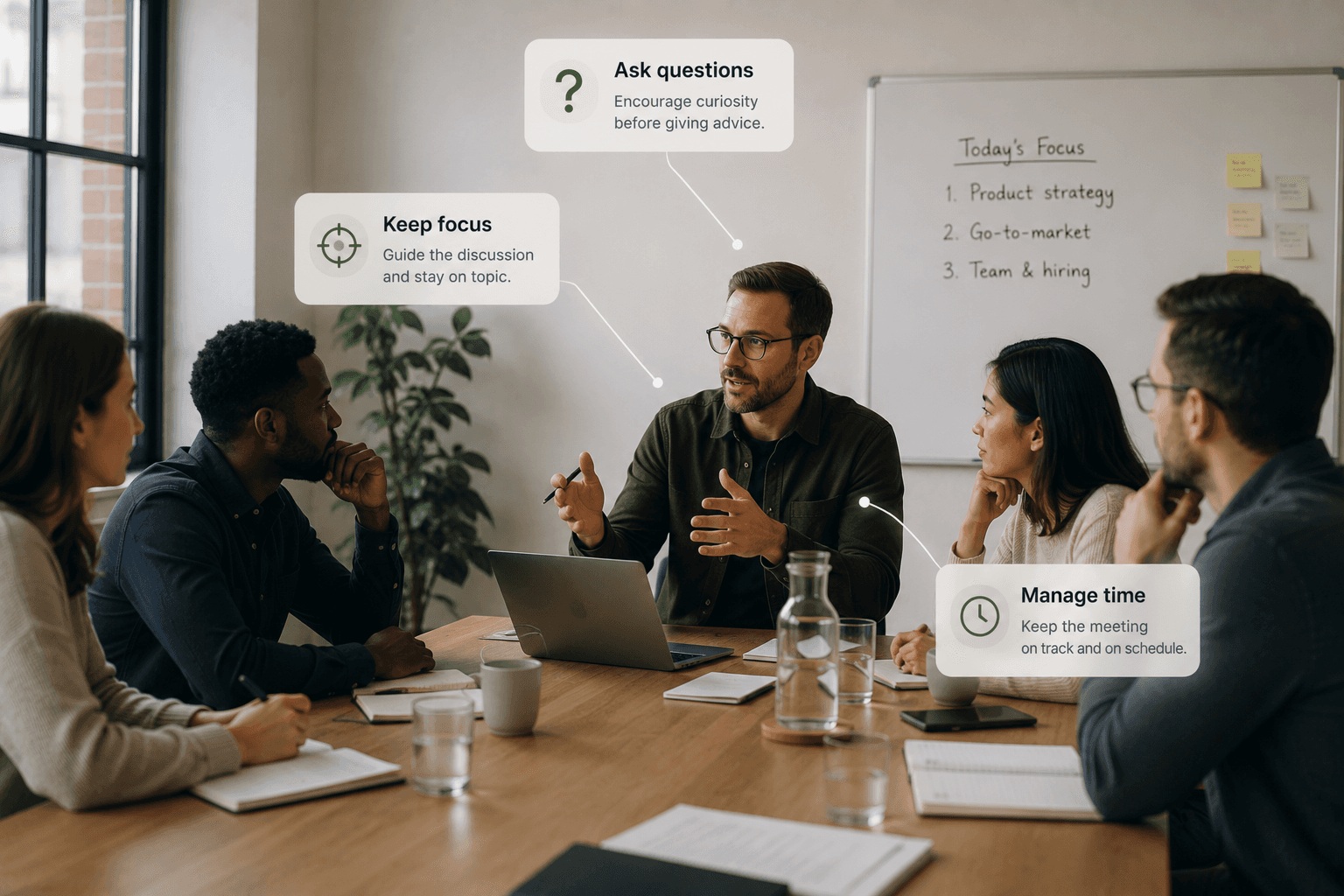
Even with the right members and a well-designed agenda, a mastermind group can lose momentum without effective facilitation. The facilitator isn't expected to have all the answers. Instead, their role is to guide discussions, encourage participation, and keep the group focused on helping members make better decisions.

A common misconception is that the facilitator should dominate the conversation. In reality, the opposite is true. The most effective facilitators speak less than the members and focus on asking thoughtful questions that help entrepreneurs uncover solutions themselves.

Keep conversations focused

It's surprisingly easy for discussions to drift away from the original topic.

A member might ask about pricing, which leads to marketing, which turns into a discussion about hiring. Thirty minutes later, the original problem remains unsolved.

The facilitator should regularly bring the conversation back by asking questions like:

  • "What decision are we trying to make?"

  • "How does this relate to the original challenge?"

  • "What's the biggest obstacle right now?"

Keeping discussions focused doesn't mean limiting creativity. It simply ensures the group spends its time solving the right problem.

Ask questions before giving advice

Many entrepreneurs immediately jump to solutions.

While that's understandable, advice is often more valuable after everyone fully understands the situation. Good facilitators encourage curiosity before recommendations.

Instead of immediately suggesting what someone should do, encourage questions such as:

  • What have you already tried?

  • What assumptions are you making?

  • What outcome are you hoping to achieve?

  • What constraints are affecting this decision?

This approach usually leads to more thoughtful brainstorming and more relevant recommendations.

Make sure every member participates

Different personalities contribute in different ways.

Some members naturally think out loud, while others prefer to reflect before speaking. A facilitator should create an environment where both communication styles are equally valued.

If someone hasn't contributed during an important discussion, invite their perspective directly.

For example:

"We've heard several ideas already. I'd love to hear your perspective before we move on."

Small prompts like this help quieter members become active contributors without putting unnecessary pressure on them.

Keep the meeting on schedule

Time management is one of the facilitator's most important responsibilities.

If one discussion continues far beyond its allocated time, later members receive less attention and the overall quality of the mastermind session suffers.

Simple techniques include:

  • Displaying a visible timer.

  • Giving a five-minute warning before moving to the next topic.

  • Parking unrelated ideas for future discussions.

  • Assigning follow-up conversations outside the meeting when appropriate.

A predictable structure makes it easier for members to come prepared because they know exactly what to expect.

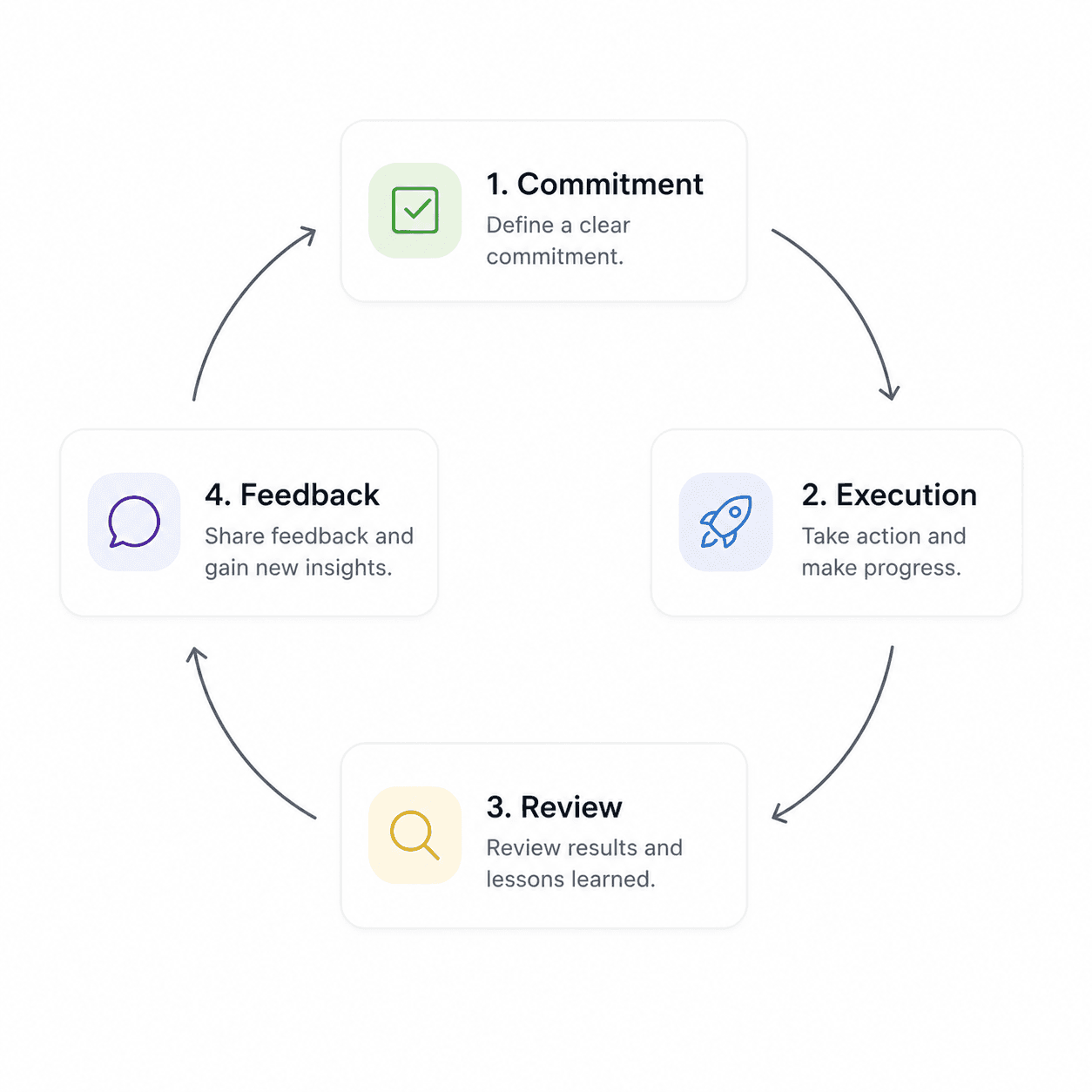
Keep members accountable between meetings

Accountability is one of the biggest reasons entrepreneurs join a mastermind in the first place.

Without it, meetings often become interesting conversations that rarely translate into action. The real value comes from helping members consistently follow through on the commitments they make.

Effective accountability doesn't require constant reminders. Instead, it creates a system where members naturally want to report meaningful progress to the group.

Track commitments

Every meeting should end with a written list of commitments.

Rather than vague goals like "work on marketing," encourage specific action items that can easily be reviewed during the next session.

For example:

Weak commitment

Strong commitment

Improve onboarding

Interview five new customers about onboarding

Work on pricing

Publish a new pricing page by next Friday

Grow LinkedIn

Publish two founder posts before the next meeting

Specific commitments make progress much easier to evaluate.

Follow up on progress

The beginning of each meeting is the perfect time to review previous commitments.

Rather than asking whether someone "made progress," ask what happened since the last session.

Questions like these often lead to more productive discussions:

  • What did you accomplish?

  • What prevented you from finishing?

  • What did you learn?

  • What will you do differently next time?

The goal isn't to criticize members who fall behind. Instead, it's to identify obstacles and help them move forward.

Celebrate wins

Accountability shouldn't focus exclusively on unfinished tasks.

Celebrating progress keeps motivation high and reminds members that consistent execution produces meaningful results over time.

Wins don't always need to be dramatic. Signing a new customer, publishing a long-delayed product update, making a difficult hiring decision, or finally shipping a feature can all be worth celebrating.

Recognizing these achievements also reinforces positive behavior within the group and encourages members to continue following through on their commitments.

Keep members engaged over time

Every mastermind experiences periods where participation naturally declines.

Busy schedules, vacations, product launches, and personal commitments all affect attendance from time to time. The key is preventing temporary slowdowns from becoming permanent disengagement.

Several practices help maintain long-term engagement:

Groups that continuously adapt tend to remain valuable for much longer than those that never evolve.

Common mistakes when you run a mastermind

Even experienced facilitators make mistakes. Fortunately, most of them are predictable and relatively easy to avoid.

Some of the most common include:

Mistake

Why it hurts the group

Inviting anyone who asks to join

Reduces compatibility between members

Allowing one person to dominate

Limits participation from everyone else

Skipping accountability

Discussions don't lead to action

Having no clear purpose

Conversations become unfocused

Ignoring attendance issues

Engagement gradually declines

Trying to solve too many problems in one meeting

Discussions become shallow

Recognizing these patterns early makes it much easier to maintain a healthy and productive mastermind group.

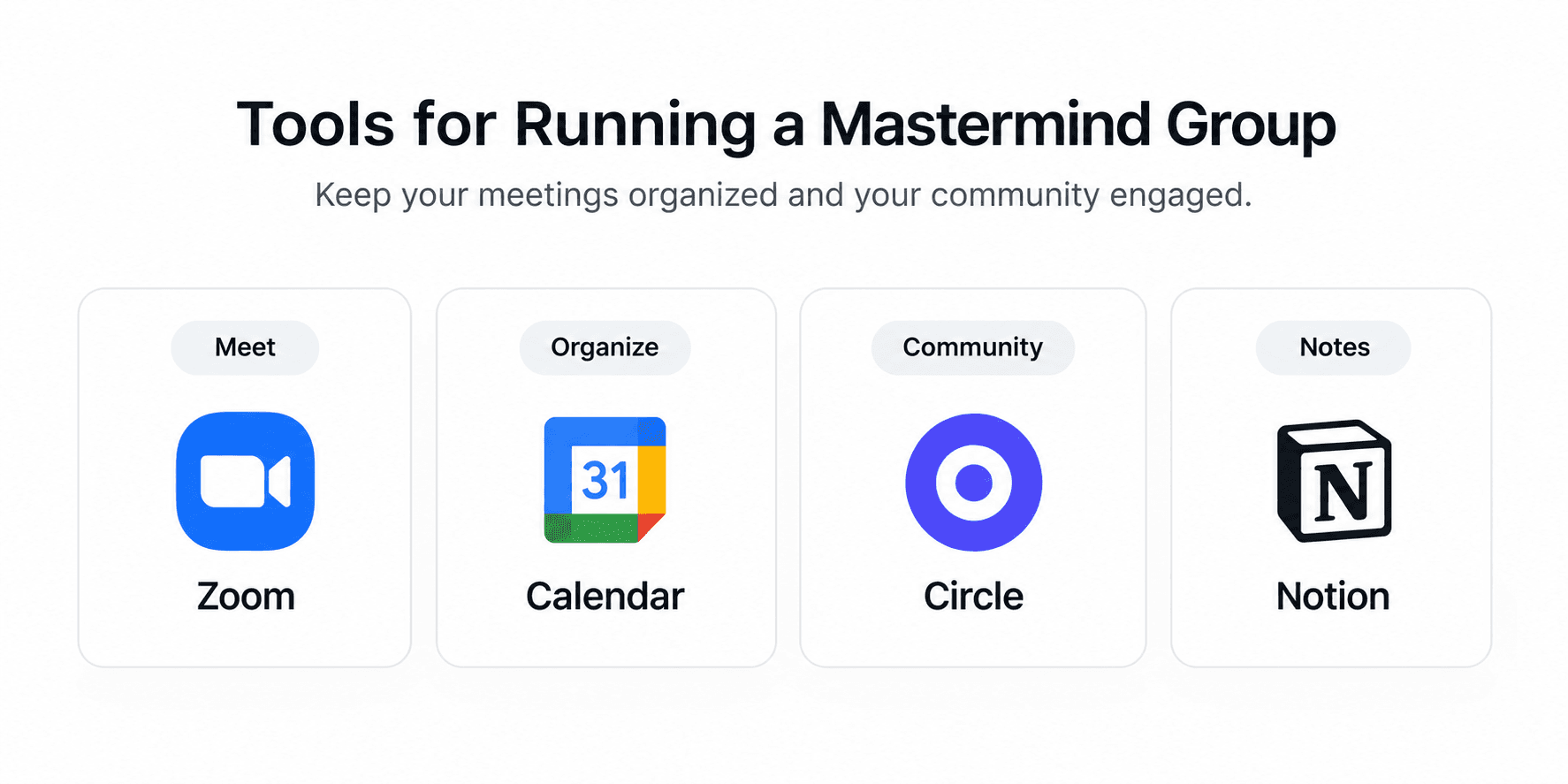
Tools that help you run a mastermind group

Technology won't make a weak mastermind successful, but the right tools can reduce administrative work and help meetings run more smoothly.

Some commonly used tools include:

Purpose

Examples

Video meetings

Zoom, Google Meet, Microsoft Teams

Scheduling

Calendly, Google Calendar

Shared notes

Google Docs, Notion

Community platform

Circle, Slack, Discord

Task tracking

Trello, Asana, ClickUp

Choose tools that are simple enough for every member to use consistently. Complicated systems often create more friction than value.

Frequently asked questions

How many people should be in a mastermind group?

Most mastermind groups work best with six to eight members. This provides enough diversity of experience while still giving everyone meaningful speaking time during each meeting.

How long should a mastermind group meeting last?

Most meetings last between 60 and 90 minutes. Larger groups may occasionally require more time, but longer meetings aren't always more productive.

How often should a mastermind group meet?

Meeting every two weeks is a common choice because it balances accountability with enough time for members to complete meaningful action items between sessions.

Does a successful mastermind group need a facilitator?

Not necessarily, but having a facilitator usually leads to more productive discussions. Someone should be responsible for managing time, encouraging participation, and keeping conversations focused.

Can you start your mastermind online?

Absolutely. Many highly successful mastermind groups operate entirely online, allowing entrepreneurs from different countries and time zones to participate regularly.

Subscribe to newsletter that helps SaaS founders get unstuck from mind blocks, blind spots, and skill gaps.

Free newsletter. Unsubscribe anytime.

3,000+

Subscribers

Subscribe to newsletter that helps SaaS founders get unstuck from mind blocks, blind spots, and skill gaps.

Free newsletter. Unsubscribe anytime.

3,000+

Subscribers

Subscribe to newsletter that helps SaaS founders get unstuck from mind blocks, blind spots, and skill gaps.

Free newsletter. Unsubscribe anytime.

3,000+

Subscribers

Subscribe to newsletter that helps SaaS founders get unstuck from mind blocks, blind spots, and skill gaps.

Free newsletter. Unsubscribe anytime.

3,000+

Subscribers

Join our supportive community

Get started with zero commitments

Join our supportive community

Get started with zero commitments

Join our supportive community

Get started with zero commitments

Join our supportive community

Get started with zero commitments