Personal Development
How to Network as a Startup Founder: 12 Proven Strategies

, Community Leader
27 minutes


Building a startup is often described as a product challenge or a fundraising challenge. In reality, it's also a relationship challenge. The founders you meet, the mentors who share their experience, the early customers who introduce you to others, and the investors who remember your progress months later can all influence the direction of your company.
Many first-time founders assume networking is about collecting as many contacts as possible. Successful founders approach it differently. They focus on creating meaningful connections with people who share similar interests, challenges, or goals. Over time, those relationships become a source of introductions, advice, partnerships, hiring opportunities, customer referrals, and emotional support during difficult stages of building a business.
This guide explains how to network as a startup founder, whether you're building your first company or preparing to scale your next venture. You'll learn practical networking strategies, where to meet the right people, how to build genuine relationships both online and offline, and how to grow your network without feeling like you're constantly selling yourself.
How to Network as a Startup Founder and Build a Stronger Network
Networking is one of the few startup activities that creates compound returns. A single introduction can lead to your first customer, your next hire, an investor meeting, or a future co-founder. Yet many founders postpone networking until they urgently need something. By then, they have very little relationship capital to draw from.
The best time to start building your network is before you need help. When you consistently connect with people, provide value, and keep in touch over time, opportunities tend to appear naturally.
What startup networking means for founders
Startup networking is the process of building long-term professional relationships with people who can help you learn, grow, and create opportunities throughout your entrepreneurial journey.
That network may include:
People | How they can help |
|---|---|
Other startup founders | Share experience, introductions, accountability, and support |
Investors | Offer funding, strategic advice, and connections |
Mentors | Help avoid common mistakes and accelerate learning |
Potential customers | Validate ideas and provide product feedback |
Industry experts | Share specialized knowledge and market insights |
Business owners | Introduce partnership or distribution opportunities |
Notice that most of these relationships create value long before money changes hands. That's why relationship building should be viewed as a long-term investment rather than a short-term growth tactic.
How a strong founder network supports startup growth
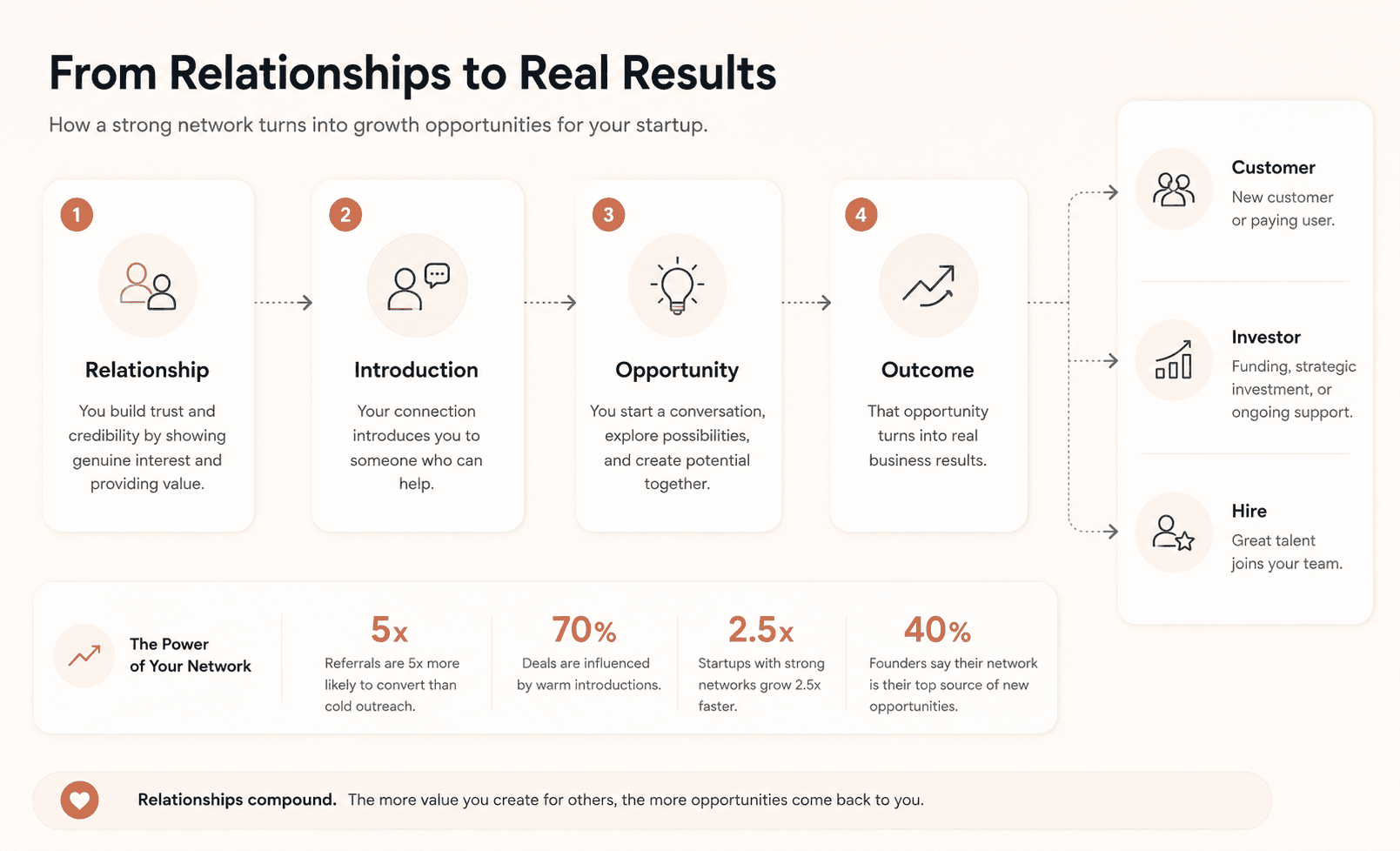
A strong founder network can influence almost every stage of building a company.
During the idea stage, experienced founders can help validate assumptions before months of development are wasted. At the pre-seed stage, introductions often become more valuable than cold outreach because investors naturally trust referrals from people they already know. Later, as your startup grows, your network can help you recruit talent, find strategic partners, or discover new customers.
Some of the most valuable networking opportunities include:
Receiving warm introductions to investors.
Finding early adopters willing to test your product.
Learning from founders who recently solved the same problem.
Meeting potential advisors or mentors.
Discovering speaking opportunities or podcast invitations.
Expanding your visibility through recommendations and introductions.
These opportunities rarely appear after a single conversation. They emerge after months of consistently building relationships.
Why building relationships matters more than collecting contacts
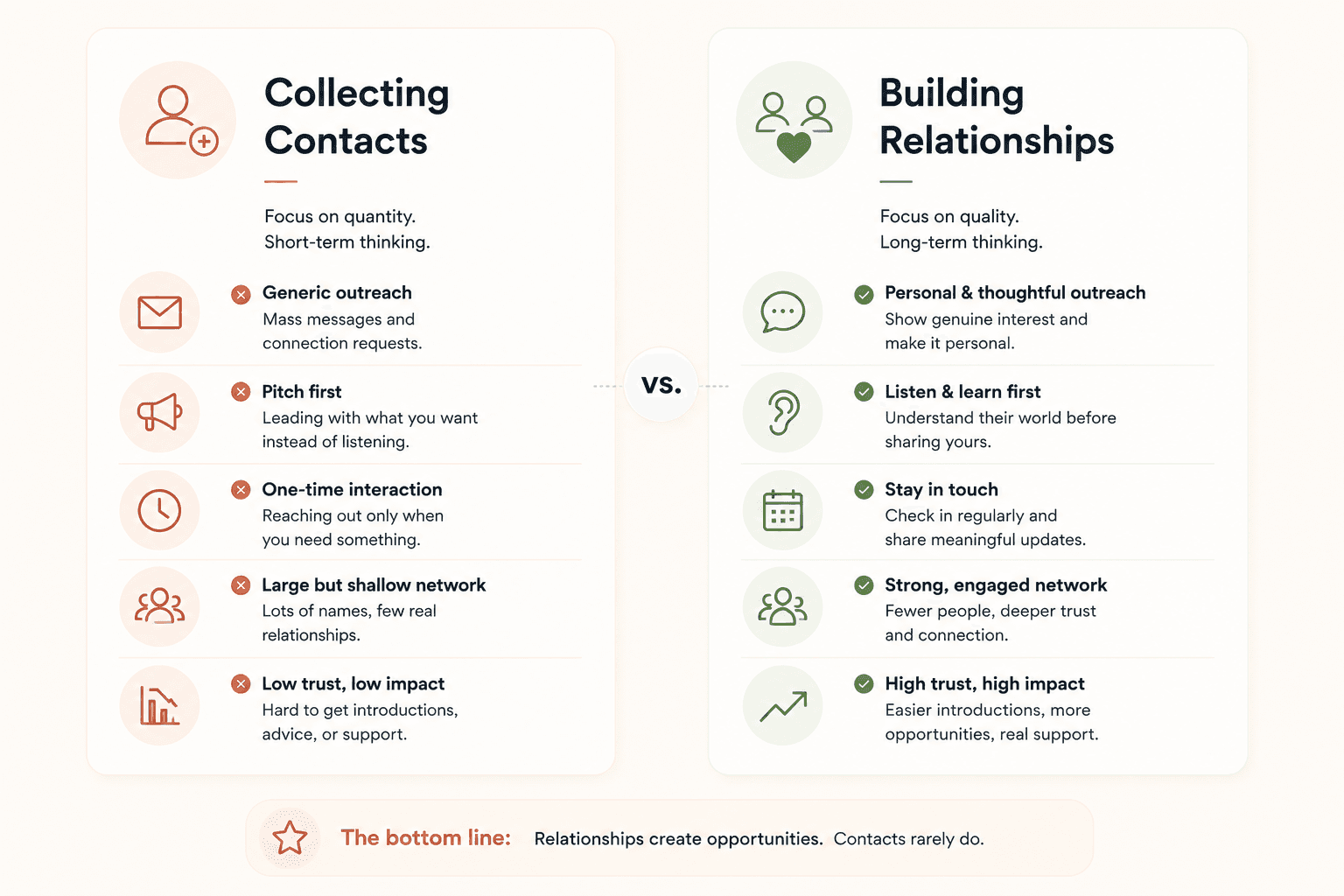
One of the biggest networking mistakes startup founders make is optimizing for quantity instead of quality.
It's easy to accumulate thousands of LinkedIn connections or collect dozens of business cards at conferences. That doesn't mean you've built a valuable network. If nobody remembers you, trusts you, or understands what you're building, those contacts are unlikely to create meaningful opportunities.
Instead, focus on building genuine relationships with a smaller group of people. Regular conversations, thoughtful introductions, and occasional follow-ups often generate far more value than hundreds of superficial connections.
Consider the difference:
Collecting contacts | Building relationships |
|---|---|
Sending generic connection requests | Sending a personalized message |
Pitching immediately | Showing genuine interest first |
Contacting people only when you need something | Keeping in touch consistently |
Maximizing the number of connections | Creating meaningful connections |
Focusing on quantity | Quality over quantity |
This mindset also makes networking feel much more natural. Instead of wondering what you can gain from every interaction, you begin asking questions like:
How can I help this person?
What can I learn from their experience?
Is there someone I can introduce them to?
How can we stay in touch?
Ironically, founders who stop treating networking like a transaction often build the strongest professional relationships over time.
Create a Startup Networking Strategy Before You Start
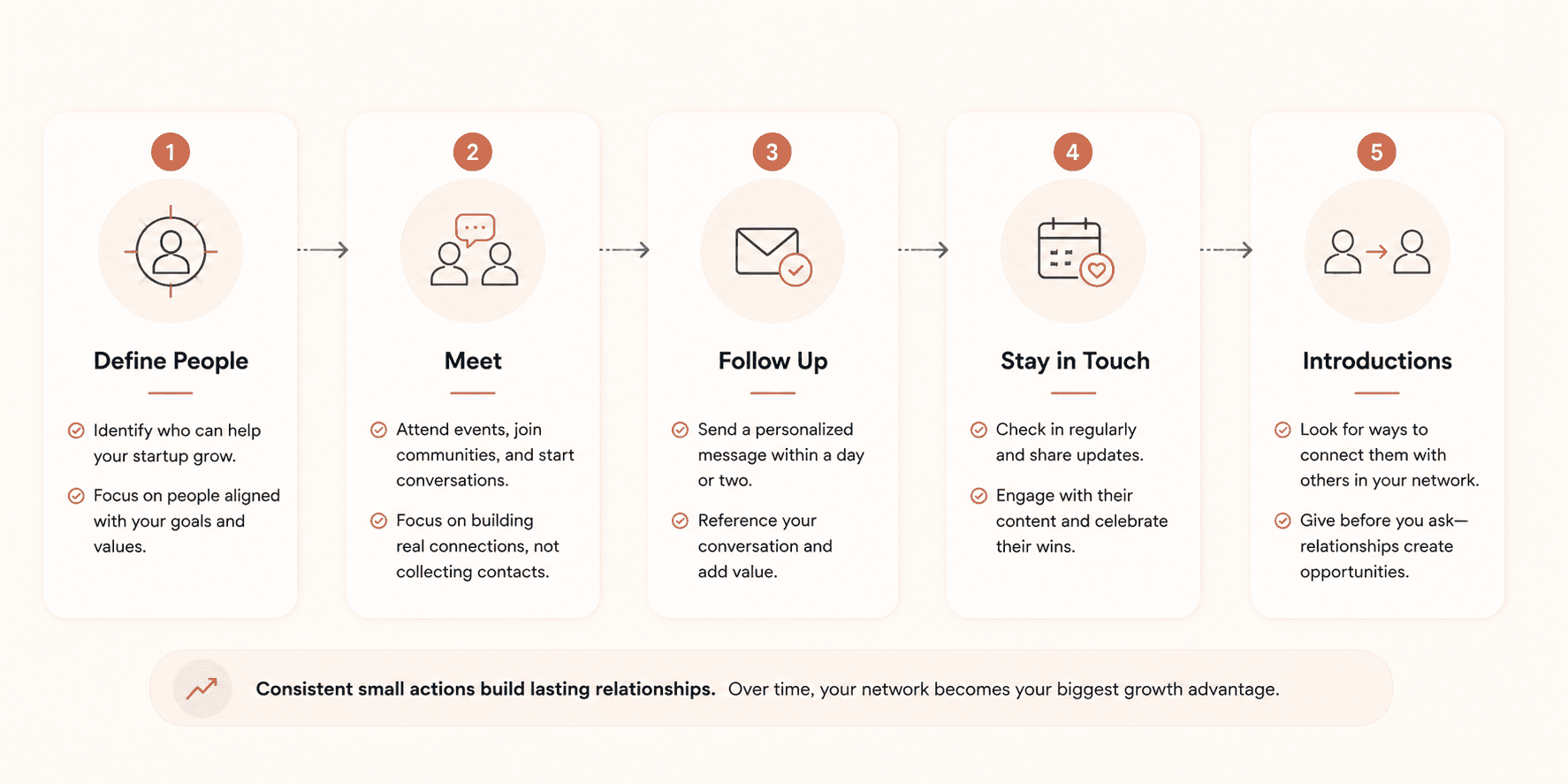
Many founders approach networking without a plan. They attend events, send connection requests, and hope something useful happens. While this occasionally works, a simple networking strategy makes your efforts far more effective.
Just as you wouldn't market your product to everyone, you shouldn't try to connect with everyone. The goal is to build a network of people who are genuinely relevant to your startup and your long-term goals.
Define who you want in your network
Before reaching out to anyone, identify the types of people who can help you grow both personally and professionally.
Depending on your current stage, your priorities may look different.
Startup stage | People to prioritize |
|---|---|
Idea stage | Founders, mentors, potential customers |
Pre-seed | Founders, angel investors, accelerator mentors |
Early traction | Customers, partners, investors, industry experts |
Growth stage | Experienced founders, executives, strategic partners |
Having a clear picture of your ideal network prevents random networking and helps you invest your time where it matters most.
Focus on developing a small number of relevant relationships
You don't need hundreds of new contacts every month.
Many successful founders intentionally focus on a handful of high-quality relationships that they nurture over time. Those people often become connectors who introduce them to dozens of others later.
Think of networking as creating a series of trusted relationships rather than continuously expanding your contact list. A network built on trust tends to grow organically because people are more willing to introduce someone they know well.
Set realistic goals for growing your network
Networking works best when it becomes part of your weekly routine instead of something you only do before fundraising or attending a conference.
Simple goals are often enough:
Reach out to two new founders each week.
Schedule one virtual coffee conversation.
Attend one networking event or meetup each month.
Comment thoughtfully on several LinkedIn posts every week.
Reconnect with one existing contact you haven't spoken with recently.
These habits don't require much time, but over the course of a year they can dramatically expand your network and create relationships that continue generating value for years.
Use LinkedIn and Social Media to Grow Your Network

While networking events and conferences are valuable, most startup founders build the majority of their professional relationships online. Social media platforms allow you to connect with people regardless of geography, making it possible to build a strong network long before you ever meet someone in person.
The key is to use social media as a conversation platform rather than a broadcasting platform. People are far more likely to remember founders who regularly contribute thoughtful ideas than founders who only promote their products.
Use LinkedIn to connect with startup founders
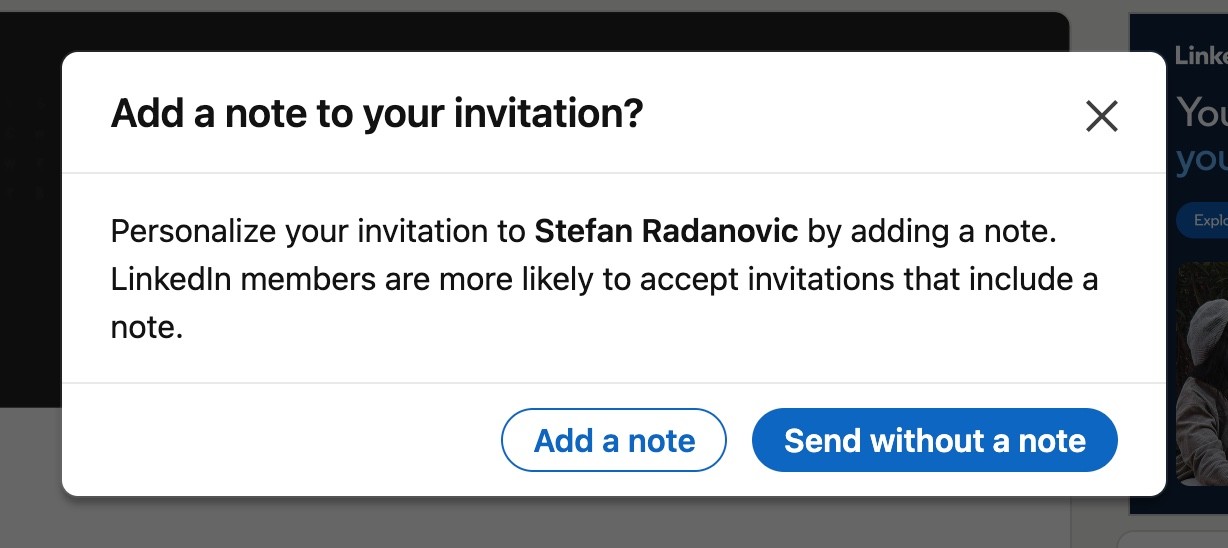
LinkedIn remains the most effective platform for professional networking, especially if your customers, investors, and peers are active there.
Instead of sending dozens of generic connection requests every day, focus on connecting with people whose work genuinely interests you. Read their posts, leave thoughtful comments, and start building familiarity before sending a personalized message.
A simple networking process might look like this:
Find founders working in a similar market or at a similar stage.
Read several of their recent posts.
Leave meaningful comments over a few weeks.
Send a personalized connection request referencing something specific they shared.
Continue engaging after they accept.
This approach requires more patience than mass outreach, but it produces far better results because you're building genuine relationships instead of creating another cold introduction.
Use social media platforms to join relevant conversations
LinkedIn is only one part of the picture. Depending on your industry, other social media platforms can also create valuable networking opportunities.
Platform | Best for |
|---|---|
Founders, investors, B2B customers, hiring | |
X (Twitter) | Startup discussions, builders, investors, VCs |
Industry communities, customer research, feedback | |
Facebook Groups | Founder communities, niche industries |
Slack & Discord | Specialized startup and technical communities |
Rather than trying to be active everywhere, choose one or two platforms where your target audience already spends time.
Consistency matters more than volume. Commenting on a few high-quality discussions every week is usually more effective than publishing daily content that receives little engagement.
Share your startup journey and build relationships through content
One of the easiest ways to connect with people is to document what you're learning while building your company.
You don't need to position yourself as an expert. In fact, founders often relate more to honest lessons than polished success stories.
Topics worth sharing include:
Customer discovery insights.
Product development challenges.
Lessons from failed experiments.
Marketing results.
Hiring experiences.
Fundraising progress.
Mistakes that changed your thinking.
When people repeatedly see your work and recognize your interests, conversations become much easier because they already know something about you.
Content also creates networking opportunities passively. Instead of introducing yourself from scratch every time, your posts act as an ongoing introduction that demonstrates your experience and interests.
Turn online conversations into long-term relationships
Many founders make the mistake of treating every interaction as a one-time event.
A much better approach is to nurture relationships gradually.
For example, after having a useful conversation, you might:
Send an article related to a topic you discussed.
Introduce them to someone who could help.
Congratulate them on a product launch.
Comment on their future posts.
Stay in touch every few months.
These small interactions help build relationships naturally without making every conversation feel transactional.
Join Startup Communities, Accelerators, and Founder Groups
Trying to build your network entirely through individual outreach can be slow. Startup communities accelerate the process because they bring together people who already share similar interests and challenges.
Instead of introducing yourself to one founder at a time, you're joining an environment where relationship building happens continuously.
Find a startup community that matches your stage
Not every founder community provides the same value.
Some focus on first-time entrepreneurs validating ideas, while others are designed for SaaS founders, technical founders, bootstrapped businesses, venture-backed startups, or specific industries.
When evaluating a community, ask yourself:
Are members building companies similar to mine?
Are discussions active every week?
Do members actually help each other?
Is the community focused on learning rather than promotion?
Would I enjoy participating even if I weren't selling anything?
Use an accelerator network during the pre-seed stage
Joining an accelerator isn't only about funding.
Many founders discover that the greatest long-term value comes from the network they gain access to. Accelerator programs bring together founders, mentors, investors, alumni, and industry experts who continue helping each other long after the program ends.
Even if you're not accepted into an accelerator, many organizations organize public events, demo days, office hours, or educational sessions where founders can participate.
Those events often provide opportunities to meet investors and experienced entrepreneurs in a much more relaxed setting than formal fundraising meetings.
Participate consistently instead of promoting your startup
Communities reward participation.
Founders who only appear when launching a product or raising money rarely become well known inside the group.
Instead, try to:
Answer other founders' questions.
Share lessons you've learned.
Ask for advice when you're genuinely stuck.
Offer value whenever possible.
Celebrate other members' achievements.
People naturally remember members who consistently contribute to discussions.
Nurture relationships with other community members
Joining a community is only the beginning.
The strongest relationships usually develop outside the main discussion channels through one-on-one conversations, introductions, or collaborative projects.
If you regularly interact with the same people, don't hesitate to suggest a short virtual coffee or continue the discussion privately. These smaller conversations often become the foundation for long-term professional relationships.
Network at Startup Events and Conferences
Although online networking has become increasingly important, offline events still offer advantages that are difficult to replicate digitally.
Meeting people face to face builds trust faster, creates stronger first impressions, and often leads to conversations that would never happen over email or LinkedIn.
The goal isn't to attend every conference you can find. It's to attend events where you're likely to meet people relevant to your startup.
Choose startup networking events with the right audience
Different events attract different people.
A founder looking for early customers will benefit from different networking events than someone preparing to raise venture capital.
Before registering, consider questions like:
Will the attendees match my target audience?
Are investors or founders likely to attend?
Are there structured networking sessions?
Will I have opportunities for meaningful conversations?
Smaller industry-specific conferences often produce better networking outcomes than massive trade shows because conversations tend to be longer and more focused.
Prepare a clear elevator pitch before attending
An elevator pitch shouldn't sound like a memorized sales script.
Its purpose is simply to help someone quickly understand what you're building and why it matters.
A useful structure includes:
What problem you're solving.
Who you're helping.
Why the problem matters.
One sentence about your solution.
Once you've introduced your startup, shift the focus back to the other person. Asking thoughtful questions almost always creates better conversations than continuing to talk about your company.
Start conversations without turning them into a sales pitch
The best networkers spend more time listening than speaking.
Good conversation starters include:
"What are you working on these days?"
"What brought you to this event?"
"What's been your biggest challenge recently?"
"Have you built companies in this industry before?"
Questions like these create natural discussions and make it easier to identify shared interests.
Remember that people usually enjoy talking about their own experiences. Showing genuine interest often leaves a stronger impression than delivering a perfect pitch.
Follow up while the conversation is still fresh
Many promising introductions disappear simply because nobody follows up.
For example:
Great meeting you yesterday. I enjoyed our conversation about customer acquisition for SaaS startups. Here's the article I mentioned. I'd love to stay in touch.
A thoughtful follow-up dramatically increases the likelihood that someone will remember you months later, especially if you continue checking in occasionally rather than only reaching out when you need something.
Build Relationships with Founders, Investors, and Customers
As your startup grows, so does the number of people you'll interact with. Some founders focus almost exclusively on meeting investors, while others spend most of their time talking to customers or attending networking events. In practice, the strongest founder networks are much more balanced.
Different relationships create different opportunities. Fellow founders help you solve challenges they've already faced, customers validate your assumptions, mentors accelerate your learning, and investors provide strategic guidance alongside potential funding. Building a diverse network ensures you can draw on the right people at every stage of your entrepreneurial journey.
The table below summarizes the role each group typically plays.
Relationship | What they help with | Long-term value |
|---|---|---|
Startup founders | Sharing experience and solving similar challenges | Referrals, partnerships, accountability |
Investors | Strategic feedback and fundraising advice | Capital, introductions, credibility |
Customers | Product validation and market insights | Revenue, testimonials, referrals |
Mentors and advisors | Knowledge and objective feedback | Better decisions and faster growth |
Rather than trying to meet everyone, focus on developing meaningful connections with people whose experience complements your own. A smaller network built on trust almost always creates more opportunities than a large contact list filled with people who barely know you.
Network with startup founders facing similar challenges
For most entrepreneurs, other founders become the most valuable people in their professional network. They understand the uncertainty of building a business because they're living through many of the same challenges themselves.
Conversations with fellow founders are often far more practical than conversations with people outside the startup ecosystem. Instead of explaining why customer acquisition costs suddenly increased or why a product launch failed to gain traction, you can immediately discuss possible solutions with someone who has faced similar situations.
These relationships also create opportunities that are difficult to predict. A founder you meet today may become your future partner, introduce you to an investor six months later, recommend your product to a customer, or share a hiring strategy that saves you weeks of work.
When networking with founders, prioritize those who are close enough to your stage to understand your current challenges but experienced enough to offer a different perspective. You'll usually gain more from these conversations than from speaking only with founders who are years ahead or just getting started.
Some of the most valuable discussions between founders revolve around topics such as:
Customer acquisition and marketing experiments.
Hiring and building early teams.
Pricing and monetization.
Product positioning.
Fundraising preparation.
Productivity and decision-making.
Notice that none of these conversations involve selling. They focus on exchanging knowledge, and that naturally leads to stronger professional relationships.
Approach an investor before you begin fundraising
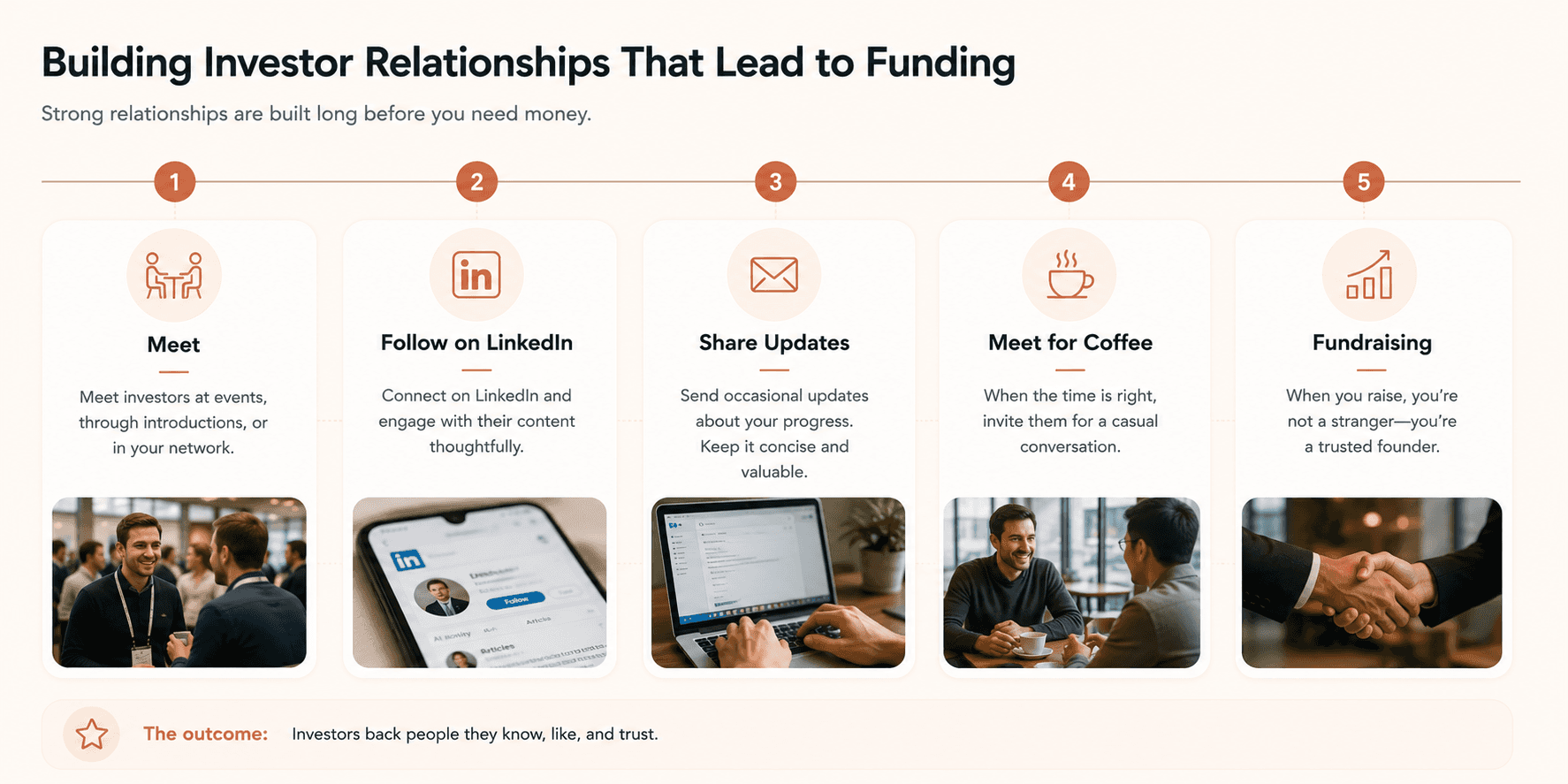
Many founders wait until they're actively raising capital before they start connecting with investors. Unfortunately, this means every conversation begins as a cold introduction.
A far more effective strategy is to start building those relationships well in advance. Investors rarely make decisions based on a single meeting. They prefer to see how founders execute over time, respond to challenges, and consistently make progress.
Imagine meeting an investor at a startup conference. Instead of asking for a pitch meeting immediately, you connect on LinkedIn, thank them for the conversation, and occasionally share meaningful updates about your startup over the following months. By the time you're ready to raise funding, they already understand your business and have watched your progress.
When speaking with investors before fundraising, the goal isn't to impress them with a polished presentation. It's to begin building trust.
Topics that often lead to productive conversations include:
Instead of asking... | Consider discussing... |
|---|---|
"Would you invest in us?" | Recent customer insights you've discovered |
"Can I pitch my startup?" | How you're validating product-market fit |
"Can you introduce me to investors?" | Industry trends or market changes you're observing |
"What do you think of my deck?" | Challenges where you'd genuinely value their perspective |
Learn from potential customers without immediately pitching
Customers aren't just buyers. They're one of the best sources of knowledge you'll ever have.
Many successful startups improve dramatically because founders spend time understanding customer problems before presenting their solution. Those early conversations reveal pain points, buying behavior, and unmet needs that product analytics alone cannot uncover.
For example, imagine you're building software for marketing agencies. During a discovery call, instead of demonstrating your product immediately, you spend thirty minutes asking how the agency currently manages reporting, where the biggest bottlenecks exist, and which tasks consume the most time.
Even if that conversation doesn't lead to an immediate sale, you've learned something valuable. You've also started building a relationship with someone who may become a future customer or recommend your product to others.
A simple framework for customer networking conversations is to spend significantly more time asking questions than presenting your solution.
Useful questions include:
How are you solving this problem today?
Which part of the process is most frustrating?
What have you already tried?
If you could improve one part of your workflow, what would it be?
How do you currently evaluate new software?
Listening first demonstrates genuine interest and often leads to more productive discussions than jumping directly into a product demo.
Nurture relationships with mentors and advisors
Mentors and advisors can help you avoid mistakes that would otherwise take months or even years to discover on your own. Their greatest value isn't having all the answers—it's recognizing patterns because they've already experienced similar situations.
The best mentor relationships develop gradually. Instead of asking someone to become your mentor after a single conversation, seek occasional advice on specific challenges and demonstrate that you're willing to act on the feedback you receive.
When asking for advice, specificity matters.
For example, compare these two questions:
Less effective | More effective |
|---|---|
"Do you have any startup advice?" | "We're deciding whether to focus on SMBs or enterprise customers first. What factors would you consider?" |
"Can you help us grow?" | "Our trial conversion rate has plateaued at 12%. Where would you start investigating?" |
Specific questions are easier to answer and show respect for the other person's time and expertise.
Just as importantly, close the loop after receiving advice. A short message explaining what you implemented and what happened afterward helps strengthen the relationship. People are naturally more willing to continue helping founders who demonstrate curiosity, take action, and appreciate the guidance they've received.
By investing in relationships with founders, investors, customers, and mentors before you urgently need their help, you'll build a network that continues creating opportunities throughout every stage of your startup's growth.
Networking Tips for Startup Founders Who Prefer Smaller Groups
Not every founder enjoys introducing themselves to dozens of strangers at a large conference. Fortunately, successful networking doesn't depend on being the most outgoing person in the room. Many entrepreneurs build exceptional professional networks through smaller groups where conversations are more focused and relationships develop naturally over time.
The key is to choose networking environments that match your personality instead of forcing yourself into situations where meaningful conversations are difficult. For many founders, quality interactions with a handful of like-minded people create far more value than briefly meeting hundreds of attendees at a major event.
Choose focused founder groups over crowded conferences
Large conferences are excellent for discovering new people, but they rarely provide enough time to build genuine relationships. Most conversations last only a few minutes before someone moves on to the next meeting.
Smaller communities, mastermind groups, local meetups, and industry-specific events often produce better results because you'll see the same people repeatedly. Those repeated interactions create familiarity, trust, and stronger professional connections.
The table below compares the strengths of different networking environments.
Networking environment | Best for | Relationship potential |
|---|---|---|
Large conferences | Expanding your network quickly | Medium |
Local startup meetups | Meeting founders nearby | High |
Founder communities | Ongoing discussions and collaboration | Very high |
Mastermind groups | Accountability and peer learning | Very high |
Industry-specific events | Connecting with experts in your niche | High |
Rather than attending every event available, identify a few communities where your ideal network is already active. Consistent participation usually delivers better results than constantly searching for new networking opportunities.
Use social media before meeting people in person
Networking often starts long before two people meet face to face.
If you're planning to attend a conference or meetup, spend a little time beforehand identifying attendees, speakers, or organizers whose work genuinely interests you. Read their recent LinkedIn posts, leave thoughtful comments, or join conversations related to topics they'll likely discuss at the event.
By the time you introduce yourself in person, you've already established some familiarity. Instead of starting from zero, you're continuing a conversation that began online.
This approach has another advantage: it naturally encourages personalized messages instead of generic introductions. Mentioning a recent article, podcast appearance, or LinkedIn post demonstrates genuine interest and gives the other person an immediate reason to remember you.
Prepare a simple conversation template
Many people worry about saying the wrong thing during networking conversations. In reality, successful conversations usually depend more on curiosity than on having the perfect introduction prepared.
A simple framework can help you feel more confident while keeping the discussion natural.
Ask what the other person is working on.
Learn about a recent challenge or milestone.
Share a relevant experience if it adds value.
Explore whether there's an opportunity to help each other.
Exchange contact information if continuing the conversation makes sense.
This isn't a script to memorize. Think of it as a guide that helps you focus on understanding the other person rather than worrying about what you'll say next.
Focus on developing one relationship at a time
One of the biggest misconceptions about networking is that success depends on how many people you meet.
In reality, professional relationships compound over time. A founder who regularly stays in touch with twenty trusted contacts often has access to more introductions, opportunities, and advice than someone with thousands of inactive LinkedIn connections.
Instead of measuring your networking efforts by the number of business cards collected or connection requests accepted, consider asking yourself questions like:
Did I learn something valuable today?
Did I meet someone I'd genuinely like to know better?
Can I help someone I spoke with?
Should I schedule a follow-up conversation?
Answering "yes" to even one of these questions means your networking efforts are moving in the right direction.
Common Startup Networking Mistakes
Most networking mistakes don't happen because founders lack communication skills. They happen because people approach networking with the wrong mindset.
Recognizing these common mistakes early can save you time and help you build stronger relationships from the beginning.
Using every conversation as an opportunity to pitch
It's natural to feel excited about your startup, especially after months of hard work. However, introducing your product within the first minute of every conversation often has the opposite effect from what founders hope.
People generally remember conversations that taught them something interesting or made them feel understood. They rarely remember unsolicited product pitches.
Whenever possible, spend the first part of a conversation learning about the other person's goals, challenges, or interests. If your startup is genuinely relevant, it will naturally become part of the discussion.
Sharing an elevator pitch before understanding the other person
Preparing an elevator pitch is useful. Delivering it before learning anything about the person you're speaking with usually isn't.
Imagine meeting two founders at the same event. One is looking for technical co-founders, while the other recently raised funding and is hiring salespeople. Starting both conversations with the exact same pitch ignores their completely different situations.
Listening first allows you to adapt the conversation and create a much more meaningful connection.
Contacting your network only when you need help
Relationships become transactional when every message contains a request.
If the only time people hear from you is when you're looking for introductions, investment, or advice, they're less likely to feel connected to you over the long term.
Instead, look for small reasons to stay in touch throughout the year. Congratulate someone on a product launch, share an article related to a previous conversation, or simply ask how a recent project turned out.
These interactions take only a few minutes, but they help maintain relationships long before you need assistance.
Trying to grow your network without nurturing relationships
Building a network and maintaining one are two different skills.
Many founders invest significant time meeting new people while neglecting the relationships they've already established. Over time, those connections naturally weaken unless they're maintained through occasional conversations and shared experiences.
A useful way to think about networking is this:
Instead of... | Focus on... |
|---|---|
Collecting contacts | Building meaningful connections |
Sending generic messages | Writing personalized messages |
Maximizing connection count | Developing long-term relationships |
Asking for favors immediately | Providing value first |
Meeting new people every week | Staying in touch with existing contacts |
Strong professional networks grow because relationships deepen over time, not because contact lists become longer.
How to Nurture and Maintain Your Founder Network
Meeting interesting people is only the beginning. The long-term value of networking comes from consistently investing in relationships after the first conversation.
Fortunately, maintaining your network doesn't require hours every week. Small, consistent actions often have the greatest impact.
Create a simple follow-up system
As your network grows, it becomes increasingly difficult to remember who you've spoken with and what you discussed.
A simple spreadsheet, CRM, or Notion database can help you keep track of:
The date of your last conversation.
Topics you discussed.
Shared interests.
Potential introductions.
Follow-up ideas.
This habit makes it much easier to reconnect naturally several months later instead of relying entirely on memory.
Introduce people who could help each other
One of the most effective ways to provide value is by making thoughtful introductions.
Perhaps one founder is searching for a growth marketer while another recently hired someone excellent. Maybe two business owners serve the same audience but offer complementary products.
Helping people connect without expecting anything in return strengthens your reputation as someone who contributes to the community rather than simply benefiting from it.
Support founders publicly on LinkedIn
Not every interaction needs to happen through direct messages.
Commenting thoughtfully on LinkedIn posts, celebrating product launches, recommending useful resources, or sharing another founder's achievements all help strengthen relationships while increasing your visibility within your network.
Consistent public support also demonstrates genuine interest in other people's success, making future conversations feel much more natural.
Reconnect with people before making a request
One of the simplest networking habits is scheduling time every month to reconnect with a few people in your network.
You don't need a specific reason to reach out. Sharing an interesting article, congratulating someone on a milestone, or asking how a recent project turned out is often enough to restart a conversation.
When you consistently keep in touch, future requests for advice or introductions feel like a continuation of an existing relationship rather than an unexpected favor.
Frequently Asked Questions About Startup Networking
How do startup founders network?
Most startup founders build relationships through a combination of LinkedIn, founder communities, startup events, accelerators, industry-specific meetups, and warm introductions. The most successful networking strategies prioritize relationship building over simply expanding a contact list.
How can a founder grow their network from scratch?
Start by joining founder communities, participating in discussions on LinkedIn, attending local networking events, and consistently sharing your entrepreneurial journey. Building your network takes time, but regular participation and genuine curiosity create lasting relationships.
Where can startup founders meet investors?
Founders commonly connect with investors through accelerators, demo days, startup conferences, angel investor events, founder communities, office hours, and warm introductions from other entrepreneurs.
What is the best networking strategy for a startup founder?
Focus on providing value before asking for anything in return. Building genuine relationships, staying in touch consistently, and helping other people often produces better long-term results than aggressive outreach.
Should pre-seed founders join an accelerator?
For many startups, the greatest benefit of an accelerator is access to experienced mentors, alumni, investors, and fellow founders. Even if funding isn't your immediate goal, these relationships can continue creating opportunities long after the program ends.
Which social media platforms are best for startup networking?
LinkedIn remains the most effective platform for professional networking among startup founders. Depending on your audience, X (Twitter), Reddit, Slack communities, Discord servers, and Facebook Groups can also provide valuable networking opportunities.