Personal Development
What Experienced Founders Can Teach That Courses Usually Miss

, Community Leader
10 minutes


Most founders buy courses for the same reason. They want to avoid expensive mistakes by learning from people who have already built successful companies.
There is nothing wrong with that approach. In fact, startup courses are one of the fastest ways to build a solid foundation. They explain terminology, introduce proven frameworks, and help founders understand concepts that would otherwise take months to discover.
The problem appears later.
Many founders finish several courses, understand every framework, and still feel uncertain when facing real decisions. The knowledge is there, but confidence is not.
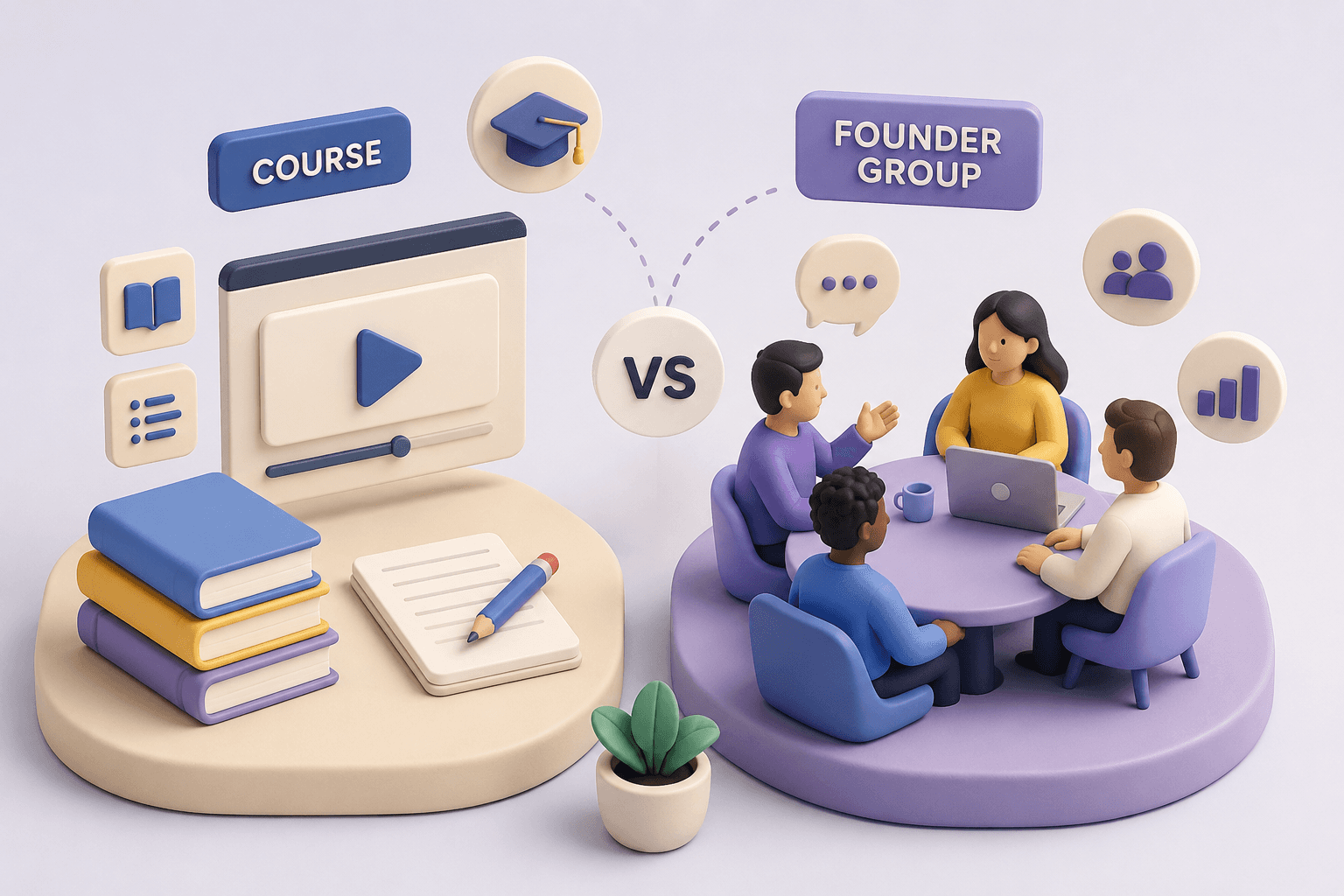
That happens because courses teach what usually works. Experienced founders teach how to think when nothing works exactly as expected.
Why Courses Feel Complete but Reality Doesn't
Courses are designed to simplify complexity.
They present startup building as a sequence of logical steps.
Find a problem.
Validate demand.
Build an MVP.
Acquire customers.
Scale.
That structure is excellent for learning.
The problem is that almost no startup follows it in a straight line.
A founder may discover that customers love the product but refuse to pay for it. Another may find paying customers before the product is fully built. Someone else may realize that their biggest problem has nothing to do with marketing and everything to do with onboarding.
None of these situations fit neatly into a lesson called Module 7.
Courses usually teach | Experienced founders often explain |
|---|---|
The ideal process | What actually happened |
Best practices | Trade-offs and compromises |
Frameworks | Decision making under uncertainty |
Success stories | Mistakes, pivots, and recovery |
This is why conversations with experienced founders often feel surprisingly different from watching another video course.
Instead of hearing, "Here's the right framework," you hear things like:
"We thought pricing was the problem. Six customer interviews later we realized positioning was the real issue."
Or:
"We almost hired our first salesperson. Fortunately, we discovered our onboarding process was broken first."
These stories rarely provide universal rules.
They provide something more valuable.
They teach founders how experienced people interpret incomplete information.
Knowledge Is Easy to Package. Judgment Isn't.
Courses are excellent at transferring knowledge.
Judgment is much harder.
Knowing that customer interviews matter is knowledge.
Recognizing that a customer is politely rejecting your product rather than asking for another feature is a judgment.
Understanding different pricing models is knowledge.
Recognizing that doubling your price could increase conversions because buyers associate higher prices with lower risk is a judgment call.
The difference becomes clearer when you compare what each source is optimized to deliver.
Courses help you... | Experienced founders help you... |
|---|---|
Learn concepts | Interpret situations |
Understand frameworks | Challenge assumptions |
Build vocabulary | Develop intuition |
Avoid beginner mistakes | Navigate ambiguous decisions |
Neither approach replaces the other.
A founder who only consumes courses often struggles when reality becomes messy.
A founder who listens only to anecdotes, without understanding the underlying principles, often copies decisions that worked in completely different circumstances.
The strongest founders combine both. They learn the fundamentals from structured education, then refine their judgment through conversations with people who have already faced similar decisions. That combination is difficult to replace because it develops not only knowledge, but also the ability to apply it when there is no obvious answer.
What Experienced Founders Learn That Rarely Fits Into a Course
The biggest difference between courses and experienced founders is not the amount of information they provide.
It is the type of information.
Courses focus on repeatable knowledge because repeatable knowledge can be taught at scale. Experienced founders often talk about situations that were unique, messy, and impossible to predict. Ironically, those situations are often where the most valuable lessons come from.
Below are several examples of knowledge that is difficult to package into a curriculum but becomes obvious after enough real-world experience.
Recognizing Patterns Instead of Following Playbooks
New founders often ask, "What should I do next?"
Experienced founders usually ask a different question.
"What problem am I actually trying to solve?"
That difference matters because the same symptom can have completely different causes.
For example, slow sales might mean:
your positioning is weak
you're talking to the wrong audience
your pricing creates the wrong expectations
your onboarding fails to demonstrate value
your product simply isn't solving an important problem
The observable result is identical.
The solution is not.
A course may recommend improving sales copy or generating more leads because those are common solutions. An experienced founder is more likely to spend time identifying which assumption is actually failing before suggesting any action.
That habit saves enormous amounts of time.
Learning What Not to Build
One of the most common beginner mistakes is believing that progress equals shipping more features.
Experienced founders eventually realize the opposite.
Every new feature increases complexity. Complexity makes onboarding harder, customer support slower, and product decisions more difficult.
Instead of asking:
"What should we build next?"
Experienced founders often ask:
"Can we solve this problem without building anything?"
That mindset rarely appears in startup courses because saying "build less" is less exciting than teaching feature prioritization frameworks.
In practice, removing work often creates more value than adding it.
The easiest feature to maintain is the one you never build.
Making Decisions With Incomplete Information
One misconception about experienced founders is that they have more certainty.
Usually they don't.
They simply become more comfortable making decisions before all the information is available.
Consider how different these situations look.
Beginner thinking | Experienced founder thinking |
|---|---|
I need more data before deciding. | I probably have enough information to test an assumption. |
What if this decision is wrong? | What is the cheapest way to find out? |
I should wait until I'm confident. | Confidence usually comes after taking action. |
I need the correct answer. | I need the next useful experiment. |
This shift changes how founders approach almost every challenge.
Instead of searching endlessly for certainty, they reduce uncertainty through small experiments.
That approach is faster, cheaper, and usually produces better decisions.
Where Founder Experience Creates the Biggest Advantage
Not every topic requires advice from experienced founders.
If you want to learn accounting basics, SQL, copywriting, or how venture capital works, a well-produced course is often the most efficient option.
Founder experience becomes most valuable when decisions involve uncertainty, trade-offs, or human behavior.
Some of the best examples include:
deciding whether customer feedback represents one opinion or a broader pattern
knowing when to raise prices
recognizing the difference between feature requests and real customer problems
hiring the first employee
deciding whether to bootstrap or raise capital
identifying when persistence becomes stubbornness
None of these decisions have universal answers.
They depend on context.
That is exactly why founder conversations tend to be so valuable. They rarely provide formulas. Instead, they provide ways of thinking through difficult situations.
By hearing how experienced founders reached their conclusions, you begin developing the same decision-making process rather than simply memorizing someone else's answer. That is a skill that continues to compound long after any single course has been completed.
Where Courses Still Have a Clear Advantage
After reading this article, it might seem like courses are becoming obsolete.
That is not the case.
In fact, experienced founders are often among the biggest consumers of books, courses, and other educational content. The difference is that they know exactly what these resources are designed to do.
Courses are excellent at building foundational knowledge. They help you understand concepts that would otherwise take years to discover through trial and error.
For example, a good course can teach you:
pricing models
technical or marketing skills
Learning these topics from experienced founders one conversation at a time would be slow and inefficient.
The goal of a course is to compress years of accumulated knowledge into a structured learning experience.
That is exactly what they do well.
The problem begins when founders expect courses to prepare them for every decision they will face.
They cannot.
No curriculum can anticipate your customers, your market, your financial situation, or the unexpected challenges that appear while building a company.
Courses explain principles.
Experience teaches adaptation.
How to Learn From Experienced Founders Without Copying Them
One mistake many founders make is trying to imitate successful people instead of understanding why their decisions worked.
This often leads to disappointing results.
Imagine reading that a founder doubled prices and revenue increased.
Should you do the same?
Maybe.
Or maybe their product had been dramatically underpriced. Perhaps they had already established strong customer trust. Maybe their target audience associated higher prices with better quality.
Without understanding the context, copying the decision becomes little more than guesswork.
A better approach is to treat founder stories as case studies rather than instructions.
When listening to experienced founders, ask questions like these:
What assumptions were they making?
What information did they have at the time?
Which signals caused them to change direction?
What alternatives did they reject?
Would the same reasoning apply to my business?
These questions reveal far more than simply asking what happened.
Experienced founders are valuable because they expose their thinking process, not because every decision they made should be repeated.
The Best Learning Strategy Combines Both
The most effective founders rarely rely on a single source of learning.
Instead, they combine structured education with continuous exposure to people who are actively building companies.
A practical learning model looks something like this:
Learn from courses | Learn from experienced founders |
|---|---|
Core concepts and frameworks | Decision-making under uncertainty |
Technical skills | Prioritization and trade-offs |
Marketing and sales fundamentals | Real customer conversations |
Proven methodologies | Situational judgment |
Terminology and best practices | Pattern recognition |
Each source compensates for the other's limitations.
Courses provide structure.
Founder conversations provide context.
Courses help you move faster at the beginning.
Experienced founders help you avoid expensive mistakes later.
Neither one is sufficient on its own.
Conclusion
There is a reason startup communities, founder groups, and mastermind programs continue to grow even though thousands of excellent startup courses already exist.
Founders are not looking for more information.
They are looking for perspective.
When every decision involves uncertainty, hearing how someone else navigated a similar situation is often more valuable than consuming another ten hours of video content.
The strongest founders understand this balance. They use courses to learn the fundamentals, then sharpen their judgment through conversations with people who have already faced similar challenges.
Knowledge tells you what usually works.
Experience helps you recognize when your situation is different.
Frequently Asked Questions
Are startup courses worth paying for?
Yes, especially if you are new to entrepreneurship. A well-designed course can help you understand essential concepts much faster than learning entirely through trial and error. Just remember that completing a course is the beginning of learning, not the end.
Can founder communities replace online courses?
Not completely. Founder communities excel at discussing real decisions, sharing practical experience, and providing feedback. Courses remain the better choice for learning structured concepts, technical skills, and proven frameworks.
When should founders stop taking courses?
There is no point at which learning should stop. However, many founders benefit from shifting their focus after building a foundation. Instead of consuming more educational content, spend more time applying what you know, talking with experienced founders, and testing ideas in the real world.
How do you know whether founder advice applies to your startup?
Look beyond the outcome and examine the context. Understand the company's stage, customers, market, available resources, and constraints before applying any advice. The goal is not to copy someone else's decisions but to understand the reasoning behind them.