Personal Development
How a SaaS Mastermind Creates Accountability Without Feeling Corporate

, Community Leader
12 minutes

Many accountability systems fail because they rely on external pressure instead of internal commitment. Managers assign tasks, software tracks deadlines, and weekly check-ins often become status reports. Founders usually don't need more supervision. They need an environment where commitments feel meaningful, conversations are honest, and progress is visible.
A well-run SaaS mastermind creates accountability without feeling corporate because every member owns their goals, understands the context behind other founders' businesses, and receives constructive feedback from peers rather than instructions from a manager. The result is better execution, stronger consistency, and higher follow-through on commitments without introducing bureaucracy.
This guide explains why traditional accountability systems often break down for founders, how mastermind groups foster true accountability, and what sets this approach apart from accountability partners, coaches, or management frameworks.
How a SaaS Mastermind Creates Accountability Without Feeling Corporate
The phrase accountability is often misunderstood. Many founders immediately associate it with performance reviews, management meetings, or someone checking whether work has been completed. That model makes sense inside large organizations, but it rarely works for entrepreneurs building a SaaS business.
True accountability is not about someone watching your work. It is about making commitments that matter, communicating them clearly, and returning to explain what happened. The difference may sound subtle, but it completely changes how people feel about the process.
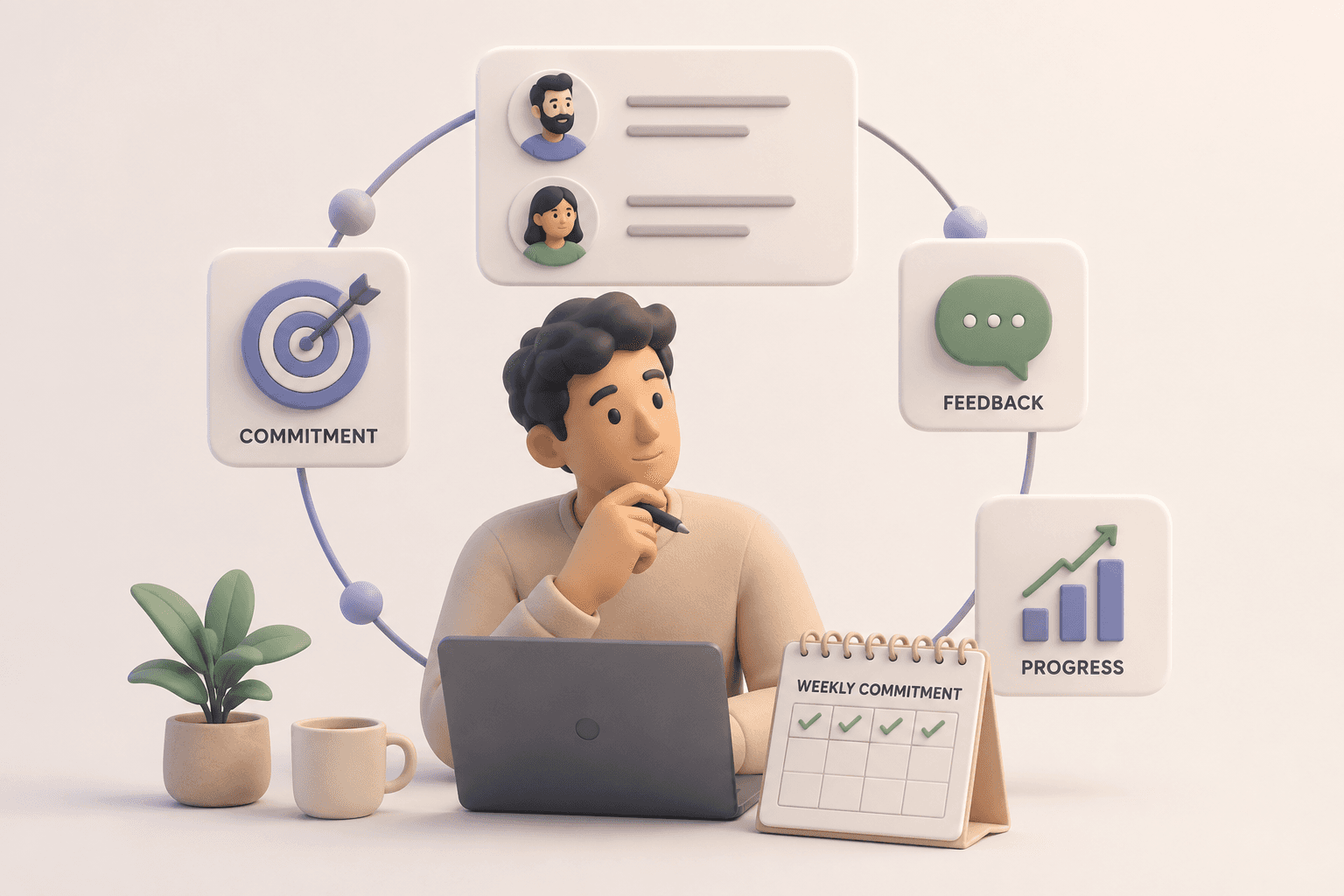
A SaaS mastermind creates accountability by replacing hierarchy with peer commitment. There is no manager assigning work, measuring productivity, or enforcing deadlines. Instead, every member owns their priorities and shares measurable commitments with a small team of founders facing similar challenges.
This shift creates an environment where responsibility feels voluntary rather than imposed. People naturally want to follow through because they respect the group and value the conversations, not because someone has authority over them.
Key idea
Accountability works best when founders choose to make commitments publicly instead of having commitments imposed by someone else.
Consider the difference below.
Corporate accountability | Mastermind accountability |
|---|---|
Manager assigns priorities | Founder defines priorities |
Progress is reported upward | Progress is shared with peers |
Success is measured by task completion | Success is measured by meaningful execution |
Feedback comes from supervisors | Constructive feedback comes from experienced founders |
Motivation is external | Motivation comes from ownership and commitment |
This distinction also changes the quality of conversations. In many organizations, people avoid difficult conversations because they worry about performance evaluations or morale. Inside a small mastermind, difficult conversations serve a different purpose. They help founders uncover assumptions, challenge decisions, and strengthen execution before costly mistakes happen.
For example, a founder might commit to launching a pricing experiment before the next meeting. A week later, they return having completed only half of the work. Instead of asking, "Why didn't you finish?", the group asks what created the bottleneck. Was the experiment too ambitious? Did customer interviews reveal unexpected objections? Did another priority become more important?
The discussion shifts the focus from judging performance to solving problems together. Accountability becomes a mechanism for better decision-making rather than a way to enforce discipline.
Why Traditional Accountability Systems Rarely Work for SaaS Founders
Most accountability frameworks were designed for organizations with managers, departments, and clearly defined roles and responsibilities. SaaS founders operate in a completely different environment.
A solo founder might be responsible for product development, sales, onboarding, customer support, hiring, and marketing in the same week. Priorities change quickly, new information appears daily, and many important decisions cannot be reduced to simple checklists.
That is why traditional systems often create friction instead of clarity.
Common examples include:
tracking activity instead of outcomes;
measuring hours instead of customer impact;
encouraging predictable reporting rather than honest discussion;
creating clear expectations that become outdated within days;
rewarding completion instead of learning.
Ironically, adding more structure often reduces ownership. Founders begin reporting progress instead of thinking critically about whether they are working on the right problem.
A mastermind approaches accountability differently. Rather than asking, "Did you complete every task?", the group asks questions like:
What was the biggest obstacle?
Which assumption proved wrong?
What did you learn?
What decision will you make next?
What commitment are you willing to own before the next session?
Those questions reinforce accountability while encouraging better decisions. They also build trust over time as members learn that accountability's purpose is progress, not judgment.
When founders consistently return to discuss both successes and failures, something important happens. The group develops shared context. Members remember previous commitments, understand why priorities changed, and can provide increasingly relevant feedback. Over time, accountability stops feeling like another meeting and starts becoming part of the way the team thinks and collaborates.
How Great Mastermind Teams Build Accountability
The effectiveness of a mastermind does not come from meeting every week. It comes from creating the right conditions for accountability to emerge naturally. Simply gathering a group of founders and asking everyone to share updates rarely produces meaningful results.
The strongest mastermind teams share four characteristics.
Shared context leads to better decisions
Generic accountability groups often struggle because members lack context. Advice becomes superficial when participants don't understand the product, customers, pricing model, or the business's growth stage.
In a SaaS mastermind, conversations improve over time because members gradually build a mental model of each founder's company. They know previous experiments, recent customer feedback, and long-term goals. That context reduces the gap between explaining a problem and solving it.
Instead of spending twenty minutes describing the business, founders can immediately discuss the difficult decision in front of them.
For example, imagine a founder says they want to lower prices to increase conversions. A new advisor might agree without hesitation. A mastermind team that has followed the company for several months may remember that pricing has already changed twice and that onboarding, not pricing, was previously identified as the bottleneck. That history leads to a much more productive conversation.
Commitments are measurable but flexible
One reason corporate accountability feels restrictive is that commitments often become fixed obligations. Founders, however, operate in an environment where new information appears every day.
Effective accountability balances commitment with adaptability.
A good weekly commitment should be specific enough to measure but flexible enough to change if better information becomes available.
For example:
Weak commitment | Strong commitment |
|---|---|
Work on marketing. | Publish one comparison article targeting founders evaluating alternatives. |
Improve onboarding. | Interview five new customers to identify onboarding friction. |
Find more leads. | Contact twenty qualified founders and book three discovery calls. |
Notice that every commitment has a clear outcome. During the next session, there is no ambiguity about whether progress was made.
At the same time, members are encouraged to explain why priorities changed. If a founder abandoned a commitment because customer interviews uncovered a larger problem, that is often a sign of good decision-making rather than poor execution.
Constructive feedback replaces performance reviews
Many people associate accountability with criticism. In reality, effective accountability depends on constructive feedback.
The goal is not to evaluate performance but to improve thinking.
When founders explain why they made a particular decision, other members can challenge assumptions, identify blind spots, or suggest alternative approaches before expensive mistakes happen.
Constructive feedback usually sounds like this:
"What evidence supports that assumption?"
"Have you considered solving the onboarding issue before increasing traffic?"
"What would success look like in measurable terms?"
"What customer signal would make you change direction?"
These questions encourage clarity without creating defensiveness.
Because everyone in the group is building a business, feedback is collaborative rather than hierarchical. Nobody is trying to prove authority. Everyone is trying to help another founder make better decisions.
Practical Ways to Create Accountability That Actually Work
Whether you already participate in a mastermind or are considering joining one, several practices consistently strengthen accountability.
Build consistency through small weekly commitments
Large quarterly goals rarely improve execution on their own. Weekly commitments create momentum by reducing the distance between planning and action.
Instead of saying, "Launch our referral program," a founder might commit to interviewing five existing customers before building anything.
Small commitments make follow-through easier while creating regular opportunities to celebrate progress.
Foster a culture of accountability instead of compliance
Accountability becomes sustainable when founders feel ownership over their commitments.
A healthy culture encourages people to:
make realistic promises;
admit when priorities change;
discuss failures openly;
ask for support before problems become bottlenecks;
celebrate meaningful progress rather than perfect execution.
This approach creates an environment in which accountability strengthens morale rather than damaging it.
By contrast, groups that focus only on checking boxes often create unnecessary pressure. Members become reluctant to share setbacks because they worry about being judged.
Accountability should reinforce execution, not reporting
One useful question can determine whether a mastermind is creating real value:
Did today's conversation improve next week's execution?
If every meeting ends with clearer priorities, measurable commitments, and greater confidence about the next decision, accountability is working.
If meetings consist mostly of status updates, the group is probably reinforcing reporting rather than execution.
The difference may seem small, but it changes how founders experience accountability. Instead of feeling like another recurring meeting, the mastermind becomes part of their decision-making process. That is one of the reasons experienced founders continue participating long after they no longer need someone to remind them to get work done.
SaaS Mastermind vs Accountability Partner vs Coach
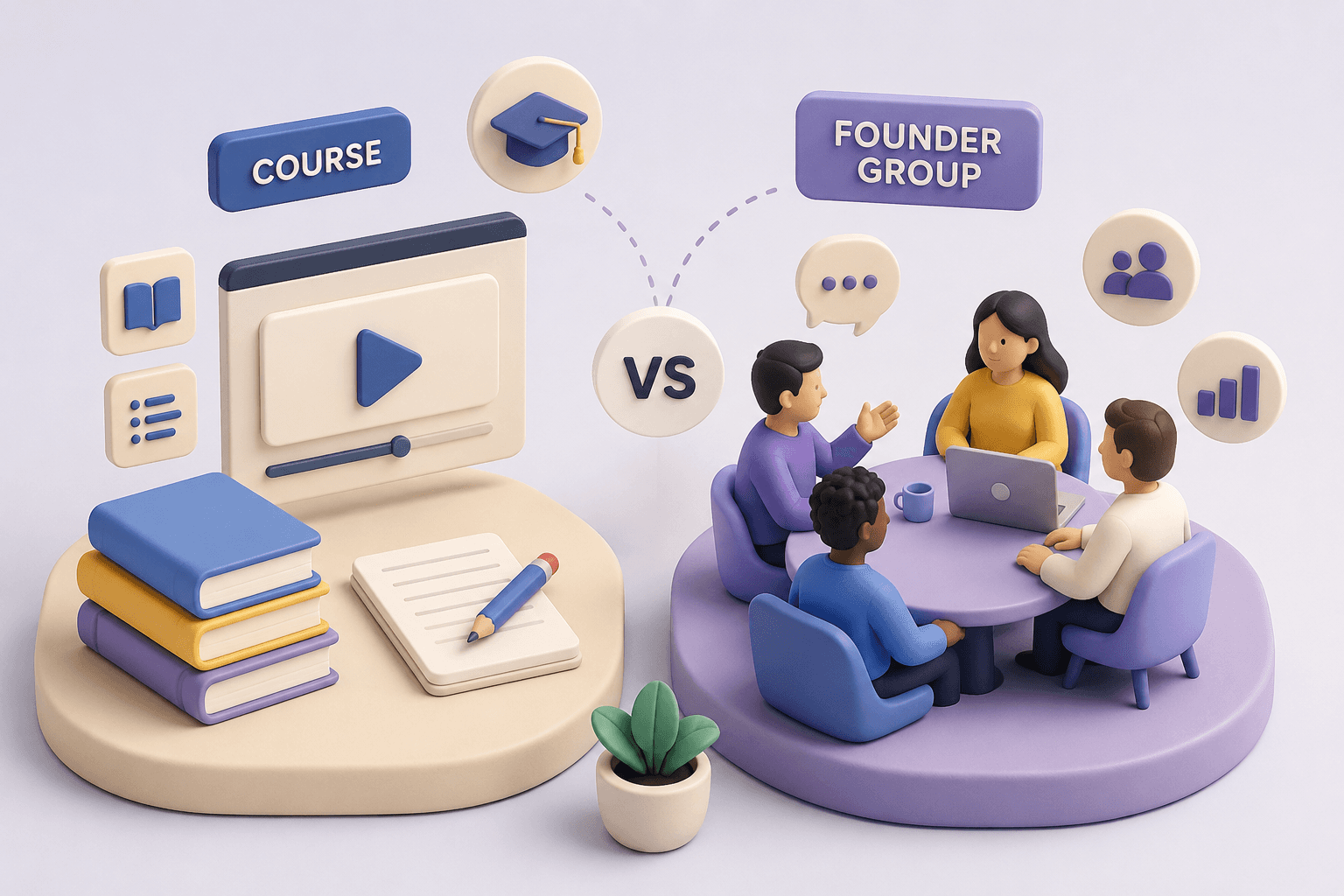
Founders often compare mastermind groups with accountability partners, business coaches, or advisors. All three can improve execution, but they solve different problems.
The biggest difference is perspective.
An accountability partner primarily helps you follow through on commitments. A coach brings expertise and guidance based on their own experience. A mastermind combines accountability with collective problem-solving, allowing founders to benefit from multiple perspectives rather than relying on a single person.
Approach | Best for | Limitations |
|---|---|---|
Accountability partner | Maintaining consistency and following through on commitments | Limited perspective and experience |
Business coach | Solving specific business challenges with expert guidance | Feedback comes from one individual and can become expensive |
SaaS mastermind | Better decision-making, accountability, and peer learning | Requires active participation and regular attendance |
The right choice depends on your current bottleneck.
If you already know exactly what to do but struggle to execute consistently, an accountability partner may be enough.
If you need specialized expertise in an area such as pricing, fundraising, or enterprise sales, working with a coach can accelerate your progress.
If your biggest challenge is making better decisions while staying accountable over time, a mastermind usually provides the strongest combination of support, accountability, and diverse perspectives.
Common Mistakes That Turn Accountability Into Corporate Management
Even well-intentioned groups sometimes create an environment that feels more like a management meeting than a mastermind.
The first mistake is measuring activity instead of outcomes.
Completing twenty tasks does not necessarily move a business forward. A founder who conducts ten customer interviews may achieve more than someone who finishes fifty small tasks.
The second mistake is creating unrealistic commitments.
People often overestimate what they can accomplish in a week. When missed commitments become the norm, accountability loses credibility. Smaller, measurable commitments build consistency because members experience regular progress instead of repeated failure.
Another common mistake is avoiding difficult conversations to protect morale.
Healthy accountability requires respectful disagreement. If every idea receives immediate agreement, members lose opportunities to identify flawed assumptions before they become expensive mistakes.
Finally, some groups spend most of their time reporting updates.
Status reporting creates information.
Discussion creates insight.
The most productive masterminds spend less time describing what happened and more time exploring why it happened, what was learned, and what should happen next.
Is a SaaS Mastermind the Right Accountability System for You?
A mastermind is not the right solution for every founder.
It works particularly well if you:
already have a product or active customers;
regularly make strategic decisions without anyone to challenge your thinking;
want consistent accountability without being managed;
value constructive feedback from experienced founders;
are willing to contribute to other members' success.
You may benefit less if you:
expect other people to solve problems for you;
are unwilling to prepare before meetings;
frequently miss commitments without communicating why;
prefer one-to-one expert advice over peer discussion.
Like any team, a mastermind becomes more valuable when every member actively participates. The strongest groups are built on mutual responsibility rather than passive attendance.
Action Checklist for Building Accountability That Lasts
If you want accountability that improves execution instead of creating unnecessary pressure, use the following checklist.
✅ Make commitments measurable rather than vague.
✅ Share commitments with people who understand your business context.
✅ Review outcomes instead of simply reporting completed tasks.
✅ Encourage constructive feedback and difficult conversations.
✅ Treat missed commitments as learning opportunities, not personal failures.
✅ Focus on ownership rather than supervision.
✅ Build consistency through small weekly commitments.
✅ Celebrate meaningful progress to reinforce positive habits.
Key Takeaways
Accountability is often misunderstood because many founders associate it with managers, reporting, and performance reviews. In reality, true accountability comes from ownership, clear expectations, and meaningful conversations with people who understand the challenges you face.
A SaaS mastermind creates accountability without feeling corporate because founders choose their own commitments, receive constructive feedback from peers, and strengthen their decision-making over time. The focus shifts from checking whether work was completed to understanding what moves the business forward.
If your current accountability system feels like another meeting on your calendar, the problem may not be accountability itself. It may simply be the environment. The right group creates clarity, encourages better decisions, reinforces ownership, and helps founders consistently follow through on the commitments that matter most.