Personal Development
Why solo founders need accountability, not more productivity hacks

, Community Leader
10 minutes

Accountability helps solo founders stay consistent when motivation fades. Productivity tools make it easier to organize work, but organization alone rarely changes execution. Many founders already know their highest-priority task. The challenge is following through day after day when no manager, colleague, customer, or investor is expecting progress.
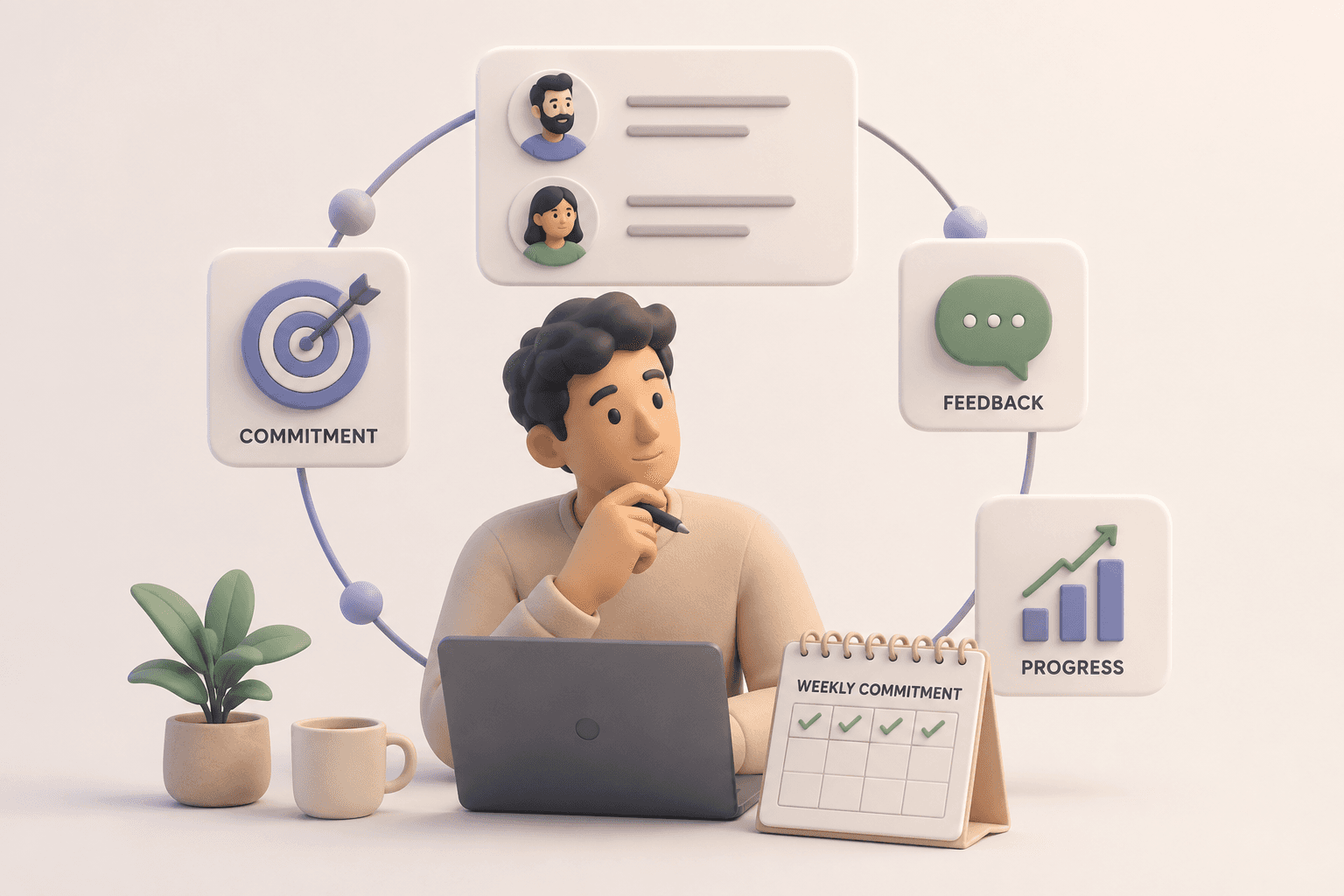
Building an effective accountability system introduces something productivity software cannot provide: visible commitment, regular feedback, and meaningful consequences. Instead of relying entirely on motivation or willpower, founders create an environment that naturally encourages consistent execution.
Why solo founder accountability breaks without external commitment
One of the biggest differences between working in a company and building a startup alone is the presence of external expectations.
Inside an organization, accountability exists almost automatically. Projects have owners, meetings create deadlines, and unfinished work affects other people. Even without formal performance reviews, employees receive continuous signals about whether they are making progress.
A solo founder operates in a completely different environment. There may be no scheduled reviews, no recurring meetings, and no one asking for a status update. Priorities can change several times a week without any immediate consequence. Over time, this makes it surprisingly easy to postpone difficult work, even when the founder understands exactly what should be done.
The difference becomes clearer when comparing the two environments.
Company environment | Solo founder environment |
|---|---|
Shared deadlines | Self-imposed deadlines |
Team members expect progress | Nobody expects an update |
Regular meetings | Complete schedule freedom |
Immediate feedback | Feedback only after shipping |
External accountability | Self-accountability |
Complete freedom sounds attractive, but it removes many of the mechanisms that help people execute consistently. The issue is rarely a lack of knowledge or ambition. Most founders already know which task would create the biggest impact. The difficult part is maintaining the same level of commitment week after week without anyone else's participation.
Productivity tools organize work, but they don't create commitment
Productivity software has become remarkably good at organizing information. Modern apps help founders prioritize tasks, plan projects, manage calendars, and reduce cognitive load. These improvements are valuable, but they solve only one part of the problem.
Execution depends on behavior, and software has limited influence over behavior when no one else is involved.
A task manager cannot ask why an important feature is still unfinished. A calendar doesn't notice when a deadline moves for the fifth time. Even the best productivity app simply reflects the decisions you make. It does not influence whether those decisions are carried out.
This explains why many founders continue searching for better tools while their execution changes very little. The bottleneck often isn't organization. It's the absence of an accountability system that makes commitments visible.
Without consequences, every startup deadline becomes optional
Behavior changes when other people know what you've committed to.
Psychologists have long observed that public commitments are more likely to be carried out than private intentions because they entail social consequences. Even relatively small forms of accountability can influence behavior:
sharing weekly goals with another founder;
posting a public progress update;
participating in accountability groups;
scheduling recurring review sessions with an accountability buddy.
None of these activities makes the work easier. What they change is the cost of delaying it.
When nobody knows your deadline, moving it carries almost no consequence. Once another person expects an update, postponing the same task feels different. That small psychological shift is often enough to improve consistency.
Willpower is weaker than a good accountability system
Many founders believe consistency comes from stronger discipline. In practice, systems usually matter more than motivation.
An effective accountability system reduces the number of decisions you need to make each day. Your priorities are already defined, your commitments are visible, and someone expects to see progress. Instead of debating whether to work on an important task, you simply follow through on a decision that has already been made.
The result isn't more pressure. It's less friction between intention and action.
How external accountability systems help solo founders stay consistent
Once founders recognize that execution depends on accountability rather than motivation alone, the next question becomes practical: what kind of system actually works?
An effective accountability system doesn't need to be complicated. It doesn't require expensive software or a full-time coach. The goal is to make your commitments visible, create regular opportunities for feedback, and introduce enough external expectations that important work doesn't quietly disappear from your priority list.
The strongest systems usually combine three elements:
a clear commitment;
a recurring review cycle;
another person who expects an update.
When those three elements exist together, consistency becomes much easier to maintain.
Why accountability groups work better than another productivity app
Most productivity tools help you manage information. Accountability groups influence behavior.
The difference is significant because founders rarely struggle to remember what needs to be done. They struggle to keep moving when difficult work offers no immediate reward or consequence.
A good accountability group changes that dynamic. Every member publicly shares goals, reports progress, and receives feedback from peers who understand the realities of building a business.
This creates several advantages simultaneously.
Productivity app | Accountability group |
|---|---|
Organizes tasks | Creates commitment |
Tracks deadlines | Tracks follow-through |
Stores information | Provides feedback |
Personal workflow | Shared accountability |
Private planning | Visible progress |
Another benefit is perspective.
Many founders spend weeks trying to solve a problem that another founder has already encountered. A short discussion can reveal insights that prevent unnecessary work or help validate an idea before investing weeks of development.
As a result, accountability groups improve both execution and decision-making.
An accountability buddy creates real commitment
Not every founder wants to join a community. In many cases, a single accountability buddy is enough.
The arrangement is simple. Two founders agree to review each other's progress every week. Before the meeting, each person shares a small number of specific commitments. During the conversation, both explain what was completed, what created friction, and what the next priority will be.
For this approach to work, commitments should be concrete rather than vague.
Vague commitment | Clear commitment |
|---|---|
Improve onboarding | Interview five new users |
Work on marketing | Publish one landing page |
Grow revenue | Contact 20 prospects |
Build the product | Ship the onboarding redesign |
Specific commitments are easier to measure and easier to discuss. They also make it easier to identify patterns when progress repeatedly slows down.
Over time, these conversations create momentum because unfinished work no longer disappears into a private to-do list.
Weekly updates turn intentions into action
Many founders underestimate how powerful a simple weekly update can be.
A recurring update creates a natural rhythm for execution. Instead of evaluating progress only when a project is finished, founders review smaller outcomes every week. This short feedback cycle helps identify blocked work early, keeps priorities aligned, and prevents important projects from drifting for months.
A typical weekly update can include just four questions:
What did you ship this week?
What metric improved?
What obstacle slowed you down?
What is your single highest-priority commitment for next week?
The format is intentionally simple. It reduces cognitive load while making progress visible to other people.
Over time, these recurring updates create a feedback loop that strengthens accountability without creating unnecessary pressure. Founders stop relying on occasional bursts of motivation and instead build a predictable rhythm of planning, execution, feedback, and adjustment.
That rhythm is often the difference between a startup that moves forward every week and one that spends months reorganizing its task list without shipping meaningful outcomes.
How bootstrap founders can build an accountability system
Many founders assume accountability requires a large team or an expensive coaching program. In reality, the opposite is often true. The most effective systems are usually simple enough to become part of your weekly routine.
The objective isn't to add more work to your calendar. It's to create a structure that makes progress visible, provides regular feedback, and helps you stay committed to the work that matters most.
If you're building a bootstrap startup, start with a system you can maintain for months, not weeks.
Share progress publicly to create external accountability
One of the easiest ways to introduce external accountability is to make your progress visible.
When other people know what you're building, unfinished work becomes more noticeable. This doesn't mean documenting every hour of your day. It means creating a consistent habit of sharing meaningful milestones.
For example, you might publish a weekly update that includes:
what you shipped;
the most important lesson you learned;
one metric you improved;
your next commitment.
Public updates also create an unexpected benefit. People begin to notice patterns in your work and offer feedback you wouldn't have received otherwise. A customer may point out friction you overlooked, another founder may suggest a simpler solution, or someone in your network may introduce an opportunity that helps your startup move forward.
Making progress visible increases accountability while creating more opportunities for valuable conversations.
Join accountability groups for founders
Building alone doesn't solve every problem.
Good accountability groups combine two important functions. The first is helping founders follow through on their commitments. The second is providing feedback before small problems become expensive mistakes.
The best groups share several characteristics:
members are founders facing similar challenges;
everyone participates regularly;
discussions focus on concrete actions rather than general advice;
members report outcomes, not just intentions.
Consistency matters more than group size. A small founder community that meets every week usually creates stronger accountability than a large community where members rarely interact.
Over time, founders also develop something that is difficult to build alone: a support network. People become familiar with each other's businesses, remember previous conversations, and provide context-aware feedback instead of generic suggestions.
Build external support around the metrics that matter
Not every commitment deserves the same attention.
Many founders track dozens of numbers while ignoring the few metrics that actually determine whether the business is improving. Accountability becomes much more effective when it's connected to measurable outcomes.
Examples include:
Goal | Metric |
|---|---|
Validate an MVP | Customer interviews completed |
Improve activation | Activation rate |
Increase revenue | Monthly recurring revenue |
Grow organic traffic | Qualified visitors |
Build a sales pipeline | Discovery calls booked |
Choosing one primary metric also makes conversations more productive. Instead of asking, "Did you stay busy this week?" your accountability partner can ask, "What changed?"
That shift moves the discussion away from activity and toward outcomes.
The best accountability system is the one you can't ignore
Every founder eventually discovers that productivity has limits. A better calendar, another planning framework, or a new task management app can improve organization, but consistent execution depends on behavior.
An effective accountability system changes the environment around your work. It makes commitments visible, creates regular opportunities for feedback, and introduces enough external expectations to keep important priorities moving.
The exact format is less important than the habit itself. Some founders work with an accountability buddy. Others participate in weekly mastermind sessions or founder communities. Some publish weekly progress reports for customers or investors.
The common principle is always the same: progress becomes visible to someone besides yourself.
Once that happens, priorities become clearer, momentum becomes easier to maintain, and consistency gradually replaces bursts of motivation. Over time, those small weekly commitments compound into meaningful progress, which is exactly how most successful startups are built.